

More than one driver, company, or other party may be legally responsible for a multi-vehicle crash on I-75 in Naples. Florida negligence law allows fault to be allocated among multiple responsible parties, meaning investigators must determine what each person or entity did before the collision rather than simply blaming the first or last vehicle involved.
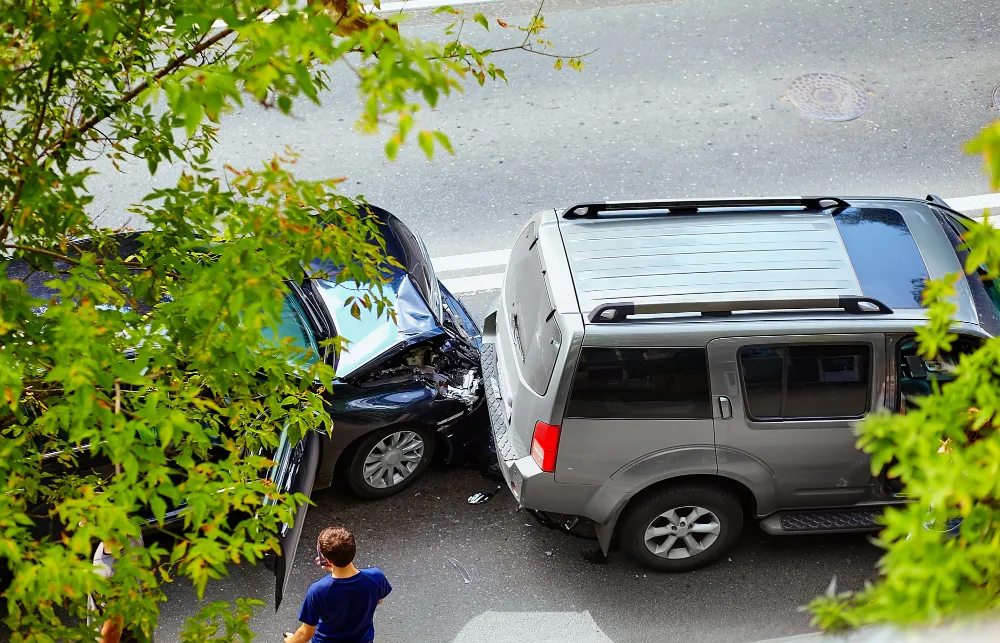
That distinction matters on Interstate 75, where one negligent act can trigger a sequence involving several vehicles.
A speeding driver may start the collision. A distracted driver may then fail to stop. A commercial truck may compound the damage. Another driver may have been following too closely.
One crash can therefore produce several separate questions of negligence.
Can Multiple Drivers Be At Fault for the Same Naples Crash?
Yes.
Florida Statutes §768.81 provides for comparative fault in negligence actions. The law allows responsibility to be assigned according to each party’s percentage of fault.
The statute directs courts to enter judgment against liable parties based on their respective percentages of fault rather than imposing liability through traditional joint and several liability.
Consider a hypothetical I-75 collision.
Driver A abruptly changes lanes while distracted.
Driver B is speeding and cannot stop in time.
Driver C is following Driver B too closely and strikes the vehicles after the initial impact.
The fact that Driver A triggered the first contact does not necessarily make Driver A the only potentially responsible person.
Evidence may establish that several actions contributed to the resulting injuries.
What If a Commercial Truck Is Involved?
Commercial-vehicle crashes can introduce additional potential defendants.
Depending on the evidence and applicable law, an investigation might examine the conduct of:
- The truck driver
- The driver’s employer
- A trucking company
- A vehicle owner
- Maintenance providers
- Other contractors
- Manufacturers when an allegedly defective component contributed to the harm
The presence of a commercial vehicle does not automatically make every company connected to it liable.
Each theory requires supporting facts.
That is why identifying the truck’s ownership, driver, employer relationships, maintenance history, and other evidence can become important early in an investigation.
Why Is Evidence So Important in a Chain-Reaction Collision?
Because the final resting position of the vehicles does not always explain how the collision began.
A multi-car crash can unfold in seconds.
Evidence may include:
- Police crash reports
- Photographs and video
- Vehicle damage
- Witness statements
- Dash-camera recordings
- Nearby surveillance footage
- Event data recorder information
- Cellphone evidence when legally obtainable
- Commercial-driver records
- Electronic logging information
- Inspection and maintenance records
- Physical roadway evidence
Different evidence answers different questions.
Vehicle damage may help reconstruct impact sequences. Video may reveal a lane change. Electronic information may provide evidence about vehicle movement or driver conduct.
The objective is to reconstruct the sequence rather than assume that the driver who struck another vehicle must bear all responsibility.
What If One Driver Blames Another?
Conflicting accounts are common after complicated collisions.
Driver A may claim Driver B was speeding.
Driver B may say Driver A entered the lane without warning.
Driver C may argue there was no reasonable opportunity to avoid the pileup.
Those statements become allegations, not final determinations.
Independent evidence becomes particularly valuable when accounts conflict.
This is one reason early preservation can matter after a serious highway crash. Some evidence is temporary. Vehicles are repaired or destroyed. Video can be overwritten. Memories can become less precise.
Can an Injured Driver Also Be Partly Responsible?
Yes.
Florida now follows a modified comparative-fault system for negligence actions covered by §768.81.
A claimant’s damages are generally reduced according to the percentage of fault assigned to that claimant. But there is an important limit: under the current statute, a party found more than 50% responsible for his or her own harm cannot recover damages in covered negligence actions.
Suppose damages are established at $300,000 and an injured driver is found 20% responsible.
The driver’s own fault can reduce the recoverable amount attributable to the claim.
But if that claimant is found more than 50% responsible for his or her own harm, the statutory bar becomes critical.
This makes fault allocation far more than an academic question.
What About a Driver Who Wasn’t Physically Hit First?
Being later in the collision sequence does not necessarily eliminate liability.
The relevant question is whether negligent conduct contributed to the accident or resulting injuries.
Imagine traffic has already begun slowing because of an initial collision.
A driver approaching from behind is looking at a phone, fails to brake, and crashes into the stopped vehicles at highway speed.
The driver’s vehicle was not part of the initial contact, but that driver’s conduct may have caused additional harm.
Multi-vehicle cases therefore require analysis of the entire event.
Why I-75 Crashes Deserve Local Context
Interstate crashes are different from low-speed parking-lot collisions.
Higher speeds can produce more severe forces. Multiple lanes create complicated vehicle movements. Commercial traffic can add differences in vehicle mass, braking, and operating requirements.
Local context also matters.
The Law Offices of Marc L. Shapiro, P.A. specifically identifies I-75 corridor accidents and commercial-vehicle collisions as part of its Naples personal injury practice in Collier County. Founder Marc L. Shapiro has been admitted to practice in Florida since 1992, giving the firm a long-standing connection to Southwest Florida injury litigation.
That is a meaningful distinction in an I-75 case. The legal issue is not merely “Was there an accident in Florida?” It can involve a specific interstate corridor, local evidence sources, multiple insurers, commercial defendants, and Florida’s current fault-allocation rules.
Can Fault Be Assigned to Someone Who Isn’t a Defendant?
Potentially.
Florida’s comparative-fault statute contains procedures addressing allocation of fault to a nonparty.
A defendant seeking to allocate fault to a nonparty must satisfy statutory requirements, including pleading the nonparty’s fault and proving that fault at trial before it can be used for apportionment.
That matters because a lawsuit with two named defendants does not necessarily mean only those two actors will be relevant to the fault analysis.
What Damages Can Matter After a Serious I-75 Crash?
A serious multi-vehicle collision can produce both immediate and long-term losses.
Florida’s comparative-fault statute defines economic damages to include categories such as medical expenses, past lost income, future lost income reduced to present value, and other economic losses that would not have occurred but for the injury.
Depending on the claim, an injured person may therefore need documentation relating to:
- Emergency treatment
- Hospitalization
- Surgery
- Rehabilitation
- Future medical care
- Lost wages
- Reduced future earning ability
- Other accident-related losses
The severity of the injuries can make accurate fault allocation even more consequential.
What Should Someone Do After a Multi-Vehicle I-75 Crash?
Medical safety comes first.
After immediate medical and emergency needs have been addressed, preserve whatever information can reasonably be preserved.
That may mean keeping photographs, medical documents, insurance communications, repair information, witness details, and other records associated with the collision.
Avoid assuming that the police report alone will resolve every liability issue.
A report can be important, but complicated injury litigation may require evidence from several independent sources.
Liability Starts With the Sequence, Not the Number of Cars
The central question after an I-75 pileup is not:
Which vehicle caused the accident?
It is:
Whose conduct contributed to the collision and the resulting injuries, and by how much?
Those are different questions.
Florida’s comparative-fault framework recognizes that more than one actor can contribute to a loss.
For an injured person in Naples, reconstructing the entire sequence can therefore determine not only who may be legally responsible, but also how responsibility and damages are ultimately allocated.
In a multi-vehicle collision, the first impact may begin the story.
It rarely tells the whole story.







