

The Hinge lawsuit accuses the popular dating app of using addictive, manipulative design to keep users hooked and paying for premium subscriptions. If you spent money on Hinge, you may qualify for compensation.
Multiple class action complaints target Match Group, the company behind Hinge. They claim the app was never really “designed to be deleted.” Instead, plaintiffs say it was built to create compulsive usage and drive recurring revenue.
The case has picked up serious momentum heading into 2026. Millions of users could be affected. This article breaks down every detail: the allegations, who qualifies, how much you might receive, and how to file a claim.
One stat worth knowing right away: Hinge generated over $400 million in revenue in 2023 alone, much of it from the subscription model now under legal fire.
Hinge Lawsuit 2026: What You Need to Know Right Now
The Hinge lawsuit in 2026 is an active class action case alleging that the dating app deliberately engineered addictive features to trap users into paying for subscriptions. The case is moving through federal court and could affect anyone who has used the app’s paid tiers.
At its core, this lawsuit says Hinge’s business model depends on keeping you single. The longer you stay on the app, the more you pay. Plaintiffs argue that’s not an accident but a calculated design strategy.
The legal claims include deceptive trade practices, unjust enrichment, and violations of state consumer protection laws. Several states have seen individual and consolidated complaints.
| Detail | Info |
|---|---|
| Case Type | Class action lawsuit |
| Defendant | Match Group Inc. (Hinge parent) |
| Primary Allegations | Addictive design, deceptive subscriptions |
| Status in 2026 | Active, pre-settlement |
| Potential Class Size | Millions of U.S. users |
What makes this case different from typical tech lawsuits is the behavioral psychology angle. Plaintiffs hired experts who compared Hinge’s design to slot machines. That comparison could prove powerful in court.
The case also has political tailwind. Several U.S. senators have publicly called out dating apps for predatory practices. That kind of attention tends to push settlements forward faster.
What Is the Hinge Class Action Lawsuit About?
The Hinge class action lawsuit is about one central claim: that Hinge intentionally designed its app to be psychologically addictive so it could profit from users who keep paying for premium features. Plaintiffs say the app exploits human emotions for revenue.
Think of it like a casino. The house always wins because the games are designed that way. Plaintiffs argue Hinge works on the same principle. The “game” of swiping, matching, and messaging is rigged to keep you playing.
The legal complaint lists several specific design choices that allegedly create compulsive behavior:
- Variable ratio reinforcement through unpredictable match timing
- Artificial scarcity by limiting daily likes for free users
- FOMO-driven notifications that pull users back into the app
- Algorithmic suppression of profiles to create urgency to upgrade
- Pay-to-play barriers that gate basic features behind subscriptions
These aren’t random app choices. Plaintiffs say each one was tested and optimized to maximize time spent on the app and money spent on subscriptions.
The class action seeks damages for all U.S. users who purchased Hinge subscriptions or premium features. It also asks the court to force Hinge to change its design practices going forward.
Is Hinge Being Sued Right Now?
Yes, Hinge is actively being sued in 2026. Multiple lawsuits have been filed against Match Group Inc., the parent company that owns Hinge. These cases are in various stages of litigation across federal and state courts.
The most prominent case was filed in the U.S. District Court for the Northern District of California. It names Match Group as the defendant and focuses specifically on Hinge’s design and monetization practices.
Other related lawsuits have been filed in New York and Texas. Some target Hinge specifically, while others name multiple Match Group apps including Tinder and OkCupid.
| Court | Status | Focus |
|---|---|---|
| N.D. California | Active, discovery phase | Addictive design claims |
| S.D. New York | Active, pre-trial motions | Subscription deception |
| Texas State Court | Consolidated | Consumer protection violations |
There is also regulatory pressure building. The Federal Trade Commission has signaled interest in dating app business practices. Several state attorneys general have opened investigations into Match Group’s operations.
So yes, Hinge is very much being sued. And the legal pressure is growing, not shrinking.
Key Takeaway: Hinge faces multiple active lawsuits in 2026 alleging its app was deliberately designed to addict users and extract subscription revenue through manipulative features.
The Hinge Dating App Lawsuit Explained
The Hinge dating app lawsuit boils down to a broken promise. Hinge marketed itself as the app “designed to be deleted,” implying it would help you find a relationship and leave. Plaintiffs say the opposite is true.
According to court filings, Hinge’s internal metrics prioritize “time on app” and “subscription conversion.” Those are the numbers executives tracked most closely. That tells you what the company actually cared about.
Former Hinge employees have provided statements suggesting the company knew its design created compulsive behavior. Internal documents allegedly show discussions about “hook cycles” and “engagement loops.”
The lawsuit argues this creates a bait-and-switch scenario. Users download Hinge expecting a relationship tool. Instead, they get a dopamine slot machine dressed up as a dating app.
What really stings for users is the financial angle. Hinge’s premium subscription, HingeX, costs up to $50 per month. Rose features, boost options, and “preferred” status add even more costs. Plaintiffs say those features are artificially necessary because the free version is intentionally crippled.
The case cites internal A/B testing that allegedly showed Hinge could give free users better results but chose not to. That’s a significant claim because it suggests the company deliberately degraded the free experience to push upgrades.
Hinge App Addictive Design Lawsuit Allegations
The addictive design allegations against Hinge center on a concept called “variable ratio reinforcement,” the same psychological mechanism that makes slot machines so addictive. Plaintiffs say Hinge borrowed this playbook intentionally.
Here is how it works in the app. You swipe through profiles and sometimes get a match. But the timing is unpredictable. You might get three matches in a row, then nothing for days. That inconsistency is what hooks your brain.
Behavioral psychologists call this the most powerful form of conditioning. Your brain releases dopamine not when you get a match but when you anticipate one. The uncertainty is the drug.
The lawsuit identifies several specific addictive features:
- Unpredictable match delivery even when matches are available
- Push notifications timed to moments of vulnerability (late night, weekends)
- Streak mechanics that punish you for not opening the app daily
- Limited daily interactions that create artificial urgency
- Profile boosts that promise visibility but deliver inconsistent results
Plaintiffs compare this to tobacco companies engineering nicotine delivery systems. The product is designed to create dependency, and the company profits from that dependency.
Expert witnesses in the case include behavioral psychologists and former tech industry designers who specialize in identifying dark patterns. Their testimony could prove critical in establishing that Hinge’s design was intentional, not accidental.
Hinge Manipulative Features at the Center of the Case
The manipulative features alleged in the Hinge lawsuit go beyond simple app design. Plaintiffs say Hinge uses a coordinated system of psychological triggers designed to keep users engaged and spending money.
The complaint breaks these features into categories.
Visibility manipulation is the first category. Plaintiffs claim Hinge controls who sees your profile and when. Paying users get more visibility. Free users get buried. But Hinge never tells you this directly.
Communication barriers form the second category. Free users face limits on how many people they can contact. This creates frustration and pushes them toward paid subscriptions.
| Manipulative Feature | How It Works | User Impact |
|---|---|---|
| Algorithmic throttling | Limits profile visibility for free users | Forces upgrades for basic function |
| Timed notifications | Sends alerts during vulnerable hours | Creates compulsive checking |
| Artificial scarcity | Caps daily likes and interactions | Generates FOMO and urgency |
| Pay-gated features | Locks “Roses” and “Boosts” behind paywall | Extracts premium pricing |
| Hidden ELO scoring | Ranks users by desirability secretly | Creates frustration and insecurity |
The third category involves emotional manipulation. Plaintiffs say Hinge’s notification system is designed to exploit loneliness. Messages like “Someone is waiting for you” or “Don’t miss your match” create anxiety.
These aren’t features designed to help you date. Plaintiffs argue they’re features designed to make you feel like you need Hinge.
Key Takeaway: The lawsuit alleges Hinge uses visibility manipulation, communication barriers, and emotional triggers as a coordinated system to keep users addicted and paying for premium features.
How Hinge Lawsuit Deceptive Practices Claims Work
The deceptive practices claims in the Hinge lawsuit are based on state and federal consumer protection laws. In plain English, plaintiffs are saying Hinge lied to users about what the app does and how it works.
The core deception claim is about Hinge’s marketing. The company told users the app was “designed to be deleted.” That tagline implies the goal is to match you with someone and help you leave. Plaintiffs say Hinge’s actual design does the opposite.
Under consumer protection law, a company doesn’t have to tell an outright lie to be deceptive. Misleading statements count too. If a reasonable person would interpret “designed to be deleted” as a promise that the app prioritizes successful matches, and the app actually prioritizes engagement and revenue, that’s potentially deceptive.
The legal standard varies by state but generally requires showing three things:
- The company made a representation (the “designed to be deleted” tagline)
- The representation was misleading or false
- Consumers suffered financial harm because of it (subscription payments)
Plaintiffs also allege deception around the paid features themselves. Hinge promotes “Roses” and “Boosts” as ways to stand out. But the lawsuit claims these features deliver inconsistent results and that Hinge manipulates their effectiveness to encourage repeat purchases.
Think of it like buying a gym membership where the company secretly locks half the equipment. You can technically use the gym, but you’re not getting what you paid for.
The Hinge Subscription Lawsuit and Paid Features
The Hinge subscription lawsuit targets the app’s paid tiers specifically: Hinge Plus, HingeX, and individual premium features like Roses, Boosts, and Standouts. Plaintiffs claim these products are overpriced, misleadingly marketed, and designed to exploit vulnerable users.
Here’s what the subscriptions cost:
| Subscription Tier | Monthly Cost | What It Promises |
|---|---|---|
| Hinge Plus (Hinge+) | $29.99/month | Unlimited likes, see who likes you |
| HingeX | $49.99/month | Priority visibility, enhanced filters |
| Roses (individual) | $3.99 each | “Stand out” to a specific person |
| Boosts | $9.99 each | Temporary visibility increase |
Plaintiffs argue these prices are inflated because Hinge artificially limits the free experience. If the free version worked properly, fewer people would pay. So the subscription model depends on the free version being frustrating.
The auto-renewal practices are also under fire. Some users report difficulty canceling subscriptions. Others say they were charged after believing they had canceled. These claims echo similar lawsuits against other subscription services.
One particularly damaging allegation involves age-based pricing. Reports suggest Hinge has charged older users higher prices for the same subscription. If true, this could violate age discrimination protections in several states.
The financial harm adds up quickly. A user paying for HingeX for one year spends $600. Over two or three years, that’s well over a thousand dollars on a product plaintiffs say was designed to keep them paying indefinitely.
Match Group Lawsuit Over Hinge: The Corporate Connection
Match Group Inc. is the real target behind the Hinge lawsuit. Match Group owns Hinge along with Tinder, OkCupid, Match.com, Plenty of Fish, and several other dating platforms. Plaintiffs argue that the manipulative design patterns aren’t unique to Hinge but reflect a corporate-wide strategy.
Match Group is publicly traded on the NASDAQ under the ticker symbol MTCH. The company reported $3.19 billion in total revenue for 2023. Dating app subscriptions drive the vast majority of that income.
Here’s why the corporate connection matters. If plaintiffs can show that Match Group’s leadership directed or approved the addictive design practices across its apps, the damages could be much larger. It’s not just about Hinge anymore. It’s about a pattern.
Court filings reference internal Match Group presentations that allegedly discussed user psychology, engagement optimization, and revenue maximization through design choices. These documents could be pivotal.
Match Group has pushed back hard. The company argues that its apps provide genuine value and that users freely choose to subscribe. They’ve filed motions to dismiss several complaints, calling the lawsuits “baseless.”
But courts have so far allowed the cases to proceed. Judges have noted that the allegations, if proven, could represent significant consumer harm. That’s an encouraging signal for plaintiffs.
Key Takeaway: Match Group, not just Hinge, is the real defendant in these lawsuits, and internal documents about engagement optimization across its dating app portfolio could determine the case’s outcome.
Hinge Lawsuit Settlement: What We Know So Far
A formal Hinge lawsuit settlement has not been announced as of early 2026. The case is still in the litigation phase, meaning the two sides are battling over evidence, class certification, and legal arguments before any settlement talks can begin in earnest.
That said, settlement is the most likely outcome. The vast majority of class action lawsuits, roughly 95%, settle before reaching trial. Both sides have financial incentives to negotiate.
For Match Group, a trial risks exposing internal documents publicly and generating bad press. For plaintiffs, a settlement means guaranteed money sooner rather than waiting years for a verdict.
Based on comparable cases involving tech companies and deceptive practices, legal analysts expect any settlement to fall in a certain range:
| Settlement Scenario | Estimated Total Fund | Per-User Payout |
|---|---|---|
| Low estimate | $20 million to $50 million | $15 to $50 |
| Mid estimate | $50 million to $150 million | $50 to $200 |
| High estimate | $150 million to $400 million | $200 to $500+ |
These are estimates based on similar cases. The actual numbers depend on the class size, the strength of evidence, and how aggressively Match Group negotiates.
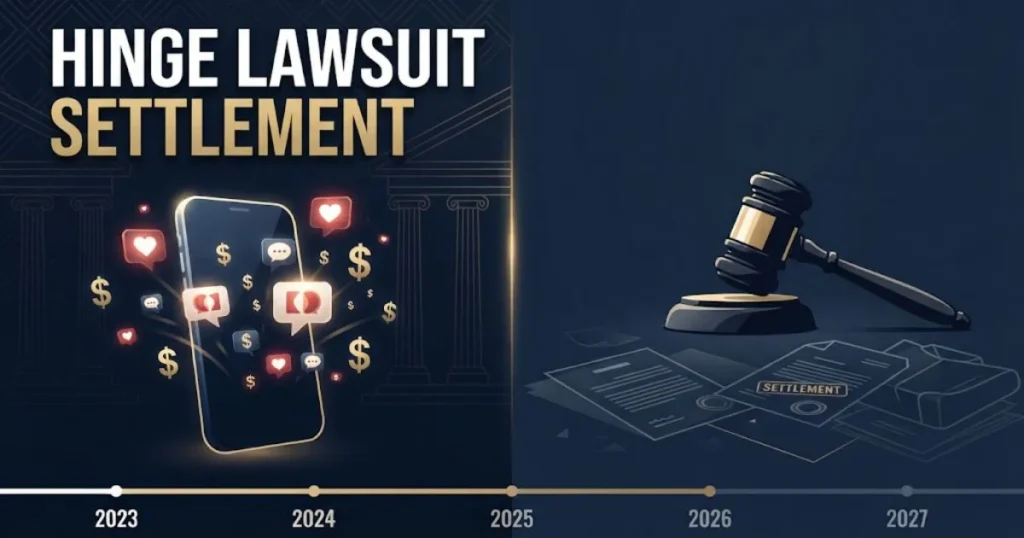
If a settlement is reached, it would likely be announced in late 2026 or early 2027. Users would then have a window to submit claims and receive payouts.
Hinge Lawsuit Payout: How Much Could You Receive?
The Hinge lawsuit payout for individual users will depend on several factors, including how much money you spent, how long you subscribed, and what evidence you can provide. No fixed amount has been set yet.
In class action settlements, payouts are almost never one-size-fits-all. Courts typically create tiers based on the level of harm each class member experienced.
Here’s how tiered payouts typically work in cases like this:
| Tier | User Profile | Estimated Payout Range |
|---|---|---|
| Tier 1 | Free users who downloaded the app | $5 to $15 |
| Tier 2 | Users who made one-time purchases (Roses, Boosts) | $20 to $75 |
| Tier 3 | Short-term subscribers (1 to 6 months) | $50 to $150 |
| Tier 4 | Long-term subscribers (6+ months) | $150 to $500+ |
Users who kept receipts, email confirmations, or bank statements showing Hinge charges will likely receive higher payouts. Documentation is everything in class action claims.
Some lawsuits also include injunctive relief. That means the court could force Hinge to change its business practices. While that doesn’t put cash in your pocket, it could save you money in the future.
The attorneys representing the class typically take 25% to 33% of the total settlement fund. That comes off the top before individual payouts are calculated.
How Much Money Can You Get from the Hinge Lawsuit?
How much money you can actually get from the Hinge lawsuit comes down to one question: how much did you spend? The more you paid Hinge, the more you’re likely to receive.
Based on the subscription pricing and typical class action math, here are some realistic examples:
- A user who paid for 3 months of Hinge Plus ($90 total) might receive $30 to $90 depending on the settlement terms.
- A user who subscribed to HingeX for a year ($600 total) could receive $150 to $400.
- A user who bought individual Roses and Boosts totaling $50 might get $15 to $50 back.
These numbers are educated projections. The actual amounts won’t be known until a settlement is finalized and a claims administrator calculates distributions.
One thing to keep in mind: you’ll likely need to file a claim to get paid. In most class actions, money doesn’t show up automatically. You have to submit a form, provide proof of purchase, and wait for processing.
The good news is that filing a claim is usually free and takes about 10 to 15 minutes. You just need your account information and payment records.
Key Takeaway: Your Hinge lawsuit payout will likely be proportional to how much you spent on the app, with long-term subscribers and heavy spenders receiving the largest amounts, but you must file a claim to get anything.
Who Qualifies for the Hinge Lawsuit?
If you downloaded and used Hinge in the United States and spent money on the app, you likely qualify for the Hinge lawsuit class. The eligibility requirements are broader than most people expect.
The proposed class definition in the primary lawsuit includes:
- All U.S. residents who created a Hinge account
- Users who purchased any Hinge subscription (Hinge Plus or HingeX)
- Users who bought individual premium features (Roses, Boosts, Standouts)
- Users who were charged auto-renewal fees
You do not need to have been “addicted” to the app to qualify. The lawsuit is about deceptive practices and design, not about proving you personally developed a dependency.
| Qualification Factor | Required? |
|---|---|
| U.S. resident | Yes |
| Had a Hinge account | Yes |
| Paid for subscription or features | Yes (for financial damages) |
| Free user only | May qualify for limited damages |
| Still using Hinge | Not required |
| Proof of payment | Strongly recommended |
Free users may also be included in the class depending on how the court defines the affected group. However, financial damages for free users would be minimal since they didn’t pay anything.
The class period, meaning the timeframe of eligible activity, hasn’t been finalized. But it’s expected to cover at least 2019 through 2025, and possibly earlier.
Hinge Lawsuit Eligibility Requirements Explained
Hinge lawsuit eligibility has a few specific requirements that you should check before assuming you’re part of the class. Meeting these criteria doesn’t guarantee a payout, but it means you can participate.
The primary requirements are straightforward:
- Geographic: You must be a resident of the United States. International Hinge users are not currently included.
- Account: You must have created a Hinge account during the class period.
- Financial: You must have spent money on Hinge subscriptions or premium features.
- Timeframe: Your purchases must fall within the class period (expected 2019 to 2025).
There are a few things that would not disqualify you:
- Deleting your Hinge account
- No longer having the app installed
- Not remembering your exact login credentials
- Having a positive experience on the app
The court hasn’t certified the class yet. Class certification is a critical legal step where the judge decides whether the case can proceed as a class action rather than individual lawsuits. This decision is expected sometime in mid-2026.
If the class is certified, you’ll be considered a member automatically unless you opt out. Opting out means you give up your share of any settlement but retain the right to sue Hinge individually.
Most people should stay in the class unless they have extraordinary damages that justify a personal lawsuit. For the average subscriber, the class action is the most practical path to compensation.
How to File a Hinge Lawsuit Claim
Filing a Hinge lawsuit claim is not yet possible because no settlement has been approved. But once a settlement is reached, the claims process will open, and here’s what it will look like based on how similar cases work.
Step-by-step, the process typically goes like this:
- Settlement announcement is made public through court filings, news coverage, and direct emails to class members
- Claims portal opens online with a simple form
- You fill out the form with your name, email address, Hinge account details, and payment information
- You submit proof of Hinge purchases (bank statements, email receipts, app store records)
- Claims administrator reviews your submission
- Payout is processed via check, direct deposit, or digital payment
The entire process usually takes 10 to 20 minutes to complete. There is no cost to file a claim.
To prepare right now, you should:
- Save your Hinge payment receipts (check your email for Apple App Store or Google Play receipts)
- Download your bank statements showing Hinge charges
- Screenshot your Hinge account if you still have access
- Note your subscription history including dates and amounts
| Preparation Step | Why It Matters |
|---|---|
| Save payment receipts | Proves you spent money on Hinge |
| Download bank statements | Backup evidence of charges |
| Screenshot account info | Confirms you were a user |
| Note subscription dates | Establishes class period eligibility |
Don’t wait until the claims window opens. Gathering this information now will make the process much smoother later.
Key Takeaway: You can’t file a claim yet, but you should start gathering your Hinge payment receipts, bank statements, and account information right now so you’re ready the moment a settlement is announced.
Hinge Lawsuit Update 2026: Latest Developments
The most important Hinge lawsuit update for 2026 is that the case is progressing through the discovery phase, which means both sides are exchanging evidence. This is where the real ammunition gets uncovered.
During discovery, plaintiffs’ attorneys have requested internal Match Group documents including:
- Product design meeting notes
- A/B testing results for engagement features
- Executive communications about user retention strategies
- Revenue reports tied to specific design changes
- User behavior analytics and engagement metrics
Match Group has pushed back on some of these requests, citing trade secret protections. The court is currently resolving disputes about what must be disclosed.
A few major developments have already happened in early 2026:
- January 2026: The court denied Match Group’s second motion to dismiss, allowing all claims to proceed.
- February 2026: Plaintiffs filed an amended complaint adding new allegations about age-based pricing discrimination.
- March 2026: A scheduling order was issued setting key deadlines for the remainder of the year.
The judge overseeing the primary case has signaled interest in moving toward class certification by summer 2026. If the class is certified, settlement talks could begin in earnest by fall.
Media coverage has also increased. Major outlets have published investigative pieces about dating app design practices, which helps build public awareness and puts pressure on Match Group to settle.
Hinge Lawsuit Timeline: Key Dates and Milestones
The Hinge lawsuit timeline stretches back to the original filing and extends into late 2026 and beyond. Here’s a comprehensive look at every milestone that matters.
| Date | Event |
|---|---|
| Mid-2023 | First individual complaints filed against Match Group |
| Late 2023 | Class action complaint filed in N.D. California |
| Early 2024 | Match Group files motion to dismiss |
| Mid-2024 | Court denies motion to dismiss on key claims |
| Late 2024 | Discovery phase begins |
| Early 2025 | Amended complaints add new allegations |
| Mid-2025 | Additional state-level lawsuits filed |
| January 2026 | Second motion to dismiss denied |
| February 2026 | Age-based pricing allegations added |
| March 2026 | Scheduling order issued |
| Summer 2026 (projected) | Class certification hearing |
| Fall 2026 (projected) | Settlement negotiations begin |
| Late 2026 to early 2027 (projected) | Settlement announcement (if reached) |
| 2027 (projected) | Claims window opens and payouts begin |
The timeline could shift in either direction. If Match Group cooperates with discovery, things move faster. If they fight every request, it slows down.
One wild card is whether the FTC opens a separate investigation. Federal regulatory action could accelerate settlement talks significantly. Companies often prefer to settle private lawsuits quickly when government regulators start paying attention.
Another factor is public opinion. As more people learn about the lawsuit, the class size grows. A larger class puts more financial pressure on Match Group and increases the incentive to negotiate.
The projected payout timeline of 2027 assumes a settlement is reached in late 2026. If the case goes to trial instead, payouts could be delayed until 2028 or later.
Key Takeaway: The Hinge lawsuit is on track for a class certification hearing in summer 2026, with potential settlement talks by fall 2026 and payouts possibly beginning in 2027.
Frequently Asked Questions
Can I join the Hinge class action lawsuit in 2026?
Yes, if you are a U.S. resident who spent money on Hinge, you are likely an automatic class member.
You do not need to take any action to join right now.
Once a settlement is reached, you will need to file a claim to receive payment.
How much money will I get from the Hinge lawsuit settlement?
Most users can expect between $15 and $500 depending on how much they spent.
Long-term subscribers will receive more than users who made small one-time purchases.
Exact amounts will be determined after a settlement is finalized.
What manipulative features is Hinge accused of using?
Hinge is accused of using variable ratio reinforcement, artificial scarcity, and FOMO-driven notifications.
These features allegedly create compulsive app usage and push users toward paid subscriptions.
The lawsuit compares these tactics to gambling mechanics used in slot machines.
Is Match Group responsible for the Hinge lawsuit?
Yes, Match Group Inc. is the named defendant as the parent company that owns and operates Hinge.
Plaintiffs allege that manipulative design practices were directed at the corporate level.
Match Group also owns Tinder, OkCupid, and several other dating platforms.
When will the Hinge lawsuit be settled?
A settlement could be announced in late 2026 or early 2027 based on the current case timeline.
Class certification is expected by summer 2026, which typically precedes settlement negotiations.
If the case goes to trial, resolution could extend into 2028.
The Hinge lawsuit is one of the most significant consumer protection cases targeting a dating app. If you paid for Hinge subscriptions or premium features, your best move is to save your payment records and watch for settlement announcements.
When the claims window opens, filing will be free and quick. Stay informed through trusted legal news sources, and make sure you’re ready to submit your claim on day one.
Your receipts are your ticket. Keep them safe.







