The last week of February 2026 was one of the busiest stretches in generative AI litigation history. Netflix sent a cease-and-desist letter to ByteDance over its Seedance 2.0 video tool on February 20. A YouTuber filed a class action against Runway AI on February 24. A federal judge denied Nvidia’s bid to pause discovery in a copyright case the same week.
These are not isolated events. They are part of a coordinated wave of legal action reshaping how AI companies train their models, how they compensate creators, and what consumers can claim when things go wrong.
This guide covers every major generative AI lawsuit active during February 20-27, 2026. You will learn which cases matter, who qualifies for settlements, how much money is on the table, and what deadlines you cannot miss. One number stands out: Anthropic’s $1.5 billion settlement, finalized in July 2026, paid roughly $3,000 per copyrighted work to over 500,000 authors.
That kind of money changes lives. Here is what you need to know right now.
Generative AI Lawsuits February 2026: The Full Picture
The last full week of February 2026 saw five major developments in generative AI litigation. Netflix, Sony, and other Hollywood studios escalated their fight against ByteDance. A class action against Runway AI landed in federal court. Nvidia lost a procedural battle in its copyright case.
These cases share one common thread: creators and consumers are fighting back against AI companies that trained on their work without permission.
Here is a quick snapshot of the week:
| Date | Case | Key Development |
|---|---|---|
| Feb 20, 2026 | Netflix v. ByteDance | Cease-and-desist over Seedance 2.0 |
| Feb 20, 2026 | Nvidia copyright case | Court denies bid to pause discovery |
| Feb 20, 2026 | In re Google AI Litigation | Hearing held before Judge Lee |
| Feb 24, 2026 | Scott v. Runway AI | Class action filed in federal court |
| Feb 20-27, 2026 | Sony/Disney v. ByteDance | Multiple cease-and-desist letters |
The pattern is clear. Copyright holders are no longer waiting for courts to define fair use. They are sending demand letters, filing class actions, and forcing AI companies into expensive discovery fights.
Key Takeaway: February 2026 marked a turning point where Hollywood, independent creators, and authors all escalated legal pressure on AI companies simultaneously.
Netflix ByteDance AI Lawsuit: Seedance 2.0 Under Fire
Netflix sent a formal cease-and-desist letter to ByteDance on February 20, 2026, accusing the Chinese company’s Seedance 2.0 AI video tool of enabling widespread copyright infringement. This is not a lawsuit yet. It is a legal ultimatum.
The letter demands ByteDance remove Netflix intellectual property from its training datasets and implement safeguards to prevent future infringement.
Netflix’s litigation chief, Mindy LeMoine, called Seedance a “high-speed piracy machine” in a statement reported by Variety. The streaming giant specifically cited unauthorized videos featuring characters and scenes from Stranger Things, Squid Game, Bridgerton, and KPop Demon Hunters.
One alarming example: users generated videos placing Elon Musk inside Squid Game scenarios. Another recreated the final episode of Stranger Things with high fidelity to the show’s characters and monsters.
This move follows similar cease-and-desist letters from Disney, Paramount, and Warner Bros. The Motion Picture Association coordinated the broader Hollywood offensive.
ByteDance responded publicly, claiming it respects intellectual property rights. The company said it is strengthening protections against unauthorized use.
Quick Facts:
- Letter sent: February 20, 2026
- Tool accused: Seedance 2.0
- Shows cited: Stranger Things, Squid Game, Bridgerton, KPop Demon Hunters
- Demands: Remove Netflix IP from training data, implement safeguards, report past infringement
The legal theory here is direct and secondary copyright infringement. Netflix argues that ByteDance built a commercial product designed to replicate copyrighted characters, costumes, and storylines. That is not fair use, according to Netflix. It is piracy at scale.
Runway AI Class Action Lawsuit: YouTuber Takes on Video Generation
YouTuber Ross Scott filed a copyright class action against Runway AI on February 24, 2026, in what legal observers call the latest “input” claim against generative AI companies. The case is Scott v. Runway AI.
The lawsuit alleges that Runway violated intellectual property laws by training its generative video models on massive troves of copyrighted content without consent or compensation.
This case matters because it targets a different kind of AI: video generation, not text or images. If Scott prevails, every video AI company that scraped YouTube, Vimeo, or other platforms faces potential liability.
The proposed class includes creators whose videos were used in Runway’s training data. Scott and his legal team are seeking to establish a “fair licensing” regime as an alternative to the fair use defense that AI developers typically mount.
| Case Detail | Information |
|---|---|
| Filing Date | February 24, 2026 |
| Plaintiff | Ross Scott (YouTuber) |
| Defendant | Runway AI |
| Legal Theory | Copyright infringement via AI training |
| Relief Sought | Fair licensing regime, class certification |
The case invokes Rule 23 of the Federal Rules of Civil Procedure. That rule governs class actions. Scott’s team argues that class treatment is appropriate because AI training practices have systemic effects on groups of creative professionals.
Key Takeaway: The Runway AI case extends copyright litigation from text and images into video, opening a new front in the AI training wars.
Nvidia AI Training Copyright Lawsuit: Discovery Denied
A federal judge denied Nvidia’s request to pause discovery in a copyright lawsuit on February 20, 2026, forcing the company to produce documents while it fights to dismiss the case. The ruling came from U.S. District Judge Jon S. Tigar in Oakland, California.
Nvidia wanted to freeze discovery while Judge Tigar considered its motion to dismiss the authors’ most recent complaint. Tigar ruled from the bench that Nvidia had not met its burden of showing the motion would succeed.
This means discovery moves forward. The plaintiffs, a group of authors, will get access to Nvidia’s internal records about how it trained its large language models.
Why does this matter? Discovery is expensive and invasive. Companies often settle to avoid it. By denying the stay, Judge Tigar increased pressure on Nvidia to resolve the case.
The case alleges that Nvidia illegally used authors’ works to train its LLMs. The court previously allowed direct infringement claims to proceed based on allegations that Nvidia used shadow libraries to acquire training data.
| Ruling Detail | Information |
|---|---|
| Date | February 20, 2026 |
| Judge | Jon S. Tigar |
| Court | U.S. District Court, Oakland |
| Ruling | Discovery stay denied |
| Impact | Nvidia must produce documents while fighting dismissal |
Google Generative AI Copyright Litigation: February 20 Hearing
A public hearing was held in In re Google Generative AI Copyright Litigation on February 20, 2026, before Judge Eumi K. Lee in the Northern District of California. The case number is 5:23-cv-03440.
The hearing transcript was initially sealed but unsealed on March 5, 2026, after Google filed a statement consenting to its release. The transcript covers proceedings that remain central to the case.
This case consolidates multiple copyright claims against Google over its Gemini AI model. Authors and publishers allege that Google trained Gemini on their copyrighted books without permission.
The February 20 hearing addressed procedural motions and case scheduling. Judge Lee also denied several administrative motions to seal materials in March 2026, signaling that the court wants transparency in the proceedings.
For authors whose works may have been used in Gemini’s training, this case represents one of several potential avenues for compensation. It is separate from the Anthropic settlement but follows a similar legal theory.
Quick Facts:
- Case: In re Google Generative AI Copyright Litigation, 5:23-cv-03440
- Hearing date: February 20, 2026
- Judge: Eumi K. Lee
- Court: N.D. California
- Key issue: Whether training Gemini on copyrighted books infringes copyright
Key Takeaway: The Google case is moving through procedural stages but has not reached a settlement or trial. Authors should monitor this docket closely.
Midjourney Disney Copyright Case: Discovery Battles Continue
Disney, Universal, and Warner Bros. are suing Midjourney for copyright infringement, alleging the AI image generator lets users create unauthorized copies of their characters. The case is Disney Enterprises Inc. v. Midjourney Inc., Case No. 2:25-cv-05275, in the Central District of California.
The case was filed in June 2025 but remained active through February 2026 and beyond. Discovery disputes have dominated the docket.
Midjourney asked the court to force Disney to disclose its own AI practices and prompts. A federal magistrate judge rejected that request in June 2026, limiting discovery to consumer-facing AI applications.
In August 2026, Midjourney filed a motion for judgment on the pleadings. Disney opposed it. The case is ongoing.
This lawsuit matters because it directly tests whether AI image generators can be held liable for what users create with them. If Disney wins, every AI art platform faces massive liability.
| Case Detail | Information |
|---|---|
| Case Name | Disney Enterprises Inc. v. Midjourney Inc. |
| Case Number | 2:25-cv-05275 |
| Court | C.D. California |
| Filed | June 2025 |
| Status | Active, discovery and motion practice |
AI Training Data Class Action Eligibility: Who Can Join
You can join an AI training data class action if your copyrighted work was used to train an AI model without your permission. Eligibility depends on which case you are joining and what the class definition covers.
The Anthropic settlement, for example, covered copyright owners of books on a court-approved list. Those books were downloaded from LibGen and PiLiMi, two online libraries.
To qualify for that settlement, you had to own a copyright in a book included on the list. The court approved the list, and more than 91% of eligible works were claimed by April 2026.
For the Runway AI class action, the proposed class includes video creators whose content was used in training data. The exact class definition has not been finalized.
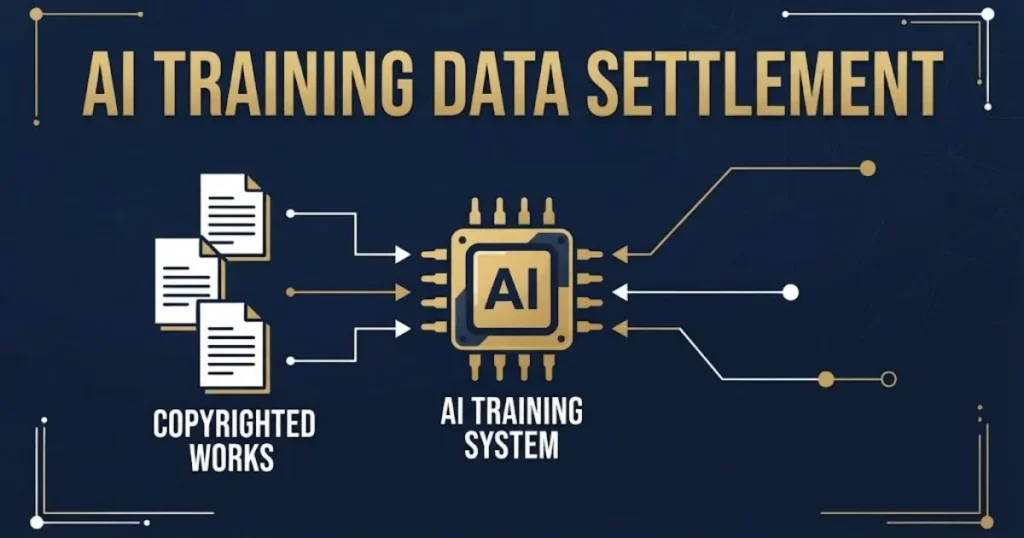
For the Nvidia case, the class includes authors whose works were used to train Nvidia’s LLMs. The court has allowed direct infringement claims to proceed.
| Case | Class Definition | Status |
|---|---|---|
| Anthropic (Bartz) | Copyright owners of books on approved list | Settlement finalized July 2026 |
| Runway AI (Scott) | Video creators whose content trained models | Class certification pending |
| Nvidia | Authors whose works trained LLMs | Discovery ongoing |
| Google (In re) | Authors and publishers of books used in Gemini | Active litigation |
Key Takeaway: Eligibility varies by case. If you own a copyright in a work that an AI company scraped or downloaded, you may have a claim in one or more of these cases.
Who Qualifies for AI Training Lawsuit Settlement
You qualify for an AI training lawsuit settlement if you can prove you own a copyright in a work that was used to train an AI model without your permission. The specific criteria depend on the settlement.
For the Anthropic settlement, the criteria were straightforward. You needed to own a copyright in a book that appeared on the court-approved list of works downloaded from LibGen and PiLiMi.
The settlement covered over 500,000 potential class members. Of those, more than 91% claimed their share by April 2026. Only 350 valid opt-out requests were submitted.
For future settlements, the same principle applies. If your work was scraped, downloaded, or otherwise used without a license, you likely qualify.
Here is a simple checklist:
- Do you own a copyright in a book, article, image, video, or song?
- Was that work available online in a place where AI companies could scrape it?
- Did an AI company use it to train a commercial model?
- Did you receive any compensation or licensing offer?
If you answered no to the last question, you may have a claim.
Quick Facts:
- Anthropic settlement: $3,000 per work
- Class members: 500,000+
- Claims filed by April 2026: 91%+
- Opt-outs: 350
OpenAI Copyright Lawsuit Authors: The Authors Guild Case
The Authors Guild and 17 authors sued OpenAI in September 2023, and the case is still active in 2026. The named plaintiffs include George R.R. Martin, John Grisham, Jodi Picoult, Jonathan Franzen, David Baldacci, and Sylvia Day.
The case is In re OpenAI, Inc. Copyright Infringement Litigation, MDL No. 1:25-md-03143, in the Southern District of New York. The Authors Guild and co-plaintiffs filed a motion for summary judgment on September 4, 2026.
The plaintiffs allege that OpenAI trained ChatGPT on their copyrighted books without permission. OpenAI’s defense is fair use.
In September 2026, the Trump administration filed a statement supporting OpenAI’s fair use defense. The Department of Justice argued that training AI on copyrighted works can be transformative and beneficial.
This case is separate from the Anthropic settlement. It has not settled. A summary judgment ruling could come in late 2026 or 2027.
| Case Detail | Information |
|---|---|
| Filed | September 2023 |
| Plaintiffs | Authors Guild, George R.R. Martin, John Grisham, Jodi Picoult, others |
| Defendant | OpenAI, Microsoft |
| Court | S.D.N.Y. |
| Status | Summary judgment motion filed Sept 4, 2026 |
Key Takeaway: The OpenAI authors’ case is the highest-profile AI copyright litigation. A ruling on fair use could reshape the entire legal landscape.
AI Training Data Lawsuit Settlement 2026: The Anthropic Deal
The largest AI training data settlement in U.S. history was finalized on July 20, 2026, when Judge Araceli Martinez-Olguin approved Anthropic’s $1.5 billion class action settlement in Bartz v. Anthropic.
The settlement covers copyright owners of books that Anthropic downloaded from LibGen and PiLiMi to train its Claude chatbot. Eligible works received approximately $3,000 each before fees and costs.
That is roughly four times the minimum statutory damages typically awarded for ordinary copyright infringement. The fund is non-reversionary, meaning unclaimed money stays available for eligible class members rather than returning to Anthropic.
The court approved approximately $101.6 million in attorneys’ fees, well below the $187.5 million requested. Litigation expenses of about $2.6 million and service awards of $15,000 for each of the three class representatives were also approved.
Anthropic must destroy the original pirated copies of books it obtained from LibGen and PiLiMi, subject to legal preservation requirements.
Quick Facts:
- Settlement total: $1.5 billion
- Per work: ~$3,000
- Class members: 500,000+
- Final approval: July 20, 2026
- Attorneys’ fees: $101.6 million
Anthropic $1.5 Billion Settlement Breakdown: Where the Money Goes
The $1.5 billion Anthropic settlement breaks down into several buckets. Most of the money goes to authors and publishers. A smaller portion covers legal fees and administrative costs.
Here is the breakdown:
| Category | Amount |
|---|---|
| Authors and publishers (per work) | ~$3,000 each |
| Total class fund | $1.5 billion |
| Attorneys’ fees approved | $101.6 million |
| Litigation expenses | $2.6 million |
| Service awards (3 representatives) | $15,000 each |
The settlement did not resolve all claims against Anthropic. Authors and publishers who opted out can still pursue separate cases. The settlement also does not prevent future claims over AI-generated outputs or future conduct.
Bloomsbury, the publisher of Harry Potter, confirmed it would receive a payout covering 14,087 of its titles. That gives you a sense of the scale.
Key Takeaway: The Anthropic settlement is the template for future AI copyright settlements. If you own a copyright in a book used for AI training, you should check whether your work is on any approved settlement list.
Generative AI Lawsuit Settlement Payout: How Much Can You Get
Payouts in generative AI lawsuits range from a few hundred dollars to several thousand per work, depending on the case. The Anthropic settlement paid roughly $3,000 per copyrighted work. That is the highest known per-work payout in an AI training case.
Other cases have not settled yet. The Runway AI class action, the Nvidia case, and the Google litigation are all in earlier stages. No payout amounts have been established.
For future settlements, expect per-work amounts to vary based on:
- The number of eligible works
- The total settlement fund
- The strength of the copyright claims
- Whether the AI company acted willfully
The statutory damages range for copyright infringement is $750 to $30,000 per work for non-willful infringement, and up to $150,000 per work for willful infringement. Settlements typically land well below statutory maximums.
| Case | Payout Status | Per-Work Amount |
|---|---|---|
| Anthropic (Bartz) | Finalized | ~$3,000 |
| Runway AI (Scott) | Pending | Unknown |
| Nvidia | Pending | Unknown |
| Google (In re) | Pending | Unknown |
AI Lawsuit Filing Deadline 2026: Key Dates to Know
There is no single filing deadline for all AI lawsuits. Each case has its own schedule. But several key dates matter for anyone following or participating in these cases.
The Anthropic settlement claim deadline has passed. More than 91% of eligible works were claimed by April 2026. If you missed it, you may have lost your chance unless you qualify for a late-claim process.
The Stability AI trial was scheduled for September 8, 2026, but was pushed to April 5, 2027. That is the first jury trial over AI image training.
For the Nvidia case, discovery is ongoing as of February 2026. No trial date has been set.
| Case | Key Date | What It Means |
|---|---|---|
| Anthropic settlement | April 2026 | Claim deadline passed |
| Stability AI trial | April 5, 2027 | First jury trial on AI image training |
| Nvidia discovery | Ongoing | No trial date set |
| OpenAI summary judgment | Sept 2026 filing | Ruling could come 2027 |
Key Takeaway: Deadlines vary by case. If you believe you have a claim, consult a class action attorney immediately. Do not wait for a deadline to pass.
AI Copyright Lawsuit Fair Use Ruling: The Central Legal Question
The fair use doctrine is the central legal question in nearly every AI copyright lawsuit. AI companies argue that training models on copyrighted works is transformative and therefore fair use. Copyright holders disagree.
A federal judge in California ruled in 2025 that training AI on lawfully acquired books is fair use. The court distinguished between lawful acquisition and piracy. Anthropic’s use of lawfully acquired books was protected. Its use of pirated books was not.
That ruling shaped the Anthropic settlement. Anthropic agreed to pay $1.5 billion for the pirated books, while the fair use ruling on lawful training remains law.
In India, the Delhi High Court ruled in July 2026 that AI training falls within fair dealing exceptions. The court declined to grant an interim injunction against OpenAI.
In Munich, the Regional Court ruled in GEMA v. Suno that US fair use does not protect AI training when copies are stored inside model weights. That is a different outcome from the US ruling.
| Jurisdiction | Ruling | Outcome |
|---|---|---|
| US (N.D. Cal.) | Bartz v. Anthropic | Lawful training = fair use; piracy = infringement |
| India (Delhi HC) | ANI v. OpenAI | Training = fair dealing, no injunction |
| Germany (Munich) | GEMA v. Suno | Fair use rejected, injunction granted |
The legal landscape is split. A US Supreme Court ruling may eventually be needed to resolve the issue.
Stability AI Lawsuit Trial Date: April 5, 2027
The first US jury trial over AI image training has been pushed to April 5, 2027. The case is Andersen v. Stability AI, filed in January 2023 by visual artists Sarah Andersen, Karla Ortiz, and Kelly McKernan.
The trial was originally scheduled for September 8, 2026. It was delayed by roughly seven months. The case now names four defendants: Stability AI, Midjourney, DeviantArt, and Runway AI.
At the center of the case is LAION, a dataset of around five billion images scraped from the internet. The artists argue that including their work in that dataset to train commercial AI systems was copyright infringement.
This trial matters because it will be the first time a jury, not a judge, decides whether AI training on copyrighted images is infringement. A jury verdict carries different weight than a legal ruling.
Quick Facts:
- Trial date: April 5, 2027
- Original date: September 8, 2026
- Plaintiffs: Sarah Andersen, Karla Ortiz, Kelly McKernan
- Defendants: Stability AI, Midjourney, DeviantArt, Runway AI
- Dataset: LAION (5 billion images)
Key Takeaway: The Stability AI trial is the first jury test of AI image training. Its outcome will influence every other AI copyright case in the US.
AI Music Copyright Lawsuit GEMA Suno: Munich Ruling
The Munich Regional Court ruled against Suno, an AI music generator, on July 31, 2026, in a case brought by GEMA, the German music rights organization. The case number is 42 O 763/25.
The court found that Suno infringed copyrights in six musical works, including “Atemlos durch die Nacht,” “Rasputin,” “Big in Japan,” “Forever Young,” “Daddy Cool,” and the refrain of “Mambo No. 5.”
The ruling was sweeping. The court granted an injunction covering training-phase reproduction in the US, storage in model parameters in Germany, and public performance of outputs in Germany.
Suno was ordered to render an account of infringements and revenues and is liable for damages from July 1, 2023. The court also ordered publication of the judgment in the Süddeutsche Zeitung at Suno’s expense.
This is the first European case on AI music generation. The court applied US fair use doctrine and rejected it. That creates a direct conflict with the US ruling in the Anthropic case.
| Case Detail | Information |
|---|---|
| Court | Munich Regional Court I |
| Case Number | 42 O 763/25 |
| Ruling Date | July 31, 2026 |
| Plaintiff | GEMA |
| Defendant | Suno |
| Outcome | Injunction granted, damages ordered |
AI Copyright Infringement Case Update: Where Things Stand
As of February 2026, the generative AI copyright litigation landscape includes dozens of active cases across multiple jurisdictions. The Anthropic settlement is the first major resolution. Others are still moving through discovery, motions, and trial preparation.
Here is the current status of the major cases:
| Case | Status | Next Key Event |
|---|---|---|
| Anthropic (Bartz) | Settled ($1.5B) | Distributions ongoing |
| OpenAI (Authors Guild) | Active | Summary judgment ruling pending |
| Stability AI (Andersen) | Active | Trial April 5, 2027 |
| Nvidia | Active | Discovery ongoing |
| Google (In re) | Active | Post-hearing motions |
| Midjourney (Disney) | Active | Motion for judgment pending |
| Runway AI (Scott) | Active | Class certification |
| Suno (GEMA) | Ruled | Appeal likely |
The big picture: AI companies are losing procedural battles, facing expensive discovery, and settling when the numbers make sense. Copyright holders are winning early rounds. But the fair use question remains unresolved in the US Supreme Court.
Generative AI Lawsuit Class Action Certification: What It Means
Class action certification is the legal process that turns individual claims into a collective lawsuit. If a court certifies a class, all affected people are automatically included unless they opt out.
The Anthropic settlement was a class action. The court approved the class definition and the settlement. More than 500,000 potential class members were covered.
For the Runway AI case, class certification is still pending. Scott’s legal team argues that Rule 23 of the Federal Rules of Civil Procedure is appropriate because AI training practices have systemic effects on groups of creative professionals.
Certification matters because it gives plaintiffs leverage. A certified class can seek damages on behalf of thousands of people, making settlement more likely.
Here is what certification requires:
- Numerosity: Too many class members to join individually
- Commonality: Shared legal or factual questions
- Typicality: Class representatives’ claims are typical
- Adequacy: Representatives will fairly protect class interests
Key Takeaway: Class certification is the gateway to collective relief. Once certified, a class action can force AI companies to settle on terms that benefit everyone.
Frequently Asked Questions
How much will I get from the Anthropic AI settlement?
Most eligible claimants received approximately $3,000 per copyrighted work.
The exact amount depended on how many works you owned and whether they appeared on the court-approved list.
Payments began after final approval in July 2026.
Who qualifies for the AI training data lawsuit settlement?
You qualify if you own a copyright in a book that Anthropic downloaded from LibGen or PiLiMi.
The court approved a specific list of works covered by the settlement.
More than 91% of eligible works were claimed by April 2026.
What is the filing deadline for the Runway AI class action?
No filing deadline has been set yet because the court has not certified the class.
The case was filed on February 24, 2026, and is in early stages.
Monitor the docket for updates on class certification and claim procedures.
When is the Stability AI trial?
The trial is scheduled for April 5, 2027.
It was originally set for September 8, 2026, but was delayed by seven months.
This will be the first jury trial over AI image training.
Can I still file a claim if I missed the Anthropic settlement deadline?
The claim deadline passed in April 2026.
Late claims may be accepted in limited circumstances, but you should consult a class action attorney immediately.
Do not assume you can still file.
What Comes Next in the AI Lawsuit Wave
The generative AI lawsuit wave is not slowing down. If anything, February 2026 proved that copyright holders are more organized and aggressive than ever.
The Anthropic settlement set a benchmark. $3,000 per work is real money. The Netflix, Disney, and Sony actions against ByteDance show that Hollywood will not back down. The Runway AI class action extends the fight to video.
If you own a copyright in a book, image, song, or video, you should check whether your work was used to train an AI model. The sooner you act, the better your options.
Start by reviewing any settlement notices you have received. Check the court-approved lists for cases like Anthropic. If you are unsure, contact a class action attorney who handles AI copyright cases.
The legal landscape is shifting fast. Stay informed. Stay ready. And do not miss a deadline.