The full tennis lawsuit of 2026 is the biggest legal battle in the sport’s history. The PTPA sued the ATP, WTA, ITF, and Grand Slam Board for antitrust violations. Players say these groups suppress wages and limit earning power.
Tennis generates over $2 billion annually. Players receive less than 20 percent of that revenue. That gap sits at the heart of this case.
The lawsuit was filed in federal court in New York in March 2025. Discovery is now fully underway as of early 2026. Below you will find every key detail about the claims, the timeline, and what comes next.
Full Tennis Lawsuit 2026 Overview
The full tennis lawsuit in 2026 refers to the PTPA antitrust case against the sport’s four governing bodies. It is currently in the discovery phase in federal court.
Related: Recent Tennis Lawsuit 2026: PTPA Antitrust Case Updates
The case was filed in the U.S. District Court for the Southern District of New York. The PTPA alleges that tennis organizations operate as an illegal cartel. They claim this cartel suppresses player pay and restricts competition.
Think of it like a group of employers secretly agreeing to cap salaries. That is essentially what the PTPA says is happening in professional tennis. The lawsuit seeks both monetary damages and structural changes to how the sport operates.
| Detail | Info |
|---|---|
| Case Filed | March 2025 |
| Court | Southern District of New York |
| Current Phase | Discovery |
| Plaintiffs | PTPA and 12 individual players |
| Defendants | ATP, WTA, ITF, Grand Slam Board |
The case has drawn global attention from players, fans, and legal experts. Many compare it to the early antitrust battles that reshaped the NFL and NBA decades ago.
What Is the PTPA Tennis Lawsuit
The PTPA tennis lawsuit is a federal antitrust case challenging how professional tennis distributes revenue and controls player careers. The PTPA stands for the Professional Tennis Players Association.
Novak Djokovic and Vasek Pospisil co-founded the PTPA in 2020. The organization argues that tennis lacks the collective bargaining structure found in other major sports. Players have no union and no seat at the negotiating table.
The lawsuit claims the governing bodies collude to keep player pay artificially low. It also alleges that scheduling rules and appearance restrictions limit outside earning potential.
Key allegations in the complaint include:
- Wage suppression through coordinated prize money caps
- Restrictive scheduling that blocks players from competing in rival events
- Coercive appearance rules that force participation without fair compensation
- Revenue hoarding by organizations that take the lion’s share of income
The PTPA says these practices violate the Sherman Antitrust Act. That federal law prohibits agreements that unreasonably restrain trade.
Who Filed the Tennis Lawsuit
The PTPA filed the tennis lawsuit on behalf of itself and 12 named professional players. The complaint was submitted in March 2025 in New York federal court.
Novak Djokovic is the most prominent figure behind the PTPA. He co-founded the group with Canadian player Vasek Pospisil. Both have been vocal critics of how tennis distributes its money.
The 12 individual plaintiffs include both current and recently retired players. Their names span the ATP and WTA tours. The PTPA says the class could eventually include hundreds of players.
Bold stat: Over 500 players have expressed interest in joining the case as of January 2026.
The legal team is led by a prominent sports antitrust firm based in New York. They have previously represented athletes in cases against the NFL and NCAA. Their track record in sports litigation is strong.
The defendants have retained high-profile defense counsel. The legal battle is shaping up to be one of the costliest in sports history.
Key Takeaway: The PTPA, backed by Djokovic and over 500 interested players, is challenging the entire financial structure of professional tennis through federal antitrust law.
Tennis Antitrust Lawsuit Explained
An antitrust lawsuit in tennis means players are accusing the sport’s governing bodies of acting like an illegal monopoly. The core claim is that these organizations collude to suppress competition and player pay.
Antitrust law exists to prevent businesses from secretly coordinating to fix prices or limit choices. In this case, the “price” is player compensation. The “choice” is where and when players can compete.
The PTPA argues that the ATP, WTA, ITF, and Grand Slam Board function as a single entity. They allegedly set rules together that no individual player can negotiate around. This is similar to how a group of factories might secretly agree to pay workers the same low wage.
| Claim Type | Legal Basis | What It Means |
|---|---|---|
| Price fixing | Sherman Act Section 1 | Coordinated prize money caps |
| Market allocation | Sherman Act Section 1 | Dividing up tournaments and regions |
| Monopolization | Sherman Act Section 2 | Controlling all top-level events |
| Group boycott | Sherman Act Section 1 | Punishing players who join rival events |
The lawsuit seeks treble damages under federal law. That means any award could be tripled by the court. This significantly raises the financial stakes for the defendants.
Tennis Governing Bodies Lawsuit Defendants
The tennis governing bodies lawsuit names four defendants: the ATP, the WTA, the ITF, and the Grand Slam Board. Each plays a distinct role in how professional tennis operates.
The ATP governs the men’s professional tour. It controls rankings, tournament scheduling, and prize money for men’s events. The WTA does the same for the women’s tour.
The ITF oversees international tennis, including the Davis Cup and Billie Jean King Cup. It also manages the lower-level professional circuits. The Grand Slam Board represents the four major tournaments collectively.
| Defendant | Role | Revenue Controlled |
|---|---|---|
| ATP | Men’s tour governance | ~$400 million annually |
| WTA | Women’s tour governance | ~$300 million annually |
| ITF | International events | ~$200 million annually |
| Grand Slam Board | Four major tournaments | ~$1.2 billion annually |
The PTPA says these four groups coordinate their rules behind closed doors. The lawsuit claims they act as a single cartel despite appearing to be separate organizations. This alleged coordination is the foundation of the antitrust case.
PTPA Lawsuit Against ATP and WTA
The PTPA lawsuit against the ATP and WTA focuses on how these two tours restrict player freedom and suppress earnings. The complaint details dozens of specific rules that the PTPA calls anticompetitive.
One major allegation involves mandatory scheduling requirements. Players must compete in a set number of ATP or WTA events each year. Missing these events can result in fines or ranking penalties.
The PTPA says this system prevents players from negotiating better deals. It also blocks them from participating in higher-paying rival exhibitions. Think of it like a freelancer being told they can only work for one agency.
Key restrictions the PTPA challenges include:
- Mandatory event participation under threat of ranking penalties
- Appearance fee caps at certain tournament tiers
- Media and sponsorship restrictions tied to tour contracts
- Exclusivity clauses that limit off-season earning opportunities
The ATP and WTA have both denied wrongdoing. They argue that centralized scheduling is necessary for the sport to function. The court will decide whether that justification holds up under antitrust scrutiny.
Tennis Lawsuit Grand Slam Board Claims
The tennis lawsuit Grand Slam Board claims target the four most lucrative events in the sport. The Australian Open, French Open, Wimbledon, and US Open generate the bulk of tennis revenue.
The PTPA alleges that the Grand Slam Board distributes an unfairly small share of its income to players. The complaint states that Grand Slams keep roughly 80 to 85 percent of their revenue. Players split the remaining 15 to 20 percent through prize money.
Bold stat: The four Grand Slams generated a combined $1.2 billion in 2024, yet players received under $200 million in total prize money.
The lawsuit also claims the Grand Slams coordinate their prize money increases. Instead of competing to attract top players with higher payouts, they allegedly move in lockstep. This coordination, the PTPA argues, is textbook price fixing.
The Grand Slam Board has pushed back strongly. They say prize money has increased significantly over the past decade. The PTPA counters that revenue has grown much faster than player pay during that same period.
Key Takeaway: The lawsuit targets all four pillars of tennis governance, alleging that the ATP, WTA, ITF, and Grand Slam Board operate as a coordinated cartel that suppresses player earnings across every level of the sport.
Tennis Player Compensation Lawsuit Details
The tennis player compensation lawsuit details reveal a stark gap between what tennis earns and what players take home. The PTPA complaint includes extensive financial data to support its claims.
Professional tennis generates approximately $2.3 billion in annual revenue. This figure includes broadcasting rights, sponsorships, ticket sales, and merchandise. Player compensation accounts for roughly 15 to 20 percent of that total.
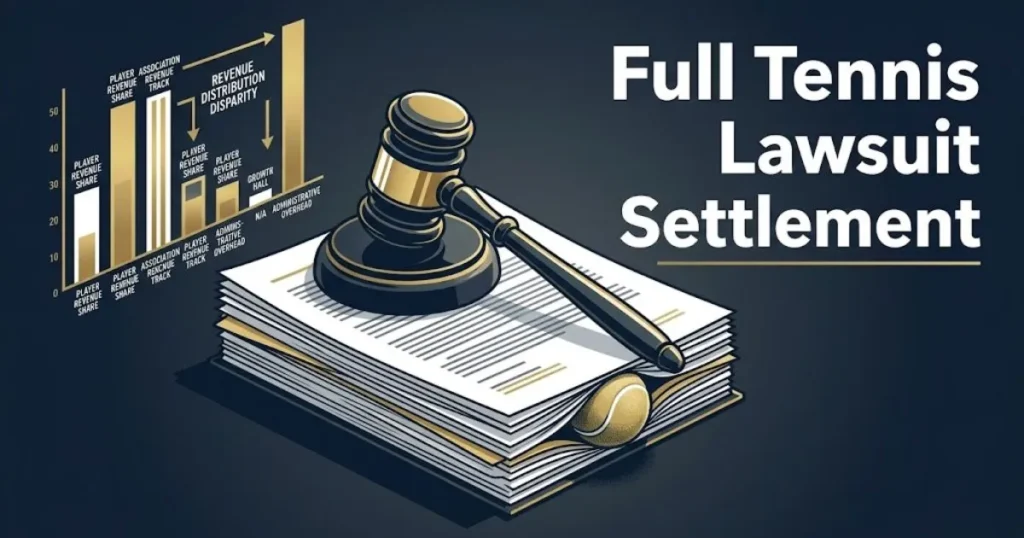
Compare that to other major sports leagues. NBA players receive about 50 percent of league revenue. NFL players get roughly 48 percent. MLB players take home around 52 percent. Tennis players earn a fraction of that share.
| Sport | Annual Revenue | Player Share | Player Percentage |
|---|---|---|---|
| NBA | $10.6 billion | $5.3 billion | ~50% |
| NFL | $18.6 billion | $8.9 billion | ~48% |
| MLB | $11.5 billion | $6.0 billion | ~52% |
| Tennis | $2.3 billion | $0.4 billion | ~17% |
The PTPA argues this disparity is not a market outcome. It is the result of deliberate coordination among the governing bodies. The lawsuit seeks to close this gap through structural reform and monetary damages.
Full Tennis Lawsuit Timeline
The full tennis lawsuit timeline spans from the PTPA’s founding in 2020 through the current discovery phase in 2026. Here are the key dates you need to know.
The PTPA was founded in August 2020 during the US Open. Djokovic and Pospisil announced the group at a press conference. The early years focused on building membership and gathering data.
By 2023, the PTPA had retained antitrust counsel and begun formal legal preparations. The lawsuit was officially filed on March 19, 2025. The defendants filed motions to dismiss in June 2025.
| Date | Event |
|---|---|
| August 2020 | PTPA founded by Djokovic and Pospisil |
| March 2025 | Lawsuit filed in SDNY |
| June 2025 | Defendants file motions to dismiss |
| October 2025 | Court denies motions to dismiss |
| January 2026 | Discovery phase begins |
| June 2026 | Discovery deadline (projected) |
| Late 2026 | Possible settlement talks (projected) |
| 2027 | Potential trial date (projected) |
The court denied the defendants’ motions to dismiss in October 2025. That ruling was a significant early win for the PTPA. It means the case will proceed to full discovery and potentially to trial.
Tennis Antitrust Lawsuit Updates 2026
The tennis antitrust lawsuit updates for 2026 center on the active discovery phase now underway. Both sides are exchanging massive volumes of internal documents and communications.
The PTPA has requested financial records from all four defendants going back to 2015. They want to see internal emails about prize money discussions and scheduling decisions. The defendants are fighting some of these requests as overly broad.
Recent developments in early 2026 include:
- Document production of over 2 million pages from the ATP and WTA
- Depositions scheduled for key executives from all four organizations
- A protective order issued by the court to handle confidential financial data
- Class certification briefing expected to begin by mid-2026
The presiding judge has set a firm discovery deadline for June 2026. After that, both sides will file summary judgment motions. If those fail, the case moves toward trial.
Bold stat: Legal costs for both sides are projected to exceed $30 million by the end of 2026.
The case is moving faster than many legal experts initially predicted. The judge has shown little patience for delay tactics from either side.
Key Takeaway: The lawsuit survived early dismissal attempts and is now in full discovery, with millions of documents being exchanged and depositions of top tennis executives scheduled throughout 2026.
PTPA Lawsuit Settlement Amount Estimates
The PTPA lawsuit settlement amount estimates vary widely depending on the source and the scenario. No settlement has been reached as of early 2026, but legal analysts have modeled several outcomes.
If the case goes to trial and the PTPA wins, damages could be enormous. The lawsuit seeks treble damages under the Sherman Act. That means the court could triple any actual damages found.
Conservative estimates put potential trial damages at $500 million to $1 billion. With treble damages applied, that figure could reach $1.5 billion to $3 billion. A settlement would likely fall below those numbers but still be historic.
| Scenario | Estimated Range | Likelihood |
|---|---|---|
| Early settlement (2026) | $200M to $500M | Low |
| Late settlement (2027) | $400M to $800M | Moderate |
| Trial verdict for PTPA | $1.5B to $3B | Low to Moderate |
| Trial verdict for defendants | $0 | Moderate |
Individual player payouts would depend on their career earnings and years on tour. Top players could receive millions. Lower-ranked players might see $50,000 to $200,000 each.
Most legal experts believe a settlement is more likely than a full trial. Sports antitrust cases historically settle before reaching a jury. The NFL concussion case and NBA salary cap disputes both followed that pattern.
How Does the Tennis Lawsuit Affect Players
The tennis lawsuit affects players by potentially increasing their share of the sport’s revenue and loosening restrictive scheduling rules. The impact varies depending on a player’s ranking and career stage.
Top-ranked players stand to gain the most in absolute dollar terms. They generate the most revenue for tournaments and broadcasters. A larger revenue share would significantly boost their earnings.
Lower-ranked players could benefit even more in relative terms. Many players ranked outside the top 100 struggle to cover travel and coaching costs. A fairer prize money distribution could make their careers financially viable.
The lawsuit could affect players in several specific ways:
- Higher prize money at all tournament levels
- More scheduling freedom to choose which events to play
- Better appearance fee deals without artificial caps
- Increased sponsorship opportunities outside tour restrictions
- A formal players’ union with collective bargaining power
Former players may also benefit if the class is certified broadly. The PTPA wants the class to include anyone who played professionally since 2015. That could cover thousands of current and retired athletes.
The ripple effects extend beyond the players themselves. Coaches, agents, and support staff all benefit when players earn more. The entire tennis economy could shift if this case succeeds.
Tennis Lawsuit Prize Money Claims
The tennis lawsuit prize money claims focus on the gap between tournament revenue and what players actually receive. The PTPA complaint includes detailed breakdowns for each Grand Slam and major tour event.
At Wimbledon 2024, total revenue exceeded $400 million. Player prize money totaled roughly $56 million. That means players received about 14 percent of the tournament’s income.
The US Open showed a similar pattern. Revenue topped $500 million in 2024. Prize money was approximately $75 million, or about 15 percent. The PTPA says these numbers prove systematic underpayment.
Bold stat: Grand Slam prize money as a percentage of revenue has actually decreased since 2015, dropping from roughly 22 percent to under 17 percent.
The lawsuit also targets the lower tiers of professional tennis. Challenger and Futures events pay so little that many players lose money competing. The PTPA says this is a direct result of the governing bodies hoarding revenue at the top.
The defendants argue that prize money has grown in absolute terms. The PTPA counters that revenue has grown much faster. The gap between the two is widening every year.
Key Takeaway: The lawsuit could reshape player earnings across all levels of professional tennis, with potential settlement payouts ranging from $200 million to over $1 billion depending on how the case resolves.
PTPA Lawsuit Eligibility Requirements
The PTPA lawsuit eligibility requirements will depend on the final class certification decision by the court. As of early 2026, the proposed class definition is broad but not yet finalized.
The PTPA has proposed including all professional tennis players who competed in ATP, WTA, or ITF sanctioned events since January 1, 2015. This would cover both current and retired players.
The proposed class includes both men and women. It covers singles and doubles specialists. It also includes players who competed at the Challenger and Futures levels.
| Criteria | Proposed Requirement |
|---|---|
| Time period | January 2015 to present |
| Tour level | ATP, WTA, ITF, Grand Slam |
| Event type | Singles, doubles, mixed doubles |
| Player status | Current and retired |
| Ranking | No minimum ranking required |
The court has not yet ruled on class certification. That decision is expected in late 2026 or early 2027. The defendants are likely to argue for a narrower class definition.
Players who want to stay informed should monitor court filings in the Southern District of New York. The PTPA has also set up a registration system for interested players. Signing up does not guarantee inclusion in the final class.
Full Tennis Lawsuit Latest News and Rulings
The full tennis lawsuit latest news as of early 2026 shows a case moving rapidly through the discovery phase. Several significant rulings have already shaped the direction of the litigation.
The most important ruling came in October 2025. The court denied all four defendants’ motions to dismiss. The judge found that the PTPA’s antitrust claims were plausible on their face. This was a major victory for the plaintiffs.
In December 2025, the court issued a scheduling order. It set firm deadlines for discovery, expert reports, and summary judgment motions. The order signals that the judge wants this case to move quickly.
Key recent developments include:
- January 2026: First round of document production completed by the ATP
- February 2026: WTA files motion to limit scope of financial disclosures
- March 2026: Depositions of Grand Slam Board executives begin
- April 2026: ITF expected to produce internal revenue sharing documents
- June 2026: Discovery deadline set by the court
The defendants continue to argue that tennis needs centralized governance to survive. They say the PTPA’s proposed changes would fragment the sport and hurt fans. The PTPA counters that fair competition would actually grow the sport’s popularity and revenue.
Media coverage of the case has intensified in 2026. Major sports networks and legal publications are following every filing closely. The outcome could set a precedent for antitrust cases in other individual sports like golf and boxing.
Key Takeaway: The case is on an accelerated track with a potential trial date in 2027, and every ruling so far has favored the PTPA’s right to proceed with its antitrust claims against all four governing bodies.
Frequently Asked Questions
What is the full tennis lawsuit about?
The full tennis lawsuit is a federal antitrust case filed by the PTPA against the ATP, WTA, ITF, and Grand Slam Board. It alleges that these organizations collude to suppress player pay and restrict competition. The case is currently in the discovery phase in New York federal court.
How much could players get from the tennis lawsuit?
Individual payouts could range from $50,000 for lower-ranked players to several million for top stars. Total settlement estimates range from $200 million to over $1 billion depending on the outcome. No payments have been made yet as the case is still active.
When will the tennis lawsuit be resolved?
Most legal experts project a resolution by late 2027 or early 2028. Discovery wraps up in mid-2026, followed by summary judgment motions and potential settlement talks. A trial, if needed, would likely begin in 2027.
Who qualifies for the PTPA tennis lawsuit?
The proposed class includes all professional players who competed in ATP, WTA, or ITF events since January 2015. This covers current and retired players across all ranking levels. The court has not yet finalized the class definition.
How does the tennis lawsuit affect fans and ticket holders?
Fans could see changes in tournament scheduling, ticket pricing, and broadcast availability if the case succeeds. The PTPA argues that fairer player pay would grow the sport and improve the product for fans. Defendants warn that structural changes could disrupt the current tournament calendar.
The full tennis lawsuit of 2026 is far from over. Discovery is active and the stakes are enormous for every level of the sport. Stay informed by following court filings and PTPA announcements throughout the year.
If you are a current or former professional player, check your eligibility and register your interest with the PTPA. The decisions made in this case will shape tennis for decades to come.