

A defective vehicle lawsuit lets you demand money from car makers for dangerous flaws. Over 42,000 drivers filed new claims in 2025 alone. That number is climbing fast in 2026.
Ford, Hyundai, and Stellantis face the heaviest legal pressure right now. Faulty transmissions, bad airbags, and electrical fires lead the complaint list. You may qualify even if your car was already recalled.
This guide breaks down settlement amounts, eligibility rules, and filing deadlines. You will learn exactly what to do next.
The average defective vehicle payout hit $28,500 in recent class actions. That figure could rise as new cases hit federal courts this year.
Defective Vehicle Lawsuit
A defective vehicle lawsuit is a legal claim against a car maker for safety flaws. These cases cover design defects, manufacturing errors, and failure to warn buyers.
You can sue for injuries, repair costs, or diminished vehicle value. Both individual claims and class actions are valid paths forward.
Federal law and state lemon laws both protect consumers here. The Magnuson-Moss Warranty Act also applies to many vehicle disputes.
Most cases begin when a driver spots a recurring problem. The dealer fails to fix it after multiple repair attempts. That pattern of failed repairs becomes your strongest evidence.
| Detail | Info |
|---|---|
| Case Type | Product liability |
| Governing Law | State and federal |
| Common Defendants | Ford, GM, Toyota, Hyundai |
| Typical Duration | 12 to 36 months |
Courts have awarded billions in defective vehicle cases over the past decade. The pace is accelerating in 2026.
How Much Is a Defective Car Lawsuit Worth
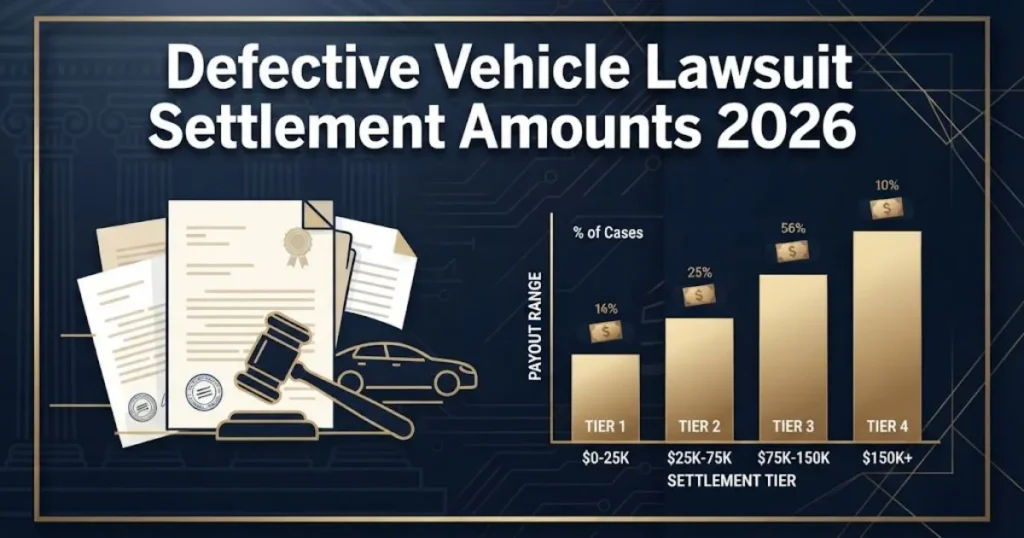
A defective car lawsuit is typically worth between $5,000 and $150,000 for most claimants. Severe injury cases can reach into the millions.
The exact amount depends on the defect type and the harm you suffered. A faulty transmission claim pays less than an airbag failure that caused a crash.

Repair cost reimbursement is the most common payout category. Medical bills and lost wages add significant value to injury claims.
| Defect Type | Average Payout Range |
|---|---|
| Transmission Failure | $5,000 to $25,000 |
| Airbag Malfunction | $20,000 to $150,000 |
| Electrical Fire Risk | $10,000 to $75,000 |
| Brake System Defect | $15,000 to $100,000 |
| Steering Loss | $25,000 to $200,000 |
Think of it like a medical malpractice case. The worse the harm, the bigger the check. Your repair receipts and medical records drive the final number.
Defective Car Lawsuit Settlement
A defective car lawsuit settlement is a negotiated payout that avoids a full trial. Most vehicle defect cases settle before ever reaching a jury.
Settlements in 2025 averaged $28,500 per claimant in major class actions. Individual settlements tend to be higher because they reflect specific damages.
The settlement process usually starts with a demand letter from your attorney. The manufacturer responds with a counteroffer. Negotiations continue until both sides agree on a number.
Quick Facts on 2026 Settlements:
- 92% of defective vehicle cases settle out of court
- Average settlement timeline is 8 to 14 months
- Class action settlements pay less per person but require less effort
- Individual claims take longer but often yield higher payouts
Manufacturers prefer settling quietly to avoid bad publicity. That pressure works in your favor during negotiations.
Key Takeaway: Most defective vehicle claims settle for $5,000 to $150,000, and over 90% resolve without a trial.
Lemon Law Claim 2026
A lemon law claim in 2026 lets you force a car maker to replace or refund a chronically defective vehicle. Every state has its own version of this law.
Most states require at least three or four failed repair attempts for the same issue. Some states count 30 cumulative days in the shop as enough.
The vehicle must still be under its original factory warranty. Once the warranty expires, your lemon law window typically closes.
| State | Repair Attempts Needed | Days in Shop Threshold |
|---|---|---|
| California | 4 attempts or 30 days | 30 cumulative days |
| Texas | 4 attempts or 30 days | 30 cumulative days |
| Florida | 3 attempts or 15 days | 15 cumulative days |
| New York | 4 attempts or 30 days | 30 cumulative days |
Lemon law claims move faster than traditional lawsuits. Many resolve within 3 to 6 months through state arbitration programs.
How to Sue a Car Manufacturer
You sue a car manufacturer by filing a product liability complaint in state or federal court. The process starts long before any paperwork hits a courthouse.
First, gather every repair order and dealer invoice you have. These documents prove the manufacturer knew about the defect. Photos and videos of the problem help too.
Next, send a formal written notice to the manufacturer. Most states require this step before you can file a lawsuit. Give them one final chance to fix the issue.
Steps to Sue a Car Maker:
- Collect all repair records and warranty documents
- Photograph and video the defect in action
- Send written notice to the manufacturer by certified mail
- Wait the required response period (usually 30 days)
- File your complaint in the appropriate court
Think of it like building a house. Your repair records are the foundation. Without them, the whole case collapses.
Vehicle Defect Class Action
A vehicle defect class action is a single lawsuit filed on behalf of thousands of affected car owners. One court decision covers everyone in the group.
Class actions make sense when the defect is widespread and individual damages are modest. A faulty fuel pump affecting 500,000 cars is a classic example.
You do not need to hire your own lawyer to join a class action. The lead attorneys handle everything and take their fee from the settlement pool.
| Feature | Class Action | Individual Lawsuit |
|---|---|---|
| Effort Required | Minimal | High |
| Typical Payout | $100 to $5,000 | $5,000 to $150,000 |
| Timeline | 2 to 5 years | 8 to 18 months |
| Lawyer Needed | No | Yes |
| Control Over Case | None | Full |
The tradeoff is simple. Class actions are easy but pay less. Individual suits take more work but pay more.
Key Takeaway: Lemon law claims resolve fastest, while class actions require the least effort but pay the smallest individual amounts.
Car Recall Lawsuit Rights
A car recall does not take away your right to sue the manufacturer. You can still file a lawsuit even after the recall repair is completed.
Recalls fix the physical defect. Lawsuits recover the money you already spent dealing with it. Those are two separate legal tracks.
If the recall repair itself fails, your case gets even stronger. Courts view a failed recall fix as evidence of gross negligence.
Your Rights After a Recall:
- Right to sue for repair costs incurred before the recall
- Right to claim diminished vehicle value
- Right to seek medical damages if the defect caused injury
- Right to demand a buyback if the recall fix does not work
Bold Stat: Over 62 million vehicles were recalled in the United States in 2024. Many of those owners still have active legal claims.
Defective Vehicle Compensation
Defective vehicle compensation covers every financial loss caused by the car flaw. This goes well beyond just the repair bill.
You can claim reimbursement for towing, rental cars, and lost wages. If the defect caused a crash, medical bills and pain and suffering apply too.
Diminished value is a category many drivers overlook. A car with a known defect history is worth less at trade-in time. Courts recognize that loss.
| Compensation Category | Typical Range |
|---|---|
| Repair Costs | $500 to $15,000 |
| Rental Car Reimbursement | $300 to $3,000 |
| Diminished Value | $2,000 to $10,000 |
| Medical Bills | $1,000 to $500,000+ |
| Pain and Suffering | $5,000 to $1,000,000+ |
Keep every receipt related to your vehicle problem. That shoebox of paperwork could be worth thousands of dollars later.
Lemon Law Buyback Process
The lemon law buyback process forces the manufacturer to repurchase your defective vehicle at or near full price. You get your money back and the car goes back to the maker.
The manufacturer must refund your purchase price, taxes, registration fees, and finance charges. They can deduct a small amount for the miles you drove before the first repair.
In most states, the buyback must happen within 30 to 60 days of a final arbitration decision. Some manufacturers drag their feet and need a court order.
Buyback Calculation Example:
- Purchase price: $35,000
- Usage deduction (8,000 miles): -$2,333
- Taxes and fees refunded: +$3,200
- Total buyback: $35,867
A buyback is often the cleanest resolution. You walk away with cash and no more car trouble.
Key Takeaway: Recall repairs do not cancel your lawsuit rights, and lemon law buybacks can return your full purchase price minus a small mileage deduction.
Auto Manufacturer Liability
Auto manufacturer liability means the car maker is legally responsible for defects in vehicles it sells. This applies whether the flaw was intentional or accidental.
Courts use a standard called “strict liability” in most vehicle defect cases. You do not need to prove the manufacturer was careless. You only need to prove the defect exists and caused harm.
Three types of defects trigger manufacturer liability. Design defects affect every car in a model line. Manufacturing defects affect individual vehicles. Failure to warn defects involve missing safety labels or instructions.
| Defect Type | Example | Liability Standard |
|---|---|---|
| Design Defect | SUV prone to rollover | Strict liability |
| Manufacturing Defect | Airbag with bad inflator | Strict liability |
| Failure to Warn | No label about brake risk | Negligence or strict |
Major automakers spend billions each year defending these claims. That budget tells you how seriously they take the threat.
Defective Car Parts Lawsuit
A defective car parts lawsuit targets the specific component that failed, not just the car brand. Sometimes the parts supplier is the real defendant.
Takata airbag inflators are the most famous example. The parts maker went bankrupt while automakers faced billions in claims.
You can sue the parts manufacturer, the car maker, or both. Your attorney will determine which defendants have the deepest pockets.
Common Parts That Trigger Lawsuits:
- Airbag inflators and sensors
- Transmission control modules
- Brake calipers and master cylinders
- Fuel pumps and fuel lines
- Electronic stability control units
- Lithium-ion battery packs in EVs
Bold Stat: The Takata airbag recall affected over 100 million vehicles worldwide. It remains the largest auto recall in history.
Vehicle Safety Defect Reporting
Vehicle safety defect reporting to NHTSA is the first step that can trigger a federal investigation and strengthen your lawsuit. You file a complaint online or by phone.
NHTSA collects these reports and looks for patterns. When enough drivers report the same problem, the agency opens a formal investigation.
Your NHTSA complaint becomes a public record. Plaintiff attorneys routinely pull these records to build class action cases.
How to Report a Defect to NHTSA:
- Go to the NHTSA website complaint portal
- Enter your VIN and describe the problem
- Upload photos or repair records if available
- Call the NHTSA hotline at 888-327-4236
Think of NHTSA complaints like votes. One complaint may not matter. But 500 identical complaints force the government to act.
Key Takeaway: Strict liability means you do not have to prove negligence, and filing an NHTSA complaint can directly support your future lawsuit.
Car Warranty Lawsuit
A car warranty lawsuit arises when a manufacturer refuses to honor its own warranty promises. The Magnuson-Moss Warranty Act is the federal law behind these claims.
This law says a warranty must mean what it says. If the dealer denies a valid repair, the manufacturer is in breach of contract.
Warranty lawsuits often overlap with lemon law claims. The difference is that warranty claims focus on the broken promise itself. Lemon law claims focus on the repeated failure to fix.
| Claim Type | Key Focus | Federal Law |
|---|---|---|
| Warranty Lawsuit | Broken repair promise | Magnuson-Moss Act |
| Lemon Law Claim | Repeated failed repairs | State statutes |
| Product Liability | Defect caused injury | State tort law |
A strong warranty claim can recover your repair costs plus attorney fees. The Magnuson-Moss Act specifically allows fee recovery.
Defective Vehicle Attorney Fees
Defective vehicle attorney fees are usually paid on a contingency basis, meaning you pay nothing upfront. The lawyer takes a percentage of your settlement or verdict.
Most contingency fees range from 25% to 40% of the total recovery. The percentage often increases if the case goes to trial.
For lemon law claims, many states require the manufacturer to pay your attorney fees separately. That means you keep 100% of your settlement.
| Fee Structure | Typical Percentage | When It Applies |
|---|---|---|
| Contingency (settlement) | 25% to 33% | Case resolves before trial |
| Contingency (trial) | 33% to 40% | Case goes to jury verdict |
| Fee-shifting (lemon law) | 0% to you | Manufacturer pays fees |
| Class action | 25% to 30% | Deducted from settlement pool |
Bold Stat: In California lemon law cases, the manufacturer pays your legal fees 100% of the time when you win. You owe nothing out of pocket.
Defective Vehicle Lawsuit Deadline 2026
The defective vehicle lawsuit deadline in 2026 depends on your state’s statute of limitations. Most states give you 2 to 4 years from the date you discovered the defect.
Missing this deadline kills your case permanently. Courts do not grant extensions for vehicle defect claims in most situations.
The clock usually starts when you first notice the problem, not when you bought the car. That distinction matters for older vehicles with latent defects.
| State | Statute of Limitations | Clock Starts |
|---|---|---|
| California | 2 years (injury) / 4 years (property) | Date of discovery |
| Texas | 2 years | Date of discovery |
| Florida | 4 years | Date of discovery |
| New York | 3 years | Date of injury or discovery |
| Illinois | 2 years (injury) / 5 years (property) | Date of discovery |
Do not wait. The deadline will not extend itself. File your claim or at least consult an attorney well before the clock runs out.
Key Takeaway: Most states give you 2 to 4 years to file, lemon law fees are often paid by the manufacturer, and the clock starts when you discover the defect.
Frequently Asked Questions
Can I sue if my car was already recalled?
Yes, a recall does not eliminate your right to sue. You can still claim repair costs, diminished value, and injury damages. The recall fixes the car but does not reimburse your losses.
How long does a defective vehicle lawsuit take?
Most cases resolve within 8 to 18 months if settled out of court. Class actions can take 2 to 5 years due to the number of claimants involved. Individual claims move faster.
Do I need a lawyer to file a lemon law claim?
You can file a lemon law claim without a lawyer through state arbitration. However, an attorney significantly increases your chances of a full buyback. Most lemon law attorneys charge you nothing upfront.
What counts as a vehicle defect under the law?
A vehicle defect is any flaw in design, manufacturing, or labeling that creates an unreasonable safety risk. This includes faulty brakes, airbag failures, transmission problems, and electrical fires.
Can I join a class action and still file my own claim?
Generally you must choose one path or the other. Joining a class action usually means you waive your right to sue individually. Opt out of the class if you want to pursue a separate claim.
Closing
Your defective vehicle claim has real value in 2026. Settlements are rising and courts are siding with consumers more than ever.
Gather your repair records, check your state deadline, and take action before the clock runs out. The manufacturer is counting on you to do nothing.
File your NHTSA complaint today and explore your legal options while the evidence is fresh.







