The Colonel Sanders KFC gravy lawsuit was a real defamation case filed in 1978 by a Bowling Green franchisee against the KFC founder. The Kentucky Supreme Court threw it out because Sanders criticized the entire chain, not one specific restaurant. That legal distinction still shapes how courts handle corporate defamation claims today.
If you found this page searching for a 2026 class action settlement, you are not alone. Thousands of people are looking for a payout that does not exist. The confusion comes from viral social media posts mixing up the historic libel case with unrelated KFC legal disputes from other countries.
This article breaks down exactly what happened, why the lawsuit failed, and what the 1978 ruling means for franchise law in 2026. You will learn the real timeline, the exact quotes that sparked the case, and how to spot fake settlement offers online. One surprising fact: Colonel Sanders once sued KFC for $122 million and settled for $1 million just a few years before the gravy lawsuit.
What Was the Colonel Sanders KFC Gravy Lawsuit?
The Colonel Sanders KFC gravy lawsuit was a defamation claim filed by Kentucky Fried Chicken of Bowling Green, Inc. against Harland Sanders and the Courier-Journal newspaper in 1975. The franchisee claimed Sanders hurt its business by calling KFC gravy “wallpaper paste” in a published interview. The case reached the Kentucky Supreme Court in 1978.
Sanders did not hold back in his criticism. He told the Courier-Journal that KFC’s gravy was made from tap water, flour, and starch. He said it was “pure wallpaper paste” with no nutrition. He also said the chain should not be allowed to sell it.
The Bowling Green franchise took those comments personally. The restaurant argued that customers would stop buying gravy because the founder himself said it was terrible. That argument failed in court.
The case is officially cited as Kentucky Fried Chicken of Bowling Green, Inc. v. Sanders, 563 S.W.2d 8 (1978). The ruling became a landmark for class defamation claims in Kentucky.
| Case Detail | Information |
|---|---|
| Court | Kentucky Supreme Court |
| Decision Date | March 14, 1978 |
| Citation | 563 S.W.2d 8 |
| Plaintiff | KFC of Bowling Green, Inc. |
| Defendants | Harland Sanders, Courier-Journal, Dan Kauffman, KFC Corp. |
| Outcome | Dismissed in favor of Sanders |
Who Was Involved in the KFC Gravy Defamation Case?
The KFC gravy defamation case involved four named defendants and one angry franchise owner. Colonel Harland Sanders was the founder and public face of KFC. The Courier-Journal and Louisville Times published the interview. Staff writer Dan Kauffman conducted the interview. KFC Corporation was also named because it owned the brand.
The plaintiff was a single franchise location in Bowling Green, Kentucky. That restaurant believed Sanders’ comments directly targeted its business. The franchisee wanted damages for lost sales and reputation harm.
Sanders had sold KFC to investors in 1964 for $2 million. He stayed on as a brand ambassador but had no operational control. By the 1970s, Heublein Inc. owned the chain. Sanders watched the company change his recipes and hated what he saw.
The interview happened while Sanders was discussing whether a chicken wing is white meat. He pivoted to criticize the gravy without being asked. That unprompted rant became the basis for the lawsuit.
| Party | Role |
|---|---|
| Harland Sanders | KFC Founder and Defendant |
| Courier-Journal | Newspaper that Published Interview |
| Dan Kauffman | Staff Writer Who Conducted Interview |
| KFC Corporation | Brand Owner and Defendant |
| Bowling Green Franchise | Plaintiff Seeking Damages |
What Exactly Did Colonel Sanders Say About KFC Gravy?
Colonel Sanders said KFC gravy was “horrible” and compared it to “wallpaper paste” in a 1978 Courier-Journal interview. He also said it contained no nutrition and should not be sold. Those exact words became the centerpiece of the defamation lawsuit.
The full quote from the court record reads: “My God, that gravy is horrible. They buy tap water for 15 to 20 cents a thousand gallons and then they mix it with flour and starch and end up with pure wallpaper paste. And I know wallpaper paste, by God, because I’ve seen my mother make it.”
He did not stop there. Sanders added that the gravy was sold for 65 to 75 cents a pint. He said there was no nutrition in it. Then he said the chain should not be allowed to sell it at all.
He also attacked KFC’s crispy chicken recipe in the same interview. Sanders called it “nothing in the world but a damn fried doughball stuck on some chicken.” That comment was included in the lawsuit but played a smaller role in the ruling.
The quote spread quickly. Newspapers across Kentucky picked it up. The Bowling Green franchise saw customers talking about it and decided to sue.
Key Takeaway: The gravy lawsuit was not about a secret recipe or a class action settlement. It was about whether one franchise could claim defamation when the founder criticized the entire brand.
Why Did the Bowling Green KFC Franchise Sue Colonel Sanders?
The Bowling Green KFC franchise sued Colonel Sanders because it believed his public criticism would drive customers away. The franchise argued that Sanders’ comments were libelous and directly harmed its business. It sought damages for lost sales and reputational injury.
Libel is a published false statement that damages a person’s reputation. The franchise had to prove that Sanders’ comments were false. It also had to prove that the comments specifically identified the Bowling Green location.
That second requirement killed the case. Sanders never mentioned Bowling Green in the interview. He never mentioned any specific restaurant. He talked about KFC as a whole.
The franchise also sued the Courier-Journal for publishing the interview. It claimed the newspaper should not have printed Sanders’ comments. That claim failed for the same reason.
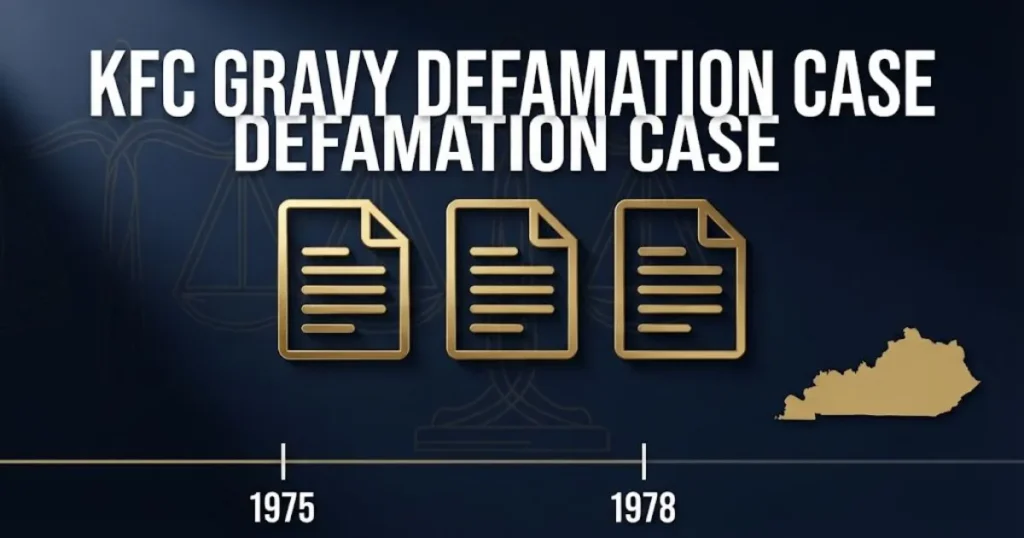
The lawsuit was filed in 1975. A circuit court dismissed it. The franchise appealed. The Kentucky Supreme Court affirmed the dismissal in 1978.
| Legal Element | Franchise’s Burden | Outcome |
|---|---|---|
| False Statement | Prove Sanders’ comments were false | Not reached |
| Identification | Prove comments targeted Bowling Green | Failed |
| Publication | Prove comments were published | Met |
| Damages | Prove financial harm | Not reached |
What Did the Kentucky Supreme Court Rule in 1978?
The Kentucky Supreme Court ruled that Sanders’ comments were not defamatory because they targeted KFC as a whole, not the Bowling Green franchise. The court dismissed the case and affirmed the lower court’s decision. The ruling was unanimous.
The court explained that to defame a class, the statement must apply to every member of that class. Sanders’ comments applied to more than 5,000 KFC outlets worldwide. That made it impossible for one franchise to claim it was specifically targeted.
The court also noted that Sanders was discussing KFC generally in the interview. He was not talking about the Bowling Green restaurant. There was “nothing in the present article which identified” the plaintiff.
The franchise tried a second argument. It pointed to a separate statement Sanders made in a local Bowling Green newspaper. Sanders said the new operators were not preparing chicken according to his original recipe. The court rejected that too.
The court said the chicken preparation statement was not defamatory. Slight deviations from a recipe are almost inevitable in a large franchise system. That statement did not harm the franchise’s reputation.
| Court Finding | Legal Reasoning |
|---|---|
| Class Defamation | Statement must apply to every member |
| No Specific Identification | Bowling Green not mentioned |
| Size of Class | 5,000+ outlets made targeting impossible |
| Recipe Deviation Claim | Not defamatory as a matter of law |
| Final Outcome | Dismissal affirmed |
Key Takeaway: The Kentucky Supreme Court created a clear rule: if you criticize a brand with thousands of locations, no single location can claim you defamed it specifically.
How Does the 1978 Ruling Affect Franchise Law in 2026?
The 1978 ruling still affects franchise law in 2026 because it set a high bar for franchisees suing over brand-wide criticism. A franchisee must prove the statement specifically identified its location. General criticism of the brand is not enough.
This rule protects founders, critics, and journalists. If a company founder says the brand’s food quality declined, no single franchise can sue for defamation. The statement must point to that specific franchise.
Modern courts in Kentucky still cite Kentucky Fried Chicken of Bowling Green, Inc. v. Sanders when handling similar cases. The case is taught in media law classes as a classic example of class defamation limits.
Franchise agreements in 2026 often include clauses about brand criticism. Some agreements prohibit franchisees from making negative public statements. But those clauses cannot override First Amendment protections for opinions and general criticism.
The ruling also matters for social media reviews. If a customer says a chain’s food is terrible, no single location can sue for defamation. The same logic applies to food critics and bloggers.
| Legal Principle | 2026 Application |
|---|---|
| Class Defamation Limit | Brand-wide criticism is protected |
| Specific Identification | Franchisee must prove direct targeting |
| Opinion Protection | General quality opinions are not libel |
| Media Shield | Journalists can publish founder criticism |
| Franchise Contracts | Cannot override constitutional protections |
What Was the $122 Million Lawsuit Between Sanders and Heublein?
The $122 million lawsuit was a separate legal battle between Colonel Sanders and Heublein Inc., the company that owned KFC in the 1970s. Sanders sued Heublein in 1974 for misusing his image and name. The case settled out of court for $1 million in 1975.
Sanders was angry about more than gravy. He believed Heublein was slapping his face on products he never developed. He also believed the company was degrading the food quality he built his reputation on.
The lawsuit asked for $122.39 million in damages. Sanders and his wife Claudia filed it in January 1974. The case was a major media event.
Heublein settled the day before Sanders’ 85th birthday. The company paid Sanders and his wife $1 million. It also agreed to a training arrangement. Sanders got less than 1% of what he asked for, but he won the principle.
This settlement is often confused with the gravy lawsuit. They are two separate cases. The gravy lawsuit was filed by a franchisee against Sanders. The Heublein lawsuit was filed by Sanders against the parent company.
| Lawsuit | Plaintiff | Defendant | Amount Sought | Outcome |
|---|---|---|---|---|
| Heublein Case | Sanders | Heublein Inc. | $122 million | Settled for $1 million |
| Gravy Case | Bowling Green KFC | Sanders | Unspecified | Dismissed |
Is There a 2026 KFC Gravy Class Action Settlement?
There is no 2026 KFC gravy class action settlement. The viral posts claiming a payout are false. The only real KFC gravy lawsuit is the 1978 defamation case that was dismissed. No court has approved a settlement for KFC customers.
Social media posts in 2026 have spread a fake claim that KFC customers can get $50 to $300 for buying gravy. Those posts link to surveys and data collection sites. They are not connected to any real lawsuit.
Some posts mix up the 1978 case with a 2026 KFC employee settlement in Australia. That settlement involved 90,000 current and former KFC employees over wage theft claims. It has nothing to do with gravy or customers.
Other posts confuse the gravy lawsuit with a 2026 KFC food poisoning case in India. A consumer commission in Ludhiana fined KFC 25,000 rupees over food poisoning from hot wings. That case is unrelated to Colonel Sanders.
If you see a KFC gravy settlement claim on social media, check for a court docket number. Real class actions have a federal or state case number. Fake posts never include one.
| Claim | Reality |
|---|---|
| KFC gravy class action settlement 2026 | No such case exists |
| $50 to $300 payout for gravy buyers | Fake social media claim |
| $1 million settlement for customers | That was the Heublein case |
| File a claim for KFC gravy | No claims process exists |
| 2026 filing deadline | Fabricated |
Key Takeaway: If a KFC gravy settlement offer asks for your personal information or a payment, it is a scam. No legitimate settlement exists.
What Is the Difference Between the Gravy Lawsuit and the Heublein Case?
The gravy lawsuit was a defamation case filed by a franchisee against Sanders. The Heublein case was a contract and image rights case filed by Sanders against KFC’s parent company. They happened at the same time but involved different parties and different legal claims.
The gravy lawsuit focused on Sanders’ public statements about food quality. The Heublein case focused on how the company used Sanders’ name and face on products he did not approve.
The gravy lawsuit was dismissed. The Heublein case settled for $1 million. The outcomes were opposite because the legal issues were different.
The two cases together show the complexity of Sanders’ relationship with KFC after he sold the company. He was a paid ambassador but had no control. He wanted the food to stay true to his standards but could not enforce them.
| Factor | Gravy Lawsuit | Heublein Case |
|---|---|---|
| Filed By | Bowling Green Franchise | Sanders |
| Filed Against | Sanders, Courier-Journal | Heublein Inc. |
| Legal Claim | Defamation | Image Rights and Contract |
| Year Filed | 1975 | 1974 |
| Outcome | Dismissed | Settled for $1 million |
Why Did Colonel Sanders Hate KFC Gravy So Much?
Colonel Sanders hated KFC gravy because the company changed his original recipe after he sold the business. His original gravy used chicken cracklings, seasoned breading, milk, and cream. The new version used tap water, flour, and starch.
Sanders was a perfectionist about food quality. He spent decades building KFC’s reputation. When he saw the gravy become what he called “wallpaper paste,” he felt personally insulted.
He also hated KFC’s crispy chicken recipe. He called it a “damn fried doughball stuck on some chicken.” He believed the company was cutting corners to save money.
His criticism was not just about taste. He believed the new gravy had no nutrition. He thought KFC should not sell it at all. That opinion is protected speech, which is why the defamation lawsuit failed.
| Original Gravy Ingredients | 1970s KFC Gravy Ingredients |
|---|---|
| Chicken cracklings | Tap water |
| Seasoned breading | Flour |
| Milk and cream | Starch |
| Sanders’ original spices | No nutritional value |
Who Qualifies for the 1978 KFC Gravy Lawsuit?
No one qualifies for the 1978 KFC gravy lawsuit because it was a defamation case between a franchise and Sanders. It was not a class action. There was no claims process. There was no settlement fund. The case was dismissed.
The only party that could have received damages was the Bowling Green franchise. It lost. Sanders did not pay anything.
If you are looking for a KFC gravy lawsuit payout in 2026, you will not find one. No court has authorized any compensation for KFC customers related to gravy.
The confusion comes from fake articles and social media posts. They use the phrase “class action settlement” to attract clicks. They promise payouts that do not exist.
| Eligibility Factor | Status |
|---|---|
| KFC customers | Not eligible |
| Bowling Green franchise | Lost case |
| Sanders | Won case |
| Class action status | Never certified |
| Settlement fund | None |
How Did the Media Cover the KFC Gravy Lawsuit in 2026?
The media covered the KFC gravy lawsuit heavily in 2026 because of viral nostalgia content. Fox News, The Takeout, Chowhound, and Parade all published articles about Sanders’ hatred of KFC gravy. Most of them focused on the “wallpaper paste” quote.
These articles are accurate about the history. They correctly explain that the lawsuit was dismissed. They correctly note that Sanders won.
But they do not address the fake settlement claims. They do not tell readers that no class action exists. That gap allows misinformation to spread.
Some 2026 articles mix the gravy lawsuit with unrelated KFC legal news. They mention the Australian wage theft settlement. They mention the Indian food poisoning case. That mixing confuses readers.
| Publication | Date | Focus |
|---|---|---|
| Fox News | May 31, 2026 | Sanders’ hatred of gravy |
| The Takeout | May 27, 2026 | History of the lawsuit |
| Chowhound | March 30, 2026 | Sanders’ criticism and lawsuit |
| Parade | June 29, 2026 | Sanders’ harsh quotes |
| NY Post | June 1, 2026 | Sanders’ menu item hatred |
Key Takeaway: Media coverage of the gravy lawsuit focuses on the history, not on modern settlement claims. Always check for a court case number before believing a settlement offer.
What Legal Precedent Did the Gravy Lawsuit Set?
The gravy lawsuit set a precedent that general criticism of a brand is not defamation against individual franchisees. The Kentucky Supreme Court ruled that a statement must specifically identify the plaintiff to be defamatory. This is now known as the class defamation rule.
The rule applies beyond KFC. Any franchise system with multiple locations benefits from this precedent. A McDonald’s franchisee cannot sue a food critic for saying McDonald’s burgers are bad. The critic is criticizing the brand, not that specific restaurant.
The ruling also protects journalists. The Courier-Journal published Sanders’ interview without fear of liability. The court affirmed that publishing critical opinions about a brand is protected.
The case is still cited in media law textbooks. It is a foundational case for understanding the limits of defamation claims by class members.
| Precedent | Application |
|---|---|
| Class Defamation Rule | Statement must apply to every class member |
| Specific Identification | Plaintiff must be directly named or identified |
| Opinion Protection | General quality opinions are not libel |
| Media Shield | Publishers protected when reporting brand criticism |
How Can You Spot a Fake KFC Gravy Settlement?
You can spot a fake KFC gravy settlement by checking for these red flags: no court docket number, no official claims administrator, requests for payment, and promises of guaranteed money. Real class action settlements have all of those elements except the payment request.
Legitimate settlements have a website with a case number. They have a claims deadline. They have a court-approved notice. They never ask you to pay to file a claim.
Fake settlements appear on social media with urgent language. They say “act now” or “limited time.” They ask for your email, phone number, or credit card. They link to survey sites.
If you are unsure, search for the case on a court records website. If no case exists, the settlement is fake. The KFC gravy lawsuit has no settlement. Any claim otherwise is false.
| Red Flag | What It Means |
|---|---|
| No case number | Likely fake |
| Asks for payment | Definitely a scam |
| Guaranteed payout | Not how settlements work |
| Urgent language | Pressure tactic |
| Social media only | No official source |
Frequently Asked Questions
What was the Colonel Sanders KFC gravy lawsuit?
It was a 1978 defamation case filed by a Bowling Green KFC franchise against Sanders and the Courier-Journal. Sanders called KFC gravy “wallpaper paste” in an interview. The Kentucky Supreme Court dismissed the case because Sanders criticized the whole chain, not one restaurant.
Is there a KFC gravy class action settlement in 2026?
No. There is no KFC gravy class action settlement in 2026. The only real gravy lawsuit was the 1978 defamation case, which was dismissed. Viral posts claiming a payout are scams.
How much did Colonel Sanders settle for with Heublein?
Sanders settled his $122 million lawsuit against Heublein for $1 million in 1975. The settlement also included a training agreement. That case was separate from the gravy lawsuit.
Who qualifies for the KFC gravy lawsuit payout?
No one qualifies for a KFC gravy lawsuit payout. The 1978 case was not a class action. There was no settlement fund. No claims process exists for KFC customers.
What did Colonel Sanders say about KFC gravy?
Sanders said KFC gravy was “horrible” and compared it to “wallpaper paste.” He said it was made from tap water, flour, and starch with no nutrition. He also said KFC should not be allowed to sell it.
What Should You Do If You Want to Stay Updated on KFC Lawsuits?
Stay updated on KFC lawsuits by following official court records and verified news sources. Ignore social media posts that promise payouts without a case number. Check the Kentucky Supreme Court docket for the historical case. Check federal court records for any new class actions.
Set a Google Alert for “KFC class action lawsuit” to get real updates. Follow legal news sites that cover consumer protection cases. Avoid clicking on ads that promise settlement money.
If a real KFC settlement ever happens, it will be announced through official channels. There will be a claims website. There will be a court-approved deadline. There will be no payment required to file.
The best protection is skepticism. If a settlement offer feels too good to be true, it probably is. The KFC gravy lawsuit is history. The next real KFC lawsuit will follow the same rules as every other class action.
Key Takeaway: No KFC gravy settlement exists in 2026. The 1978 lawsuit was dismissed. Fake posts promising payouts are scams. Always verify with a court docket number before sharing personal information.