

The Chobani lawsuit phthalates case is one of the biggest food safety legal battles heading into 2026. Consumers across the country are learning that their favorite Greek yogurt may contain chemicals linked to serious health problems.
Phthalates are industrial plasticizers that have no business being in your breakfast. Yet independent testing has detected these chemicals in several Chobani products sold nationwide.
This article covers everything you need to know. You will learn the latest case updates, which products are affected, who qualifies to file a claim, estimated payouts, and exact filing deadlines. One detail that might surprise you: phthalate levels detected in some dairy products have exceeded what many scientists consider safe by a significant margin.
Whether you ate Chobani yogurt once a week or every single day, this guide breaks down what the lawsuit means for you in plain English.
Chobani Lawsuit Phthalates: What Is This Case About?
The Chobani lawsuit phthalates case alleges that Chobani sold yogurt products containing harmful industrial chemicals called phthalates without warning consumers. Plaintiffs claim these chemicals entered the products through food processing equipment, packaging materials, and dairy supply chain contamination.
At its core, this case is about trust. Chobani markets itself as a natural, wholesome brand. Consumers paid premium prices expecting a clean product.
The lawsuits accuse Chobani of violating consumer protection laws. They allege breach of warranty and fraud by omission. Plaintiffs argue Chobani knew or should have known about the contamination.
| Case Detail | Information |
|---|---|
| Defendant | Chobani LLC |
| Case Type | Class Action / Product Liability |
| Primary Allegation | Undisclosed phthalate contamination |
| Products at Issue | Multiple Chobani yogurt lines |
| Jurisdiction | Federal and state courts |
The lawsuit does not claim Chobani intentionally added phthalates. Rather, it argues the company failed to test for them adequately. It also argues Chobani failed to disclose known contamination risks to buyers.
The Chobani Phthalates Lawsuit Explained
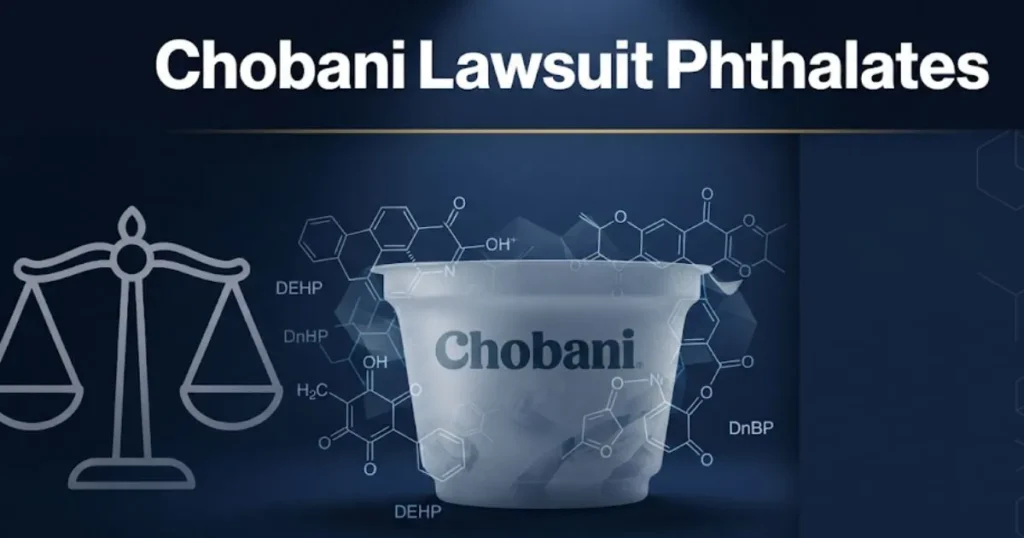
The Chobani phthalates lawsuit centers on allegations that Chobani’s yogurt products contain detectable levels of phthalates, which are chemicals used to make plastics more flexible. These chemicals are classified as endocrine disruptors, meaning they can interfere with human hormone systems.
Plaintiffs in this case purchased Chobani products believing they were safe. They relied on Chobani’s branding, which emphasizes natural ingredients and quality sourcing.
The legal claims typically include:
- Breach of express warranty for failing to deliver a product matching label claims
- Breach of implied warranty of merchantability
- Violation of state consumer protection statutes
- Unjust enrichment from selling contaminated products at premium prices
- Negligence in quality control and supply chain oversight
Court filings reference independent laboratory testing that detected phthalates in Chobani products. The specific chemicals identified include DEHP and DBP, two of the most commonly studied phthalates.
Chobani has not publicly admitted to any contamination. The company’s position has been that its products meet all applicable FDA requirements and are safe for consumption.
Chobani Class Action Lawsuit Overview
The Chobani class action lawsuit is a legal action where one or a few plaintiffs file on behalf of a much larger group of affected consumers. This means you do not have to file your own individual lawsuit to potentially benefit from the case.
Class actions exist because it would be impractical for millions of yogurt buyers to each file separate cases. One case handles claims for everyone in the class.
The proposed class generally includes all consumers who purchased specific Chobani yogurt products within a defined time period. That period typically covers several years of sales.
| Class Action Detail | Information |
|---|---|
| Named Plaintiffs | Individual consumers (varies by filing) |
| Proposed Class | All U.S. purchasers of affected products |
| Class Period | Approximately 2020 to 2025 |
| Legal Basis | Consumer fraud, product liability, warranty breach |
| Court Status | Active litigation as of early 2026 |
For a class to be certified, the court must agree that common questions of law and fact exist among all class members. The judge must also find that a class action is the best way to resolve these claims efficiently.
Class certification is a critical milestone. Without it, the case cannot proceed on behalf of all consumers.
Key Takeaway: The Chobani phthalates case is a class action alleging undisclosed chemical contamination in yogurt products, covering purchases made over several years and potentially affecting millions of consumers.
Chobani Lawsuit Update for 2026
As of 2026, the Chobani lawsuit is in active litigation with several key developments shaping its trajectory. Courts are reviewing motions, discovery is underway, and settlement discussions may be on the horizon.
The case has moved past initial procedural hurdles. Chobani’s motions to dismiss faced mixed results, with courts allowing core consumer fraud and warranty claims to proceed.
Discovery is the phase where both sides exchange evidence. This includes internal Chobani communications, quality control records, supplier contracts, and lab testing data. Plaintiffs’ attorneys are digging into what Chobani knew about phthalate contamination and when they knew it.
Several important dates to watch in 2026:
- Discovery deadlines throughout the first half of 2026
- Class certification hearing expected mid-2026
- Potential settlement negotiations if certification is granted
- Expert witness disclosures on health effects and contamination sources
No trial date has been set yet. Most class actions of this type settle before reaching trial. The settlement stage usually begins after class certification and completion of discovery.
If you bought Chobani products during the class period, keep your receipts. Digital purchase records from grocery store loyalty programs also count as proof of purchase.
How Did Chobani Yogurt Contamination Happen?
Chobani yogurt contamination with phthalates likely occurred through multiple points in the production and supply chain, not through any single source. Phthalates are pervasive in food manufacturing environments because they exist in plastic tubing, conveyor belts, packaging materials, and processing equipment.
Think of it like this: when you pour hot coffee into a cheap plastic cup, chemicals from the plastic leach into your drink. A similar process happens at industrial scale in food manufacturing.
Dairy products are especially vulnerable to phthalate contamination. Fats in milk and yogurt absorb these chemicals readily. The higher the fat content, the greater the potential for chemical absorption.
Common contamination sources include:
- PVC tubing used in milking equipment on dairy farms
- Plastic gaskets and seals in processing machinery
- Food contact packaging containing phthalate plasticizers
- Printed labels and inks on product containers
- Recycled paperboard used in shipping materials
The plaintiffs argue Chobani could have reduced contamination by switching to phthalate-free equipment. Other dairy companies have already made this transition. The cost would have been manageable for a company of Chobani’s size.
Chobani’s facility in Twin Falls, Idaho processes millions of cups of yogurt daily. Even small contamination levels at that scale affect enormous numbers of consumers.
What Are Phthalates in Chobani Yogurt?
Phthalates in Chobani yogurt are synthetic chemicals that were detected through independent laboratory testing of the company’s products. These chemicals are plasticizers, meaning their primary industrial purpose is making hard plastics soft and bendable.
They were never supposed to be in your food. Yet they show up in dairy products with alarming regularity.
The phthalates most commonly detected in food products include:
| Phthalate | Abbreviation | Common Source |
|---|---|---|
| Di-2-ethylhexyl phthalate | DEHP | PVC tubing, food packaging |
| Dibutyl phthalate | DBP | Adhesives, printing inks |
| Diisononyl phthalate | DiNP | Plastic equipment, hoses |
| Butyl benzyl phthalate | BBzP | Vinyl flooring, food conveyor belts |
DEHP is the phthalate most frequently found in dairy products. Studies have detected it in milk, cheese, butter, and yogurt across multiple brands. It migrates from plastic materials into fatty foods during processing and storage.
The FDA has not set strict limits on phthalates in food. This regulatory gap is part of why lawsuits are necessary. Without clear federal standards, companies face less pressure to test and eliminate these chemicals.
Phthalates do not appear on ingredient labels. You cannot taste or smell them. The only way to know they are present is through laboratory testing.
Key Takeaway: Phthalates are industrial plasticizers that enter yogurt products through manufacturing equipment and packaging, and they cannot be detected by consumers without specialized lab testing.
Chobani Phthalates Health Risks You Should Know
Chobani phthalates health risks stem from these chemicals’ ability to disrupt the human endocrine system. Phthalates mimic or block natural hormones, throwing off the body’s carefully balanced chemical signaling.
The health effects are not theoretical. Decades of peer-reviewed research link phthalate exposure to real medical problems.
Documented health risks associated with phthalate exposure include:
- Reproductive harm: reduced fertility in both men and women
- Developmental effects: altered genital development in male infants
- Thyroid disruption: interference with thyroid hormone production
- Metabolic problems: increased risk of insulin resistance and obesity
- Respiratory issues: higher rates of asthma and allergies in children
- Neurological effects: associations with attention and behavioral problems in kids
Children face the greatest risk. Their developing bodies are more sensitive to hormone disruption. They also consume more food relative to their body weight than adults.
Pregnant women represent another high-risk group. Phthalate exposure during pregnancy has been linked to preterm birth and low birth weight in multiple studies.
The dose matters, but so does duration. Eating contaminated yogurt once probably will not cause harm. Eating it daily for months or years creates cumulative exposure that scientists consider concerning.
| Risk Group | Primary Concern | Evidence Level |
|---|---|---|
| Children under 6 | Developmental delays, asthma | Strong |
| Pregnant women | Preterm birth, low birth weight | Strong |
| Adult men | Reduced sperm quality, low testosterone | Moderate to strong |
| Adult women | Fertility issues, thyroid disruption | Moderate |
Chobani Yogurt Phthalate Testing Results
Chobani yogurt phthalate testing results have come from independent laboratory analyses, not from Chobani’s own quality control program. Several consumer advocacy groups and plaintiffs’ legal teams commissioned testing that detected measurable phthalate levels.
The testing used gas chromatography-mass spectrometry, which is the gold standard for detecting trace chemicals in food products. This method can identify specific phthalate compounds at parts-per-billion concentrations.
Reports indicate DEHP was the most frequently detected phthalate in Chobani samples. Levels varied across product lines and production dates. Some samples showed concentrations that independent toxicologists flagged as concerning for daily consumers.
For context, the European Union has set specific migration limits for DEHP in food contact materials at 1.5 milligrams per kilogram. The United States has no equivalent standard for phthalates in finished food products.
| Testing Detail | Information |
|---|---|
| Testing Method | Gas chromatography-mass spectrometry |
| Primary Phthalate Detected | DEHP |
| Other Phthalates Found | DBP, DiNP (in some samples) |
| U.S. FDA Limit | No specific limit for food |
| EU Limit for DEHP | 1.5 mg/kg in food contact materials |
Not every Chobani product tested positive. Results varied by product type, batch, and production facility. The inconsistency actually supports the contamination theory, since manufacturing equipment and packaging vary across production runs.
Plaintiffs’ attorneys are expected to present these testing results as key evidence during the litigation.
Is Chobani Yogurt Safe to Eat Right Now?
Chobani yogurt is still sold in stores and has not been recalled by the FDA or by Chobani as of early 2026. The company maintains that its products are safe and comply with all applicable food safety regulations.
That said, “legal” and “safe” are not always the same thing. The FDA has not set limits on phthalates in food, so compliance with FDA rules does not mean phthalates are absent.
If you are concerned, you have some practical options:
- Switch to glass-packaged dairy products when available
- Choose organic brands that use phthalate-free processing equipment
- Reduce overall processed food intake to lower cumulative exposure
- Rotate between brands rather than eating one product daily
The reality is that phthalates exist in many food products, not just Chobani. A 2021 Consumer Reports investigation found phthalates in numerous food items across dozens of brands. Chobani is not uniquely bad, but it is being held accountable because of its “natural” marketing claims.
Parents of young children may want to exercise extra caution. Limiting daily yogurt consumption and varying brands can reduce any single source of exposure. Pediatricians can answer questions about age-appropriate dietary adjustments.
Key Takeaway: Chobani yogurt remains on store shelves with no recall in effect, but consumers concerned about phthalate exposure can take practical steps to reduce their risk while the lawsuit proceeds.
Who Qualifies for the Chobani Lawsuit?
Anyone who purchased Chobani yogurt products during the class period may qualify for the Chobani lawsuit. You do not need to prove you suffered a specific health injury to be eligible for a consumer fraud or warranty claim.
The eligibility criteria are relatively straightforward compared to many other class actions.
To qualify, you generally need to meet these conditions:
- You purchased Chobani yogurt products during the defined class period
- You are a U.S. resident who made purchases in the United States
- Your purchase was for personal consumption, not commercial resale
- You can provide some form of proof of purchase (receipts, loyalty card records, bank statements)
| Eligibility Factor | Requirement |
|---|---|
| Product Purchased | Chobani yogurt (specific lines TBD by court) |
| Purchase Location | United States |
| Purchase Period | Approximately 2020 to 2025 |
| Proof Needed | Receipt, loyalty card data, or bank/credit card statement |
| Health Injury Required | No (for consumer fraud claims) |
| Minimum Purchase Amount | Not specified |
You do not need a lawyer to be part of the class. If the court certifies the class, you are automatically included unless you choose to opt out.
People who experienced health problems they believe are connected to phthalate exposure may have separate, larger individual claims. Those cases would require medical documentation and typically involve higher potential compensation.
Which Chobani Products Contain Phthalates?
The Chobani products identified in the lawsuit include several popular yogurt lines sold in plastic cups across the United States. Testing has focused on products packaged in plastic containers, since packaging is a primary pathway for phthalate contamination.
Specific products named or implicated in legal filings include:
- Chobani Greek Yogurt (various flavors, single-serve cups)
- Chobani Flip (mix-in yogurt products)
- Chobani Less Sugar yogurt cups
- Chobani Complete high-protein yogurt
- Chobani Vanilla Blended yogurt
Not every flavor or size has been individually tested. The lawsuits generally target product lines rather than specific SKUs. Courts may narrow or expand the product list as the case progresses.
| Product Line | Format | Included in Lawsuit |
|---|---|---|
| Chobani Greek Yogurt | Single-serve plastic cups | Yes |
| Chobani Flip | Plastic cups with mix-in compartment | Yes |
| Chobani Less Sugar | Single-serve plastic cups | Yes |
| Chobani Complete | Single-serve plastic cups | Yes |
| Chobani Oat Milk | Carton | Under review |
| Chobani Coffee Creamers | Plastic bottles | Under review |
Products sold in larger multi-serve containers may also be included. The key factor is whether the product came into contact with phthalate-containing materials during manufacturing or packaging.
If you bought any Chobani product in a plastic container during the class period, it is worth keeping your purchase records until the court finalizes the product list.
Chobani Phthalates Settlement: What to Expect
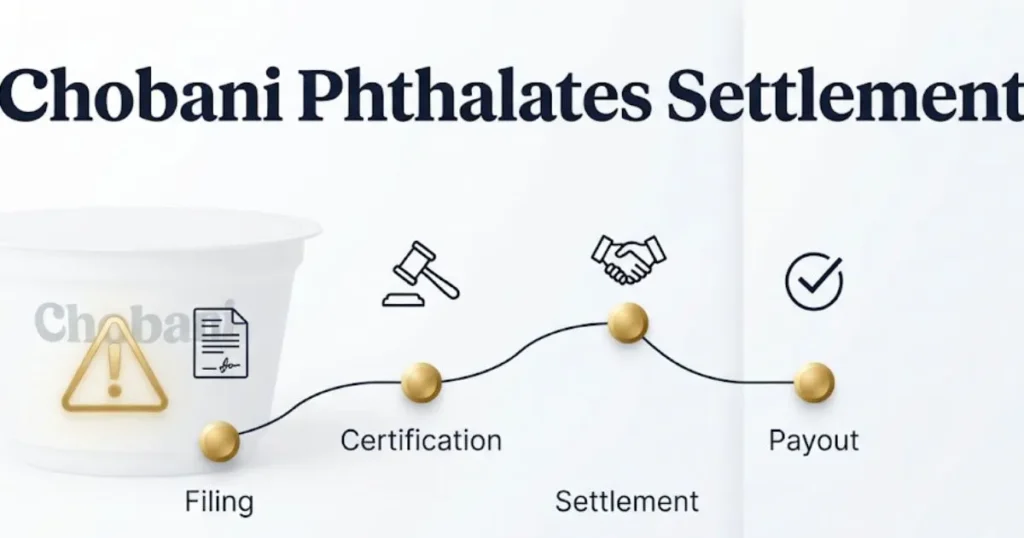
A Chobani phthalates settlement has not been finalized as of early 2026, but the case is moving toward a resolution that could include monetary compensation for consumers. Settlements in food contamination class actions typically combine cash payments with business practice changes.
Based on how similar cases have resolved, a Chobani settlement would likely include:
- Direct cash payments to consumers who file valid claims
- Cy pres donations to food safety organizations if unclaimed funds remain
- Injunctive relief requiring Chobani to test for phthalates regularly
- Labeling changes to more accurately reflect product contents
- Supply chain reforms to reduce phthalate contamination sources
The settlement structure matters. Some food class actions offer a flat payment per claimant. Others create tiers based on purchase volume or proof of purchase.
| Settlement Component | Likely Structure |
|---|---|
| Cash to consumers with receipts | Higher tier payment |
| Cash to consumers without receipts | Lower tier payment (self-attestation) |
| Injunctive relief | Required testing and reporting |
| Attorney fees | Paid from settlement fund (separate) |
| Claims administration | Third-party administrator |
Settlement negotiations often begin after class certification. If the court certifies the class in mid-2026, serious settlement talks could follow within months. Most food safety class actions settle within 12 to 18 months of certification.
Key Takeaway: While no settlement exists yet, comparable food contamination cases suggest consumers can expect cash payments and required business practice changes as part of any resolution.
Chobani Lawsuit Payout Estimate
The Chobani lawsuit payout estimate for individual consumers will likely range from $10 to $100 per claimant for those without receipts, and potentially $50 to $500 for those with documented proof of significant purchases. These estimates are based on settlements in comparable food contamination class actions.
Nobody can guarantee a specific amount right now. Payouts depend on the total settlement fund, the number of valid claims filed, and the tier structure the court approves.
Here is how similar cases have paid out:
| Comparable Case | Settlement Fund | Per-Person Payout |
|---|---|---|
| Kraft Mac and Cheese phthalates | $15.5 million (proposed) | $15 to $50 per claimant |
| Annie’s Homegrown labeling | $6.5 million | $10 to $30 per claimant |
| Dannon probiotic claims | $21 million | Up to $100 per consumer |
| Red Bull false advertising | $13 million | $10 per consumer |
The total settlement fund is the biggest variable. A larger fund means bigger individual checks. Chobani’s annual revenue exceeds $2 billion, which gives plaintiffs’ attorneys ammunition to push for a substantial settlement.
Consumers with extensive purchase records will receive more. If you have loyalty card data showing years of weekly Chobani purchases, your claim is worth more than someone who bought one cup.
Filing a claim is free. There is no risk in submitting one. Even a modest payout of $25 or $50 reflects accountability for the contamination.
Other Phthalates in Food Lawsuits
Phthalates in food lawsuits extend well beyond Chobani. Multiple food companies have faced legal action over phthalate contamination in recent years, creating a growing body of case law that strengthens the Chobani claims.
The most notable comparable cases include:
Kraft Heinz Mac and Cheese Case: A proposed class action alleged phthalates in Kraft’s iconic boxed macaroni and cheese. The cheese powder was identified as the contamination source. Testing found DEHP and several other phthalates.
Annie’s Homegrown Lawsuit: Organic food brand Annie’s faced similar allegations. The case highlighted that “organic” labeling does not prevent phthalate contamination from processing equipment.
General Mills Cheerios Claims: Allegations surfaced regarding phthalates in Cheerios products, linked to packaging and processing materials.
These cases share common themes:
- Contamination from manufacturing, not intentional addition
- Companies marketing products as healthy, natural, or wholesome
- Consumer expectations that premium prices mean cleaner products
- Gaps in FDA regulation that allow contamination to go unchecked
Each case that moves forward builds legal precedent. Judges and juries become more familiar with phthalate science. Settlement values tend to increase as the issue gains public attention.
The Chobani case benefits from this wave of litigation. Attorneys can point to established science and prior rulings to strengthen their arguments.
How to File a Chobani Lawsuit Claim
Filing a Chobani lawsuit claim is a straightforward process that does not require hiring a personal attorney. Once a settlement is approved and a claims process is established, eligible consumers can submit claims online or by mail.
Here is the typical step-by-step process:
Step 1: Watch for the official settlement notice. After a settlement is reached, the court appoints an administrator who sends notices by email, mail, and sometimes social media.
Step 2: Visit the official claims website. Every class action settlement has a dedicated website where you can review the settlement terms and file a claim.
Step 3: Complete the claim form. Provide your name, address, and details about your Chobani purchases. This includes approximate dates, products purchased, and where you shopped.
Step 4: Submit proof of purchase if available. Receipts, loyalty card records, credit card statements, or grocery delivery records all work. If you do not have receipts, many settlements allow self-attestation up to a certain dollar amount.
Step 5: Wait for claim review and payment. The administrator reviews claims, and approved payments are issued by check or electronic transfer.
| Filing Step | What You Need |
|---|---|
| Claim form | Name, address, contact information |
| Purchase details | Products, dates, store names |
| Proof of purchase | Receipts, bank statements, loyalty data |
| Submission method | Online form or mailed paper form |
| Cost to file | Free, no fees |
Start gathering your purchase records now. Do not wait for the settlement to be announced.
Key Takeaway: Filing a claim is free and simple, but having proof of purchase will increase your payout, so start collecting receipts and digital purchase records immediately.
How to Join the Chobani Class Action
Joining the Chobani class action does not require any active step on your part in most cases. If the court certifies the class and you fall within the class definition, you are automatically a member unless you affirmatively opt out.
That is how class actions work. You are in by default.
However, there are ways to stay engaged and protect your interests:
- Register with the claims administrator once the settlement website launches
- Sign up for case update notifications through the plaintiffs’ law firm
- Save all Chobani purchase records from the class period
- Do not discard grocery receipts or delete digital purchase histories
If you want to play a more active role, you can contact the plaintiffs’ attorneys handling the case. They can explain whether your situation warrants individual participation beyond the class.
| Action | When to Do It | Why It Matters |
|---|---|---|
| Save purchase records | Now | Strengthens your claim amount |
| Monitor case updates | Ongoing through 2026 | Ensures you do not miss deadlines |
| Register for notices | When claims site launches | Guarantees you receive notifications |
| Consider opting out | Only if pursuing individual claim | May allow larger individual recovery |
Opting out is rare and only makes sense if your damages are significant enough to justify a private lawsuit. For most consumers, staying in the class is the best option.
What Is the Chobani Lawsuit Deadline?
The Chobani lawsuit deadline for filing claims has not been set as of early 2026 because the case has not yet reached the settlement stage. Once a settlement is approved, the court will establish a specific deadline for consumers to submit their claims.
Based on standard class action timelines, here is what to expect:
| Milestone | Estimated Timing |
|---|---|
| Class certification decision | Mid-2026 |
| Settlement negotiations | Late 2026 |
| Preliminary settlement approval | Late 2026 to early 2027 |
| Claims filing period opens | Early to mid-2027 |
| Claims filing deadline | 60 to 120 days after opening |
| Final settlement approval | Mid-2027 |
| Payments issued | Late 2027 |
The claims filing window is typically 60 to 120 days. That sounds like plenty of time, but deadlines pass faster than people expect. Missing the deadline means forfeiting your right to compensation entirely.
There is no deadline to preserve your purchase records. Start doing that today. The earlier you organize your receipts and digital records, the easier the claims process will be when it opens.
Some class actions also have a statute of limitations issue for the underlying legal claims. In most states, consumer fraud claims must be filed within 3 to 6 years of the purchase. This is another reason the case covers a defined class period.
Chobani Yogurt Lawsuit in 2026: What Comes Next?
The Chobani yogurt lawsuit in 2026 will likely see its most significant developments yet, including class certification proceedings and possible settlement talks. This year could determine whether the case resolves quickly or heads toward a trial.
Several factors will shape the case this year.
Class certification is the biggest upcoming milestone. If the court certifies the class, Chobani faces pressure to settle. If certification is denied, plaintiffs must regroup and potentially refile with narrower class definitions.
Expert testimony will play a major role. Both sides will present scientists, toxicologists, and food safety experts. Plaintiffs need to prove that phthalate levels in Chobani products pose a real risk. Chobani will argue its products are safe under current regulations.
Public attention could accelerate the process. Media coverage of phthalates in food has increased dramatically. Congressional interest in food safety reform adds political pressure on companies and regulators alike.
Here is what consumers should do right now:
- Keep buying records from any Chobani purchases
- Stay informed about case developments
- Talk to your doctor if you have health concerns related to phthalate exposure
- Be skeptical of scam claims websites pretending to be official settlement administrators
The legitimate claims process will come through court-appointed administrators only. Any website asking for money to file a claim is fraudulent.
Key Takeaway: 2026 is the pivotal year for this case, with class certification and potential settlement negotiations on the calendar, making it essential for affected consumers to preserve purchase records and stay informed.
Frequently Asked Questions
What is the Chobani phthalates lawsuit about?
The lawsuit alleges Chobani sold yogurt containing undisclosed phthalates, which are industrial chemicals linked to hormone disruption.
Plaintiffs claim Chobani’s “natural” marketing was misleading because the products contained synthetic contaminants.
The case seeks compensation for consumers and changes to Chobani’s manufacturing practices.
How much money could I get from the Chobani settlement?
Most consumers can expect between $10 and $100 without receipts, or $50 to $500 with proof of purchase.
The exact amount depends on the total settlement fund and how many people file claims.
Payments are not expected to begin until late 2026 at the earliest.
Which Chobani products are included in the lawsuit?
The lawsuit covers Chobani Greek Yogurt, Chobani Flip, Chobani Less Sugar, and Chobani Complete products sold in plastic cups.
Other product lines may be added as the case progresses.
Any Chobani product in plastic packaging from approximately 2020 to 2025 could potentially qualify.
What is the deadline to file a Chobani phthalates claim?
No deadline has been set yet because the case has not reached the settlement stage.
Once a settlement is approved, consumers will typically have 60 to 120 days to file.
Start saving your purchase records now so you are ready when the claims window opens.
Are phthalates in Chobani yogurt dangerous to my health?
Phthalates are classified as endocrine disruptors and are linked to reproductive harm, thyroid problems, and developmental issues in children.
A single serving is unlikely to cause harm, but daily consumption over months or years creates cumulative exposure risks.
Children and pregnant women are the most vulnerable groups.
This lawsuit is not going away. The Chobani phthalates case represents a growing push to hold food companies accountable for hidden chemical contamination.
If you bought Chobani yogurt between 2020 and 2025, start saving your receipts and digital purchase records today. When the claims process opens, you will want to be ready.
Stay updated on case developments through 2026. Your right to compensation depends on acting before the deadline.







