

Latest update (November 17, 2026): The acetaminophen lawsuit, In re Acetaminophen ASD-ADHD Products Liability Litigation (MDL No. 3043, S.D.N.Y.), is moving again. On July 13, 2026, the Second Circuit reversed Judge Denise Cote’s 2023 exclusion of plaintiffs’ expert testimony and revived about 500 cases, and on October 16, 2026 it denied rehearing. No bellwether trial date or settlement has been announced.
What’s next: The cases return to Judge Cote, where Kenvue says it will again challenge the plaintiffs’ expert evidence, and Kenvue says it will ask the Supreme Court to review the ruling. We’ll update this page if new details emerge.
Last updated: November 2026
The acetaminophen lawsuit is a group of product liability cases claiming that acetaminophen (the active ingredient in Tylenol) taken during pregnancy contributed to autism or ADHD in children. The defendants include Kenvue, the maker of Tylenol, and retailers that sold store-brand acetaminophen. The drug companies deny the claims, and regulators say a causal link has not been established.
What Is the Acetaminophen Lawsuit About?
Families allege that manufacturers and retailers failed to warn pregnant women that prenatal acetaminophen use might raise the risk of neurodevelopmental disorders. The suits do not ask to pull acetaminophen from shelves. They argue labels should have carried a warning so patients and doctors could decide with full information.
| Detail | Info |
|---|---|
| What is alleged | Acetaminophen during pregnancy contributed to autism or ADHD; failure to warn |
| Who is sued | Kenvue (Tylenol) and retailers of store-brand acetaminophen, including Walgreens, which is named in the appeal case |
| Federal court | U.S. District Court, Southern District of New York |
| MDL | In re Acetaminophen ASD-ADHD Products Liability Litigation, MDL No. 3043 (created October 2022) |
| Judge | Denise Cote |
| Cases | About 500 federal cases returned to the district court by the Second Circuit |
| Type | Mass tort (individual cases), not a class action |
Acetaminophen Lawsuit Update for 2026
In December 2023, Judge Cote ruled that the plaintiffs’ general-causation experts did not meet the federal reliability standard, excluded their testimony, and entered judgment for the defendants. Roughly 500 cases were affected, and families appealed.
The Second Circuit heard arguments in Rutledge v. Walgreen Co. on November 18, 2025. On July 13, 2026, a three-judge panel reversed in part. It held that Judge Cote went beyond her gatekeeping role in excluding certain expert testimony, reinstated three experts (Drs. Andrea Baccarelli, Eric Hollander and Brandon Pearson), and noted that new studies published since her ruling should be addressed on remand. The court denied rehearing and rehearing en banc on October 16, 2026, so the ruling stands.
- The federal cases are back before Judge Cote in the Southern District of New York.
- Kenvue says it will challenge the reliability of the plaintiffs’ expert evidence again and plans to seek Supreme Court review. As of late October 2026, no petition had been reported.
- No bellwether trial date, case schedule or settlement had been announced when we checked.
- State attorneys general are also involved. Texas sued Johnson & Johnson and Kenvue in October 2025, as covered in our Texas Tylenol lawsuit guide.
What the ruling does not mean: it does not decide whether acetaminophen causes autism or ADHD. It only means the plaintiffs’ experts can be heard, so the cases are not thrown out at the expert stage.
Did the FDA Change Anything?
On September 22, 2025, the FDA said it was starting the process of a label change for acetaminophen and sent a letter to physicians, citing studies that report an association between use in pregnancy and conditions such as autism and ADHD. The agency also said a causal relationship has not been established and that contrary studies exist. Medical groups continue to say acetaminophen is an option for fever and pain in pregnancy when used as needed, at the lowest effective dose and for the shortest time. Talk to your doctor about your own situation and do not stop treating a high fever without medical advice.
Acetaminophen Lawsuit Settlement and Payout
No global settlement exists, and no verdict has been reached in the federal cases. Any dollar figures you see online for a Tylenol payout are estimates from law firms or commentators, not amounts approved by a court. Payouts in mass torts usually depend on the severity of the child’s diagnosis, how well the use of acetaminophen in pregnancy is documented, medical and care costs, and the strength of the expert evidence. For one explainer on estimates, see our guide to Tylenol autism settlement amounts.
Who Qualifies for the Acetaminophen Lawsuit?
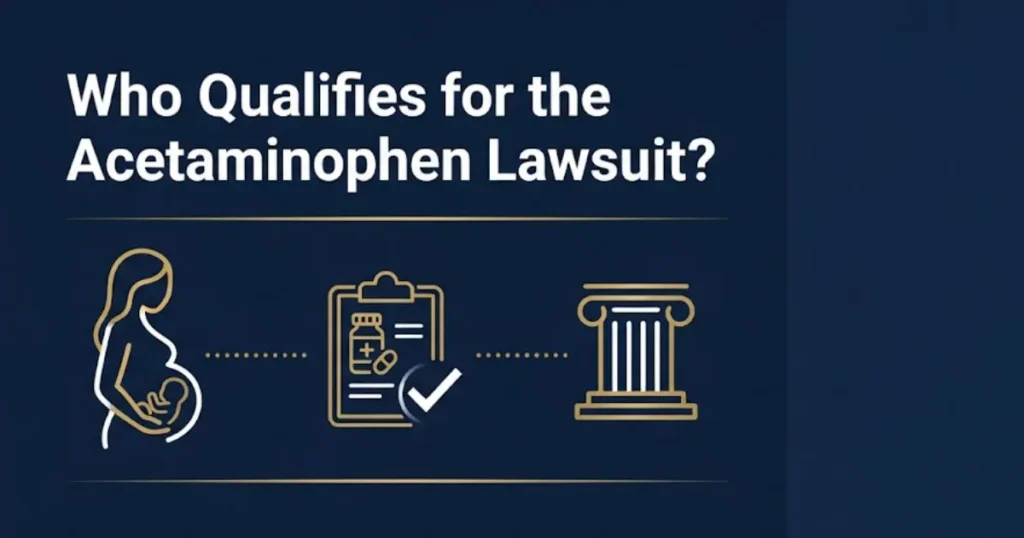
Law firms generally look for a child with an autism spectrum disorder or ADHD diagnosis from a licensed professional, and a mother who used acetaminophen during pregnancy that can be supported by medical, pharmacy or other records. Brand-name Tylenol and store brands are both covered by the allegations. Cases with another clear cause for the child’s condition, such as a genetic syndrome, may be harder to bring. Whether a particular case qualifies is a legal decision for an attorney. If your child has an ADHD diagnosis, see our Tylenol ADHD lawsuit guide.
How to File an Acetaminophen Lawsuit
This is not a claim form you file yourself. You hire an attorney who handles pharmaceutical mass torts, and the firm files in federal court or the right state court.
- Contact a law firm with acetaminophen or Tylenol experience for a free case review.
- Share prenatal records, pharmacy or purchase records, and your child’s diagnostic reports.
- If the firm accepts the case, review the fee agreement. These cases are usually handled on contingency, meaning no fee unless there is a recovery.
- Your attorney files the case. You rarely need to appear in court in a mass tort.
Acetaminophen Lawsuit Deadline
There is no single national deadline. Each state sets its own statute of limitations for product liability claims, and the rules about when the clock starts (at injury, at diagnosis, or when the cause was discovered) differ. Because the periods can be as short as two years in some states, and because a child’s age can change the calculation, speak to an attorney soon rather than assuming you have time.
What Does the Science Say?
Several studies have reported an association between prenatal acetaminophen use and later ADHD or autism diagnoses, and in 2021 a consensus statement signed by 91 scientists, published in Nature Reviews Endocrinology, called for precautionary steps. Other research, including large sibling-comparison studies, found no clear link once family factors are accounted for. The FDA says causation has not been established. This disagreement is the core of the litigation, and it is why the expert-testimony ruling mattered so much.
Is the Acetaminophen Lawsuit a Class Action?
No. It is a mass tort in a multidistrict litigation. Each family has its own case, which is pooled with others for pretrial work, and each case is valued separately. That means there is no single class settlement fund to claim from.
Frequently Asked Questions
What is the latest in the acetaminophen lawsuit?
On July 13, 2026, the Second Circuit reversed in part the 2023 ruling that excluded plaintiffs’ experts, reviving about 500 cases. Rehearing was denied on October 16, 2026, and the cases are back before Judge Cote.
Has any acetaminophen lawsuit gone to trial or settled?
Not in the federal MDL as of our last check. No bellwether trial date or settlement has been announced.
How much money can I get from the acetaminophen lawsuit?
No amount has been set. Any figure is an estimate. Compensation, if any, would depend on the individual case.
What is the deadline to file?
It depends on your state’s statute of limitations, and no national deadline applies. Ask an attorney as soon as you can.
Does the lawsuit cover store brands?
Yes. The claims name retailers that sold store-brand acetaminophen, and brand-name Tylenol is also covered by the allegations.
Is acetaminophen safe in pregnancy?
Regulators and medical groups say a causal link has not been established. The FDA has started a label change process. Ask your doctor before using any medicine in pregnancy.
This page is general information, not legal advice. Sources include the Second Circuit’s July 13, 2026 decision as reported by Bloomberg Law and Jurist, and FDA statements of September 22, 2025.







