The supreme court conversion therapy case is reshaping mental health law across America right now. The Chiles v. Salazar ruling directly affects bans in over 20 states.
This case pits free speech rights against protections for LGBTQ+ minors. The outcome determines whether counselors can legally practice conversion therapy on young people.
You will learn the key facts, the full timeline, and the real-world impact of this ruling. The decision could invalidate existing state bans almost overnight.
More than 23 states currently restrict conversion therapy for minors. That number could drop dramatically depending on how the court rules. The stakes have never been higher for affected families.
Related: Supreme Court Transgender Case 2026: What the Ruling Means
Supreme Court Conversion Therapy Case Overview
The supreme court conversion therapy case refers to Chiles v. Salazar. This is the highest-profile legal challenge to state-level conversion therapy bans in U.S. history.
Kaley Chiles is a licensed professional counselor in Colorado Springs. She challenged Colorado’s law banning conversion therapy for minors. She argues the law violates her First Amendment rights.
The Supreme Court granted certiorari in early 2025. The justices heard oral arguments later that year. A decision arrived during the 2026 term.
This case matters because it sets a national precedent. State laws across the country now face new legal scrutiny.
| Detail | Info |
|---|---|
| Case Name | Chiles v. Salazar |
| Court | U.S. Supreme Court |
| Term | 2025 to 2026 |
| States Affected | 23 or more |
| Core Issue | First Amendment free speech |
What Is the Supreme Court Conversion Therapy Case
The supreme court conversion therapy case is a legal battle over whether states can ban talk therapy aimed at changing a minor’s sexual orientation or gender identity.
Colorado passed its ban in 2019 under Senate Bill 85. The law prohibits licensed counselors from performing conversion therapy on anyone under 18. Violators face professional discipline and fines.
Kaley Chiles sued the state in 2021. She claimed the ban prevents her from providing faith-based counseling to minors who seek it voluntarily. The state argued the law protects children from documented psychological harm.
Think of it like a zoning dispute. One side says the government can regulate what happens inside a professional office. The other side says the government cannot police the words a counselor speaks.
Key fact: Over 700,000 LGBTQ+ adults in the U.S. report having undergone conversion therapy at some point in their lives, according to the Williams Institute at UCLA.
Chiles v Salazar Supreme Court Decision
The Chiles v. Salazar Supreme Court decision addresses whether Colorado’s conversion therapy ban is a permissible professional regulation or an unconstitutional speech restriction.
The Tenth Circuit Court of Appeals previously upheld the ban. That court classified conversion therapy as professional conduct rather than protected speech. Chiles and her legal team at Alliance Defending Freedom appealed to the Supreme Court.
The Supreme Court’s review focused on a key question. Is talk therapy “speech” protected by the First Amendment? Or is it “conduct” that states can freely regulate?
The ruling carries enormous weight for professional licensing laws nationwide. It extends well beyond conversion therapy into all forms of regulated counseling.
| Legal Position | Argument |
|---|---|
| Chiles (Petitioner) | Talk therapy is speech and deserves full First Amendment protection |
| Salazar (Respondent) | Therapy is professional conduct subject to state regulation |
| Tenth Circuit | Upheld the ban as a valid conduct regulation |
| Supreme Court | Reviewed the speech versus conduct distinction |
Key Takeaway: The Chiles v. Salazar case forces the Supreme Court to draw a line between protected speech and regulable professional conduct for the first time in the therapy context.
Conversion Therapy Ban Supreme Court Ruling 2026
The conversion therapy ban supreme court ruling in 2026 marks a turning point for mental health regulation in the United States.
The justices had to reconcile conflicting lower court decisions. The Ninth Circuit upheld California’s ban in Pickup v. Brown back in 2013. The Eleventh Circuit struck down a similar ban in Otto v. City of Boca Raton in 2020.
This circuit split is exactly why the Supreme Court stepped in. The justices needed to provide a single national standard. Without one, your rights as a counselor or patient depended entirely on your zip code.
The 2026 ruling now sets that national standard. State legislatures are scrambling to understand what they can and cannot enforce.
Bold stat: Before this ruling, 23 states and the District of Columbia had some form of conversion therapy ban for minors on the books.
Conversion Therapy First Amendment Challenge
The conversion therapy first amendment challenge argues that banning specific therapeutic conversations violates free speech protections.
Chiles’s legal team made a straightforward argument. The government cannot tell a licensed counselor which words to use with a willing client. They compared it to the government banning a journalist from writing about certain topics.
Colorado’s defense relied on the “professional speech” doctrine. This legal theory says that speech within a professional relationship receives less First Amendment protection. The state cited the Supreme Court’s own precedent in Planned Parenthood v. Casey.
The tension is real and deeply personal. On one side, counselors claim a right to speak freely. On the other, advocates say certain therapeutic practices cause measurable psychological damage to minors.
- The First Amendment protects speech from government censorship
- Professional speech doctrine creates a lower tier of protection
- The Supreme Court narrowed professional speech doctrine in NIFLA v. Becerra (2018)
- Chiles argues NIFLA effectively killed the professional speech exception
Chiles v Colorado Case Timeline
The Chiles v. Colorado case timeline spans nearly five years of litigation from initial filing to the Supreme Court ruling.
Understanding the timeline helps you see how this case evolved. Each stage added new layers of legal complexity.
| Date | Event |
|---|---|
| 2019 | Colorado enacts conversion therapy ban (SB 85) |
| 2021 | Kaley Chiles files federal lawsuit against Colorado |
| 2022 | U.S. District Court dismisses the case |
| 2023 | Tenth Circuit Court of Appeals affirms dismissal |
| 2024 | Chiles petitions the Supreme Court for review |
| Early 2025 | Supreme Court grants certiorari |
| Late 2025 | Oral arguments held before all nine justices |
| 2026 | Supreme Court issues its ruling |
The case moved relatively quickly by Supreme Court standards. Most major constitutional cases take six to eight years to reach a final decision. This one took about five.
Key Takeaway: The conversion therapy first amendment challenge hinges on whether the Supreme Court views talk therapy as protected speech or regulable professional conduct, and the 2026 ruling now provides that answer.
Conversion Therapy Ban for Minors
A conversion therapy ban for minors is a state law that prohibits licensed mental health professionals from attempting to change a young person’s sexual orientation or gender identity through therapy.
These bans specifically target licensed practitioners. They do not criminalize conversations between parents and children. They also do not apply to unlicensed religious counselors acting in a purely pastoral role.
The rationale behind these bans is rooted in medical consensus. The American Psychological Association, the American Medical Association, and the American Academy of Pediatrics all oppose conversion therapy for minors. They cite studies showing increased risks of depression, anxiety, and suicidal ideation.
Opponents of the bans argue they are too broad. They say the laws prevent counselors from even exploring a minor’s feelings about gender or sexuality in an open-ended way.
- 23 states plus D.C. have enacted minor conversion therapy bans
- Most bans carry professional license penalties rather than criminal charges
- Some bans include exemptions for clergy and unlicensed religious advisors
- The typical age threshold is 18 years old
Conversion Therapy Ruling Impact on States
The conversion therapy ruling impact on states varies significantly depending on how each state’s ban is written and enforced.
States with narrowly tailored bans face the least disruption. These laws target only specific harmful practices and leave general counseling untouched. States with broader language face more legal vulnerability.
Colorado’s ban is considered one of the more detailed statutes. It defines conversion therapy precisely and lists specific prohibited practices. Other states use vaguer language that courts may now strike down.
Think of it like building codes after an earthquake. Some buildings were built to modern standards and survive intact. Others were built to older, weaker codes and now need major retrofitting.
| Impact Level | States | Reason |
|---|---|---|
| Low Impact | California, New York, Oregon | Narrowly written bans with clear definitions |
| Moderate Impact | Colorado, Illinois, Virginia | Detailed but broader scope |
| High Impact | Utah, New Mexico, Maine | Vague language vulnerable to challenge |
Conversion Therapy Ban States List 2026
The conversion therapy ban states list in 2026 includes jurisdictions that still have enforceable restrictions on the books after the Supreme Court ruling.
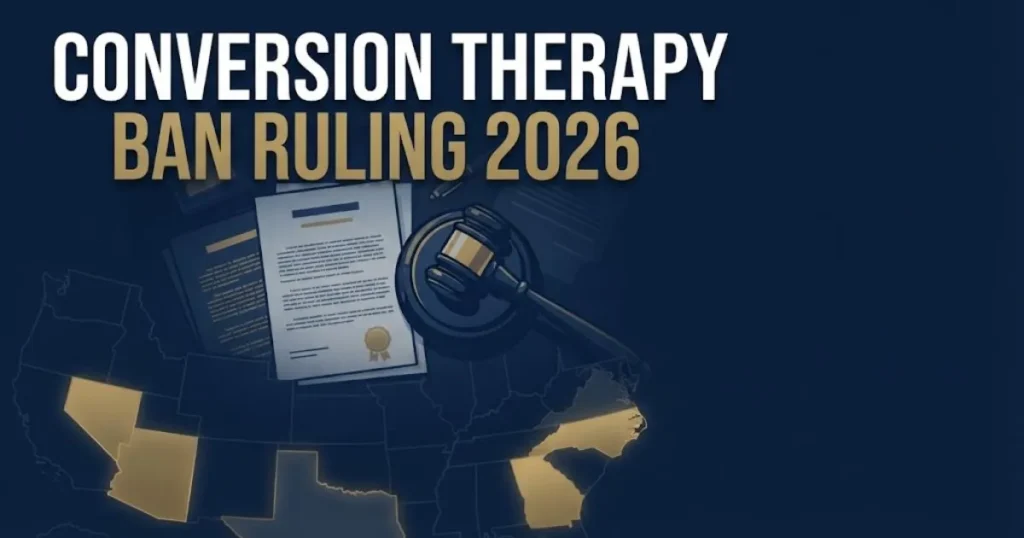
Before the ruling, 23 states and D.C. had active bans. The Supreme Court decision does not automatically erase all of them. Each state must evaluate whether its specific law survives the new legal standard.
Some states will likely keep their bans with minor revisions. Others may see their laws challenged in federal court within months. A few states may voluntarily repeal bans they now consider legally indefensible.
Bold stat: At least 7 states face active legal challenges to their conversion therapy bans as of mid-2026.
- California (2012 ban, oldest in the nation)
- New Jersey (2013)
- Oregon (2015)
- Illinois (2015)
- New York (2019)
- Colorado (2019)
- Washington (2018)
- Massachusetts (2019)
- Connecticut (2017)
- Rhode Island (2017)
Key Takeaway: The 2026 ruling creates a patchwork effect where some state bans survive intact, some need revision, and others face imminent legal challenges that could strike them down entirely.
Conversion Therapy Counselor Lawsuit
The conversion therapy counselor lawsuit at the heart of this case was filed by Kaley Chiles, a licensed professional counselor and devout Christian.
Chiles operates a private practice in Colorado Springs. She specializes in working with adolescents dealing with anxiety, depression, and identity questions. She says some of her young clients and their parents specifically request faith-based counseling that aligns with their religious beliefs about sexuality.
Under Colorado’s ban, Chiles faced the loss of her professional license if she provided the type of counseling her clients requested. She described the law as forcing her to choose between her career and her conscience.
Her lawsuit was not a class action. It was an individual civil rights claim filed under 42 U.S.C. Section 1983. She sought a permanent injunction against enforcement of the ban.
- Plaintiff: Kaley Chiles, LPC
- Legal Representation: Alliance Defending Freedom
- Claim Type: First Amendment free speech and free exercise
- Relief Sought: Injunction blocking enforcement of Colorado’s ban
- Filing Court: U.S. District Court for the District of Colorado
Religious Freedom Conversion Therapy Ruling
The religious freedom conversion therapy ruling dimension adds a second constitutional layer to the case beyond free speech.
Chiles argued that the ban also violates the Free Exercise Clause of the First Amendment. She claimed the law disproportionately targets counselors whose religious beliefs motivate their therapeutic approach. Secular counselors, she argued, face no equivalent restrictions on their worldview-driven practices.
Colorado countered that the law is religiously neutral. It applies equally to all licensed counselors regardless of their personal beliefs. The state pointed out that the ban targets a specific practice, not a specific religion.
The Supreme Court has been increasingly protective of religious exercise in recent years. Cases like Kennedy v. Bremerton School District (2022) and 303 Creative v. Elenis (2023) signal a court more willing to side with religious objectors.
Key fact: The Free Exercise claim was secondary to the free speech claim but could prove equally significant for future cases involving faith-based professionals.
Conversion Therapy Ban Constitutionality
The conversion therapy ban constitutionality question boils down to one core legal test: does the ban survive strict scrutiny?
Strict scrutiny is the highest standard of judicial review. A law must serve a compelling government interest and be narrowly tailored to achieve that interest. If the Supreme Court classifies conversion therapy bans as content-based speech restrictions, strict scrutiny applies.
Colorado argued the ban easily passes this test. The state cited extensive medical research showing that conversion therapy causes real harm to minors. Protecting children from psychological damage is a compelling interest by any measure.
Chiles’s team argued the ban is not narrowly tailored. They said the state could achieve its goals through informed consent requirements or age restrictions without banning the speech entirely.
| Legal Test | What It Requires | Who Favors It |
|---|---|---|
| Strict Scrutiny | Compelling interest, narrow tailoring | Chiles (petitioner) |
| Intermediate Scrutiny | Important interest, substantial relation | Potential middle ground |
| Rational Basis | Legitimate interest, rational connection | Colorado (respondent) |
Key Takeaway: The religious freedom and constitutionality arguments together create a two-pronged challenge that makes it harder for states to defend broad conversion therapy bans under the new ruling.
Supreme Court LGBTQ Therapy Case Update
The supreme court LGBTQ therapy case update for 2026 reflects a legal environment in rapid transition.
LGBTQ+ advocacy organizations like Lambda Legal and the Trevor Project have closely monitored the case. They argue that conversion therapy bans are among the most important legal protections for queer youth. The Trevor Project reports that LGBTQ+ young people who underwent conversion therapy were more than twice as likely to attempt suicide.
On the other side, organizations like the Alliance Defending Freedom frame the case as a matter of parental rights and therapeutic freedom. They argue that parents should be able to choose the type of counseling their children receive.
The political dimension is hard to ignore. Red states have largely avoided passing conversion therapy bans. Blue states have led the charge. The Supreme Court ruling now forces both sides to recalibrate their strategies.
- The Trevor Project surveyed over 34,000 LGBTQ+ youth in 2024
- 42% of respondents seriously considered suicide in the past year
- Youth in states with bans reported lower rates of attempted suicide
- The ruling may prompt new legislative action in both red and blue states
Conversion Therapy Legal Challenges 2026
Conversion therapy legal challenges in 2026 extend far beyond the original Chiles case.
Several other lawsuits are winding through federal courts right now. In Florida, the aftermath of Otto v. City of Boca Raton continues to generate new litigation. Local governments are trying to draft narrower ordinances that survive First Amendment review.
In Virginia, a group of Christian counselors filed a parallel challenge in 2025. Their case is currently on hold pending the Supreme Court’s guidance from Chiles. Similar cases are pending in Michigan and Minnesota.
The legal strategy on both sides is evolving. States are now hiring constitutional law specialists to rewrite their bans. Opponents are building a coordinated litigation campaign modeled on the strategy that succeeded in Chiles.
| State | Case Status | Key Issue |
|---|---|---|
| Florida | Active litigation | Local ordinance scope |
| Virginia | Stayed pending Chiles | Free exercise claim |
| Michigan | Early filing stage | Parental rights angle |
| Minnesota | Pre-litigation | Legislative revision |
How Does the Conversion Therapy Ruling Affect Me
How the conversion therapy ruling affects you depends on your role: counselor, parent, minor, or concerned citizen.
If you are a licensed counselor, the ruling changes what you can legally say to minor clients. You need to review your state’s current ban language carefully. Some states will update their laws within months. Others may take a year or more.
If you are a parent, the ruling affects the types of therapy available to your child. In states where bans are struck down, you may have access to a wider range of counseling options. In states where bans survive, the restrictions remain in place.
If you are an LGBTQ+ young person, this ruling directly impacts the protections available to you. Advocacy groups recommend staying connected with supportive resources regardless of legal changes.
- Counselors: Check your state licensing board for updated guidance
- Parents: Review your state’s current law and any pending legislation
- Minors: Know your rights and reach out to trusted support organizations
- Citizens: Follow your state legislature for proposed changes in 2026 and 2027
Frequently Asked Questions
What did the Supreme Court decide about conversion therapy?
The Supreme Court ruled on whether state bans on conversion therapy for minors violate the First Amendment. The decision sets a national standard for how states can regulate therapeutic speech. The ruling requires states to narrowly tailor any restrictions to survive constitutional review.
Is conversion therapy still banned in my state?
It depends on your state’s specific law and how it aligns with the new ruling. Some states with narrowly written bans will keep their restrictions intact. Other states with broader language may see their bans challenged or struck down in the coming months.
Can counselors face penalties for conversion therapy in 2026?
Counselors in states with surviving bans can still face professional discipline. Penalties typically include license suspension, fines, or mandatory retraining. The specific consequences vary by state and depend on the current legal status of each ban.
Does the ruling apply to adults or only minors?
The ruling focuses on bans that target therapy for minors under 18. Most existing state laws already exempt adults from conversion therapy restrictions. The Supreme Court’s analysis centered on the state’s authority to protect children specifically.
What happens next after the Supreme Court conversion therapy ruling?
State legislatures will review and likely revise their conversion therapy laws throughout 2026 and 2027. New lawsuits will test the boundaries of the ruling in federal courts. Advocacy groups on both sides are already preparing their next legal and legislative moves.
The supreme court conversion therapy case is far from a settled issue in everyday life. The ruling sets the framework, but the real changes happen at the state level over the next year or two.
Check your state’s current laws and stay informed about legislative updates. The legal ground is shifting fast, and what applies today may change by next year. Keep watching this space for the latest developments.