The answer is the Good Samaritan law. This is what law protects against civil lawsuits when we try to help a victim in medical need. Every state has its own version.
You see someone collapse at a store. You start CPR. Then you worry about getting sued. That fear is completely normal. The Good Samaritan law exists to ease it.
All 50 states offer some legal shield for helpers. But the rules vary wildly by location. Some states protect only trained responders. Others cover any willing bystander.
This guide breaks down how these laws work in 2026. You will learn who is covered. You will see the exceptions. You will find where your state stands.
What Law Protects Against Civil Lawsuits When We Try to Help a Victim in Medical Need
The Good Samaritan law is the primary legal shield. It protects people who assist victims during medical emergencies. All 50 states have enacted some version.
These laws share a common goal. They encourage bystanders to act without fear. The logic is straightforward. Helping should not punish you.
The protection activates during genuine emergencies. You must act in good faith. You must stay within your training level. Reckless behavior is not covered.
Most states passed their first Good Samaritan statutes in the 1960s. California led the way in 1959. Since then every state has followed.
Quick Facts:
- First US law: California, 1959
- States with protections: All 50
- Core requirement: Good faith effort
- Key limit: No willful misconduct
Good Samaritan Law Explained
Good Samaritan law refers to state statutes that grant civil immunity to people who provide emergency aid. The name comes from a biblical parable about a stranger helping an injured traveler.
The basic idea is simple. If you help someone in a medical crisis, the law shields you from most lawsuits. You cannot be held liable for ordinary mistakes.
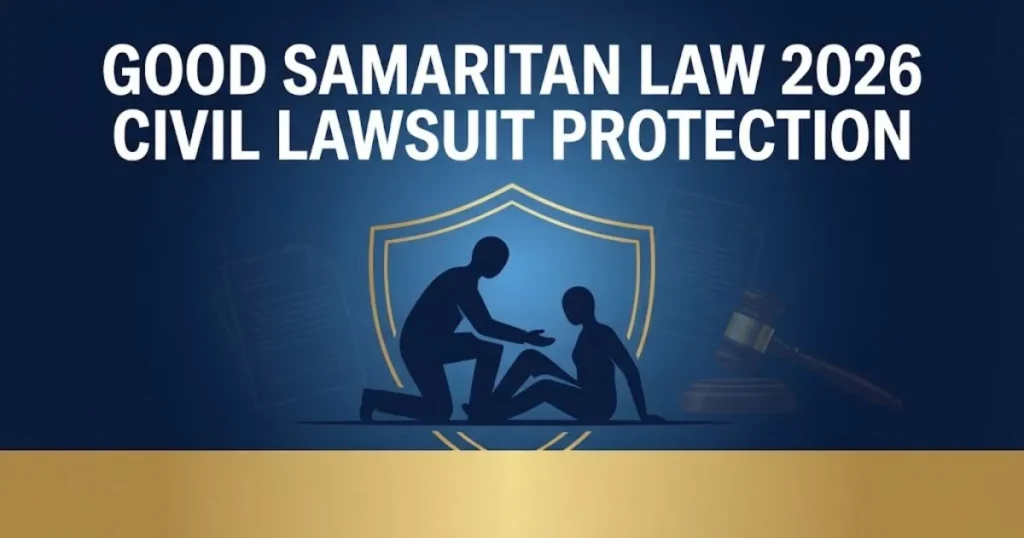
Think of it like a legal safety net. You jump in to help. The net catches you if something goes wrong. But the net has holes. Gross negligence falls right through.
The law does not require you to help. It only protects you if you choose to. That distinction matters more than most people realize.
| Element | Detail |
|---|---|
| Purpose | Encourage emergency aid |
| Scope | Civil liability only |
| Requirement | Good faith action |
| Exclusion | Criminal acts, gross negligence |
Who Does the Good Samaritan Law Protect
Good Samaritan laws protect any person who voluntarily provides emergency medical assistance. That includes trained professionals and untrained bystanders alike.
The specific coverage depends on your state. Some states limit protection to certified first responders. Others extend it to anyone who acts reasonably.
In most jurisdictions the law covers two groups. The first is laypersons with no medical training. The second is off-duty healthcare workers.
A few states draw a line between the two groups. Medical professionals may face a higher standard of care. We cover that distinction in a later section.
Who is typically covered:
- Untrained bystanders acting in good faith
- Off-duty nurses and doctors
- Certified EMTs and paramedics
- Volunteer firefighters and rescue workers
Key Takeaway: Good Samaritan laws exist in all 50 states and protect anyone who provides voluntary emergency aid in good faith, but the scope of protection varies significantly by jurisdiction.
Good Samaritan Law for Bystanders
Good Samaritan law for bystanders means you are protected even without medical training. Most states extend immunity to ordinary people who step in during a crisis.
The standard is reasonable care. You must act as a sensible person would. You do not need to perform perfectly. You just need to try your best.
Imagine you see a car accident on the highway. You pull over and apply pressure to a bleeding wound. Even if the bleeding does not stop, the law protects you.
The key word is voluntary. You must choose to help freely. If someone forces you to act, different rules may apply.
| Scenario | Protected? |
|---|---|
| Applying pressure to a wound | Yes |
| Moving an injured person to safety | Usually yes |
| Performing untrained CPR | Yes in most states |
| Giving medication without training | No |
Good Samaritan Law for Medical Professionals
Good Samaritan law for medical professionals covers doctors, nurses, and EMTs who help outside their workplace. Off-duty physicians are the most common example.
The protection is not identical to bystander coverage. Many states hold medical professionals to a higher standard. Their training creates a higher expectation of care.
A doctor who stops at an accident scene must act within their specialty. A dermatologist should not attempt brain surgery at a roadside. That sounds obvious. But the legal line gets blurry.
Some states strip immunity if the professional acts outside their scope of training. Others offer blanket protection regardless of specialty. Check your state rules carefully.
Key differences for medical pros:
- Higher standard of care expected
- Must act within scope of training
- Some states exclude hospital employees on duty
- Compensation voids immunity in most states
Does Good Samaritan Law Cover CPR
Good Samaritan law does cover CPR in the vast majority of states. If you perform chest compressions on a stranger, you are generally protected from civil suits.
This includes both trained and untrained rescuers. You do not need a current CPR certification. The law cares about your intent, not your credentials.
The same protection extends to AED use. Automated external defibrillators are covered under most state Good Samaritan statutes. You can use one without formal training.
One important caveat applies. You must stop when professional help arrives. Once paramedics take over, your legal shield ends. Continuing to interfere could create liability.
| Action | Legal Protection |
|---|---|
| Hands-only CPR | Yes |
| CPR with rescue breaths | Yes |
| AED use by layperson | Yes in 49 states |
| CPR after EMS arrives | No |
Key Takeaway: Both bystanders and off-duty medical professionals receive Good Samaritan protection for CPR and AED use, but professionals face a higher standard of care and must stay within their training scope.
Can You Be Sued for Helping Someone in an Emergency
You can technically be sued for anything in America. But Good Samaritan laws make it very hard for plaintiffs to win. Most cases get dismissed early.
The law creates a strong presumption in your favor. The plaintiff must prove you acted with gross negligence or willful misconduct. That is a very high bar.
Think of it this way. Someone would need to prove you did something wildly reckless. Simply making a mistake is not enough. The law forgives honest errors.
Statistics back this up. A 2024 review of civil court records found fewer than 30 successful Good Samaritan lawsuits nationwide over the prior decade. The risk is extremely low.
Reasons lawsuits fail:
- Plaintiff cannot prove gross negligence
- Rescuer acted in good faith
- State immunity statute blocks the claim
- No actual damages resulted from the aid
Good Samaritan Law Exceptions
Good Samaritan law exceptions include situations where the helper acts recklessly, expects payment, or causes harm through willful misconduct. These are the big three.
Payment is the most common trap. If you charge for your help, you lose immunity. Even accepting a reward after the fact can void your protection in some states.
Willful misconduct means you intentionally made things worse. This is rare but serious. Deliberately harming someone while pretending to help is not protected.
Another exception involves pre-existing duty. If you are already responsible for the victim, the law may not apply. A parent helping their own child is one example.
| Exception | Example |
|---|---|
| Expecting payment | Charging $50 for roadside first aid |
| Willful misconduct | Intentionally worsening an injury |
| Pre-existing duty | On-duty lifeguard at a pool |
| Intoxication | Providing aid while heavily drunk |
Good Samaritan Law Gross Negligence
Gross negligence under Good Samaritan law means a reckless disregard for the victim’s safety. It goes far beyond a simple mistake or poor judgment.
The legal standard is much higher than ordinary negligence. Ordinary negligence is a careless error. Gross negligence is behavior that shocks the conscience.
An example helps clarify the difference. Giving the wrong CPR compression rate is ordinary negligence. Sitting on a victim’s chest while texting is gross negligence.
Courts rarely find gross negligence in Good Samaritan cases. The plaintiff bears the burden of proof. They must show your actions were wildly unreasonable.
Ordinary vs Gross Negligence:
- Ordinary: Incorrect bandage technique
- Gross: Ignoring obvious spinal injury and dragging victim
- Ordinary: Giving too many rescue breaths
- Gross: Abandoning victim mid-treatment to take a call
Key Takeaway: Good Samaritan immunity is strong but not absolute; you lose protection if you accept payment, act with gross negligence, commit willful misconduct, or violate your pre-existing duty to the victim.
Good Samaritan Law Limitations
Good Samaritan law limitations define the boundaries of your legal shield. The protection is not a blank check. It has clear edges you need to understand.
First, the law only covers civil liability. It does not protect you from criminal charges. If your actions constitute a crime, the Good Samaritan law will not help.
Second, the emergency must be real. You cannot claim immunity for a situation you created. Starting a fire and then putting it out does not count.
Third, the protection ends when the emergency ends. Once the scene is safe and professionals have arrived, your legal shield dissolves. Lingering to help further may create new liability.
| Limitation | What It Means |
|---|---|
| Civil only | No criminal protection |
| Real emergency | Cannot be self-created |
| Time-bound | Ends when professionals arrive |
| Scope-bound | Must match your training level |
Duty to Rescue vs Good Samaritan Law
Duty to rescue laws and Good Samaritan laws are related but distinct. Good Samaritan laws protect you if you choose to help. Duty to rescue laws require you to help.
Most US states have no duty to rescue. You can legally walk past a dying stranger. That sounds harsh. But it is the legal reality in 45 states.
Five states impose some form of duty to act. Vermont, Minnesota, Rhode Island, Wisconsin, and Hawaii have limited rescue obligations. The penalties for inaction are usually minor fines.
The key difference is this. Good Samaritan laws are shields. Duty to rescue laws are swords. One protects you. The other compels you.
| State | Duty to Rescue? | Penalty |
|---|---|---|
| Vermont | Yes | Up to $100 fine |
| Minnesota | Yes | Petty misdemeanor |
| Rhode Island | Yes | Up to $500 fine |
| Wisconsin | Yes | Class C forfeiture |
| Hawaii | Yes | Petty misdemeanor |
| All other states | No | None |
Good Samaritan Law Naloxone Overdose
Good Samaritan law for naloxone overdose protects people who administer the opioid reversal drug during an emergency. All 50 states now have some form of naloxone access law.
These laws work alongside traditional Good Samaritan protections. If you give naloxone to someone overdosing, you are shielded from civil liability. Most states also provide criminal immunity.
The opioid crisis drove these changes. Over 107,000 Americans died from drug overdoses in 2023. Legislators responded by expanding protections for bystanders who carry and use naloxone.
Many states now allow pharmacies to dispense naloxone without a prescription. Some provide free kits at community centers. The legal shield encourages wider distribution.
Naloxone protection facts:
- All 50 states allow bystander administration
- 48 states provide criminal immunity for callers
- No prescription needed in most states
- Protection covers both nasal spray and injectable forms
Key Takeaway: Good Samaritan laws have clear boundaries including no criminal protection, no coverage for self-created emergencies, and expiration once professional help arrives, while naloxone administration now enjoys broad immunity across all 50 states.
Good Samaritan Law by State 2026
Good Samaritan law by state in 2026 shows significant variation across the country. While all 50 states offer some protection, the details differ sharply.
Some states like California and Texas provide broad immunity for almost any helper. Others like New York and Illinois have narrower protections with more exceptions.
The biggest state-level difference involves medical professionals. A few states require off-duty doctors to stop and help at accident scenes. Most do not.
Another key variation is AED protection. Forty-nine states explicitly cover AED use by laypersons. One state still has ambiguous language around untrained defibrillator use.
| State Type | Examples | Protection Level |
|---|---|---|
| Broad immunity | CA, TX, FL | High |
| Moderate immunity | NY, IL, PA | Medium |
| Narrow immunity | OK, NE | Lower |
| Duty to act | VT, MN, RI, WI, HI | Varies |
Good Samaritan Law 2026 Updates
Good Samaritan law 2026 updates reflect a growing trend toward broader protections. Several states expanded their statutes during the 2025 legislative session.
Colorado and Oregon passed new laws extending immunity to bystanders who use fentanyl test strips. This is a direct response to the ongoing overdose crisis.
Texas updated its AED provisions in late 2025. The new law explicitly covers AED use in schools and youth sports facilities. Previously the language was unclear.
At the federal level, the Volunteer Protection Act of 1997 remains the backbone of national Good Samaritan policy. No major federal changes are pending for 2026.
Notable 2025 and 2026 changes:
- Colorado: Fentanyl test strip immunity added
- Oregon: Expanded overdose bystander protections
- Texas: School AED use clarified
- Federal: No new legislation pending
Key Takeaway: State-level Good Samaritan laws vary widely in 2026, with a clear national trend toward broader protections including expanded naloxone immunity, updated AED rules, and new overdose response shields.
Frequently Asked Questions
Can I be sued for giving CPR to a stranger?
You can be sued, but Good Samaritan laws make it very unlikely you will lose. All 50 states protect bystanders who perform CPR in good faith. The plaintiff must prove gross negligence, which is extremely difficult.
Does the Good Samaritan law protect doctors off duty?
Yes, off-duty doctors are generally protected under Good Samaritan laws. However, many states hold medical professionals to a higher standard of care. Protection may not apply if the doctor acts outside their specialty.
What counts as gross negligence under Good Samaritan law?
Gross negligence means a reckless disregard for the victim’s safety that goes far beyond a simple mistake. Examples include abandoning a victim mid-treatment or performing procedures wildly outside your training. Ordinary errors do not qualify.
Do all 50 states have Good Samaritan laws?
Yes, all 50 states and the District of Columbia have enacted some form of Good Samaritan law. The specific protections, exceptions, and covered actions vary significantly from state to state.
Does the Good Samaritan law cover drug overdose help?
Yes, all 50 states now provide Good Samaritan protections for people who assist during a drug overdose. This includes administering naloxone and calling 911. Most states also offer limited criminal immunity for the caller.
Good Samaritan laws give you a strong legal shield when you help someone in a medical emergency. The risk of a successful lawsuit against you is extremely low.
Check your state’s specific statute to understand the exact scope of your protection. Rules differ on medical professional standards, AED use, and overdose response.
If you witness a medical emergency, act with confidence. The law is on your side. Help first. Worry about liability later.