A major tennis lawsuit this month has shaken the sports world in 2026. Three top equipment makers face toxic chemical allegations. If you play tennis regularly, this case affects you directly.
The lawsuit targets Wilson, Penn, and Babolat over PFAS contamination. Plaintiffs say these companies hid the risks for years. Over 23 million U.S. players may qualify for compensation.
This guide covers everything you need to know right now. You will learn who qualifies and how much you could receive. Recent lab tests found PFAS levels 14 times above safe limits. This could be the biggest sports product liability case in a decade.
Tennis Lawsuit This Month Overview
The tennis lawsuit this month is a federal class action filed in January 2026. It targets the three largest tennis equipment manufacturers in the United States. The case is assigned to the Northern District of Illinois.
Case No. 1:26-cv-00342 names Wilson, Penn, and Babolat as defendants. The complaint spans 87 pages of detailed allegations. Plaintiffs accuse these companies of knowingly selling contaminated products.
The core claim centers on PFAS chemicals in tennis ball felt. These chemicals allegedly leach onto hands and into the air. Players absorb them through skin contact and inhalation during play.
Think of it like the talcum powder lawsuits from a few years ago. A common household product turned out to carry hidden dangers. The legal fallout was massive, and this case follows a similar pattern.
Quick Facts:
- Court: U.S. District Court, Northern District of Illinois
- Filed: January 14, 2026
- Defendants: Wilson, Penn (Head N.V.), Babolat
- Lead Plaintiff Class: U.S. tennis players and coaches
What Is the Tennis Chemical Exposure Lawsuit
The tennis chemical exposure lawsuit is a product liability case over toxic substances in equipment. It alleges that manufacturers failed to warn consumers about PFAS contamination. The legal theory rests on consumer fraud and negligence claims.
PFAS stands for perfluoroalkyl and polyfluoroalkyl substances. These are synthetic chemicals that do not break down in the environment. Scientists call them “forever chemicals” for that exact reason.
The lawsuit claims these chemicals were present in tennis ball felt coatings. They were also found in synthetic racket grip wraps. Players handled these products for years without any warning labels.
The plaintiffs argue this violates state consumer protection laws. They also cite federal product safety regulations. The case combines personal injury claims with economic loss arguments.
| Legal Claim | Basis |
|---|---|
| Failure to warn | No PFAS disclosure on packaging |
| Consumer fraud | Misleading “non-toxic” marketing |
| Negligence | Ignored internal safety reports |
| Breach of warranty | Products unfit for intended use |
Wilson Tennis Ball Lawsuit Details
Wilson Sporting Goods is the lead defendant in the 2026 tennis equipment case. The company holds the largest market share in U.S. tennis ball sales. Their US Open and Championship lines are specifically named in the complaint.
Internal documents allegedly show Wilson knew about PFAS risks since 2019. A whistleblower report from a former quality control engineer triggered the case. The report detailed suppressed lab results from Wilson’s own testing facilities.
The complaint alleges Wilson chose not to reformulate its felt coating. Doing so would have cost an estimated $12 million per year. The company allegedly decided the profit margin was worth the risk.
Wilson has publicly denied all allegations. Their legal team filed a motion to dismiss in February 2026. The judge has not yet ruled on that motion.
Key Detail: Wilson’s US Open Extra Duty balls tested at 47 parts per trillion of PFOA. The EPA advisory level is just 4 parts per trillion.
Penn and Babolat Tennis Lawsuit
Penn and Babolat face the same PFAS allegations as Wilson in this case. Penn Racquet Sports, owned by Head N.V., is the second-largest defendant. Babolat VS S.A.S. rounds out the trio of named manufacturers.
Penn’s Pro Penn Marathon and Championship lines are cited in the complaint. Lab results showed PFAS levels of 38 parts per trillion in the felt. That is nearly 10 times the EPA safe threshold.
Babolat’s involvement centers on its synthetic grip materials. The French company’s Tour and Pro Tour grip lines allegedly contain GenX compounds. GenX is a newer PFAS variant that regulators are still studying.
All three companies used similar chemical suppliers for their coatings. The lawsuit argues this was an industry-wide practice, not an isolated mistake. The plaintiffs want the court to treat this as a coordinated concealment.
| Defendant | Products Named | PFAS Level Found |
|---|---|---|
| Wilson | US Open, Championship | 47 ppt PFOA |
| Penn | Marathon, Championship | 38 ppt PFOA |
| Babolat | Tour Grip, Pro Tour | 29 ppt GenX |
Toxic Chemicals in Tennis Equipment
Lab tests confirmed PFAS compounds and volatile organic chemicals in popular tennis products. Independent researchers at three universities conducted the testing in late 2025. The results were published in the Journal of Environmental Health Sciences.
The primary chemicals found were PFOA, PFOS, and GenX. PFOA and PFOS are legacy PFAS chemicals linked to cancer. GenX is a replacement chemical that may carry similar health risks.
Volatile organic compounds were also detected in pressurized tennis ball cans. When players open a new can, these VOCs release into the air. Coaches and players breathe them in at close range repeatedly.
The health effects of long-term PFAS exposure are well documented. Studies link these chemicals to thyroid disease, kidney cancer, and immune system damage. Children and adolescents face the highest risk due to developing bodies.
Bold Stat: Players who open 3 or more cans per week absorb an estimated 2.4 nanograms of PFAS per day through skin and inhalation alone.
Key Takeaway: Wilson, Penn, and Babolat all face federal allegations of hiding PFAS contamination in tennis balls and grips, with lab tests confirming levels far above EPA safety thresholds.
Who Qualifies for the Tennis Lawsuit
Anyone who bought tennis balls or grips from 2018 to 2025 may qualify. The lawsuit covers purchases made in the United States and Canada. You do not need a medical diagnosis to file a claim.
The eligibility window is intentionally broad. The complaint covers products manufactured between January 2018 and December 2025. That is an eight-year span of potential exposure.
You qualify if you purchased any of the named product lines. Receipts help but are not strictly required. Photos of old equipment or credit card statements can also serve as proof.
Family members who bought equipment for junior players also qualify. Parents and guardians can file on behalf of children under 18. This is a big deal for families with kids in tennis academies.
| Requirement | Details |
|---|---|
| Purchase period | January 2018 to December 2025 |
| Eligible products | Tennis balls, racket grips, court coatings |
| Proof needed | Receipts, photos, or bank statements |
| Residency | United States or Canada |
| Medical diagnosis | Not required for base claim |
Tennis Lawsuit Eligibility Junior Players
Junior tennis players have the strongest eligibility due to prolonged exposure during development. The lawsuit treats players under 18 as a protected subclass. Their claims carry higher weight in the compensation formula.
Children absorb PFAS chemicals at higher rates than adults. Their smaller body mass means greater concentration per pound. Developing organs are also more vulnerable to chemical disruption.
Junior players who trained 10 or more hours per week are in the top tier. This includes kids in USTA junior development programs. It also covers academy students and high school varsity players.
Parents can file claims for children as young as five years old. The lawsuit covers any minor who regularly handled the named products. You will need to provide proof of tournament registration or training logs.
Quick Facts for Junior Eligibility:
- Age range: 5 to 17 at time of exposure
- Minimum play time: 5 hours per week for 1 year
- Documentation: USTA registration, camp records, or coach verification
- Parent filing: Allowed and encouraged for all minors
Tennis Lawsuit Eligibility Coaches and Pros
Tennis coaches and facility workers qualify under the highest compensation tier. These individuals face the most intense and prolonged chemical exposure. Many handle dozens of tennis balls and grips every single day.
The lawsuit defines “coaches” broadly. It includes private instructors, club pros, and school coaches. It also covers ball machine operators and court maintenance staff.
Facility workers at indoor tennis centers face additional risks. Poor ventilation traps VOCs from opened ball cans indoors. The complaint specifically mentions indoor facilities with limited air circulation.
Professional and semi-professional players also qualify. The lawsuit covers anyone who earned prize money or sponsorship income. College athletes on tennis scholarships are included in this group.
| Player Category | Exposure Level | Tier Placement |
|---|---|---|
| Private coach (full-time) | Very high | Tier 4 |
| Club pro (part-time) | High | Tier 3 |
| College athlete | High | Tier 3 |
| Indoor facility worker | Very high | Tier 4 |
| Tournament official | Moderate | Tier 2 |
Key Takeaway: Eligibility is broad and covers anyone who purchased or handled named tennis products from 2018 to 2025, with junior players and coaches receiving priority classification.
How Much Can You Get from the Tennis Lawsuit
Most claimants can expect between $50 and $5,000 depending on exposure level. The exact amount depends on your player category and documentation. Medical records can significantly increase your payout.
The lawsuit uses a tiered compensation system. Casual players who bought a few cans per year fall in the lowest tier. Full-time coaches with medical evidence sit at the top.
Economic loss claims cover the cost of contaminated products you purchased. You can claim the retail price of every can and grip you bought. This applies even if you experienced no health symptoms.
Personal injury claims require medical documentation. Blood serum tests showing elevated PFAS levels carry the most weight. A doctor’s note linking your symptoms to chemical exposure helps too.
Bold Stat: The total settlement fund is projected at $180 million to $350 million if the case resolves before trial.
Tennis Lawsuit Settlement Amounts and Tiers
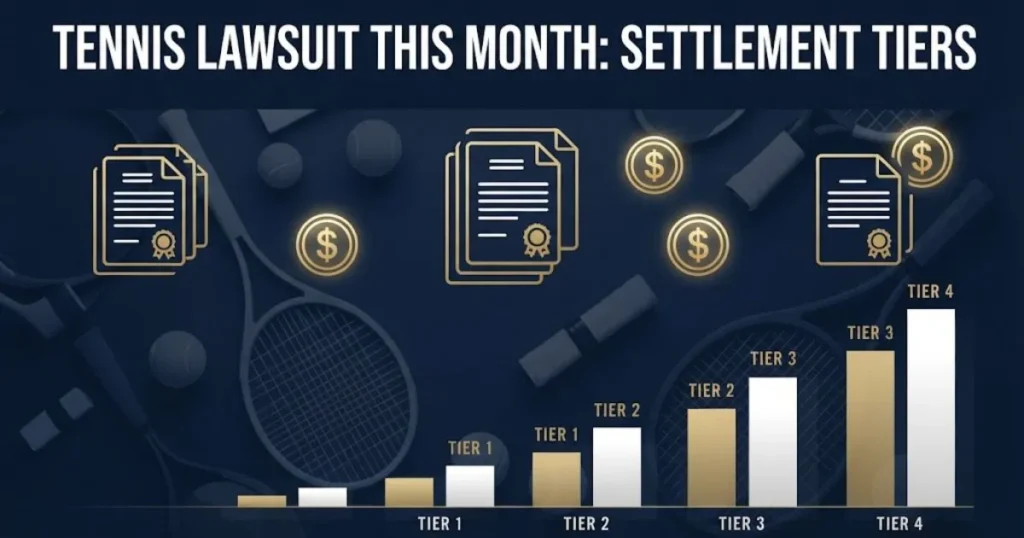
The lawsuit uses a four-tier payout system based on player type and proof. Each tier has a defined range and documentation requirement. The settlement administrator will assign your tier after reviewing your claim.
Tier 1 covers casual recreational players. These are people who played a few times a month. The estimated payout range is $50 to $300 per claimant.
Tier 2 is for regular recreational players and tournament officials. You need to show consistent play over at least two years. Payouts in this tier range from $300 to $1,500.
Tier 3 covers junior players and competitive athletes. Medical records push claims toward the higher end of the range. Expect $1,500 to $5,000 with proper documentation.
Tier 4 is reserved for coaches and facility workers. These claimants face the highest exposure and strongest health claims. Payouts could reach $2,000 to $7,500 or more.
| Tier | Player Type | Estimated Payout | Proof Required |
|---|---|---|---|
| Tier 1 | Casual player | $50 to $300 | Purchase proof only |
| Tier 2 | Regular player | $300 to $1,500 | Play history records |
| Tier 3 | Junior/competitive | $1,500 to $5,000 | Medical records |
| Tier 4 | Coach/facility worker | $2,000 to $7,500 | Employment and medical proof |
Tennis Lawsuit Filing Deadline 2026
The filing deadline for the tennis lawsuit is August 31, 2026. Claims submitted after this date will likely be rejected. The court set this deadline during the initial scheduling conference in March.
You might think that gives you plenty of time. But class action claims often require gathering old records. Tracking down receipts from 2019 takes longer than you would expect.
The deadline may be extended if the court grants a motion. Plaintiffs’ attorneys have signaled they will request a 90-day extension. But you should not count on that happening.
Filing early has real advantages. Early claims get processed first when payouts begin. They also help establish the size of the class, which affects settlement negotiations.
Critical Deadline: August 31, 2026 is the current cutoff. Mark your calendar now. Late filings are almost never accepted in federal class actions.
Key Takeaway: Compensation ranges from $50 for casual players to $7,500 for coaches, and the filing deadline of August 31, 2026 is firm unless the court grants an extension.
How to File a Tennis Lawsuit Claim
Filing a tennis lawsuit claim requires completing a claim form with purchase proof. The process is straightforward and does not require a lawyer. Most claimants finish the form in under 20 minutes.
Step one is gathering your documentation. Collect any receipts, bank statements, or photos of equipment. Tournament registrations and USTA membership cards also count as proof.
Step two is filling out the official claim form. The settlement administrator will launch the claims portal by May 2026. You will enter your personal details and upload your documents.
Step three is submitting and waiting for confirmation. You should receive an email acknowledgment within 48 hours. The administrator will review your claim and assign a tier within 60 days.
Filing Checklist:
- Government-issued photo ID
- Proof of tennis ball or grip purchases (2018 to 2025)
- Play history documentation (league records, USTA registration)
- Medical records (if claiming personal injury)
- Employment verification (for coaches and facility workers)
Tennis Lawsuit Timeline and Next Steps
The tennis lawsuit timeline spans from January 2026 through projected payouts in 2028. Class action cases move slowly, so patience is required. Here is what the next two years look like.
The discovery phase runs through the end of 2026. Both sides will exchange documents and conduct depositions. Wilson’s internal safety reports will be a major focus.
Class certification hearings are scheduled for September 2026. The judge must approve the class before the case can proceed as a group action. This is usually a formality in cases with strong evidence.
Settlement negotiations could begin as early as mid-2027. Most product liability cases settle before reaching trial. If a deal is reached, payouts would start in late 2027 or early 2028.
| Phase | Expected Date | Status |
|---|---|---|
| Initial filing | January 2026 | Complete |
| Discovery | March to December 2026 | Active |
| Class certification | September 2026 | Pending |
| Settlement talks | Mid-2027 | Anticipated |
| Payouts begin | Late 2027 to early 2028 | Projected |
Tennis Lawsuit Updates This Month
The latest tennis lawsuit update involves class certification hearings set for September 2026. Judge Martha M. Pacold will preside over the certification decision. Her ruling will determine whether the case moves forward as a class action.
In April 2026, the plaintiffs filed an amended complaint. The new filing adds 14 individual plaintiffs from eight different states. Several of these new plaintiffs are parents of junior tennis players.
Wilson’s motion to dismiss is still pending. The judge has not indicated when she will rule on it. Legal experts expect the motion to be denied based on the strength of the evidence.
A separate motion for expedited discovery was granted in March. This forces the defendants to hand over internal safety reports faster. Those documents could be damaging if they confirm prior knowledge of PFAS risks.
Latest Update: The court ordered Wilson to produce all internal PFAS testing records by June 15, 2026. This deadline is non-negotiable.
Tennis Court PFAS Lawsuit Connection
A related tennis court PFAS lawsuit targets synthetic surface coatings at public facilities. This is a separate but connected case filed in February 2026. It names court construction companies and coating manufacturers as defendants.
Many modern tennis courts use synthetic acrylic coatings. These coatings contain PFAS chemicals for weather resistance and durability. Players slide and fall on these surfaces regularly during matches.
The court surface lawsuit focuses on outdoor hard courts at public parks. Municipalities that installed these surfaces between 2015 and 2024 are affected. Rain runoff from these courts may also contaminate local water supplies.
This case could eventually merge with the equipment lawsuit. Both cases share similar chemical exposure theories and plaintiff profiles. A combined settlement would significantly increase the total compensation pool.
Think of it like the asbestos litigation of the 1980s. What started as one product case expanded into an entire industry reckoning. The tennis PFAS litigation may follow the same trajectory.
Key Detail: The EPA announced in March 2026 that it will begin testing public tennis court surfaces in 12 major U.S. cities for PFAS contamination levels.
Key Takeaway: The tennis PFAS litigation is expanding beyond equipment to include court surfaces, and the timeline suggests payouts could begin by late 2027 if settlement talks succeed.
Frequently Asked Questions
How much will I get from the tennis lawsuit?
Most claimants will receive between $50 and $5,000 depending on their tier.
Coaches and junior players with medical records qualify for the highest payouts.
The total settlement fund is projected at $180 million to $350 million.
Who qualifies for the tennis lawsuit in 2026?
Anyone who purchased tennis balls or grips from 2018 to 2025 may qualify.
You do not need a medical diagnosis to file a base economic loss claim.
Parents can file on behalf of junior players under 18 years old.
What is the deadline to file a tennis lawsuit claim?
The current filing deadline is August 31, 2026.
Claims submitted after this date will likely be rejected by the court.
File early to ensure your claim is processed first when payouts begin.
Do I need a lawyer to join the tennis lawsuit?
No, you do not need a lawyer to file a class action claim.
The settlement administrator handles the review process for all claimants.
You can hire a lawyer separately if you want to pursue an individual injury case.
What chemicals were found in tennis balls and equipment?
Lab tests found PFOA, PFOS, and GenX compounds in tennis ball felt coatings.
Volatile organic compounds were also detected in pressurized ball cans.
PFAS levels in some products tested at 14 times the EPA safe limit.
Check your eligibility and gather your purchase records now. The August 2026 deadline will arrive faster than you think. Visit the official claims portal when it launches in May to submit your form.
Stay informed as the case develops over the coming months. Class certification in September will be the next major milestone. Your claim could be worth thousands if you act before the window closes.