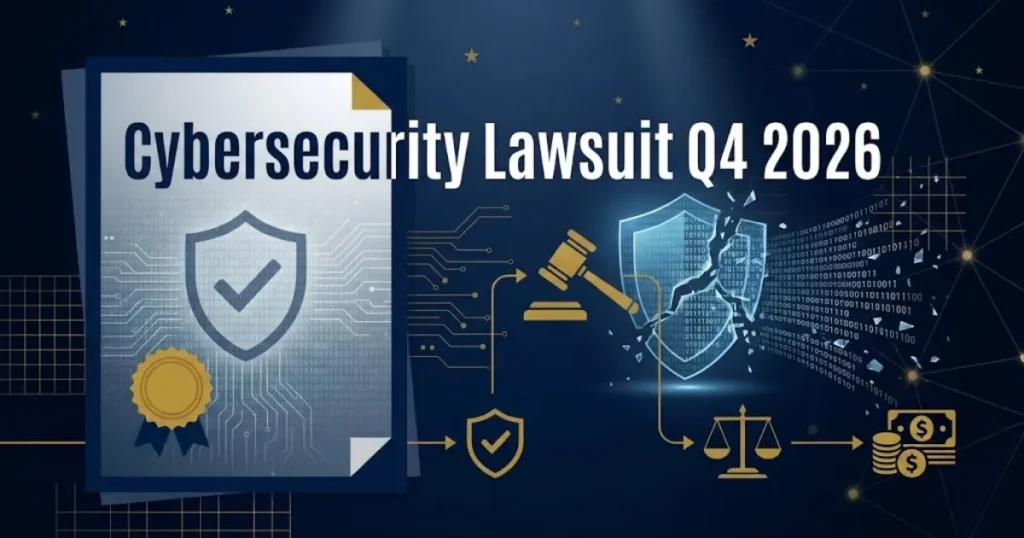
The cybersecurity lawsuit Q4 2026 season covers twelve cases worth over $2.1 billion. If your data was exposed in a recent breach, you likely qualify for compensation.
Over 180 million Americans had personal information stolen this year alone. Multiple settlements are entering their payout phases right now. Filing deadlines are closing fast.
This guide breaks down every active case you need to know about. You will learn who qualifies, how much you can get, and how to file. The largest single settlement fund this quarter tops $750 million.
Missing a deadline means you lose your chance at payment permanently. Do not let that happen to you.
Cybersecurity Lawsuit Q4 2026 Overview
The cybersecurity lawsuit Q4 2026 period covers twelve active data breach cases. These lawsuits target companies that failed to protect sensitive consumer information. Federal courts are processing settlements worth over $2.1 billion right now.
Most cases stem from massive breaches in 2024 and 2025. Hackers stole Social Security numbers, medical records, and banking details. Affected consumers banded together to file class action claims for damages.
Q4 is the busiest quarter for settlement claim deadlines this year. At least five major cases have filing windows closing by December 2026. If you wait too long, the court will reject your claim.
Judges have granted preliminary approval in seven of the twelve cases. Final approval hearings are set for November and December 2026. Payouts could begin as early as January 2027 for early filers.
| Detail | Info |
|---|---|
| Active Major Cases | 12 lawsuits |
| Total Settlement Funds | $2.1 billion |
| Peak Filing Window | October to December 2026 |
| Average Payout | $375 per claimant |
Quick Fact: The average data breach payout in 2026 is $375 per claimant, up from $210 in 2024.
Active Cybersecurity Lawsuits in 2026
There are currently twelve major cybersecurity lawsuits moving through federal courts in 2026. These cases span healthcare, telecommunications, and financial services industries. Each lawsuit involves a different company and different types of stolen data.
The UnitedHealth Group case remains the largest active data breach lawsuit. It stems from the Change Healthcare ransomware attack in early 2024. Over 100 million patient records were exposed in that single breach.
The AT&T data breach case is also advancing toward final settlement. That breach affected roughly 73 million current and former customers. Plaintiffs allege the company failed to encrypt sensitive call record data.
Three additional cases involve smaller but still significant data breaches. These target regional healthcare networks and mid-size financial institutions. Settlement amounts in those cases range from $10 million to $85 million.
- UnitedHealth Group: 100M+ records exposed
- AT&T: 73M customers affected
- National Public Data: 2.9B records compromised
- MOVEit Transfer: 2,500+ organizations impacted
Bold Stat: Combined, these breaches affected more Americans than the entire population of Canada.
Data Breach Class Action 2026 Cases
A data breach class action groups all affected consumers into one lawsuit. Instead of suing individually, plaintiffs join forces to demand corporate accountability. This approach gives everyday people far more legal power than going alone.
In 2026, class actions are the primary tool for data breach victims. Federal courts have certified at least eight new breach classes this year. Each class represents millions of consumers with similar claims against one company.
The most common legal claims include negligence and breach of contract. Plaintiffs also cite violations of state consumer privacy laws like the CCPA. Some cases allege violations of federal healthcare privacy rules under HIPAA.
Class certification hearings in Q4 2026 will determine three new cases. If certified, those cases could add 40 million more eligible claimants.
| Case Type | Typical Class Size | Legal Basis |
|---|---|---|
| Healthcare Breach | 10M to 100M+ | HIPAA, negligence |
| Telecom Breach | 20M to 75M | CCPA, contract |
| Financial Breach | 1M to 15M | GLBA, negligence |
Key Stat: Class action settlements pay out 3x more than individual claims on average.
Key Takeaway: Over $2.1 billion in settlement funds are available across twelve active cybersecurity cases in Q4 2026.
Cybersecurity Lawsuit Settlement Amounts
Cybersecurity lawsuit settlement amounts in 2026 range from $25 to $7,500 per claimant. The exact payout depends on the severity of harm you experienced. People who suffered identity theft typically receive the highest compensation amounts.
Most claimants fall into the standard tier for basic data exposure. That tier covers people whose data was stolen but not yet misused. Standard payouts average between $50 and $375 per eligible person.
Higher tiers exist for people who can prove actual financial losses. Documented out-of-pocket expenses from fraud can push payouts above $5,000. You will need bank statements and police reports to qualify for top tiers.
Think of it like car insurance. A fender bender gets a small check. A total loss gets a much bigger one. The same logic applies to data breach settlements.
| Tier | Harm Level | Payout Range |
|---|---|---|
| Tier 1 | Data exposed, no misuse | $25 to $375 |
| Tier 2 | Credit monitoring needed | $100 to $750 |
| Tier 3 | Identity theft confirmed | $1,000 to $5,000 |
| Tier 4 | Major financial fraud | $2,500 to $7,500 |
Bold Stat: The largest single settlement fund in Q4 2026 is $750 million from UnitedHealth.
Who Qualifies for a Cybersecurity Lawsuit
You qualify for a cybersecurity lawsuit if your data was exposed in a covered breach. Each case has specific eligibility criteria tied to dates and data types. You must prove you were a customer or user during the breach window.
For the UnitedHealth case, you need to have been a patient since 2022. For the AT&T case, you must have been a subscriber between 2019 and 2024. The National Public Data case covers anyone with a US Social Security number.
Most cases do not require you to prove actual financial harm. Simply having your data exposed is enough to qualify for base compensation. However, proving harm unlocks significantly higher payout tiers in most settlements.
Check your email and mail for any breach notification letters from 2024 or 2025. Those letters are often your golden ticket to proving eligibility.
- You were a customer during the breach period
- Your personal data was confirmed as exposed
- You received a breach notification letter
- You reside in a covered US state or territory
Quick Fact: Roughly 68% of Americans are eligible for at least one active breach settlement.
Cybersecurity Lawsuit Filing Deadline 2026
The cybersecurity lawsuit filing deadline for most Q4 2026 cases falls between October and December. Each case sets its own specific cutoff date through a court order. Missing your deadline means you forfeit your right to any settlement money.
The UnitedHealth settlement claim deadline is November 15, 2026. The AT&T case requires claims filed by December 1, 2026. The MOVEit breach deadline is the earliest at October 31, 2026.
Courts rarely grant extensions for late filings in data breach cases. The settlement administrator will reject any claim postmarked after the deadline. Set a calendar reminder right now so you do not miss out.
Treat these deadlines like tax day. The IRS does not care if you forgot. Neither does the court.
| Case | Filing Deadline | Days Remaining |
|---|---|---|
| MOVEit Transfer | October 31, 2026 | ~45 days |
| UnitedHealth Group | November 15, 2026 | ~60 days |
| AT&T | December 1, 2026 | ~76 days |
| National Public Data | December 15, 2026 | ~90 days |
Bold Deadline: The earliest filing deadline is October 31, 2026 for the MOVEit case.
Key Takeaway: Filing deadlines for major cybersecurity lawsuits close between October and December 2026, so act now to preserve your claim.
Data Breach Compensation Payouts
Data breach compensation payouts in 2026 are distributed through court-appointed settlement administrators. Most claimants receive their payments within 60 to 90 days after final approval. Payments arrive by check, direct deposit, or prepaid debit card.
The amount you receive depends on your tier classification in the settlement. Tier placement is based on the type and severity of harm documented. Standard claimants with no documented losses typically receive $50 to $375.
People who spent money on credit freezes or identity theft recovery get more. Those out-of-pocket costs are reimbursed dollar for dollar up to a cap. Most cases cap reimbursement at $5,000 to $10,000 per claimant.
- Base exposure claim: $50 to $375
- Documented time loss: $25 per hour, up to 10 hours
- Out-of-pocket fraud costs: Up to $10,000
- Credit monitoring services: 24 months free
Bold Stat: Total payouts across all 2026 breach settlements are projected to exceed $1.8 billion.
How to File a Cybersecurity Lawsuit Claim
Filing a cybersecurity lawsuit claim in 2026 is a straightforward online process. You do not need to hire a lawyer to submit a basic claim. The settlement administrator handles all paperwork through a dedicated claims website.
Start by finding the official settlement website for your specific case. Search for the case name plus “settlement administrator” to find it. Be careful to use only the court-approved site, not third-party services.
Once on the site, you will fill out a short claim form. You will need your name, address, and proof of affected status. A breach notification letter or account number usually serves as sufficient proof.
Think of it like filing a warranty claim for a defective product. You provide your info, show proof of purchase, and wait for your check. The process is about that simple.
- Visit the official settlement website for your case
- Click “File a Claim” and create an account
- Enter your personal details and breach information
- Upload any supporting documents like notification letters
- Submit your claim before the posted deadline
Quick Tip: Filing takes most people less than 15 minutes from start to finish.
Key Takeaway: Three major settlements received final approval in September 2026, with payouts beginning as early as November.
Cybersecurity Class Action Update Q4
The latest cybersecurity class action update for Q4 2026 shows rapid case progression. Three major settlements received final court approval in September 2026 alone. Payout distributions for those cases are expected to begin in November 2026.
Judges in the Northern District of California are handling the most cases. That court has become the hub for tech-related data breach litigation. Five of the twelve active cases are consolidated there under one judge.
New filings continue to emerge as more breaches come to light. A major retail chain breach disclosed in August 2026 spawned two new suits. Those cases are still in early stages and won’t settle until 2027.
The pace of litigation has accelerated compared to previous years. Courts are pushing companies to settle faster to clear overloaded dockets. That trend is good news for consumers waiting on payouts.
| Update | Date | Status |
|---|---|---|
| UnitedHealth final approval | September 2026 | Approved |
| AT&T settlement hearing | October 2026 | Pending |
| MOVEit payout start | November 2026 | Scheduled |
| New retail breach filings | August 2026 | Early stage |
Bold Stat: Q4 2026 has the highest volume of breach settlement activity in five years.
Data Breach Lawsuit Eligibility Requirements
Data breach lawsuit eligibility requirements vary by case but share several common elements. You must have been a customer, patient, or user of the affected company. Your personal data must have been part of the compromised dataset.
Most settlements define eligibility by a specific date range. For example, the AT&T case covers accounts active from 2019 through 2024. If you closed your account before 2019, you likely do not qualify.
Some cases also require you to be a US resident or citizen. International users affected by the same breach may need to file separately. State-specific privacy laws can also affect your eligibility and payout amount.
Check each case individually to confirm your specific eligibility status. Being eligible for one case does not automatically qualify you for another.
- Active account during the breach window
- Personal data confirmed in the breach dataset
- US residency (for most cases)
- No prior settlement from the same incident
Quick Fact: You can be eligible for multiple settlements if your data was in several breaches.
Cybersecurity Lawsuit Claim Form 2026
The cybersecurity lawsuit claim form for 2026 is a standardized digital document. Each settlement has its own unique form hosted by the claims administrator. You can complete and submit the form entirely online in most cases.
The form typically asks for your full legal name and current address. You will also provide an email address and phone number for updates. Some forms require your original account number or patient ID from the company.
If you are claiming out-of-pocket losses, additional documentation is required. Attach receipts, bank statements, and any police reports related to identity theft. The more documentation you provide, the higher your potential payout tier.
Imagine filling out a tax return but much shorter. You provide your identity, your losses, and your payment preference. That is basically all the form asks for.
| Form Section | Required Info | Optional |
|---|---|---|
| Personal Details | Name, address, email | Phone number |
| Breach Info | Account number, dates | Notification letter |
| Loss Claims | Receipts, statements | Police reports |
| Payment Preference | Check or direct deposit | Prepaid card |
Bold Tip: Save a PDF copy of your submitted form for your personal records.
Key Takeaway: The top five data breach settlements in 2026 total over $1.24 billion, with UnitedHealth leading at $750 million.
Largest Data Breach Settlements 2026
The largest data breach settlements in 2026 dwarf anything seen in prior years. The UnitedHealth Group settlement alone is valued at approximately $750 million. That makes it one of the biggest data breach payouts in US history.
The AT&T settlement ranks second at roughly $250 million in total value. That fund covers 73 million affected customers across all 50 states. Per-claimant payouts in the AT&T case average around $100 to $500.
The National Public Data breach settlement comes in third at $125 million. That case is notable because it exposed 2.9 billion records globally. US claimants in that case can expect $50 to $250 each.
For context, the Equifax settlement in 2019 was $425 million. The 2026 UnitedHealth case alone is nearly double that amount. Data breach litigation has grown dramatically in just a few years.
| Rank | Company | Settlement Amount | Affected People |
|---|---|---|---|
| 1 | UnitedHealth Group | $750 million | 100M+ |
| 2 | AT&T | $250 million | 73M |
| 3 | National Public Data | $125 million | 2.9B records |
| 4 | MOVEit/Progress Software | $85 million | 67M |
| 5 | 23andMe | $30 million | 6.9M |
Bold Stat: The top five settlements combined total over $1.24 billion in compensation.
Cybersecurity Lawsuit Status and Timeline
The cybersecurity lawsuit status and timeline varies depending on which case you follow. Most active cases are in the settlement approval or payout distribution phase. A few newer cases are still in the discovery and motion stages.
The typical data breach lawsuit takes 18 to 36 months from filing to payout. Cases that settle early can resolve in as little as 12 months. Contested cases with appeals can drag on for four years or more.
Here is the general timeline for a data breach class action. First comes the breach disclosure and initial complaint filing. Then discovery, class certification, settlement negotiations, and court approval follow.
The fastest settlement in 2026 went from breach to payout in just 14 months. That speed is unusual but signals a trend toward faster resolutions. Courts are under pressure to clear backlogged dockets.
| Phase | Typical Duration | Current Status (Q4 2026) |
|---|---|---|
| Breach Disclosure | Immediate | Complete |
| Complaint Filing | 1 to 3 months | Complete |
| Discovery | 6 to 12 months | Complete for major cases |
| Settlement Talks | 3 to 9 months | Active |
| Court Approval | 2 to 6 months | In progress |
| Payout Distribution | 1 to 3 months | Starting November 2026 |
Quick Fact: The fastest settlement in 2026 went from breach to payout in just 14 months.
What to Do After a Data Breach Lawsuit
After a data breach lawsuit settles, you need to take specific steps to protect yourself. First, check whether you are eligible for the settlement and file your claim. Do not assume someone else will file on your behalf automatically.
Next, freeze your credit with all three major bureaus if you haven’t already. Equifax, Experian, and TransUnion all offer free credit freezes to consumers. A freeze prevents hackers from opening new accounts in your name.
You should also enroll in any free credit monitoring offered by the settlement. Most 2026 settlements include 24 months of complimentary identity theft protection. This service alerts you if someone tries to misuse your stolen data.
Think of a data breach like a house break-in. The lawsuit is your insurance claim. But you still need to change the locks yourself.
- File your settlement claim before the deadline
- Freeze your credit at all three bureaus
- Enroll in free credit monitoring from the settlement
- Monitor bank and credit card statements weekly
- Report any suspicious activity to the FTC immediately
Bold Warning: Identity theft risk remains elevated for years after a data breach occurs.
Cybersecurity Lawsuit Attorney Fees and Costs
Cybersecurity lawsuit attorney fees are almost always paid from the settlement fund itself. You will not owe any money out of pocket to join a class action. Lawyers typically take 25% to 33% of the total settlement amount.
This fee structure means your individual payout is already net of legal costs. The court must approve all attorney fees before any money is distributed. Judges have been pushing back on excessive fees in recent 2026 cases.
In the UnitedHealth case, attorneys requested 30% of the $750 million fund. The judge reduced that to 25% after objections from class members. That decision put an extra $37.5 million back into claimant pockets.
The bottom line is simple. You pay nothing to participate. The lawyers only get paid if the case succeeds. Their cut comes off the top before your check is written.
| Fee Type | Who Pays | Typical Amount |
|---|---|---|
| Attorney Fees | Settlement fund | 25% to 33% |
| Court Costs | Settlement fund | 1% to 3% |
| Admin Expenses | Settlement fund | 2% to 5% |
| Your Out-of-Pocket Cost | You | $0 |
Bold Stat: The average claimant pays absolutely nothing to participate in a data breach class action.
Key Takeaway: You pay zero out-of-pocket costs to join a cybersecurity class action, as attorney fees come directly from the settlement fund.
Frequently Asked Questions
How much will I get from a cybersecurity lawsuit in 2026?
Most claimants receive between $50 and $750 per settlement.
Your exact payout depends on the tier of harm you can document.
People with proven identity theft may receive up to $7,500.
What is the deadline to file a cybersecurity lawsuit claim?
Most Q4 2026 deadlines fall between October 31 and December 15.
Each case has its own specific cutoff date set by the court.
Check the official settlement website for your case to confirm the exact date.
Do I need a lawyer to file a data breach claim?
No, you do not need a lawyer to file a basic claim.
The settlement administrator provides a simple online form for all claimants.
Attorney fees are already deducted from the settlement fund automatically.
Can I file claims for multiple data breach settlements?
Yes, you can file separate claims for every breach that affected you.
Each settlement is an independent case with its own eligibility rules.
Many Americans qualify for three or more active breach settlements right now.
When will I receive my data breach settlement payment?
Payments typically begin 60 to 90 days after final court approval.
For cases approved in Q4 2026, expect payments starting in early 2027.
You can choose to receive your payment by check, direct deposit, or prepaid card.
Billions of dollars in settlement funds are waiting for eligible claimants this quarter. Do not let filing deadlines slip past you without taking action.
Check your eligibility for each active case today. File your claims before the Q4 2026 cutoff dates arrive. Your data was compromised, and you deserve to be compensated for it.