The top NHL lawsuit in 2026 is the concussion and CTE class action. Former players are still drawing from an $18.9 million settlement fund. This is the biggest legal battle in hockey history.
Thousands of retired players filed claims over brain injuries. Many suffered repeated head trauma during their careers. The settlement aims to compensate them for lasting harm.
This article covers every detail you need right now. You will learn about payouts, deadlines, and eligibility. We also break down the claims process step by step.
Over 300 former players have already received payments. The fund remains active as of early 2026.
Top NHL Lawsuit Overview
The top NHL lawsuit is the concussion class action filed by former players. It targets the league for failing to warn about brain injury risks. The case began in federal court in 2013.
Players alleged the NHL concealed the dangers of head trauma. They argued the league prioritized violence over safety. The lawsuit eventually included hundreds of retired athletes.
Judge Susan Richard Nelson oversaw the case in Minnesota. She handled proceedings in the U.S. District Court. The parties reached a settlement in November 2018.
The approved deal was worth approximately $18.9 million. It funds medical monitoring and direct financial compensation. The NHL did not admit any wrongdoing as part of the deal.
This case stands as a landmark in sports law. It mirrors similar battles fought in football and other contact sports. Retired hockey players continue to seek their share in 2026.
| Detail | Info |
|---|---|
| Case Filed | 2013 |
| Settlement Year | 2018 |
| Total Fund | $18.9 million |
| Presiding Judge | Susan Richard Nelson |
| Court | U.S. District Court, Minnesota |
NHL Concussion Lawsuit 2026 Updates
The NHL concussion lawsuit in 2026 is in its payout distribution phase. The settlement fund is still processing approved claims. New filings are being reviewed on a rolling basis.
The settlement administrator continues to evaluate medical records. Former players must submit updated neurological testing results. Claims are scored based on the severity of cognitive decline.
Several high-profile former players have spoken out recently. They argue the settlement amount is far too low. Some believe the fund should be closer to the NFL deal.
Legal teams are monitoring the remaining fund balance closely. Distribution rates have slowed compared to earlier years. This suggests the fund may be approaching its final stages.
Players who filed early have generally received their payments. Those with pending claims face longer wait times in 2026. The court has not announced a final closure date yet.
Quick Fact: The average processing time for new claims in 2026 is approximately 6 to 9 months.
NHL CTE Settlement Update for 2026
The NHL CTE settlement update for 2026 shows ongoing claim activity. CTE stands for chronic traumatic encephalopathy. It is a degenerative brain disease linked to repeated head impacts.
The settlement recognizes CTE as a qualifying condition for compensation. Players diagnosed with CTE or related disorders can file claims. Medical documentation from a qualified neurologist is required.
Recent court filings indicate the fund has paid out over $12 million so far. That leaves roughly $6.9 million for remaining claimants. The pace of payouts has slowed in recent quarters.
CTE can only be definitively diagnosed after death. Living players must rely on symptom-based evaluations instead. This makes the claims process more complex for current filers.
Families of deceased players can also file claims. They must provide autopsy results confirming a CTE diagnosis. These claims are typically processed faster than living claimant filings.
| Claim Type | Status in 2026 |
|---|---|
| Living players with symptoms | Active, 6 to 9 month wait |
| Deceased players with CTE autopsy | Active, 3 to 5 month wait |
| Pending appeals | Under review |
| Fund remaining | Approximately $6.9 million |
Key Takeaway: The NHL concussion settlement is still active in 2026, but the fund is shrinking and claim processing times are getting longer.
NHL Class Action Lawsuit Payout Details
The NHL class action lawsuit payout varies by individual claim severity. There is no single flat payment for all former players. Each claim is evaluated on its own medical merits.
Payouts are calculated using a point-based scoring system. Factors include years played, position, and diagnosed conditions. Players with more severe cognitive decline receive higher amounts.
Most approved claimants have received between $2,000 and $50,000. The highest payouts go to players with confirmed CTE diagnoses. Lower-tier claims cover basic medical monitoring costs.
The settlement also funds a medical monitoring program. This program provides neurological testing at no cost to eligible players. It operates separately from the direct cash compensation.
Payment amounts have not increased since the original settlement. The $18.9 million cap means funds are finite. Once the money runs out, no additional payouts will be issued.
| Payout Category | Estimated Range |
|---|---|
| Basic medical monitoring | $500 to $2,000 |
| Mild cognitive impairment | $2,000 to $15,000 |
| Moderate cognitive decline | $15,000 to $35,000 |
| Severe CTE or dementia | $35,000 to $50,000 |
NHL Lawsuit Settlement Amount Breakdown
The NHL lawsuit settlement amount totals $18.9 million before legal fees. This figure was agreed upon by both sides in 2018. The court approved it as fair and reasonable.
Attorney fees and administrative costs are deducted first. Legal fees account for roughly one-third of the total fund. That leaves approximately $12.6 million for direct player compensation.
Compared to the NFL settlement, this number is strikingly small. The NFL concussion deal exceeded $1 billion in total payouts. The NHL fund is less than 2 percent of that amount.
The smaller fund reflects the NHL’s smaller player pool. Fewer players filed claims compared to football. The league also argued that hockey carries lower concussion risk.
Critics say the amount does not match the severity of injuries. Many former players live with debilitating neurological conditions. They argue the settlement undervalues their long-term suffering.
Bold Stat: The NHL settlement is roughly 1.9 percent the size of the NFL concussion deal.
NHL Brain Injury Lawsuit Eligibility Rules
NHL brain injury lawsuit eligibility depends on your playing history. You must have played in the NHL or its affiliated leagues. The settlement covers specific time periods and team rosters.
Eligible players include those who appeared in at least one NHL game. Minor league players on NHL-affiliated rosters may also qualify. The key factor is documented exposure to league play.
You do not need a formal CTE diagnosis to be eligible. Players with post-concussion syndrome or memory loss can file. The settlement covers a range of neurological conditions.
Family members of deceased players can file on their behalf. They must provide proof of the player’s NHL career. Autopsy results strengthen the claim but are not always required.
Players who opted out of the settlement are not eligible. The opt-out window closed several years ago. If you opted out, you retained the right to sue individually.
| Eligibility Factor | Requirement |
|---|---|
| League | NHL or NHL-affiliated minor league |
| Games Played | At least one professional game |
| Condition | Neurological or cognitive impairment |
| Opt-Out Status | Must not have opted out |
| Documentation | Medical records and career verification |
NHL Concussion Lawsuit Qualifications Explained
NHL concussion lawsuit qualifications center on medical evidence and career history. You must demonstrate a link between hockey and your condition. The settlement administrator reviews each claim individually.
Qualifying conditions include CTE, dementia, and Alzheimer’s disease. Post-concussion syndrome and depression also qualify under the terms. The condition must be documented by a licensed neurologist.
Your playing career must fall within the covered time frame. The settlement generally covers players active before 2014. Players who entered the league after that date face stricter scrutiny.
The severity of your condition affects your qualification tier. Mild symptoms may qualify you for medical monitoring only. Severe cognitive decline opens the door to direct cash payments.
Think of it like an insurance claim after a car accident. You need proof of the crash and proof of your injuries. The same logic applies to this settlement process.
Quick Fact: Over 1,200 former players were part of the original class. Not all of them have filed individual claims yet.
Key Takeaway: Eligibility requires NHL playing history, a qualifying neurological condition, and proper medical documentation. The earlier you file, the better your chances of receiving payment.
How to File an NHL Concussion Claim
Filing an NHL concussion claim starts with contacting the settlement administrator. The current administrator is Gilardi and Co. They manage all claim intake and processing.
You will need to complete a detailed claim form. This form asks about your playing career and medical history. Be prepared to list every team you played for and when.
Medical records are the most important part of your claim. You must submit neurological evaluations and cognitive test results. A qualified neurologist must document your current condition.
The administrator will review your submission within several months. They may request additional testing or documentation. Respond quickly to any requests to avoid delays.
Once your claim is approved, you will receive a payment notice. The notice explains your tier level and payout amount. Payments are typically issued by check within 60 days of approval.
| Filing Step | What You Need |
|---|---|
| Step 1: Contact administrator | Name, contact info, career dates |
| Step 2: Complete claim form | Playing history, team roster details |
| Step 3: Submit medical records | Neurological evaluations, test results |
| Step 4: Respond to requests | Additional testing if asked |
| Step 5: Receive payment | Approved tier and payout notice |
NHL Concussion Settlement Tiers and Levels
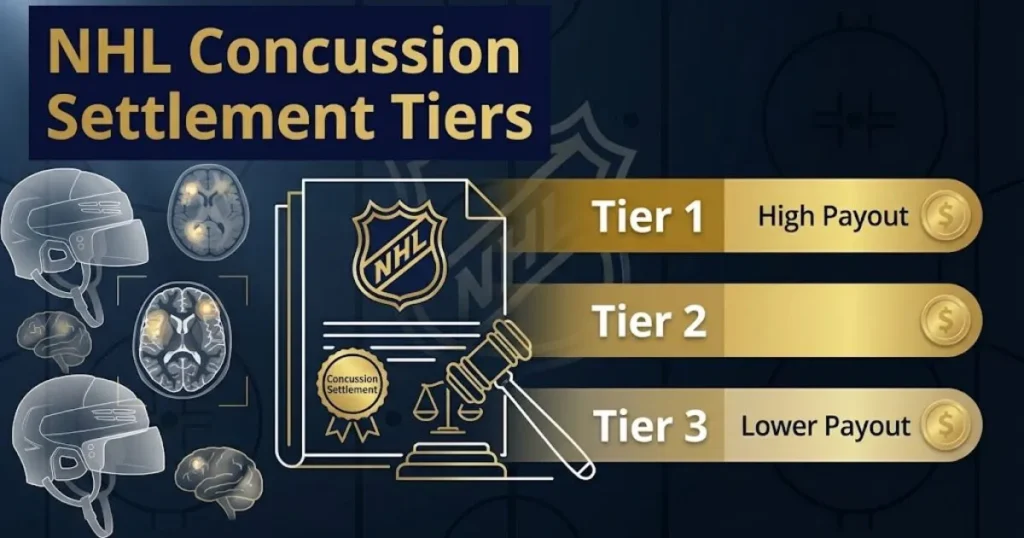
The NHL concussion settlement tiers determine how much each player receives. The system uses a scoring grid based on medical severity. Higher scores mean higher payouts.
Tier 1 covers players with mild cognitive symptoms. These claimants typically receive medical monitoring benefits. Cash payouts at this level range from $500 to $2,000.
Tier 2 includes moderate cognitive impairment diagnoses. Players in this tier may receive $15,000 to $35,000. Conditions like early-stage dementia fall into this category.
Tier 3 is reserved for the most severe cases. Confirmed CTE, advanced dementia, and ALS qualify here. Payouts at this level can reach up to $50,000.
The tier system has drawn criticism from some players. They argue the caps are too low for life-altering conditions. The court has not indicated any plans to adjust the tiers.
| Tier | Condition Level | Payout Range |
|---|---|---|
| Tier 1 | Mild symptoms | $500 to $2,000 |
| Tier 2 | Moderate impairment | $15,000 to $35,000 |
| Tier 3 | Severe CTE or dementia | $35,000 to $50,000 |
NHL Concussion Lawsuit Deadline 2026
The NHL concussion lawsuit deadline in 2026 has not been officially set. The court has not announced a final cutoff date. However, the shrinking fund creates a practical deadline.
Claims are processed on a first-come, first-served basis. As the fund depletes, later filers may receive reduced payments. This makes early filing a smart move for eligible players.
The settlement administrator has urged players not to wait. Delays in filing could mean missing out entirely. Once the fund is exhausted, no further claims will be paid.
There is no hard calendar deadline posted for 2026. The court retains the authority to set one at any time. Players should monitor official settlement communications for updates.
If you are eligible, treat this as urgent. The window is narrowing even without a formal cutoff. Filing now gives you the best chance of full compensation.
Bold Deadline Warning: The remaining fund balance of approximately $6.9 million could be depleted within 12 to 18 months at current payout rates.
NHL Lawsuit Payment Timeline
The NHL lawsuit payment timeline varies depending on your claim status. New claims filed in 2026 face a 6 to 9 month review period. Previously approved claims are paid within 60 days of approval.
The initial review phase takes the longest. The administrator must verify your career history and medical records. Any missing documents will pause the clock until you respond.
Once approved, your claim enters the payment queue. Payments are issued in batches on a quarterly schedule. Most claimants receive a single lump-sum check.
Players with complex medical histories may face longer timelines. Cases involving disputed diagnoses can take over a year. Appeals add additional months to the process.
The overall settlement timeline has stretched far beyond expectations. The original deal was approved in 2018. Eight years later, claims are still being processed.
| Phase | Estimated Duration |
|---|---|
| Initial claim review | 3 to 6 months |
| Medical verification | 2 to 4 months |
| Approval and payment | 1 to 2 months |
| Appeals (if needed) | 3 to 6 months |
| Total (typical) | 6 to 12 months |
Key Takeaway: The settlement fund is finite and shrinking. Filing sooner rather than later gives you the best shot at receiving your full entitled payout before the money runs out.
NHL CTE Lawsuit for Former Players
The NHL CTE lawsuit for former players addresses a devastating brain disease. CTE is caused by repeated blows to the head over many years. It leads to memory loss, depression, and cognitive decline.
Many former NHL enforcers and physical players are affected. Players in fighting-heavy roles face the highest risk. The settlement specifically recognizes CTE as a compensable condition.
Diagnosing CTE in living patients remains a medical challenge. Doctors rely on symptom patterns and brain imaging. Definitive diagnosis still requires a post-mortem brain examination.
Families of players who died with CTE can file claims. Autopsy results from brain banks strengthen these filings. The settlement administrator gives these claims priority processing.
The emotional toll on families is significant. Many describe watching their loved ones deteriorate over years. The settlement provides some financial relief but cannot reverse the damage.
Quick Fact: A 2023 study found CTE in the brains of over 90 percent of donated athlete brains examined. Hockey players were well represented in the sample.
NHL Class Action Settlement Fund Status
The NHL class action settlement fund started with $18.9 million. As of early 2026, approximately $12 million has been distributed. That leaves roughly $6.9 million for remaining claimants.
The fund covers three main expense categories. These are direct player payouts, medical monitoring costs, and legal fees. Attorney fees consumed about one-third of the original amount.
The medical monitoring program continues to operate separately. It provides free neurological testing to eligible former players. This program is funded through a dedicated portion of the settlement.
Fund administrators report quarterly to the court. These reports detail the number of claims processed and paid. Recent reports show a declining pace of new approvals.
The fund will eventually run out of money. When that happens, the settlement will effectively close. No additional funding from the NHL is required under the current terms.
| Fund Category | Amount |
|---|---|
| Original total | $18.9 million |
| Distributed to date | ~$12 million |
| Remaining balance | ~$6.9 million |
| Legal fees (estimated) | ~$6.3 million |
| Medical monitoring | Ongoing, separate allocation |
NHL Lawsuit vs NFL Concussion Settlement
The NHL lawsuit vs NFL concussion settlement comparison reveals a massive gap. The NFL deal is worth over $1 billion in total payouts. The NHL settlement is just $18.9 million.
The NFL settlement covers approximately 20,000 retired players. The NHL class includes roughly 1,200 former players. Even adjusting for size, the per-player difference is enormous.
NFL players with CTE can receive up to $4 million each. The NHL cap sits at around $50,000 per claimant. That is an 80-fold difference in maximum payouts.
The NFL deal also includes uncapped medical monitoring. NHL monitoring is limited to the settlement fund allocation. Once the NHL fund is gone, the monitoring program ends.
Why the huge gap? The NFL faced stronger evidence of concealment. The league also had far more public pressure and media scrutiny. Hockey’s concussion crisis received less national attention.
| Comparison Point | NHL Settlement | NFL Settlement |
|---|---|---|
| Total fund | $18.9 million | $1 billion+ |
| Players covered | ~1,200 | ~20,000 |
| Max individual payout | ~$50,000 | ~$4 million |
| Medical monitoring | Capped | Uncapped |
| Year approved | 2018 | 2015 |
Key Takeaway: The NHL settlement is dramatically smaller than the NFL deal in every measurable category. Former hockey players receive a fraction of what their football counterparts get for similar injuries.
Frequently Asked Questions
How much can I get from the NHL concussion lawsuit?
Most approved claimants receive between $2,000 and $50,000.
The exact amount depends on your diagnosis severity and career history.
Severe CTE cases receive the highest payouts under the tier system.
Who qualifies for the NHL CTE settlement?
You must have played at least one game in the NHL or an affiliated league.
You also need documented neurological impairment from a licensed neurologist.
Family members of deceased players can file claims with autopsy evidence.
Is the NHL lawsuit still accepting claims in 2026?
Yes, the settlement is still accepting and processing claims in 2026.
No official cutoff date has been announced by the court yet.
However, the shrinking fund balance makes early filing strongly advisable.
How long does an NHL settlement claim take to process?
Most new claims take 6 to 12 months from filing to payment.
Complex cases with disputed diagnoses can take longer than a year.
Responding quickly to document requests helps speed up the timeline.
What is the difference between the NHL and NFL concussion settlements?
The NFL settlement is worth over $1 billion while the NHL deal is $18.9 million.
NFL players can receive up to $4 million each compared to $50,000 in the NHL.
The NFL also provides uncapped medical monitoring unlike the NHL’s limited program.
The top NHL lawsuit remains a critical issue for former players in 2026. The settlement fund is shrinking and time is running short.
If you played professional hockey and suffer from cognitive issues, check your eligibility now. File your claim as soon as possible to secure your share.
Stay informed about deadline announcements and fund balance updates. The window to act will not stay open forever.