Developing AI lawsuit filings have surged dramatically in 2026. Federal courts are now hearing dozens of major cases. Tech companies face billions in potential liability.
Artists, writers, and everyday workers all have active claims. The biggest cases involve AI training on copyrighted work. Settlements could start paying out later this year.
This guide covers payouts, deadlines, and who qualifies. You will learn exactly how to check your options. The rules are changing fast, so timing matters.
One single case could exceed $10 billion in damages. That would make it the largest tech settlement ever. Read on to find out if you have a claim.
Developing AI Lawsuit 2026 Overview
A developing AI lawsuit is any active legal case involving artificial intelligence harm. These cases target the companies building and deploying AI systems.
In 2026, the most common claims involve copyright and data theft. Plaintiffs argue that AI firms used their work without permission.
The defendants include OpenAI, Google, Meta, and Stability AI. Each company faces multiple lawsuits across different federal courts.
Copyright claims make up about 60 percent of all AI cases. Privacy and discrimination claims account for most of the rest.
| Detail | Info |
|---|---|
| Active Cases | Over 40 |
| Top Defendants | OpenAI, Google, Meta |
| Main Claim Type | Copyright infringement |
| Estimated Total Exposure | $15 billion+ |
Most cases are still in the discovery phase right now. A few have moved to settlement negotiations this year.
The legal theory behind these cases is fairly straightforward. AI companies scraped billions of pieces of content to train models. They did not ask permission or pay for that content.
Courts are now deciding whether that counts as fair use. The outcome will reshape how AI companies operate going forward.
AI Copyright Infringement Lawsuit
An AI copyright infringement lawsuit claims that AI companies copied protected work illegally. These are the most common AI cases in 2026.
The New York Times sued OpenAI and Microsoft in late 2023. That case is still active in the Southern District of New York. The Times is seeking billions in damages.
The Authors Guild filed a similar case on behalf of fiction writers. They argue that GPT models were trained on their books. No licensing agreements were ever signed.
Getty Images also sued Stability AI in both the US and UK. The claim is that Stable Diffusion was trained on Getty photos. The watermark evidence is hard to dispute.
- The New York Times v. OpenAI: Filed December 2023
- Authors Guild v. OpenAI: Filed September 2023
- Getty Images v. Stability AI: Filed January 2023
Think of it like a photocopy shop reproducing your book. They sell copies and keep all the profit. That is essentially what these lawsuits allege.
Courts have not yet issued final rulings on the fair use question. Most legal experts expect key decisions by late 2026.
AI Training Data Lawsuit
An AI training data lawsuit focuses on the raw data used to build AI models. The core claim is that this data was taken without consent.
AI models like GPT-4 and Stable Diffusion require massive datasets. Companies like Common Crawl and LAION assembled these datasets. They scraped the open web without asking content owners.
The problem is that “open web” does not mean “free to use.” Copyright law still applies to publicly accessible content. That is the argument plaintiffs are making.
| Dataset | Estimated Size | Key Lawsuit |
|---|---|---|
| Common Crawl | 3.1 billion pages | Multiple |
| LAION-5B | 5.85 billion images | Getty v. Stability AI |
| Books3 | 196,000 books | Authors Guild v. OpenAI |
Several judges have allowed these cases to proceed past early motions. That is a significant win for plaintiffs. It means the claims are legally plausible.
The AI companies argue that training on data is transformative use. They compare it to a student reading books in a library. Courts have not yet accepted that analogy.
Key Takeaway: Over 40 active AI lawsuits target copyright, training data, and privacy violations, with potential total exposure exceeding $15 billion.
OpenAI Lawsuit Update 2026
The OpenAI lawsuit update for 2026 shows the company facing at least 12 active cases. These span copyright, privacy, and consumer fraud claims.
The biggest case remains The New York Times v. OpenAI. Discovery is ongoing, and internal emails are being produced. Those emails may show what OpenAI knew about copyright risks.
A newer case involves several major publishers suing over GPT-4 training. They claim OpenAI built a shadow library of pirated books. The evidence includes torrent download records.
| Case | Status | Court |
|---|---|---|
| NYT v. OpenAI | Discovery | SDNY |
| Authors Guild v. OpenAI | Discovery | SDNY |
| Publishers v. OpenAI | Early stage | NDCA |
| Doe v. OpenAI (Privacy) | Motion phase | NDCA |
OpenAI has argued that its use of training data is fair use. The company says AI training is like human learning. Courts are skeptical of that comparison so far.
Settlement talks have reportedly started in at least two cases. No terms have been made public yet. Any deal could set a template for the entire industry.
AI Lawsuit Settlement Amounts
AI lawsuit settlement amounts in 2026 are expected to range widely. Individual payouts could fall between $100 and $10,000 per claim.
The exact amount depends on the type of harm you suffered. Copyright holders with registered works will likely receive more. Casual internet users may receive smaller payments.
No major AI settlement has been finalized as of early 2026. However, legal analysts project total payouts could reach billions. The New York Times case alone seeks $10 billion.
| Claim Type | Estimated Range | Likelihood |
|---|---|---|
| Registered copyright | $1,000 to $10,000 | Moderate |
| Unregistered content | $100 to $1,000 | Low to moderate |
| Privacy violation | $500 to $5,000 | Moderate |
| Employment discrimination | $2,000 to $25,000 | Case dependent |
Think of it like the Facebook privacy settlement of 2022. Most people got between $30 and $75. High-profile AI cases could pay significantly more.
Settlement funds are typically divided among all eligible claimants. The more people who file, the smaller each individual share becomes. Filing early can sometimes improve your position.
Who Qualifies for AI Lawsuit
You qualify for an AI lawsuit if a tech company used your work or data without consent. That includes writers, artists, photographers, and musicians.
Workers who were harmed by AI hiring tools may also qualify. So can consumers whose personal data was used to train AI models.
Each case has its own specific eligibility rules. The New York Times case is limited to the Times itself. The Authors Guild case covers thousands of individual writers.
- Writers and journalists whose articles were used in AI training
- Visual artists whose images appear in AI-generated outputs
- Musicians whose recordings trained AI music generators
- Job applicants rejected by biased AI screening tools
- Consumers whose personal data was scraped without notice
You do not need to have filed a copyright registration to qualify. Some cases accept claims from anyone whose content was scraped. Check the specific case details for your situation.
The easiest way to check is to search for your name or work. Several AI training datasets are now searchable online. If your content appears, you likely have a claim.
Key Takeaway: Settlement amounts could range from $100 to $25,000 depending on your claim type, and eligibility extends to creators, workers, and everyday consumers.
AI Deepfake Lawsuit
An AI deepfake lawsuit targets the creation of fake images, videos, or audio using AI. These cases are growing fast in 2026.
Most deepfake lawsuits involve the unauthorized use of someone’s likeness. Celebrities have filed the most cases so far. But ordinary people are now suing too.
A major 2025 case involved a woman whose face was used in fake ads. The AI company had scraped her social media photos. The court awarded her $250,000 in damages.
Several states have passed new deepfake laws in 2025 and 2026. California, Texas, and New York now allow civil lawsuits. You can sue even if no criminal charges were filed.
| State | Deepfake Law | Damages Available |
|---|---|---|
| California | Yes (2025) | Up to $150,000 |
| Texas | Yes (2025) | Up to $100,000 |
| New York | Yes (2026) | Up to $200,000 |
| Illinois | Pending | Not yet set |
The legal theory is based on the right of publicity. Every person owns the commercial rights to their own face and voice. AI deepfakes violate that right when used for profit.
If someone created a deepfake of you without permission, you may have a case. Document everything and save screenshots immediately.
AI Bias Discrimination Lawsuit
An AI bias discrimination lawsuit claims that an AI system treated people unfairly based on race, gender, or age. These cases are gaining momentum in 2026.
The most common target is AI hiring and screening tools. Companies use AI to sort through job applications automatically. Studies show these tools often penalize certain demographics.
A 2025 case against a major retailer alleged that its AI screener rejected older applicants at twice the rate. The EEOC joined the investigation. A settlement is expected in 2026.
The legal basis for these claims comes from existing civil rights laws. Title VII of the Civil Rights Act applies to AI tools. So does the Age Discrimination in Employment Act.
- Hiring algorithms that screen out protected groups
- Lending AI that denies loans based on zip code
- Healthcare AI that underestimates pain in certain patients
- Housing algorithms that steer ads away from minorities
The burden of proof is shifting in 2026. Courts are starting to require AI companies to prove their tools are fair. That is a big change from previous years.
If you were denied a job, loan, or housing by an AI system, you may have a claim. The key is showing that the AI caused a disparate impact.
AI Employment Lawsuit
An AI employment lawsuit involves workers harmed by AI decisions in the workplace. This includes hiring, firing, scheduling, and performance reviews.
In 2026, several delivery companies face lawsuits over AI scheduling. Workers claim the AI system assigned fewer hours to older employees. The pattern was consistent across multiple locations.
Another major case involves AI surveillance tools monitoring warehouse workers. The system allegedly flagged bathroom breaks as “unproductive time.” Workers were disciplined based on AI scores alone.
| Claim Type | Example | Law Cited |
|---|---|---|
| Hiring bias | AI rejects older applicants | ADEA |
| Scheduling | AI cuts hours for parents | Title VII |
| Surveillance | AI tracks bathroom breaks | State privacy laws |
| Firing | AI terminates without review | Wrongful termination |
The Department of Labor issued new AI workplace guidelines in early 2026. These guidelines strengthen worker protections against automated decisions. Employers must now provide human review of AI actions.
Think of it like a robot boss making all the decisions. If that robot discriminates, the company is still legally responsible. The AI is just the tool.
Workers who believe AI harmed their employment should document everything. Save emails, schedules, and performance reports. Those records will be essential for any claim.
Key Takeaway: AI deepfake, bias, and employment lawsuits are expanding rapidly in 2026, with new state laws and federal guidelines giving plaintiffs stronger grounds to sue.
AI Class Action Lawsuit
An AI class action lawsuit groups thousands of affected people into a single case. This is the most common format for AI litigation in 2026.
Class actions make sense because AI harm affects millions of people. Individual claims would be too small to pursue alone. A class action pools resources and increases leverage.
The largest AI class action currently involves over 200,000 photographers. They claim Stability AI used their images without permission. The case is in the Northern District of California.
Another major class action represents freelance writers. Their articles were allegedly used to train large language models. The class was certified in early 2026.
- Photographers v. Stability AI: 200,000+ class members
- Writers v. OpenAI: Class certified January 2026
- Consumers v. Meta: Pending certification
- Job Applicants v. Hiring AI Co.: Early stage
To join a class action, you typically receive a notice by mail or email. You can also check court records for active cases. Most class actions have an opt-out deadline.
If you do nothing, you are usually included automatically. But you must file a claim form to receive any money. Missing that step means you get nothing.
AI Developer Liability
AI developer liability refers to the legal responsibility of companies that build AI systems. In 2026, courts are expanding who can be held accountable.
Traditionally, tech companies hid behind Section 230 protections. That law shields platforms from liability for user content. But courts are ruling that AI-generated content is different.
A federal judge ruled in 2025 that AI outputs are not “user content.” That means Section 230 does not protect AI developers. This ruling opened the floodgates for new lawsuits.
| Legal Theory | Applies To | Status in 2026 |
|---|---|---|
| Direct infringement | AI model creators | Active |
| Contributory infringement | Data providers | Active |
| Negligence | AI deployers | Growing |
| Strict liability | Autonomous AI | Emerging |
Developers can now be sued for the outputs their AI produces. That includes defamatory text, infringing images, and biased decisions. The legal shield is cracking.
This shift is similar to what happened with social media in the 2010s. Platforms were once untouchable. Now they face constant litigation. AI companies are following the same path.
How to File AI Lawsuit
You can file an AI lawsuit by joining an existing class action or starting an individual claim. Most people join class actions because it costs nothing upfront.
The first step is to identify which AI company used your work or data. Search your name in public AI training datasets. Several free tools now make this possible.
Next, find the specific case that covers your situation. Court records are public and searchable by defendant name. Look for cases in the Southern District of New York or Northern District of California.
- Step 1: Search AI training datasets for your content
- Step 2: Identify the relevant active lawsuit
- Step 3: Check the eligibility requirements for that case
- Step 4: Submit a claim form before the deadline
- Step 5: Keep records of your original work and any AI outputs
You do not need to hire your own lawyer for a class action. The class counsel handles the legal work. Their fees come out of the settlement fund.
For individual claims, you will need an attorney who specializes in IP or tech law. Many offer free initial consultations. Some work on contingency, meaning they only get paid if you win.
Key Takeaway: Joining an AI class action is free and straightforward, but you must actively file a claim form to receive any settlement money.
AI Lawsuit Deadline 2026
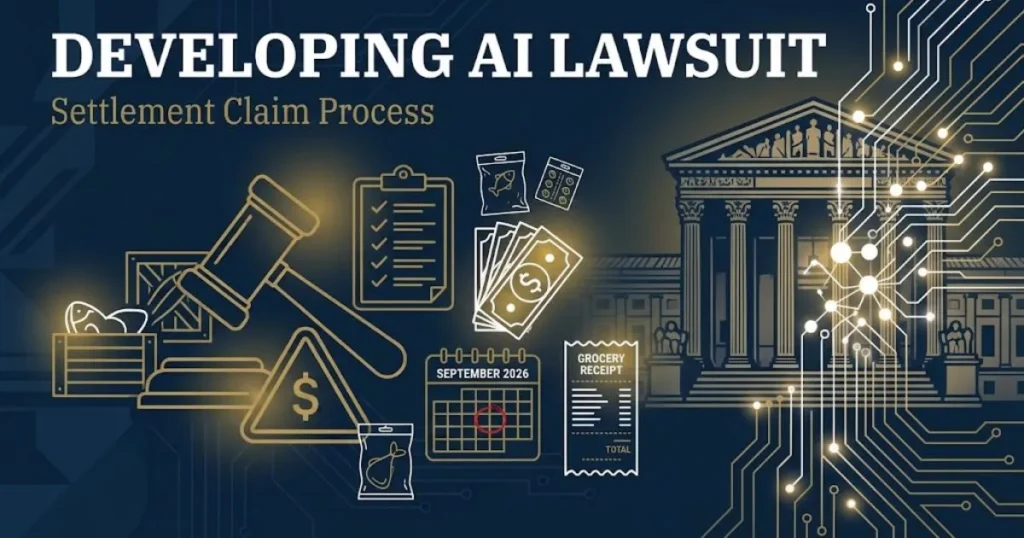
The AI lawsuit deadline in 2026 varies by case, but most claim windows close between June and December 2026. Missing the deadline means you lose your right to compensation.
The Authors Guild case has a filing deadline of August 15, 2026. The Stability AI photographer case closes on October 1, 2026. Other cases have rolling deadlines.
Courts set these deadlines during the class certification process. Once the deadline passes, no new claims are accepted. There are very few exceptions to this rule.
| Case | Filing Deadline | Status |
|---|---|---|
| Authors Guild v. OpenAI | August 15, 2026 | Open |
| Photographers v. Stability AI | October 1, 2026 | Open |
| NYT v. OpenAI | Not yet set | Discovery |
| Consumers v. Meta | TBD | Pending certification |
Some cases have not set deadlines yet because they are still early. That does not mean you should wait. Early filers sometimes receive priority in settlement distributions.
Set a calendar reminder right now for the deadlines that apply to you. Treat it like a tax deadline. If you miss it, there is no extension.
AI Lawsuit Compensation
AI lawsuit compensation refers to the money you can receive if your claim is successful. In 2026, compensation models are still being established.
For copyright claims, compensation is typically based on the value of your work. A bestselling author will receive more than a casual blogger. The court considers the scope of the infringement.
For privacy and discrimination claims, compensation depends on the harm you suffered. Lost wages, emotional distress, and reputational damage all factor in.
| Harm Type | Compensation Basis | Estimated Range |
|---|---|---|
| Copyright infringement | Per work infringed | $100 to $10,000 |
| Privacy violation | Per data point used | $50 to $5,000 |
| Employment discrimination | Lost wages and damages | $2,000 to $25,000 |
| Deepfake / likeness | Per unauthorized use | $500 to $150,000 |
Most class action settlements use a points system. You earn points based on the number and type of works affected. More points mean a larger share of the settlement fund.
Payments are typically distributed within 6 to 12 months after final approval. Some cases issue partial payments earlier. Watch for notices from the settlement administrator.
AI Lawsuit Eligibility Requirements
AI lawsuit eligibility requirements depend on the specific case you want to join. Each lawsuit defines its own class of affected people.
For copyright cases, you generally need to prove that your work was used in AI training. This can be a published article, a photograph, a song, or a book. Registration helps but is not always required.
For employment cases, you need to show that an AI system made an adverse decision about you. That could be a rejection, a demotion, or a termination. Documentation is key.
- Proof of original work: Copyright registration, publication records, or timestamps
- Evidence of AI use: Your content appearing in AI outputs or training datasets
- Proof of harm: Lost income, denied opportunities, or reputational damage
- Timely filing: Your claim must be submitted before the case deadline
Some cases require you to be a US resident or citizen. Others are open to international claimants. Check the specific case notice for geographic restrictions.
The simplest way to verify eligibility is to search for your work in AI outputs. Type your name or a unique phrase into ChatGPT or an image generator. If it reproduces your work, you likely qualify.
Key Takeaway: AI lawsuit deadlines in 2026 fall between June and December, and compensation ranges from $50 to $150,000 depending on the type and severity of harm.
Frequently Asked Questions
How much money can I get from an AI lawsuit?
Most claimants can expect between $100 and $10,000 per claim.
The exact amount depends on your type of work and proof of harm.
Payments are expected to begin in late 2026 for the earliest cases.
Who is eligible to join an AI class action?
You are eligible if an AI company used your work, data, or likeness without consent.
This includes writers, artists, photographers, musicians, and workers harmed by AI tools.
Check the specific case notice for detailed eligibility rules.
What is the deadline to file an AI lawsuit in 2026?
Most filing deadlines fall between June and December 2026.
The Authors Guild case closes on August 15, 2026.
The Stability AI photographer case closes on October 1, 2026.
Can I sue an AI company for using my artwork?
Yes, you can sue if your artwork was used to train an AI model without permission.
Several active class actions already cover visual artists and photographers.
You do not need a copyright registration to join most of these cases.
Do I need a lawyer to join an AI lawsuit?
No, you do not need your own lawyer to join a class action.
The class counsel handles all legal work on behalf of the group.
Their fees are paid from the settlement fund, not from your pocket.
If you believe an AI company used your work or data without permission, check your eligibility today. Search active case listings and note the filing deadlines that apply to you. Filing a claim takes only a few minutes, and it costs nothing to join a class action. Do not wait until the window closes.