The football lawsuit April 2026 wave is hitting hard right now. Thousands of former players are filing new claims across multiple courts. NFL concussion payouts, NCAA compensation cases, and youth injury suits are all accelerating this spring.
More than $1.2 billion has been paid out in NFL concussion claims alone. That number keeps climbing every quarter. New cases are stacking up faster than administrators can process them.
This article breaks down every major football lawsuit active right now. You will learn who qualifies, how much you could receive, and when deadlines hit.
If you played football at any level, this information could be worth serious money.
Football Lawsuit April 2026
April 2026 marks one of the busiest periods in football litigation history. Multiple major cases are reaching critical phases simultaneously.
The NFL concussion settlement continues paying claims under Judge Anita Brody’s oversight in Philadelphia. The NCAA faces a new wave of revenue-sharing lawsuits. Youth football cases are advancing in state courts across the country.
Think of it like a traffic jam on a highway. Every lane is packed. Every exit is backed up. That is what the legal system looks like for football injury claims right now.
| Case Type | Court | Status April 2026 |
|---|---|---|
| NFL Concussion | E.D. Pennsylvania | Active payouts |
| NCAA Revenue | N.D. California | Pre-trial motions |
| Youth Injury | Various state courts | Discovery phase |
| NFL Antitrust | Federal appellate | Under review |
Quick Fact: Over 30,000 retired NFL players have registered for concussion settlement benefits as of early 2026.
NFL Concussion Lawsuit Update 2026
The NFL concussion lawsuit in 2026 remains the largest sports injury settlement in American history. The uncapped settlement continues to accept and pay qualifying claims.
Settlement administrators approved over 4,200 new claims in the first quarter of 2026 alone. Average processing time has dropped to roughly 90 days for complete applications. Incomplete applications still face delays of six months or more.
The most common qualifying diagnoses include ALS, Parkinson’s disease, Alzheimer’s disease, and Level 2 neurocognitive impairment. Each diagnosis carries a different payout tier.
- ALS: Highest payout tier
- Parkinson’s disease: Second highest tier
- Alzheimer’s disease: Third tier
- Level 2 cognitive impairment: Fourth tier
Players who receive a qualifying diagnosis after their initial claim denial can refile. The settlement does not cap the number of claims per individual over time.
Key Takeaway: The NFL concussion settlement is still actively paying claims in April 2026 with no end date in sight.
Football Lawsuit Settlement Amount
Football lawsuit settlement amounts vary wildly depending on your diagnosis, age, and playing history. There is no single number that applies to everyone.
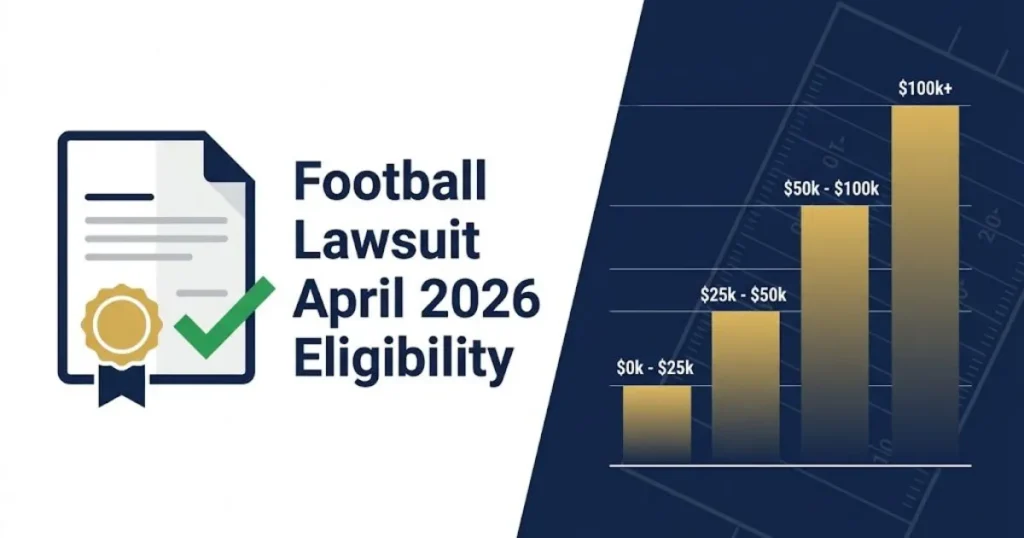
NFL concussion payouts range from roughly $25,000 for mild cognitive impairment to over $5 million for ALS diagnoses. The average approved claim pays around $200,000 to $400,000.
NCAA settlement amounts are still being determined. Early estimates suggest former college athletes could receive $5,000 to $50,000 per season played. Youth football claims typically settle for $10,000 to $100,000 depending on injury severity.
| Injury Level | NFL Payout Range | NCAA Estimate | Youth Estimate |
|---|---|---|---|
| Mild cognitive | $25,000 to $100,000 | $5,000 to $15,000 | $10,000 to $25,000 |
| Moderate impairment | $100,000 to $500,000 | $15,000 to $30,000 | $25,000 to $50,000 |
| Severe (Parkinson’s) | $500,000 to $2,000,000 | Pending | $50,000 to $75,000 |
| ALS | $2,000,000 to $5,000,000+ | Pending | $75,000 to $100,000 |
Your specific payout depends on medical records, years played, and age at diagnosis. Older players with longer careers generally receive higher amounts.
Who Qualifies for Football Lawsuit
You qualify for a football lawsuit if you played organized football and later developed a neurological condition linked to head trauma. The specific requirements depend on which lawsuit you are joining.
For the NFL settlement, you must be a retired NFL player who played at least one regular-season or preseason game. Practice squad members may also qualify under certain conditions. Family members of deceased players can file derivative claims.
For NCAA cases, you generally need to have played Division I football between specific years outlined in each complaint. Youth football claims require proof of league participation and a documented injury.
- Retired NFL players with qualifying diagnoses
- Former NCAA Division I football players
- Youth league players with documented head injuries
- Family members of deceased players with CTE
Bold Stat: Roughly 1 in 3 registered NFL claimants have been denied due to incomplete medical documentation. Get your records in order early.
Key Takeaway: Settlement amounts and eligibility vary by league level, but players at every level from youth to pro may have valid claims.
NCAA Football Lawsuit 2026
The NCAA football lawsuit landscape in 2026 is shifting fast. The House v. NCAA settlement is reshaping how college athletes get paid.
That settlement approved a revenue-sharing model worth roughly $2.8 billion over ten years. Former athletes who played between 2016 and 2025 may be eligible for back-pay claims. The claims process opened in early 2026.
Separate class actions are targeting the NCAA for concussion protocols and medical monitoring. These cases argue the NCAA failed to protect players from known head injury risks for decades.
| NCAA Case | Focus | Potential Payout |
|---|---|---|
| House v. NCAA | Revenue sharing | $5,000 to $50,000 per season |
| Concussion class action | Medical monitoring | Undetermined |
| NIL retroactive claims | Name and likeness | Varies by sport and year |
If you played college football and never received compensation for your likeness, you may have a claim. The window to file is narrowing.
CTE Football Lawsuit Settlement
CTE football lawsuit settlements are among the most complex cases in sports law. Chronic traumatic encephalopathy can only be definitively diagnosed after death, which creates unique legal challenges.
The NFL concussion settlement does cover CTE-related claims when a post-mortem diagnosis is confirmed. Families of deceased players who received a CTE diagnosis through brain donation programs can file for benefits.
Payouts for CTE claims through the NFL settlement typically fall in the $100,000 to $400,000 range. The amount depends on the player’s age at death and years of NFL service.
- CTE Stage I: Lower payout tier
- CTE Stage II: Moderate payout tier
- CTE Stage III: Higher payout tier
- CTE Stage IV: Highest payout tier
New research from Boston University continues to strengthen the link between football and CTE. This research is fueling additional lawsuits against helmet manufacturers and league organizations.
Quick Fact: Boston University has diagnosed CTE in over 345 former football players’ brains as of early 2026.
Youth Football Injury Lawsuit
Youth football injury lawsuits are growing rapidly in 2026. Parents are filing claims against leagues, schools, and equipment manufacturers for failing to protect young players.
These cases typically involve children who suffered repeated concussions before age 14. Plaintiffs argue that youth leagues ignored established safety protocols and return-to-play guidelines.
Most youth football lawsuits are filed in state courts rather than federal court. This means rules and deadlines vary significantly by state. A claim in California may look very different from one in Texas.
| Factor | Youth Lawsuit Detail |
|---|---|
| Typical plaintiff | Parent or guardian of injured minor |
| Common defendants | Local leagues, schools, helmet makers |
| Average settlement | $10,000 to $100,000 |
| Statute of limitations | Varies by state (often 2 to 4 years) |
If your child suffered multiple concussions playing youth football, document everything. Medical records, coach communications, and game footage all strengthen a claim.
Key Takeaway: Youth football lawsuits are state-specific, so deadlines and rules depend on where your child played.
Football Lawsuit Filing Deadline
The football lawsuit filing deadline depends entirely on which case you are joining. There is no single universal deadline for all football claims.
The NFL concussion settlement has no fixed end date for registration. However, individual claims must be filed within specific windows after diagnosis. You generally have two years from the date of a qualifying diagnosis to submit your claim.
NCAA revenue-sharing claims under the House settlement have a filing window that closes in late 2026. Youth football claims follow state statute of limitations rules, which typically range from two to four years after the injury.
- NFL concussion claims: 2 years from diagnosis date
- NCAA House claims: Late 2026 deadline
- Youth injury claims: 2 to 4 years from injury (state-dependent)
- CTE derivative claims: 2 years from post-mortem diagnosis
Missing a deadline can permanently bar your claim. Do not wait until the last minute to gather your documentation.
NFL Settlement Payout 2026
NFL settlement payouts in 2026 are flowing steadily but not without friction. The settlement administrator reports quarterly disbursements totaling over $150 million per quarter.
Most approved claimants receive their first payment within 60 to 90 days of approval. Payments are issued by check or direct deposit through the settlement administrator, Gilardi and Co.
Some claimants report delays caused by appeals from the NFL. The league has the right to challenge individual claims, which can add months to the process. Roughly 15 percent of approved claims face some form of appeal.
| Payout Stage | Timeline | Details |
|---|---|---|
| Initial approval | 60 to 90 days | First payment issued |
| Appeal period | 30 to 60 days | NFL may challenge |
| Appeal resolution | 90 to 180 days | Final determination |
| Supplemental claims | Ongoing | For worsening conditions |
Players whose conditions worsen over time can file supplemental claims for additional compensation. The settlement accounts for disease progression.
Pop Warner Football Lawsuit
The Pop Warner football lawsuit targets one of the largest youth football organizations in the country. Multiple families have filed claims alleging Pop Warner failed to implement adequate concussion safety measures.
These lawsuits argue that Pop Warner knew about the dangers of repetitive head impacts in young players but did not act quickly enough. Plaintiffs point to delayed adoption of contact practice limits and return-to-play protocols.
Pop Warner has since updated its safety rules. The organization now limits full-contact practice time and requires independent concussion clearance. However, these changes came after many current plaintiffs were already injured.
- Pop Warner serves over 225,000 youth players annually
- New safety rules were adopted starting in 2016
- Most lawsuits involve injuries that occurred before 2016
- Claims are filed in state courts across multiple jurisdictions
If your child played Pop Warner before 2016 and suffered head injuries, you may have grounds for a claim. Check your state’s statute of limitations carefully.
Key Takeaway: NFL payouts are steady but appeals can cause delays, and youth league lawsuits like Pop Warner focus on pre-2016 safety failures.
College Football Class Action Lawsuit
College football class action lawsuits in 2026 extend well beyond the House settlement. Several separate cases are targeting the NCAA and individual conferences for medical negligence.
One major class action seeks medical monitoring funds for all former Division I football players. The argument is simple. The NCAA knew about concussion risks for decades and did nothing meaningful to protect players.
Another class action focuses on scholarship revocation after injury. Players who lost their scholarships after suffering football-related injuries are seeking compensation for lost educational benefits.
| College Case | Status | Players Affected |
|---|---|---|
| Medical monitoring | Discovery phase | All Division I football |
| Scholarship revocation | Class certification | Injured scholarship athletes |
| Revenue sharing (House) | Claims open | 2016 to 2025 players |
These cases are still in early stages. No payouts have been issued yet for the medical monitoring or scholarship claims. But registration is open, and filing early protects your rights.
Football Brain Injury Claim
A football brain injury claim is a legal demand for compensation after head trauma sustained during organized football. These claims can cover medical bills, lost wages, pain and suffering, and long-term care costs.
Brain injury claims differ from standard personal injury cases because the damage often appears years after the initial hits. A player who suffered concussions in high school may not develop symptoms until their 40s or 50s.
To file a brain injury claim, you need three things. First, proof you played organized football. Second, medical documentation of a neurological condition. Third, expert testimony linking the condition to football-related head trauma.
- Proof of play: Rosters, yearbooks, team photos, league records
- Medical records: Neurologist evaluations, MRI results, cognitive tests
- Expert testimony: Neuropsychologists or neurologists who specialize in sports-related TBI
Start gathering these documents now even if you are not ready to file. Medical records can take months to obtain from hospitals and clinics.
Football Head Injury Lawsuit Eligibility
Football head injury lawsuit eligibility requires meeting specific criteria set by each individual case. There is no blanket eligibility rule that covers all football lawsuits.
For NFL claims, you must have played in at least one regular-season or preseason game. Practice squad members who were on the roster for a minimum number of weeks may also qualify.
For college claims, eligibility typically requires at least one season of Division I play during the years covered by the specific lawsuit. Some cases include Division II and III players, but those are less common.
| League Level | Minimum Requirement | Years Covered |
|---|---|---|
| NFL | 1 game played | All years |
| NCAA Division I | 1 season played | 2016 to 2025 (varies) |
| Youth leagues | Documented injury | Varies by state |
| High school | Documented injury | Varies by state |
Family members of deceased players can file on behalf of their loved ones. This is especially common in CTE cases where the diagnosis comes after death.
Key Takeaway: Brain injury claims require strong medical documentation, and eligibility rules differ sharply between NFL, college, and youth cases.
NFL Antitrust Lawsuit Update
The NFL antitrust lawsuit update for April 2026 centers on the aftermath of the Sunday Ticket case. A federal jury found the NFL liable for antitrust violations in 2024, and the appeals process is ongoing.
The original verdict awarded over $4.7 billion in damages to commercial subscribers and residential customers. That figure was tripled under antitrust law to roughly $14.1 billion. The NFL is fighting the verdict on appeal.
Separate antitrust claims are challenging the NFL’s draft eligibility rules and franchise tag system. Players argue these mechanisms suppress wages and restrict free movement in violation of federal antitrust law.
- Sunday Ticket verdict is under federal appellate review
- Tripled damages total approximately $14.1 billion
- Draft eligibility antitrust challenge is in early stages
- Franchise tag challenge has not yet reached trial
If you were a commercial subscriber who purchased NFL Sunday Ticket, you may be part of the class. Residential subscriber claims are being handled separately.
How to File Football Lawsuit Claim
Filing a football lawsuit claim starts with identifying which case applies to your situation. The process is different for NFL, NCAA, and youth football claims.
For NFL concussion claims, visit the official settlement program and register online. You will need to submit medical records proving a qualifying diagnosis. The settlement administrator will review your claim and issue a determination.
For NCAA claims, you typically need to register through the claims administrator assigned to the specific case. The House settlement uses a dedicated portal for former athletes to submit their information.
- Identify your league level and injury type
- Gather medical records and proof of play
- Register with the appropriate settlement program
- Submit your claim with complete documentation
- Wait for determination and respond to any requests
For youth football claims, you will likely need to work with a personal injury attorney in your state. These cases are not part of a centralized settlement program like the NFL.
Quick Fact: Claims with complete documentation are approved roughly three times faster than incomplete submissions.
Frequently Asked Questions
What football lawsuits are active in April 2026?
The NFL concussion settlement, NCAA House revenue-sharing case, and multiple youth football injury lawsuits are all active. Several antitrust and medical monitoring cases are also advancing in federal and state courts.
How much money can I get from a football lawsuit?
NFL payouts range from $25,000 to over $5 million depending on diagnosis. NCAA claims may pay $5,000 to $50,000 per season. Youth claims typically settle between $10,000 and $100,000.
Am I eligible to file a football injury claim?
You are likely eligible if you played organized football and developed a neurological condition. NFL claims require at least one game played. College and youth claims have their own specific rules.
What is the deadline to file a football lawsuit in 2026?
NFL claims must be filed within two years of diagnosis. NCAA House claims have a late 2026 deadline. Youth claims follow state statutes of limitations, usually two to four years.
Can parents file a football lawsuit for their child?
Yes, parents or legal guardians can file claims on behalf of minor children. This is common in youth football injury cases and Pop Warner lawsuits. You will need medical documentation of your child’s injuries.
The football lawsuit landscape in April 2026 offers real opportunities for players at every level. Check your eligibility, gather your medical records, and file before deadlines pass. Waiting costs you money. Start your claim process today and stay informed as these cases develop throughout the year.