A developing automotive lawsuit in 2026 could put money back in your pocket. Major car manufacturers face active class actions right now. These cases involve EV battery fires, faulty transmissions, and deadly airbag defects.
More than 40 million vehicles are under active recall investigations this year. That number keeps climbing as new defect reports surface monthly. You might own one of those vehicles without realizing it.
This article breaks down every major auto lawsuit moving through courts in 2026. You will learn who qualifies, how much you could receive, and when deadlines hit. Keep reading to find out if you have a claim.
Developing Automotive Lawsuit 2026
A developing automotive lawsuit in 2026 refers to any active legal case against a car manufacturer. These cases involve safety defects, emissions fraud, or product failures. Courts across the country are hearing dozens of them right now.
The biggest shift this year involves electric vehicles. EV-related litigation has tripled since 2023. Battery fires and software malfunctions dominate the new filings.
Traditional defect cases have not gone away either. Transmission failures and airbag recalls still generate thousands of claims. The NHTSA opened 127 new investigations in the first quarter alone.
Think of it like a rolling wave of accountability. One manufacturer settles. Another gets sued. The cycle continues as consumers demand safer vehicles.
| Case Category | Active Cases in 2026 | Primary Defendants |
|---|---|---|
| EV Battery Defects | 34 | Tesla, Hyundai, GM |
| Transmission Failures | 28 | Ford, Nissan, Stellantis |
| Airbag Recalls | 19 | Honda, Toyota, BMW |
| Brake System Defects | 15 | Kia, Mercedes, VW |
Quick Fact: Over $4.2 billion in auto settlements were paid out in 2025. The 2026 total is projected to exceed that figure.
Active Car Defect Class Action
An active car defect class action is a lawsuit filed on behalf of all affected vehicle owners. You do not need to hire your own lawyer to participate. The court appoints lead counsel to represent the entire group.
Right now, several high-profile class actions are in the discovery phase. Plaintiffs are gathering internal documents from manufacturers. These documents often reveal that companies knew about defects for years.
The most active cases target powertrain failures and electrical system malfunctions. Owners report sudden stalling, loss of power, and warning light failures. Some of these defects have caused highway accidents.
A class action works like a group purchase in reverse. Instead of pooling money to buy something, you pool claims to hold a company accountable. Strength in numbers drives better settlements.
- Ford PowerShift transmission class action remains active in federal court.
- Hyundai and Kia engine fire litigation continues in MDL proceedings.
- General Motors brake defect claims are consolidating in Michigan.
EV Battery Fire Lawsuit
An EV battery fire lawsuit targets manufacturers whose electric vehicles catch fire due to defective battery cells. These cases have exploded in 2026 as EV adoption reaches record levels.
The core allegation is simple. Manufacturers used cheaper battery components to cut costs. Those components overheat during normal charging cycles. The result is thermal runaway and vehicle fires.
Several plaintiffs have reported fires that started in parked vehicles overnight. Garage fires caused by EV battery failures have destroyed homes. Insurance companies are now pushing back on coverage claims.
The NHTSA has issued emergency recalls for three EV models this year. Each recall triggered a fresh wave of litigation. Attorneys are racing to file before statutes of limitations expire.
| EV Lawsuit Detail | Current Status |
|---|---|
| Thermal Runaway Claims | Active in 6 states |
| Garage Fire Property Damage | Consolidating in MDL |
| Battery Degradation Fraud | Pre-trial discovery |
| Charging System Defects | Settlement negotiations |
Key Stat: EV battery fire lawsuits increased by 210% between 2023 and 2026.
Key Takeaway: Over 40 million vehicles are tied to active lawsuits in 2026, with EV battery fires and transmission defects driving the largest claims.
Transmission Defect Lawsuit 2026
A transmission defect lawsuit in 2026 focuses on vehicles that slip, shudder, or fail to shift gears properly. These defects create dangerous driving conditions on highways and city streets.
Ford remains the biggest target in this category. Their dual-clutch transmissions have generated over 2 million complaints. Owners describe violent jerking and complete loss of acceleration.
Nissan CVT transmissions are also under fire. Drivers report premature failure well before 60,000 miles. Repair costs often exceed $4,000 per vehicle.
The legal theory behind these cases is straightforward. Manufacturers sold vehicles with known transmission defects. They failed to disclose the problems before purchase. That constitutes fraud under consumer protection laws.
- Ford Focus and Fiesta models from 2011 to 2016 are most affected.
- Nissan Altima, Sentra, and Versa CVT claims are growing rapidly.
- Stellantis 9-speed transmission litigation entered trial phase in January.
Imagine buying a phone that drops calls every ten minutes. You would demand a refund. A defective transmission is the same problem on a much larger and more dangerous scale.
Car Lawsuit Settlement Amounts
Car lawsuit settlement amounts vary widely based on the defect type and your level of harm. Minor defect claims may pay a few hundred dollars. Serious injury cases can reach six or seven figures.
Most class action settlements follow a tiered payout structure. The more damage you suffered, the higher your payment. Proof of repair costs and medical bills strengthens your claim.
Here is a general breakdown of what claimants are receiving in 2026.
| Claim Severity | Typical Payout Range | Proof Required |
|---|---|---|
| Minor Defect (no injury) | $200 to $1,500 | VIN and repair receipts |
| Major Repair (no injury) | $1,500 to $7,500 | Mechanic invoices |
| Property Damage | $5,000 to $50,000 | Insurance and photo evidence |
| Personal Injury | $25,000 to $500,000+ | Medical records |
| Wrongful Death | $1 million+ | Court determination |
Settlement checks typically arrive 6 to 12 months after final court approval. Some complex cases take longer. The Takata airbag settlement, for example, is still paying claims years after approval.
Bold Stat: The average auto class action payout in 2025 was $3,200 per claimant.
Automotive Recall Lawsuit Eligibility
Automotive recall lawsuit eligibility depends on your vehicle make, model, year, and ownership dates. Not every recall automatically qualifies you for a lawsuit settlement.
The first step is checking your VIN against the NHTSA recall database. If your vehicle appears in an active recall, you may have a claim. The recall must involve a safety defect, not a cosmetic issue.
Ownership timing matters too. You generally must have owned or leased the vehicle during the defect period. Selling the car before the recall does not always disqualify you.
- You owned the vehicle during the covered model years.
- The defect matches the recall description.
- You experienced the specific problem listed in the complaint.
- You filed your claim before the deadline.
Think of eligibility like a concert ticket. Having the right ticket gets you in the door. But you still need to show up at the right venue on the right night. Missing a deadline is like showing up a day late.
Key Takeaway: Settlement payouts range from $200 for minor defects to over $1 million for wrongful death, and eligibility hinges on your VIN, ownership dates, and proof of harm.
How to Join an Auto Class Action
Joining an auto class action is simpler than most people think. You do not need to file a separate lawsuit. You do not need to appear in court. Most of the work happens behind the scenes.
Start by confirming your vehicle is covered. Check the case name and class definition in public court records. Your vehicle make, model, and year must fall within the specified range.
Next, submit a claim form before the deadline. These forms ask for your VIN, purchase date, and a description of the defect. Attach any repair receipts or photos you have.
The settlement administrator processes your claim after the court approves the deal. You will receive a notice by mail or email. That notice explains your payout amount and payment timeline.
- Search for your vehicle on the NHTSA recall database.
- Visit the official settlement website for your specific case.
- Complete the claim form with accurate vehicle and personal details.
- Submit supporting documents before the posted deadline.
Important: Opting out of a class action means you give up your right to the settlement. You can sue independently, but that path costs more and takes longer.
Ford Transmission Lawsuit Update
The Ford transmission lawsuit update for 2026 shows continued progress in federal court. The PowerShift dual-clutch transmission case remains one of the largest auto defect actions in history.
Ford has already paid over $1.4 billion in settlements and repairs. Yet thousands of owners still report unresolved transmission problems. New claims continue to pour in from 2014 to 2016 model owners.
The current litigation focuses on Ford’s alleged knowledge of the defect. Internal emails suggest engineers flagged the problem before production began. Ford allegedly chose to ship the vehicles anyway.
A new wave of claims targets the 10-speed automatic transmission in F-150 trucks. Drivers report harsh shifting and sudden downshifting at highway speeds. This case is still in early discovery.
| Ford Case Detail | Status |
|---|---|
| PowerShift Dual-Clutch | Settlement payouts ongoing |
| 10-Speed F-150 | Discovery phase |
| Explorer Transmission | Class certification pending |
| Escape CVT | Pre-litigation investigation |
Deadline Alert: PowerShift claim forms for the extended settlement period close in September 2026.
Tesla Battery Lawsuit 2026
The Tesla battery lawsuit in 2026 centers on range degradation and fire risk allegations. Owners claim their vehicles lost significant battery capacity far earlier than advertised.
One major case alleges Tesla overstated driving range by up to 20%. The EPA has opened a separate investigation into these claims. Plaintiffs argue the inflated numbers influenced their purchase decisions.
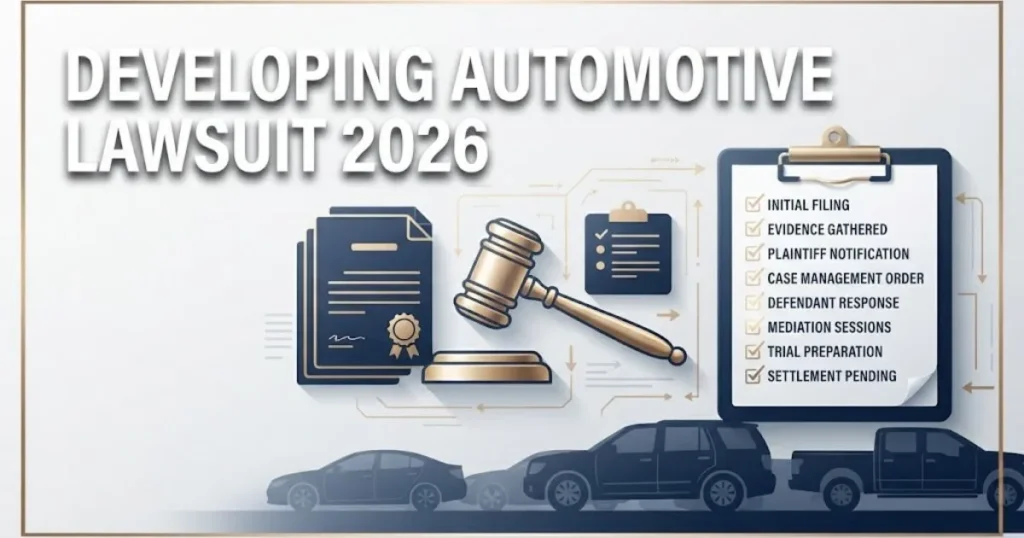
Battery fire litigation is running on a parallel track. Several Model S and Model Y owners report thermal events during Supercharger sessions. Tesla has issued software updates to limit charging speeds.
Critics say those software fixes reduce battery performance without addressing the root cause. Owners feel they paid for a product that now performs below specifications. That gap between promise and reality drives the lawsuits.
- Range inflation claims are consolidated in California federal court.
- Battery fire cases are being reviewed by the MDL panel.
- Autopilot-related battery drain claims were filed in March 2026.
Key Takeaway: Ford and Tesla face the most active transmission and battery lawsuits, with billions in settlements already paid and new claims still arriving weekly.
Takata Airbag Settlement Update
The Takata airbag settlement update in 2026 confirms that payments are still flowing to eligible claimants. This remains the largest automotive recall in history, affecting over 100 million vehicles worldwide.
Takata airbag inflators can rupture during deployment. Metal fragments shoot into the cabin at high speed. At least 27 deaths and 400 injuries have been linked to the defect.
The original settlement fund was $1.4 billion. Additional funds were added as more automakers joined the recall. Honda, Toyota, Ford, and BMW are among the affected brands.
Claimants who suffered physical injuries receive priority payments. Economic loss claims for diminished vehicle value are also being processed. The settlement administrator reports that over 85% of claims have been resolved.
| Takata Settlement Tier | Payout Range | Status |
|---|---|---|
| Physical Injury | $10,000 to $14 million | Actively paying |
| Economic Loss | $500 to $5,000 | Processing |
| Property Damage | $200 to $2,000 | Nearly complete |
| Wrongful Death | $500,000+ | Case-by-case review |
Urgent: If you own a vehicle with an unrepaired Takata airbag, get it fixed immediately. The defect is still causing injuries in 2026.
Autonomous Vehicle Accident Liability
Autonomous vehicle accident liability is the newest and most complex area of auto litigation. When a self-driving car causes a crash, the question of fault becomes extremely complicated.
Traditional car accidents involve human drivers. Insurance companies assign blame based on traffic laws. Autonomous vehicles remove the human from that equation entirely.
So who is responsible when a self-driving car hits a pedestrian? The software developer? The vehicle manufacturer? The sensor supplier? Courts are still figuring this out.
Several high-profile accidents in 2025 and 2026 have forced the issue. Cruise and Waymo vehicles were involved in incidents that injured pedestrians. Lawsuits against the parent companies are now in early stages.
- Product liability claims target the autonomous driving software.
- Negligence claims focus on inadequate safety testing protocols.
- Municipal liability claims allege cities approved unsafe deployments.
This area of law is evolving faster than the technology itself. Expect major court rulings in late 2026 that will set precedents for decades to come.
Vehicle Software Defect Lawsuit
A vehicle software defect lawsuit targets glitches in the computer systems that control modern cars. Today’s vehicles run on millions of lines of code. When that code fails, the consequences can be deadly.
Recent cases involve software bugs that disable safety features without warning. Automatic emergency braking systems have shut down mid-drive. Lane departure warnings have gone silent on busy highways.
Over-the-air updates have created a new legal gray area. Manufacturers can push fixes remotely without notifying owners. Some plaintiffs argue these silent patches amount to hidden recalls.
The NHTSA now requires automakers to report software-related defects within five days. This new rule has triggered a flood of previously undisclosed defect reports. Attorneys are using those reports as evidence in new filings.
- Infotainment system failures that disable rearview cameras.
- Battery management software bugs in EVs.
- Autonomous driving feature malfunctions.
- Emissions control software that cheats testing protocols.
Key Fact: Software-related vehicle recalls increased by 340% between 2022 and 2026.
Key Takeaway: Autonomous vehicle liability and software defect lawsuits represent the fastest-growing categories in auto litigation, with courts expected to set major precedents by late 2026.
Brake Failure Class Action 2026
The brake failure class action in 2026 targets several manufacturers linked to sudden brake loss incidents. Drivers describe pressing the brake pedal and getting zero response. These failures happen at any speed.
Kia and Hyundai face the most active brake-related litigation this year. Owners of 2021 to 2024 models report brake fluid leaks in the ABS module. The defect can cause total brake failure without any dashboard warning.
Mercedes-Benz is also defending brake defect claims in European and US courts. The issue involves a software error in the brake assist system. A recall was issued, but plaintiffs say it came too late.
Brake failure cases tend to settle for higher amounts than other defect claims. The risk of catastrophic injury makes juries sympathetic to plaintiffs. Punitive damages are common in these verdicts.
| Brake Lawsuit Defendant | Models Affected | Claim Status |
|---|---|---|
| Kia | Sportage, Sorento | Active litigation |
| Hyundai | Tucson, Santa Fe | Settlement talks |
| Mercedes | GLE, GLS | Discovery phase |
| Volkswagen | Tiguan, Atlas | Pre-trial motions |
Auto Lawsuit Filing Deadline
The auto lawsuit filing deadline varies by state and by case type. Most states enforce a statute of limitations between two and six years from the date of injury or discovery.
For class action settlements, the deadline is set by the court. You will receive a notice with a specific claim form deadline. Missing that date means you forfeit your share of the settlement.
Some deadlines are fast approaching in 2026. The extended Takata claim window closes in December. The Ford PowerShift supplemental deadline hits in September.
Statute of repose laws add another layer of complexity. These laws cap your filing window based on the vehicle’s manufacture date. In some states, you cannot sue more than 10 years after the car was built.
- Personal injury claims: 2 to 4 years in most states.
- Property damage claims: 3 to 6 years depending on jurisdiction.
- Class action claim forms: Set by court order, typically 60 to 120 days.
- Lemon law claims: 1 to 2 years from purchase date.
Act Now: Check every active settlement notice you have received. Deadlines are strict and courts rarely grant extensions.
Car Manufacturer Product Liability
Car manufacturer product liability is the legal doctrine that holds automakers responsible for defective vehicles. When a design flaw or manufacturing error causes harm, the company must pay.
Three types of defects trigger product liability claims. Design defects exist before the car is even built. Manufacturing defects occur during assembly on the factory floor. Warning defects involve failure to disclose known risks.
Strict liability applies in most auto defect cases. You do not need to prove the manufacturer was negligent. You only need to show the product was defective and caused your harm.
This legal framework protects consumers who lack the resources to investigate corporate wrongdoing. You bought a car expecting it to be safe. The law says the manufacturer must deliver on that expectation.
- Design defect: The entire model line has a dangerous flaw.
- Manufacturing defect: A specific batch of vehicles was assembled incorrectly.
- Warning defect: The company knew about a risk but did not tell buyers.
Think of product liability like a restaurant’s food safety obligation. If you get sick from contaminated food, you do not need to prove the chef was careless. The restaurant is responsible for serving safe meals. Automakers carry the same duty.
Key Takeaway: Filing deadlines for auto lawsuits range from 60 days for class action claims to 6 years for property damage, and product liability law holds manufacturers strictly accountable for defective vehicles.
Frequently Asked Questions
How much can I get from a developing automotive lawsuit in 2026?
Most claimants receive between $200 and $7,500 for non-injury claims.
Personal injury payouts can exceed $500,000 depending on severity.
Exact amounts depend on your vehicle, defect type, and documented damages.
Who qualifies for an active car defect class action?
You qualify if you owned or leased a vehicle listed in the class definition.
Your vehicle must match the covered make, model, and year range.
You must submit a claim form before the court-ordered deadline.
What is the deadline to file an auto lawsuit in 2026?
Deadlines vary by state and case type.
Most personal injury claims must be filed within 2 to 4 years.
Class action claim form windows are typically 60 to 120 days.
Do I need proof of injury to join a vehicle defect lawsuit?
No, many auto class actions cover economic losses without physical injury.
You can claim repair costs, diminished vehicle value, or out-of-pocket expenses.
Injury claims pay more but require medical documentation.
How long does an automotive class action settlement take to pay out?
Most settlements begin paying within 6 to 12 months of final approval.
Complex cases with appeals can take 2 to 3 years.
The Takata settlement is still processing claims nearly a decade after filing.
A developing automotive lawsuit in 2026 could directly affect your finances and safety. Do not wait for a notice to arrive in the mail. Check your VIN against active recalls today.
Review the deadlines listed above and gather your repair records now. The window to file closes faster than most people expect. Your claim could be worth thousands of dollars if you act before time runs out.