

The climate change lawsuit Park-Costa faces could pay affected residents up to $2,500 each. A federal class action filed in late 2025 accuses the construction giant of environmental harm across Northern California.
Park-Costa Group is one of the biggest builders in the Bay Area. Their projects span hospitals, schools, and commercial towers. Now thousands of residents say those projects damaged their air, water, and neighborhoods.
This article breaks down everything you need to know. You will learn who qualifies, how much you might get, and when to file.
Roughly 15,000 people may be eligible for compensation. The clock is ticking on the 2026 filing deadline.
What Is the Park-Costa Climate Change Lawsuit
The climate change lawsuit Park-Costa faces is a federal class action over environmental harm. The case is officially called Martinez et al. v. Park-Costa Group, LLC.
It was filed in September 2025 in the Northern District of California. Lead plaintiffs include Bay Area homeowners and construction workers. They allege the company violated state and federal environmental laws.
The core accusation is straightforward. Park-Costa allegedly cut corners on environmental protections to save money. This reportedly led to excess carbon emissions and habitat destruction.
Think of it like a restaurant skipping health inspections. The food might look fine. But the hidden risks can make people sick.
The lawsuit targets projects built between 2019 and 2024. That covers dozens of major construction sites across the region.
| Detail | Info |
|---|---|
| Case Name | Martinez et al. v. Park-Costa Group |
| Court | U.S. District Court, Northern District of CA |
| Filed | September 2025 |
| Case Number | 3:25-cv-04892 |
| Estimated Class Size | 12,000 to 18,000 people |
Park-Costa Environmental Litigation Background
Park-Costa environmental litigation did not appear out of nowhere. The company has faced regulatory scrutiny for years.
The California Air Resources Board issued warnings to Park-Costa in 2022. Those warnings concerned diesel emissions at active construction sites. The company reportedly failed to install required filtration systems.
In 2023, the Bay Area Air Quality Management District fined the company. The fine was $340,000 for dust and particulate violations. Park-Costa paid the fine but did not admit wrongdoing.
The current lawsuit builds on that history. Plaintiffs argue the fines prove a pattern of behavior. They say Park-Costa treated penalties as a cost of doing business.
Key stat: Park-Costa received at least four environmental citations between 2021 and 2024.
The company is headquartered in Walnut Creek, California. It employs over 1,500 workers across the state. Annual revenue exceeds $2 billion.
Park-Costa Construction Emissions Allegations
Park-Costa construction emissions are at the heart of this lawsuit. Plaintiffs claim the company released far more greenhouse gases than legally permitted.
The allegations focus on three main areas. First is diesel exhaust from heavy equipment. Second is concrete production emissions. Third is dust from demolition activities.
According to the complaint, Park-Costa used older diesel engines on at least six major sites. Those engines reportedly exceeded California emission standards by up to 40 percent.
Concrete production is another big issue. The lawsuit claims Park-Costa sourced from suppliers with poor environmental records. This allegedly inflated the carbon footprint of every project.
| Emission Source | Alleged Excess |
|---|---|
| Diesel equipment | Up to 40% over limits |
| Concrete supply chain | 25% above benchmarks |
| Demolition dust | 30% above permitted levels |
Demolition dust affected nearby neighborhoods the most. Residents reported breathing problems and property damage. Some families say dust coated their homes for months.
Key Takeaway: The lawsuit targets a pattern of emissions violations spanning multiple projects and years, not a single isolated incident.
Park-Costa Greenwashing Claims Explained
Park-Costa greenwashing claims are a major part of the lawsuit. The company marketed itself as an environmentally responsible builder.
Plaintiffs say that marketing was misleading. Park-Costa advertised LEED-certified buildings and carbon-neutral goals. But internal documents allegedly tell a different story.
The complaint references a 2023 internal memo. That memo reportedly showed executives knew sustainability targets were not being met. The company continued its green advertising anyway.
Greenwashing works like a food label that says “natural.” The word sounds healthy. But it may not mean anything regulated or real.
Specifically, plaintiffs challenge three claims Park-Costa made publicly. The first is “carbon-neutral construction by 2025.” The second is “100 percent sustainable sourcing.” The third is “zero-waste job sites.”
None of those claims were independently verified. The lawsuit argues they deceived clients, investors, and the public. California consumer protection laws prohibit this type of false advertising.
Who Qualifies for the Park-Costa Climate Case
You may qualify for the Park-Costa climate case if you lived or worked near an affected site. The class covers a specific geographic area and time window.
Eligible individuals include residents within two miles of a Park-Costa project. The project must have been active between January 2019 and December 2024.
Construction workers on Park-Costa sites may also qualify. This applies if you were exposed to excessive dust or diesel fumes. You do not need a medical diagnosis to file.
Small business owners near affected sites are included too. If pollution disrupted your business operations, you may have a claim.
- Bay Area residents near Park-Costa job sites
- Construction workers employed on those sites
- Small business owners in affected neighborhoods
- Property owners who experienced dust or air damage
The affected counties include Contra Costa, Alameda, San Francisco, and Sacramento. If you lived in one of these areas, check your proximity to a Park-Costa project.
Park-Costa Lawsuit Eligibility Requirements
Park-Costa lawsuit eligibility requirements are specific but not overly complicated. You need to meet two basic criteria to join the class.
First, you must have a connection to an affected location. That means living, working, or owning property near a Park-Costa site. The site must have been active during the covered period.
Second, you must have experienced some form of harm. This can be health-related, financial, or property-related. Even minor issues like dust damage to your home count.
| Requirement | Details |
|---|---|
| Location | Within 2 miles of a Park-Costa site |
| Time Period | January 2019 to December 2024 |
| Harm Type | Health, property, or financial |
| Documentation | Proof of address or employment |
You do not need to prove the harm was severe. The lawsuit covers a broad range of impacts. Even temporary inconvenience may qualify you for a smaller payout.
Key stat: Attorneys estimate roughly 70 percent of people in the affected zone will meet the basic criteria.
Key Takeaway: If you lived or worked near a Park-Costa construction site between 2019 and 2024, you likely meet the basic eligibility requirements.
Park-Costa Lawsuit Settlement Amount Estimates
Park-Costa lawsuit settlement amount estimates range from $25 million to $75 million total. That is the projected settlement pool if the case resolves before trial.
Individual payouts depend on your claim tier. Most residential claimants can expect between $200 and $800. Workers with documented health issues may receive more.
The highest payouts go to plaintiffs with verified medical conditions. Respiratory illnesses linked to construction dust qualify for the top tier. Those claims could pay up to $2,500.
Think of it like an insurance claim after a storm. Everyone on the block gets something. But the house with the most damage gets the biggest check.
| Claimant Type | Estimated Payout |
|---|---|
| Nearby residents | $200 to $800 |
| Affected workers | $500 to $1,500 |
| Medical claims | $1,000 to $2,500 |
| Property damage | $300 to $1,200 |
These numbers are estimates. The final amounts depend on the total settlement and number of claims filed. More claimants means smaller individual shares.
Park-Costa Climate Case Payout Tiers
Park-Costa climate case payout tiers divide claimants into four groups. Each tier reflects the severity and type of harm experienced.
Tier 1 covers general residents with minimal harm. These are people who lived near a site but had no major issues. Expect a payment around $200 to $400.
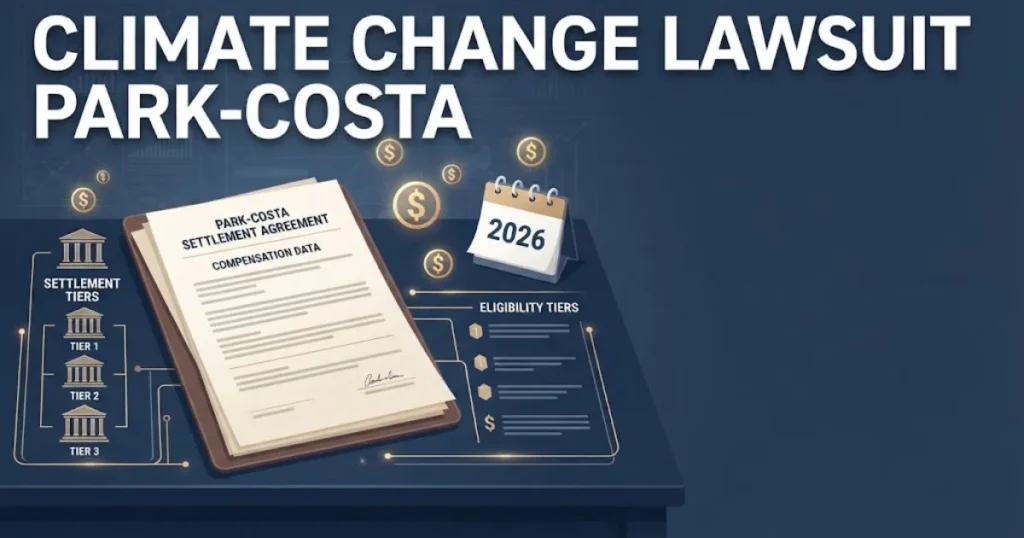
Tier 2 includes residents with property damage. Dust, debris, or air quality issues that damaged your home qualify here. Payouts range from $400 to $800.
Tier 3 is for workers with documented exposure. If you worked on a Park-Costa site and have health records showing respiratory issues, this is your tier. Payments run $800 to $1,500.
Tier 4 is the highest level. It covers severe medical conditions directly linked to site pollution. Verified asthma, COPD, or other lung diseases qualify. Payouts can reach $2,500.
- Tier 1: General residents, $200 to $400
- Tier 2: Property damage, $400 to $800
- Tier 3: Worker exposure, $800 to $1,500
- Tier 4: Medical conditions, $1,000 to $2,500
Key Takeaway: Payout tiers are based on harm severity, with medical claims receiving the highest compensation from the settlement pool.
How to File a Park-Costa Climate Claim
Filing a Park-Costa climate claim is a straightforward process. You do not need a lawyer to submit your initial claim form.
Step one is to confirm your eligibility. Check whether your address falls within two miles of a covered Park-Costa site. The court-appointed claims administrator will publish a site map.
Step two is to gather your documentation. You will need proof of address during the covered period. Utility bills, lease agreements, or tax records all work.
Step three is to complete the claim form. The form will be available through the official settlement website. It asks for basic personal info and a description of your harm.
- Confirm your address is in the affected zone
- Gather proof of residence or employment
- Complete the official claim form
- Submit before the August 2026 deadline
Step four is submission and confirmation. After you file, you will receive a confirmation number. Keep that number for your records.
The entire process should take about 20 to 30 minutes. Do not wait until the last minute. High traffic near the deadline could slow the system down.
Park-Costa Lawsuit Filing Deadline 2026
The Park-Costa lawsuit filing deadline is August 15, 2026. That is the last day to submit your claim form.
This deadline was set by the court in a preliminary order issued in March 2026. The judge denied a request to extend it further.
Missing the deadline means you lose your right to compensation. There are very few exceptions. You would need to prove extraordinary circumstances to file late.
| Milestone | Date |
|---|---|
| Claims period opens | April 1, 2026 |
| Early filing bonus deadline | June 1, 2026 |
| Final filing deadline | August 15, 2026 |
| Claims review begins | September 2026 |
Bold deadline: August 15, 2026 is the hard cutoff. Mark your calendar now.
Filing early may have a small advantage. Some class actions offer priority processing for early submissions. The claims administrator has hinted at this for the Park-Costa case.
Key Takeaway: The filing window runs from April 1 to August 15, 2026, and missing the deadline almost certainly means forfeiting your right to compensation.
Park-Costa Class Action Status Update
The Park-Costa class action status is currently in the discovery phase. The court granted preliminary class certification in February 2026.
Preliminary certification means the judge believes the case meets the basic requirements for a class action. The class is defined as all affected residents and workers in the covered zone.
Park-Costa has not admitted any wrongdoing. The company filed a motion to dismiss in November 2025. That motion was denied in January 2026.
Discovery is now underway. Both sides are exchanging documents and taking depositions. This phase typically lasts six to twelve months.
A settlement conference is scheduled for October 2026. Many class actions resolve at this stage. If no settlement is reached, the case could go to trial in early 2027.
- November 2025: Motion to dismiss filed
- January 2026: Motion denied
- February 2026: Class certified
- March to September 2026: Discovery phase
- October 2026: Settlement conference
Park-Costa Climate Case Timeline
The Park-Costa climate case timeline stretches back several years. The roots of the lawsuit go well before the 2025 filing date.
In 2021, local residents began complaining about dust and air quality. Several community groups filed complaints with state regulators. Those complaints triggered the first investigations.
By 2023, the California Air Resources Board had documented multiple violations. The evidence gathered during that period became the foundation for the lawsuit.
| Year | Event |
|---|---|
| 2019 to 2024 | Alleged violations at construction sites |
| 2021 | Community complaints begin |
| 2022 | State regulatory warnings issued |
| 2023 | Air quality fines imposed |
| September 2025 | Class action filed |
| February 2026 | Class certification granted |
| August 2026 | Claim filing deadline |
| October 2026 | Settlement conference |
The timeline shows a clear escalation pattern. Warnings led to fines. Fines led to lawsuits. Each step built on the one before it.
Key Takeaway: The case timeline reveals years of documented violations before the lawsuit was filed, strengthening the plaintiffs’ position during discovery.
Park-Costa Carbon Emission Violations Details
Park-Costa carbon emission violations are detailed extensively in the complaint. The lawsuit identifies specific projects and specific violations at each one.
The Delta Shores project in Sacramento is a primary example. The complaint alleges Park-Costa used unpermitted diesel generators for over eight months. Those generators reportedly emitted 35 percent more carbon than allowed.
Another flagged project is a hospital expansion in Oakland. The lawsuit claims Park-Costa bypassed air filtration requirements during demolition. Nearby air quality monitors recorded elevated particulate levels during that period.
A third project in San Francisco allegedly violated stormwater runoff rules. Construction debris reportedly washed into the bay during heavy rains. The EPA was notified but took no immediate action.
- Delta Shores: Unpermitted generators, 35% excess emissions
- Oakland hospital: Missing air filtration during demolition
- San Francisco commercial: Stormwater runoff into the bay
- Contra Costa school: Dust control failures over six months
Each violation carries potential penalties under California law. The cumulative effect is what makes this case so significant.
Park-Costa Construction Environmental Impact
Park-Costa construction environmental impact extends beyond emissions. The lawsuit also addresses habitat destruction and water contamination.
The complaint alleges Park-Costa damaged protected wetlands near the Delta Shores site. California law requires buffer zones around wetlands. The lawsuit claims those buffers were ignored.
Water quality is another concern. Construction runoff reportedly contaminated local waterways with sediment and chemicals. Testing showed elevated levels of heavy metals in nearby streams.
Think of it like a neighbor who dumps paint down a storm drain. The damage spreads far beyond their property line. Entire ecosystems can be affected.
Noise pollution also factors into the case. Several plaintiffs report that excessive construction noise disrupted their daily lives for years. While noise alone may not drive big payouts, it supports the broader harm argument.
Key stat: Environmental testing near three Park-Costa sites showed pollutant levels two to three times above state safety limits.
Park-Costa Environmental Damage Compensation
Park-Costa environmental damage compensation covers more than just cash payments. The lawsuit also seeks funding for community remediation projects.
Plaintiffs are asking the court to order Park-Costa to fund air quality monitoring. This would cover the affected neighborhoods for at least five years. The estimated cost is $3 million to $5 million.
The lawsuit also requests funding for wetland restoration near the Delta Shores site. Environmental experts estimate that restoration would cost roughly $2 million.
Individual compensation focuses on out-of-pocket expenses. If you paid for air purifiers, medical bills, or property cleaning, those costs may be reimbursed. Keep your receipts.
| Compensation Type | Amount |
|---|---|
| Individual cash payouts | $200 to $2,500 |
| Air quality monitoring fund | $3M to $5M |
| Wetland restoration | ~$2M |
| Community health programs | ~$1.5M |
The total compensation package could exceed $80 million. That includes both individual payouts and community remediation funds.
Key Takeaway: Compensation includes both individual payments and community-wide environmental remediation, making this one of the larger construction-related climate settlements in California history.
Park-Costa Environmental Lawsuit Update 2026
The Park-Costa environmental lawsuit update for 2026 shows a case moving quickly through the federal system. Several key developments have occurred in recent months.
In March 2026, the court appointed a claims administrator. This firm will manage the claim filing process and distribute payments. Their contact information will be published soon.
Also in March, Park-Costa filed a counter-motion arguing the class is too broad. The judge has not yet ruled on that motion. A hearing is scheduled for May 2026.
Plaintiff attorneys say they are confident in their evidence. They point to internal company documents obtained during discovery. Those documents allegedly show executives knew about the violations.
- March 2026: Claims administrator appointed
- April 2026: Claim filing window opens
- May 2026: Hearing on class scope motion
- August 2026: Filing deadline
- October 2026: Settlement conference
The next major milestone is the settlement conference in October. If both sides reach an agreement, payments could begin by early 2027. If not, prepare for a longer fight.
Frequently Asked Questions
How much can I get from the Park-Costa climate lawsuit?
Most claimants will receive between $200 and $2,500 depending on their tier. The exact amount depends on your proximity to a site and the harm you experienced. Payments are expected to begin in early 2027 if a settlement is reached.
Am I eligible to join the Park-Costa class action?
You are likely eligible if you lived or worked within two miles of a Park-Costa site. The site must have been active between January 2019 and December 2024. You need proof of address or employment during that window.
What is the deadline to file a Park-Costa climate claim?
The filing deadline is August 15, 2026. The claims window opens on April 1, 2026. Late filings will almost certainly be rejected by the court.
What did Park-Costa do wrong in this lawsuit?
Park-Costa is accused of exceeding carbon emission limits at multiple construction sites. The company also allegedly destroyed protected wetlands and made false sustainability claims. Internal documents reportedly show executives were aware of these violations.
When will Park-Costa lawsuit payments begin?
Payments could begin in early 2027 if the case settles in October 2026. If the case goes to trial, payments may be delayed until 2028 or later. The claims administrator will notify all filers once distribution starts.
The Park-Costa climate change lawsuit represents a major moment for environmental accountability in construction. If you lived or worked near an affected Bay Area site, check your eligibility today. The August 15, 2026 deadline will not be extended. Gather your documents and file your claim as soon as the window opens in April.







