A full business lawsuit covers every stage of commercial legal action from complaint to resolution. If your company faces litigation in 2026, this guide explains exactly what to expect.
U.S. businesses spent over $310 billion on litigation last year. That number is still climbing. Most owners never anticipate a lawsuit until formal papers arrive.
You will learn about lawsuit types, real costs, and realistic timelines. We also cover settlement ranges, filing steps, and defense strategies.
Whether you are suing or being sued, you need clear facts fast. This article gives you everything in plain English.
Full Business Lawsuit
A full business lawsuit is a complete civil legal action between commercial entities. It spans from the initial complaint through discovery, trial, and final judgment or settlement.
Think of it like a marathon, not a sprint. The process involves multiple phases that can stretch across months or even years. Each phase has its own rules, deadlines, and costs.
In 2026, the most common triggers include contract disputes, partnership conflicts, and intellectual property claims. State and federal courts both handle these cases depending on the dollar amount and parties involved.
A full business lawsuit typically involves a plaintiff, a defendant, and their respective legal teams. The court assigns a case number and sets a scheduling order early on.
Quick Facts:
- Average duration: 12 to 36 months
- Most common venue: State superior court
- Typical parties: LLCs, corporations, sole proprietors
- Governing rules: Federal or state civil procedure codes
Business Lawsuit Types
Business lawsuit types fall into several major categories based on the nature of the dispute. The most frequent claims in 2026 involve breach of contract, business torts, and employment conflicts.
Breach of contract cases dominate the field. They arise when one party fails to honor agreed terms. These can involve vendors, clients, or partners.
Business tort claims cover fraud, misrepresentation, and unfair competition. These cases focus on wrongful conduct that causes financial harm. They often carry higher damage awards.
Employment litigation is the fastest-growing category. Wrongful termination, wage disputes, and discrimination claims are surging. New 2026 regulations have expanded worker protections in many states.
| Lawsuit Type | Frequency | Avg. Duration |
|---|---|---|
| Breach of Contract | 42% of cases | 14 months |
| Business Torts | 23% of cases | 20 months |
| Employment Claims | 19% of cases | 11 months |
| IP Disputes | 10% of cases | 26 months |
| Partnership Disputes | 6% of cases | 18 months |
How to File a Business Lawsuit
You file a business lawsuit by drafting and submitting a formal complaint to the appropriate court. The complaint must state your legal claims, the facts supporting them, and the relief you seek.
Start by identifying the correct jurisdiction. This depends on where the defendant operates and the amount in dispute. Filing in the wrong court can get your case dismissed immediately.
Next, prepare your complaint document. It must follow strict formatting rules set by the court. Most courts now require electronic filing through their online portal systems.
After filing, you must serve the defendant with a copy of the complaint. Service must happen within a specific window, usually 30 to 90 days. A professional process server typically handles this step.
Filing Checklist:
- Confirm jurisdiction and venue requirements
- Draft complaint with numbered factual allegations
- Pay filing fee ranging from $200 to $1,500
- Serve defendant within the required deadline
- File proof of service with the court clerk
Key Takeaway: A full business lawsuit begins with a formal complaint, and the type of claim you file shapes every phase that follows.
Business Lawsuit Process
The business lawsuit process follows a structured sequence of legal phases from filing to resolution. Each phase has specific rules and deadlines that both sides must follow.
The first phase is pleading. The plaintiff files a complaint and the defendant files an answer. This stage usually takes one to three months.
Discovery comes next and is the longest phase. Both sides exchange documents, take depositions, and submit interrogatories. Discovery can last six to eighteen months in complex cases.
After discovery, the case moves to pre-trial motions. Either side may file for summary judgment to resolve the case without a trial. If the judge denies these motions, the case proceeds to trial.
Trial itself can last anywhere from a few days to several weeks. The judge or jury then renders a verdict. Post-trial motions and appeals can add months or years to the timeline.
| Phase | Typical Duration | Key Activity |
|---|---|---|
| Pleading | 1 to 3 months | Complaint and answer filed |
| Discovery | 6 to 18 months | Document exchange, depositions |
| Pre-Trial | 2 to 6 months | Motions, settlement talks |
| Trial | 3 days to 4 weeks | Evidence and testimony |
| Appeal | 6 to 18 months | Appellate court review |
Business Lawsuit Cost
Business lawsuit cost varies widely but most cases range from $10,000 to $100,000 in total legal fees. Complex cases involving multiple parties or federal courts can exceed $500,000 easily.
Attorney fees represent the largest expense. Most business litigation lawyers charge between $250 and $600 per hour in 2026. Partners at major firms often bill above $800 per hour.
Filing fees are relatively small by comparison. State court fees typically run $200 to $500. Federal court filing fees are currently $405 for civil cases.
Discovery costs can surprise business owners. Deposition transcripts, expert witness fees, and electronic document review add up fast. A single expert witness can cost $5,000 to $15,000 per day.
Cost Breakdown for a Typical Case:
- Attorney fees: $15,000 to $75,000
- Court filing fees: $200 to $1,500
- Discovery expenses: $5,000 to $30,000
- Expert witnesses: $5,000 to $50,000
- Miscellaneous costs: $1,000 to $5,000
Business Lawsuit Timeline
The business lawsuit timeline typically spans 12 to 36 months from filing to final resolution. Cases that go to full trial take longer than those resolved through settlement or mediation.
Court backlogs in 2026 are adding extra delays in many jurisdictions. Major metro areas like Los Angeles, New York, and Chicago report average wait times of 18 months just to reach trial.
Simple contract disputes may wrap up in under a year. Complex multi-party litigation can drag on for three to five years. Appeals add another 12 to 24 months on top.
Mediation and arbitration can shorten the timeline dramatically. Many courts now require mandatory mediation before allowing a trial date. This step alone resolves roughly 60% of business disputes.
2026 Timeline Reality Check:
- Fastest resolution: 4 to 8 months via early settlement
- Average resolution: 14 to 22 months
- Complex trial cases: 24 to 48 months
- With appeals: 36 to 60 months total
Key Takeaway: Budget at least $10,000 to $100,000 and expect the process to take one to three years in most jurisdictions.
Business Lawsuit Settlement
A business lawsuit settlement is a negotiated agreement that resolves the case before a trial verdict. Roughly 90% of business lawsuits settle before reaching a jury in 2026.
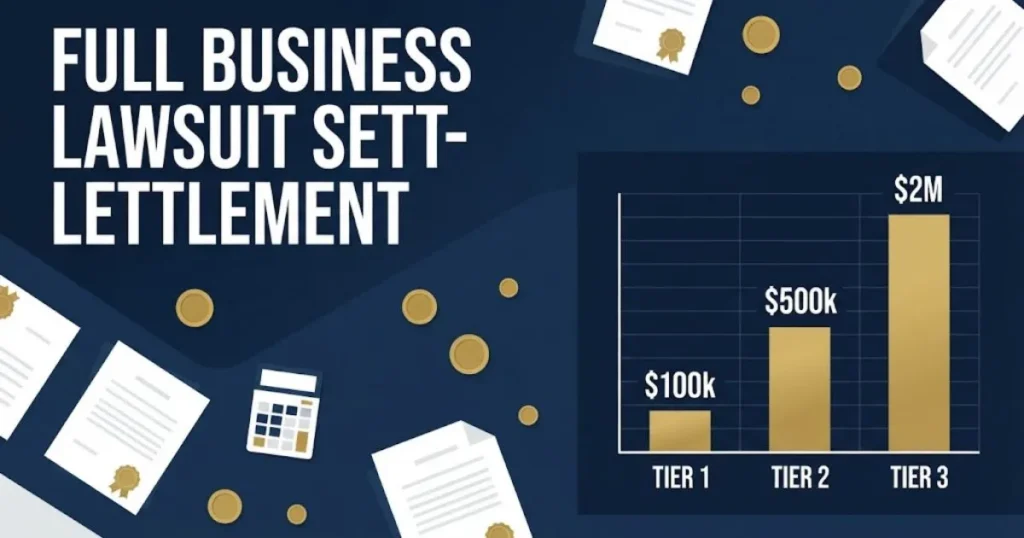
Settlement amounts depend on the strength of evidence, the damages claimed, and each side’s willingness to negotiate. Most settlements fall between $25,000 and $500,000 for mid-size disputes.
The negotiation process usually begins during discovery. Both sides gain a clearer picture of the evidence. This is when realistic settlement discussions typically start.
Mediation sessions often produce the final settlement figure. A neutral mediator helps both parties find common ground. These sessions can last a single day or stretch across multiple rounds.
| Claim Type | Low Settlement | Median | High Settlement |
|---|---|---|---|
| Breach of Contract | $10,000 | $85,000 | $750,000 |
| Business Fraud | $25,000 | $150,000 | $2,000,000 |
| Partnership Dispute | $15,000 | $60,000 | $400,000 |
| IP Infringement | $50,000 | $250,000 | $5,000,000 |
| Employment Claim | $5,000 | $45,000 | $300,000 |
Business Lawsuit Damages
Business lawsuit damages refer to the monetary compensation a court awards to the winning party. Damages fall into three main categories: compensatory, punitive, and equitable relief.
Compensatory damages cover actual financial losses. These include lost profits, out-of-pocket expenses, and contract value. The plaintiff must prove these losses with documentation.
Punitive damages punish the defendant for especially harmful conduct. Courts award these in cases involving fraud, malice, or gross negligence. They can multiply the total award significantly.
Equitable relief is non-monetary. It includes court orders forcing a party to stop certain actions or fulfill contractual obligations. Injunctions and specific performance orders fall into this category.
Damage Categories at a Glance:
- Compensatory: Lost revenue, repair costs, contract value
- Consequential: Indirect losses like lost future clients
- Punitive: Extra penalties for willful misconduct
- Statutory: Fixed amounts set by specific laws
- Equitable: Court orders, injunctions, specific performance
Small Business Lawsuit
A small business lawsuit involves legal disputes where at least one party operates a small company with fewer than 50 employees. These cases often land in state courts or small claims divisions.
Small claims court handles disputes under a specific dollar threshold. That limit ranges from $5,000 to $25,000 depending on the state. No attorney is required in most small claims venues.
For larger amounts, small businesses file in regular civil court. The process is identical to any full business lawsuit. Costs and timelines scale with the complexity of the case.
Many small business owners carry commercial general liability insurance. This coverage can pay for legal defense and settlement costs. Check your policy limits before litigation begins.
Small Business Quick Facts:
- Small claims limit: $5,000 to $25,000 by state
- Average defense cost: $3,000 to $15,000
- Insurance coverage: Check CGL policy limits
- Most common claim: Unpaid invoices and vendor disputes
Key Takeaway: Most business lawsuits settle for $25,000 to $500,000, with damages covering lost profits, punitive penalties, and court-ordered actions.
Business Lawsuit Attorney
A business lawsuit attorney is a licensed lawyer who specializes in commercial litigation and dispute resolution. Hiring the right attorney can determine whether you win or lose your case.
Look for attorneys with specific experience in your type of dispute. A contract specialist may not be the best fit for an intellectual property case. Specialization matters in business law.
Most business litigators offer a free initial consultation. Use this meeting to assess their experience, communication style, and fee structure. Ask about their track record with similar cases.
Fee arrangements vary widely. Some attorneys charge hourly rates. Others work on contingency for certain claim types. Hybrid arrangements combining a retainer with a success bonus are growing in 2026.
What to Ask Before Hiring:
- Years of experience in business litigation
- Case results for disputes similar to yours
- Fee structure and estimated total cost
- Communication frequency and preferred contact method
- Trial experience versus settlement-only practice
Business Lawsuit Examples
Real business lawsuit examples help illustrate how these cases play out in practice. Recent 2025 and 2026 cases show the range of disputes and outcomes.
A tech startup in Austin sued a former partner for trade secret theft. The jury awarded $4.2 million in compensatory and punitive damages. The case took 22 months from filing to verdict.
A restaurant chain in Chicago faced a breach of contract claim from a food supplier. The supplier alleged $380,000 in unpaid invoices. The parties settled for $210,000 during mediation.
A manufacturing company in Ohio won a $1.8 million verdict against a competitor for unfair competition. The defendant had poached key employees and solicited clients using stolen data.
| Case Type | Location | Outcome | Duration |
|---|---|---|---|
| Trade Secret Theft | Austin, TX | $4.2M verdict | 22 months |
| Unpaid Invoices | Chicago, IL | $210K settlement | 8 months |
| Unfair Competition | Columbus, OH | $1.8M verdict | 30 months |
| Partnership Fraud | Miami, FL | $950K settlement | 14 months |
Business Lawsuit Defense
Business lawsuit defense involves the legal strategies a company uses to fight claims brought against it. A strong defense can reduce damages, force a dismissal, or win outright at trial.
The first step is filing a timely answer to the complaint. Missing the response deadline can result in a default judgment against your company. Most courts allow 20 to 30 days to respond.
Common defense strategies include challenging jurisdiction, disputing the facts, and raising affirmative defenses. Statute of limitations arguments can dismiss stale claims entirely.
Motion practice is a powerful defense tool. A well-crafted motion for summary judgment can end a case before trial. Judges grant these motions when no genuine factual dispute exists.
Top Defense Strategies in 2026:
- Motion to dismiss for procedural defects
- Statute of limitations affirmative defense
- Summary judgment on undisputed facts
- Arbitration clause enforcement to move out of court
- Counterclaim filing to shift leverage
Key Takeaway: Hiring a specialized business lawsuit attorney early and preparing a strong defense strategy can save your company hundreds of thousands of dollars.
Business Lawsuit Statute of Limitations
The business lawsuit statute of limitations is the legal deadline for filing a claim after the dispute arises. Missing this deadline means you lose your right to sue permanently.
Deadlines vary by state and by claim type. Breach of contract claims typically allow three to six years. Fraud claims often have shorter windows of two to four years.
The clock usually starts when the harm occurs or when you discover it. Some states apply a “discovery rule” that delays the start date. This matters in cases involving hidden fraud.
Federal claims have their own deadlines. Antitrust claims allow four years. Securities fraud claims must be filed within two years of discovery and five years of the violation.
| Claim Type | Typical Deadline | Federal Deadline |
|---|---|---|
| Written Contract | 4 to 6 years | Varies by statute |
| Oral Contract | 2 to 4 years | Varies by statute |
| Fraud | 2 to 4 years | 2 to 5 years |
| Trade Secret | 3 to 5 years | 3 years (DTSA) |
| Employment | 1 to 3 years | 180 to 300 days (EEOC) |
Breach of Contract Lawsuit
A breach of contract lawsuit is the most common type of business litigation in the United States. It arises when one party fails to perform its obligations under a valid agreement.
To win, the plaintiff must prove four elements. A valid contract existed. The plaintiff performed their duties. The defendant failed to perform. The plaintiff suffered measurable damages.
Written contracts are easier to enforce than oral agreements. However, oral contracts are still legally binding in most states. The challenge is proving the terms without documentation.
Remedies for breach of contract include monetary damages and specific performance. Monetary damages cover the financial loss caused by the breach. Specific performance forces the defendant to fulfill the contract terms.
Elements You Must Prove:
- Valid contract with clear terms
- Your performance of contractual duties
- Defendant’s failure to perform as agreed
- Measurable damages directly caused by the breach
Business Partnership Lawsuit
A business partnership lawsuit resolves disputes between co-owners of a business entity. These cases often involve allegations of fiduciary duty breaches, mismanagement, or unfair profit distribution.
Partnership disputes are among the most emotionally charged business cases. Former allies become adversaries. The legal process can permanently destroy personal and professional relationships.
Common triggers include unequal workload, financial mismanagement, and unauthorized decisions. One partner may accuse another of diverting company funds. Another may claim exclusion from key decisions.
The governing documents matter enormously. An LLC operating agreement or partnership agreement sets the rules. Courts rely heavily on these documents when resolving disputes.
Common Partnership Dispute Triggers:
- Unequal profit distribution or hidden withdrawals
- Breach of fiduciary duty by a managing partner
- Unauthorized business decisions without consent
- Failure to contribute agreed capital or labor
- Deadlock on major business decisions
How Long Does a Business Lawsuit Take
A business lawsuit typically takes 12 to 36 months to reach final resolution in 2026. Cases that settle early may conclude in under six months. Full trials with appeals can stretch beyond five years.
The discovery phase consumes the most time. Both sides must exchange thousands of documents and conduct depositions. Electronic discovery alone can take months in data-heavy cases.
Court scheduling adds unavoidable delays. Judges manage hundreds of cases simultaneously. Getting a trial date in major metro courts often requires waiting 12 to 18 months after discovery closes.
Alternative dispute resolution can cut the timeline in half. Arbitration hearings typically occur within six to nine months of filing. Mediation sessions can produce settlements in a single day.
2026 Duration by Resolution Method:
- Early settlement: 2 to 6 months
- Mediation: 4 to 10 months
- Arbitration: 6 to 12 months
- Bench trial: 12 to 24 months
- Jury trial plus appeal: 24 to 60 months
Key Takeaway: The statute of limitations sets a hard deadline for filing, and most business lawsuits resolve within one to three years depending on the method of resolution.
Frequently Asked Questions
What is the average cost of a full business lawsuit in 2026?
Most business lawsuits cost between $10,000 and $100,000 in total legal fees. Complex federal cases can exceed $500,000 when expert witnesses and extended discovery are involved.
How long does a typical business lawsuit take from start to finish?
The average business lawsuit takes 12 to 36 months to resolve. Early settlements can wrap up in under six months while trials with appeals may stretch beyond five years.
Can I file a business lawsuit without hiring an attorney?
You can file in small claims court without a lawyer in most states. For larger claims in civil court, representing your business is legally allowed but strongly discouraged due to procedural complexity.
What types of damages can I recover in a business lawsuit?
You can recover compensatory damages for actual financial losses and punitive damages for willful misconduct. Courts may also grant equitable relief such as injunctions or specific performance orders.
Is it better to settle a business lawsuit or go to trial?
Settling is usually faster and cheaper than going to trial. About 90% of business lawsuits settle before trial because it reduces legal costs and eliminates the risk of an unpredictable jury verdict.
The full business lawsuit process demands preparation, patience, and the right legal team. Understanding the types, costs, and timelines gives you a real advantage whether you are filing or defending.
Review your contracts, document everything, and act before the statute of limitations expires. The sooner you move, the stronger your position will be in 2026.