
A fender lawsuit after a minor car crash can pay between $500 and $25,000 in 2026. The exact amount depends on your injuries and property damage.
Most people assume a small dent means a small claim. That assumption costs them thousands of dollars every year.
Minor collisions cause hidden injuries that surface weeks later. Whiplash alone accounts for over $3.9 billion in annual insurance payouts across the country.
This guide breaks down settlement ranges, filing deadlines, and fault rules. You will know exactly where you stand by the end.
Fender Bender Lawsuit
A fender bender lawsuit is a civil claim filed after a low-speed car collision. It covers medical bills, vehicle repairs, and lost wages.
These cases typically involve speeds under 15 mph. The damage might look cosmetic on the outside.
Your body tells a different story. Soft tissue injuries often appear days after the impact.
In 2026, state courts are seeing a 12 percent increase in minor accident filings. Insurance companies are pushing back harder on small claims.
That makes understanding your legal options more important than ever. A well-documented case can turn a denied claim into a fair settlement.
| Detail | Info |
|---|---|
| Average Speed at Impact | Under 15 mph |
| Most Common Injury | Whiplash |
| Typical Filing Venue | Small Claims or Civil Court |
| 2026 Filing Trend | Up 12 percent nationally |
Can You Sue for a Fender Bender
Yes, you can sue for a fender bender in all 50 states. The right to file a lawsuit does not depend on how severe the crash looked.

What matters is whether you suffered measurable harm. That harm can be physical, financial, or both.
Even a slow rear-end tap can cause spinal misalignment. Medical records are your strongest evidence.
Think of it like a cracked phone screen. The drop was small, but the repair bill is real.
The other driver’s insurance may deny your claim initially. A lawsuit forces them to take your case seriously.
Key fact: Over 60 percent of fender bender lawsuits settle before reaching trial.
How Much Is a Fender Bender Lawsuit Worth
A fender bender lawsuit is typically worth $500 to $25,000 in 2026. Cases with serious soft tissue injuries can exceed $50,000.
The value depends on three main factors. Those are medical costs, lost income, and pain severity.
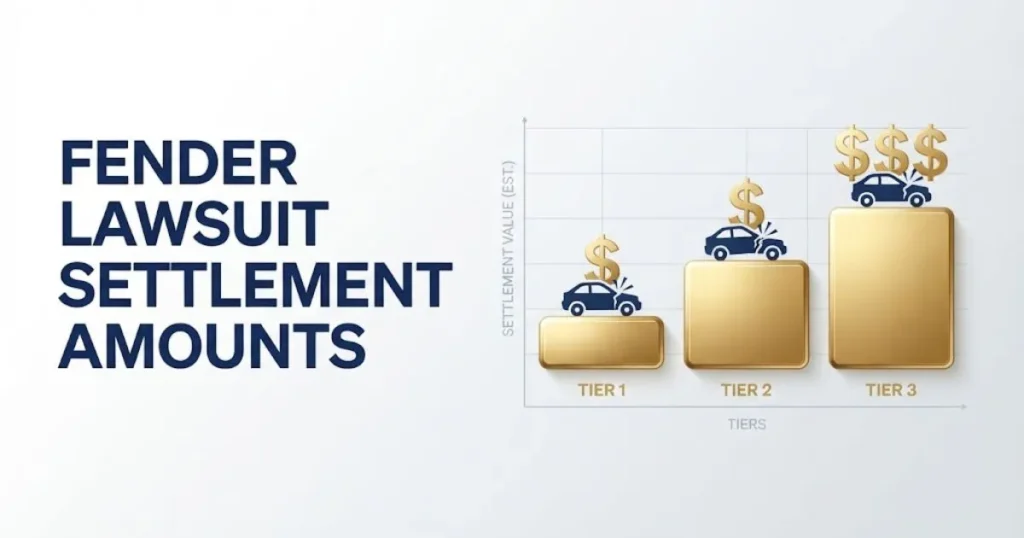
Property-only claims usually settle for $500 to $3,000. Add whiplash and the number jumps to $5,000 to $15,000.
Insurance adjusters use a multiplier formula. They multiply your medical bills by 1.5 to 5 times.
A $2,000 medical bill with moderate pain could yield a $6,000 to $10,000 settlement. Documentation drives the final number.
| Injury Level | Estimated Range |
|---|---|
| Property Damage Only | $500 to $3,000 |
| Minor Whiplash | $3,000 to $10,000 |
| Moderate Soft Tissue | $10,000 to $25,000 |
| Severe Neck or Back | $25,000 to $50,000+ |
Key Takeaway: A fender bender lawsuit can be worth far more than the visible damage suggests, especially when hidden injuries are documented properly.
Fender Bender Lawsuit Settlement Amounts
Fender bender lawsuit settlement amounts in 2026 average around $7,500 for injury claims. Property-only settlements average closer to $1,800.
These numbers reflect data from state court filings and insurance industry reports. Your individual case may differ significantly.
Settlement amounts rise when you have strong medical evidence. MRI results showing disc damage carry more weight than a simple doctor visit.
Negotiation plays a huge role in the final number. The first offer from an insurance adjuster is almost always too low.
Most claimants who reject the initial offer receive 30 to 50 percent more in the final settlement. Patience pays off.
- Average injury settlement: $7,500
- Average property-only settlement: $1,800
- First offer rejection increase: 30 to 50 percent
- Median time to settlement: 4 to 8 months
Fender Bender Injury Claim
A fender bender injury claim covers physical harm caused by a low-speed collision. Common injuries include whiplash, concussions, and shoulder strains.
You do not need a broken bone to qualify. Soft tissue damage is real and compensable under state law.
Symptoms often appear 24 to 72 hours after the crash. Delayed onset is normal and does not weaken your claim.
See a doctor within 48 hours of the accident. This creates a medical record linking your injury to the crash.
Without that paper trail, insurance companies will argue your pain came from something else. Medical documentation is the backbone of every successful claim.
| Injury Type | Avg. Recovery Time | Avg. Claim Value |
|---|---|---|
| Whiplash | 6 to 12 weeks | $3,000 to $10,000 |
| Concussion | 2 to 8 weeks | $5,000 to $15,000 |
| Shoulder Strain | 4 to 10 weeks | $2,500 to $8,000 |
| Lower Back Sprain | 8 to 16 weeks | $7,000 to $20,000 |
Key Takeaway: Fender bender injury claims succeed when you seek immediate medical care and maintain detailed records of every symptom and treatment.
Fender Bender Whiplash Lawsuit
A fender bender whiplash lawsuit targets the most common injury in low-speed rear-end crashes. Whiplash occurs when your neck snaps forward and backward on impact.
This motion stretches ligaments and muscles beyond their normal range. The result is pain, stiffness, and limited mobility.
Whiplash claims are the single largest category in minor accident lawsuits. They account for roughly 40 percent of all fender bender filings.
Insurance companies scrutinize whiplash claims more than any other injury type. They know some claimants exaggerate symptoms.
That means your medical evidence must be airtight. An MRI or CT scan showing inflammation carries far more weight than a self-reported pain diary.
Bold stat: The average whiplash settlement in 2026 is $7,200 with proper documentation.
Fender Bender Lawsuit Pain and Suffering
A fender bender lawsuit pain and suffering award compensates you for non-economic harm. This includes physical discomfort, emotional distress, and reduced quality of life.
Pain and suffering is separate from your medical bills. It sits on top of your economic damages.
Courts and insurers use two methods to calculate this. The multiplier method and the per diem method.
The multiplier method takes your medical bills and multiplies them by 1.5 to 5. A more severe injury earns a higher multiplier.
The per diem method assigns a daily dollar value to your pain. You receive that amount for every day you suffer.
- Multiplier range: 1.5x to 5x medical costs
- Per diem range: $100 to $500 per day
- Average pain and suffering award: $3,000 to $12,000
- Caps vary by state (some states limit non-economic damages)
Key Takeaway: Pain and suffering awards in fender bender lawsuits can double or triple your total payout when supported by consistent medical evidence and daily symptom logs.
Who Is at Fault in a Fender Bender
The driver who rear-ends another vehicle is at fault in most fender bender cases. This rule applies in nearly every state.
The logic is simple. The trailing driver has a duty to maintain a safe following distance.
If you hit someone from behind, you failed that duty. The presumption of fault falls on you.
However, exceptions exist. A driver who reverses into you or brake-checks you may share liability.
States use different fault systems. Some follow pure comparative negligence. Others use modified rules.
| Fault System | How It Works |
|---|---|
| Pure Comparative | You recover damages minus your fault percentage |
| Modified 50% | You cannot recover if you are 50% or more at fault |
| Modified 51% | You cannot recover if you are 51% or more at fault |
| Contributory | Any fault on your part blocks recovery entirely |
Fender Bender Rear End Collision Lawsuit
A fender bender rear end collision lawsuit is the most common type of minor accident claim. The rear driver is presumed at fault in almost all cases.
These crashes happen at stoplights, in parking lots, and in slow traffic. Speeds are usually under 10 mph.
Despite the low speed, the physics work against you. Your car stops suddenly while your body keeps moving forward.
This creates the classic whiplash mechanism. Your head snaps back, then forward, in under half a second.
The at-fault driver’s bodily injury liability coverage pays your claim. Most states require a minimum of $25,000 per person in coverage.
That minimum is often enough to cover a minor rear-end case. Larger injuries may exceed policy limits.
Bold stat: Rear-end collisions make up 29 percent of all car accidents nationwide according to federal traffic data.
Key Takeaway: In a fender bender rear end collision lawsuit, the trailing driver is almost always at fault, making these cases among the most straightforward to prove.
Fender Bender Insurance Claim vs Lawsuit
A fender bender insurance claim is your first step after a minor crash. A lawsuit becomes necessary when the insurer denies or lowballs your claim.
Most minor accident cases never reach the courtroom. Roughly 85 percent resolve through insurance negotiations alone.
You file a claim with the at-fault driver’s insurance company. An adjuster reviews your evidence and makes an offer.
If that offer covers your bills and losses, you accept it. The case closes in a matter of weeks.
When the offer falls short, you have two choices. You can negotiate further or file a formal lawsuit.
| Factor | Insurance Claim | Lawsuit |
|---|---|---|
| Timeline | 2 to 8 weeks | 6 to 18 months |
| Cost to You | Free | Attorney fees apply |
| Stress Level | Low | Moderate to High |
| Potential Payout | Lower | Higher |
| Certainty | Guaranteed if accepted | Not guaranteed |
Fender Bender Lawsuit Without Injury
A fender bender lawsuit without injury is limited to property damage recovery. You can still sue, but the payout will be smaller.
These cases cover vehicle repairs, rental car costs, and diminished value. Diminished value means your car is worth less after an accident.
Even a repaired car loses resale value. Studies show a 10 to 25 percent drop in market value after a reported collision.
Most property-only claims settle through insurance. Filing a lawsuit makes sense only when the insurer refuses to pay fair repair costs.
Small claims court is the usual venue for these cases. The filing fee is typically under $100.
- Average property-only payout: $1,200 to $3,000
- Diminished value recovery: $500 to $2,500
- Rental car reimbursement: $30 to $60 per day
- Small claims court limit: $5,000 to $10,000 depending on state
Fender Bender Lawsuit Property Damage Only
A fender bender lawsuit property damage only case focuses exclusively on vehicle and personal property losses. No bodily injury claims are involved.
This type of lawsuit is simpler and faster than an injury case. The evidence is straightforward.
You need repair estimates, photos of the damage, and a police report. An appraiser can confirm the diminished value of your vehicle.
Insurance companies try to use aftermarket parts to cut costs. You have the right to demand original equipment manufacturer parts.
The gap between an aftermarket repair and an OEM repair can exceed $1,000. That difference is recoverable in court.
Bold stat: Over 70 percent of property-only fender bender claims settle within 30 days of filing.
Key Takeaway: Property-only fender bender lawsuits are faster and simpler than injury claims, but you must document every repair cost and diminished value loss to maximize your recovery.
Fender Bender Lawsuit Statute of Limitations
The fender bender lawsuit statute of limitations ranges from 1 to 6 years depending on your state. Most states set the deadline at 2 or 3 years.
This clock starts ticking on the date of the accident. Missing the deadline means you lose your right to sue permanently.
For injury claims, the deadline is usually shorter. Property damage claims often have a longer window.
Some states pause the clock if you were a minor at the time. Others extend it if the injury was not discovered immediately.
| State Examples | Injury Deadline | Property Deadline |
|---|---|---|
| California | 2 years | 3 years |
| Texas | 2 years | 2 years |
| New York | 3 years | 3 years |
| Florida | 2 years | 4 years |
| Illinois | 2 years | 5 years |
How to File a Fender Bender Lawsuit
To file a fender bender lawsuit, you must draft a complaint and submit it to your local civil court. The complaint names the at-fault driver and states your damages.
Before filing, send a demand letter to the insurance company. This letter outlines your injuries, costs, and settlement demand.
Give the insurer 30 days to respond. If they deny or ignore your demand, proceed with the lawsuit.
You will need to pay a filing fee. Most courts charge between $50 and $400 depending on the claim amount.
After filing, the court serves the defendant with a summons. The defendant then has 20 to 30 days to respond.
- Step 1: Gather medical records and repair estimates
- Step 2: Send a demand letter to the insurer
- Step 3: Draft and file your complaint
- Step 4: Pay the court filing fee
- Step 5: Serve the defendant with a summons
- Step 6: Begin discovery and negotiation
Key Takeaway: Filing a fender bender lawsuit requires a demand letter, a formal complaint, and court fees, but most cases settle during the negotiation phase before trial.
Fender Bender Lawsuit Timeline 2026
The fender bender lawsuit timeline in 2026 ranges from 3 months to 18 months for most cases. Simple property claims resolve faster than injury cases.
The first 30 to 60 days involve evidence gathering and demand letters. This is the pre-filing phase.
Once you file, the discovery period lasts 3 to 6 months. Both sides exchange documents and take depositions.
Settlement negotiations usually happen between months 4 and 8. Most cases resolve during this window.
If no settlement is reached, the case goes to trial. Trial dates in 2026 are booked 8 to 14 months out in most urban courts.
| Phase | Duration |
|---|---|
| Pre-Filing and Demand | 1 to 2 months |
| Filing and Discovery | 3 to 6 months |
| Settlement Negotiation | 4 to 8 months |
| Trial (if needed) | 8 to 14 months |
| Payment After Settlement | 2 to 6 weeks |
Should I Get a Lawyer for a Fender Bender
You should get a lawyer for a fender bender if your injuries required medical treatment or the insurer denied your claim. Simple property-only cases often do not need an attorney.
A personal injury lawyer works on contingency. That means you pay nothing upfront.
The attorney takes 33 to 40 percent of your final settlement. If you win nothing, you owe nothing.
Studies show that claimants with lawyers receive 3.5 times more money than those who handle claims alone. That gap holds even after attorney fees.
For a $10,000 claim, going solo might net you $4,000. With a lawyer, you could walk away with $6,000 or more.
- Contingency fee: 33 to 40 percent
- Average increase with a lawyer: 3.5x higher payout
- Best for: injury claims, denied claims, disputed fault
- Skip the lawyer if: property damage under $2,000 and no injuries
Key Takeaway: Hiring a lawyer for a fender bender lawsuit costs you nothing upfront and typically results in a significantly higher net settlement, especially for injury claims.
Frequently Asked Questions
How much will I get from a fender bender lawsuit?
Most claimants receive between $3,000 and $15,000 for injury claims in 2026.
Property-only cases average $1,200 to $3,000.
Your exact payout depends on medical evidence and negotiation strength.
Can I sue for a fender bender with no injuries?
Yes, you can sue for property damage and diminished vehicle value.
These claims typically settle for $500 to $3,000.
Small claims court is the fastest route for property-only cases.
How long does a fender bender lawsuit take in 2026?
Most cases resolve within 4 to 8 months through settlement.
Cases that go to trial can take 12 to 18 months.
Property-only claims often close in under 3 months.
Do I need a lawyer for a minor car accident lawsuit?
You should hire a lawyer if you have injuries or a denied claim.
Claimants with attorneys receive 3.5 times more on average.
Property-only claims under $2,000 usually do not require legal help.
What is the deadline to file a fender bender lawsuit?
The statute of limitations is 2 to 3 years in most states.
The clock starts on the date of the accident.
Missing this deadline permanently eliminates your right to sue.
Your fender bender lawsuit could be worth thousands more than the insurance company wants you to believe. Document every injury, keep every receipt, and do not accept the first offer. Check your state’s filing deadline today and take action before the clock runs out.