Web accessibility lawsuits are surging in 2026. Over 4,500 ADA website cases were filed last year alone. That number keeps climbing every quarter.
If your site is not fully accessible, you are a target. This guide covers everything about web accessibility lawsuits right now. You will learn who gets sued and typical settlement amounts.
One shocking fact: 96 percent of home pages have detectable WCAG failures. That means almost every business faces real legal risk. The pressure from plaintiffs and regulators is not slowing down.
State laws are getting stricter too. Read on to understand your full exposure.
Web Accessibility Lawsuits 2026
Web accessibility lawsuits in 2026 have reached an all-time high. Plaintiffs filed over 4,500 ADA digital cases in 2025. That pace shows no signs of stopping this year.
The Department of Justice issued new rules in 2024. These rules set hard deadlines for government websites. Private businesses are next in line for regulation.
Courts are no longer sympathetic to ignorance claims. Saying you did not know the rules will not help. If your website fails basic accessibility tests, you face real risk.
The legal environment has shifted dramatically since 2023. Both federal and state courts are moving faster. Plaintiffs have better tools to find non-compliant sites.
Quick Fact: Over 4,500 federal ADA digital lawsuits were filed in 2025, marking the third consecutive year above 4,000.
ADA Website Lawsuits
ADA website lawsuits target businesses with digital barriers. The Americans with Disabilities Act was signed in 1990. It did not mention websites at the time.
Courts have since extended Title III to digital spaces. A blind user who cannot access your site can sue. A deaf user blocked by uncaptioned video can sue.
The law treats websites like physical storefronts. Your digital door must be open to everyone. Think of it like a wheelchair ramp for the internet.
Over 80 percent of cases target e-commerce sites. Retail, food service, and banking lead the list. Any business selling online is in the crosshairs.
| Industry | Share of Lawsuits |
|---|---|
| E-Commerce | 38% |
| Food Service | 18% |
| Banking | 14% |
| Healthcare | 11% |
| Travel | 9% |
Website Accessibility Lawsuit Statistics
Website accessibility lawsuit statistics reveal a steep upward trend. Federal ADA Title III filings hit 4,605 in 2023. That number stayed above 4,000 through 2025.
New York and California account for most filings. New York alone saw over 2,800 cases in one year. California added roughly 600 more state-level claims.
Healthcare and retail websites get hit the hardest. About 20 percent of lawsuits target repeat defendants. Some businesses get sued multiple times in one year.
The numbers tell a clear story. Digital accessibility litigation is not a fad. It is a permanent part of doing business online.
| Year | Federal Filings | Top State |
|---|---|---|
| 2023 | 4,605 | New York |
| 2024 | 4,312 | New York |
| 2025 | 4,500+ | New York |
| 2026 | 4,800+ projected | New York |
Key Takeaway: Web accessibility lawsuits are at record levels in 2026, with e-commerce and retail sites facing the highest risk across New York and California courts.
How to File a Web Accessibility Lawsuit
Filing a web accessibility lawsuit starts with documenting barriers. You must show the site blocks your access. Take screenshots of the specific failures you encounter.
Record your screen using assistive technology like a screen reader. This creates a clear record of the problem. Then contact a disability rights attorney in your state.
Most lawyers take these cases on contingency. You pay nothing upfront if you win. The attorney sends a demand letter to the business first.
Many cases settle before a formal complaint is filed. Federal court filings follow if negotiations fail. The entire process can take three to twelve months.
- Document every barrier with screenshots and video
- Contact a disability rights attorney for a free review
- Expect a demand letter before any court filing
- Most cases settle within 90 days of the complaint
Web Accessibility Lawsuit Settlements
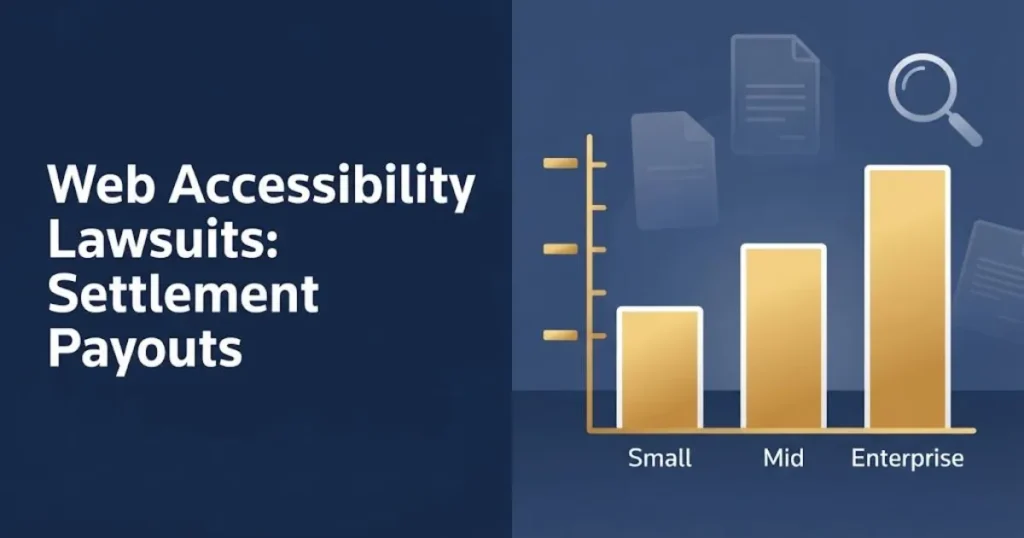
Web accessibility lawsuit settlements typically range from $10,000 to $75,000. The average payout sits around $25,000 per case. Larger companies often pay more to avoid bad press.
Settlements usually include a remediation timeline too. The defendant must fix their site within 12 to 24 months. Some agreements require third-party accessibility audits.
Plaintiffs also recover attorney fees in most settlements. Those fees can double or triple the total cost. A $25,000 settlement can become a $75,000 bill.
Think of it like a car accident claim. The medical bills are just the start. Legal fees and penalties stack up fast.
| Settlement Tier | Typical Range | Business Size |
|---|---|---|
| Small Business | $10,000 to $25,000 | Under 50 employees |
| Mid-Size | $25,000 to $50,000 | 50 to 500 employees |
| Enterprise | $50,000 to $150,000 | Over 500 employees |
ADA Title III Website Lawsuits
ADA Title III website lawsuits cover public accommodations. Title III applies to businesses open to the public. That includes hotels, restaurants, banks, and online stores.
Courts disagree on whether web-only businesses qualify. The Ninth Circuit says a physical nexus is required. The First and Seventh Circuits disagree with that view.
This split creates confusion for national businesses. The Supreme Court has not resolved the issue yet. Until then, plaintiffs shop for favorable jurisdictions.
New York and California remain the top venues. Both circuits interpret Title III broadly. Filing in those states gives plaintiffs a clear advantage.
Key Takeaway: Filing a web accessibility claim is straightforward for plaintiffs, and most cases settle for $10,000 to $75,000 before ever reaching trial.
Website Accessibility Lawsuit Cost
Website accessibility lawsuit costs hit small businesses hard. Defending a single ADA claim costs $25,000 to $50,000. That covers attorney fees and expert witnesses.
Settlement costs add another $10,000 to $75,000. Then you must pay to fix the actual website. Remediation projects run $5,000 to $50,000 depending on size.
The total cost of one lawsuit can exceed $100,000. Compare that to proactive compliance at $3,000 to $10,000 yearly. Prevention is far cheaper than litigation.
It is like skipping oil changes on your car. The repair bill always costs more than the maintenance.
| Cost Category | Estimated Range |
|---|---|
| Defense Attorney | $25,000 to $50,000 |
| Settlement | $10,000 to $75,000 |
| Website Remediation | $5,000 to $50,000 |
| Ongoing Compliance | $3,000 to $10,000/year |
Who Can Sue for Web Accessibility
Any person with a disability can sue for web accessibility. You must have a genuine barrier to access. The ADA defines disability broadly under federal law.
Visual, auditory, motor, and cognitive impairments all qualify. You do not need to be a customer yet. Attempting to use the site is enough for standing.
Some plaintiffs are serial filers who target hundreds of sites. Courts have started scrutinizing these repeat plaintiffs more closely. But legitimate claims still move forward quickly.
The bar to file is low. The bar to dismiss is high. That imbalance drives the volume of cases we see.
- Blind and low-vision users (screen reader barriers)
- Deaf and hard-of-hearing users (missing captions)
- Motor-impaired users (keyboard navigation failures)
- Cognitive disability users (confusing layouts and timers)
Web Accessibility Lawsuit Trends 2026
Web accessibility lawsuit trends in 2026 point to rapid expansion. Mobile app lawsuits are growing faster than web claims. AI-powered chatbots are a new target for plaintiffs.
Overlay widgets are failing in court as a defense. Judges are rejecting quick-fix accessibility tools more often. Courts want real compliance, not surface-level patches.
State-level laws are adding to federal pressure. Colorado and California now have their own digital rules. The European Accessibility Act also took effect in 2025.
US companies serving EU customers face dual compliance. The legal net is widening on every front. No industry is immune to this trend.
Key Takeaway: Defending a single web accessibility lawsuit costs $25,000 to $100,000 or more, while proactive compliance runs a fraction of that amount each year.
DOJ Web Accessibility Enforcement
DOJ web accessibility enforcement has intensified since 2024. The Department issued final rules under Title II in April 2024. State and local governments must comply by April 2026.
Smaller governments get an extra year until April 2027. The DOJ can investigate and fine non-compliant entities. They have already opened probes into several state portals.
Private businesses fall under Title III instead. The DOJ has not issued final Title III rules yet. But enforcement signals are clear and growing stronger.
Expect formal Title III regulations within the next two years. The writing is on the wall for private companies. The government is watching and taking notes.
| Entity Type | Compliance Deadline |
|---|---|
| Large State/Local Gov | April 26, 2026 |
| Small State/Local Gov | April 26, 2027 |
| Private Business (Title III) | Pending rulemaking |
WCAG Compliance Lawsuits
WCAG compliance lawsuits reference specific technical standards. WCAG 2.1 Level AA is the current legal benchmark. Most courts treat it as the de facto standard.
WCAG 2.2 was published in late 2023. Some newer lawsuits already reference the updated version. Failing even one success criterion can trigger a claim.
Common failures include missing alt text and poor contrast. Keyboard navigation issues are the most cited problem. Screen reader compatibility failures come in second.
Think of WCAG like building codes for the web. You would not open a store without fire exits. Your website needs digital exits too.
- Missing alt text on images (most common violation)
- Poor color contrast below 4.5:1 ratio
- No keyboard navigation for interactive elements
- Missing form labels on input fields
- Auto-playing media without pause controls
Web Accessibility Class Action
Web accessibility class action lawsuits are rare but growing. Most ADA digital cases are filed individually. Class certification requires common issues across all members.
That is hard to prove with varied disability types. A blind user faces different barriers than a deaf user. Some courts have denied class status for this reason.
But large-scale cases against major retailers have succeeded. Class actions can multiply damages significantly. A single case can represent thousands of affected users.
The Domino’s case showed how one claim can snowball. Public attention amplifies the financial and reputational damage. Class actions remain a sleeping giant in this space.
Key Takeaway: The DOJ now requires government websites to meet WCAG 2.1 AA by April 2026, and private sector rules are expected to follow within two years.
Small Business ADA Website Lawsuit
Small business ADA website lawsuits are rising sharply. About 75 percent of new filings target small companies. Plaintiffs know small firms lack resources to fight.
A demand letter alone often triggers a quick settlement. Many small business owners do not know the rules. They assume the ADA only covers physical locations.
That assumption is expensive and legally wrong. Even a local bakery with a simple site is exposed. The cost of one lawsuit can bankrupt a small shop.
If you run a small business, start with the basics. Add alt text, fix contrast, and test keyboard access. These three steps eliminate most common claims.
| Risk Factor | Small Business | Enterprise |
|---|---|---|
| Likelihood of Being Sued | High | Moderate |
| Resources to Defend | Low | High |
| Average Settlement | $10,000 to $25,000 | $50,000 to $150,000 |
| Time to Resolve | 60 to 90 days | 6 to 18 months |
Web Accessibility Lawsuit Payout
Web accessibility lawsuit payouts vary by case size. Individual plaintiffs typically receive $5,000 to $15,000. Attorney fees add $10,000 to $50,000 on top.
Large corporate settlements can exceed $100,000 easily. The Domino’s Pizza case cost millions in legal fees. Winn-Dixie spent over $250,000 before the case ended.
Payouts also depend on the jurisdiction and judge. California state law allows statutory damages per visit. That can multiply a single claim into thousands.
Federal ADA claims do not include monetary damages. Plaintiffs recover attorney fees and injunctive relief only. State law claims are where the money comes from.
Quick Fact: California’s Unruh Act allows $4,000 per violation, making it the most lucrative jurisdiction for plaintiffs filing web accessibility claims.
State Web Accessibility Laws
State web accessibility laws are expanding across the country. California’s Unruh Act allows $4,000 per violation. That stacks on top of any federal ADA claims.
New York has no specific statute but courts are aggressive. The Southern District of New York leads the nation in filings. Judges there interpret the ADA broadly.
Colorado passed SB 21-108 for government sites in 2022. Illinois and Massachusetts are considering new bills. State laws often provide stronger remedies than federal law.
Plaintiffs frequently file in both state and federal court. This dual-track approach increases settlement pressure. Defendants face two legal battles instead of one.
| State | Key Law | Damages Per Violation |
|---|---|---|
| California | Unruh Act | $4,000 |
| New York | NY State Human Rights Law | Varies |
| Colorado | SB 21-108 | Injunctive relief |
| Florida | FCRA | $1,000 to $10,000 |
Key Takeaway: Small businesses face the highest lawsuit risk with the fewest resources, and state laws like California’s Unruh Act can multiply payouts well beyond federal ADA limits.
Frequently Asked Questions
How much does a web accessibility lawsuit cost to defend?
Defending a single ADA web claim costs $25,000 to $50,000 in legal fees. Settlement and remediation costs push the total past $100,000 in many cases. Proactive compliance costs a fraction of that amount.
Can an accessibility overlay protect me from a lawsuit?
No, overlay widgets do not prevent lawsuits. Courts have rejected overlay defenses in multiple 2025 and 2026 rulings. Judges require actual code-level compliance with WCAG standards.
What is the ADA website compliance deadline for 2026?
State and local governments must meet WCAG 2.1 AA by April 26, 2026. Small governments have until April 26, 2027. Private businesses do not have a fixed federal deadline yet.
Do small businesses have to follow web accessibility laws?
Yes, small businesses must comply with the ADA regardless of size. There is no employee threshold or revenue exemption for website accessibility. Even a sole proprietor with an online store is covered.
How long does a web accessibility lawsuit take to settle?
Most cases settle within 60 to 90 days of the initial demand letter. Cases that go to federal court can take 12 to 24 months. The timeline depends on the defendant’s willingness to negotiate.
Web accessibility lawsuits are not slowing down in 2026. The numbers keep climbing and the rules keep tightening. Ignorance is no longer a defense in any jurisdiction.
Check your website against WCAG 2.1 AA standards today. Fix the basics before a demand letter shows up. The cost of prevention is always lower than the cost of a lawsuit.