Most cases never reach the Supreme Court. Out of roughly 7,000 petitions filed each year, the Court agrees to hear about 60 to 70. That is less than one percent.
So how does a case get to the supreme court in the first place? The short answer is that a losing party files a petition asking the justices to review a lower court ruling. Four of the nine justices must agree to take the case.
The path from a trial courtroom to the Marble Palace is long and narrow. It involves multiple appeals, strict deadlines, and a selection process that surprises most people.
In this 2026 guide, you will learn every step of that journey. We will cover jurisdiction, petitions, the cert pool, oral arguments, and what happens after the Court rules.
How Does a Case Get to the Supreme Court
A case reaches the Supreme Court when four justices vote to grant a petition for review. This process starts after a lower court issues a final ruling that one side believes was wrong.
The losing party files a document called a petition for a writ of certiorari. This petition asks the Court to examine the lower court decision for legal errors.
The justices do not take every case that arrives at their door. They focus on cases with national importance or cases where lower courts disagree on the same legal question.
Think of it like a filter on a coffee maker. Thousands of cases pour in. Only the strongest and most significant drip through to the top.
In the 2025 October Term, the Court received over 6,800 petitions. It granted full review to roughly 65 cases. The odds are steep for any individual petitioner.
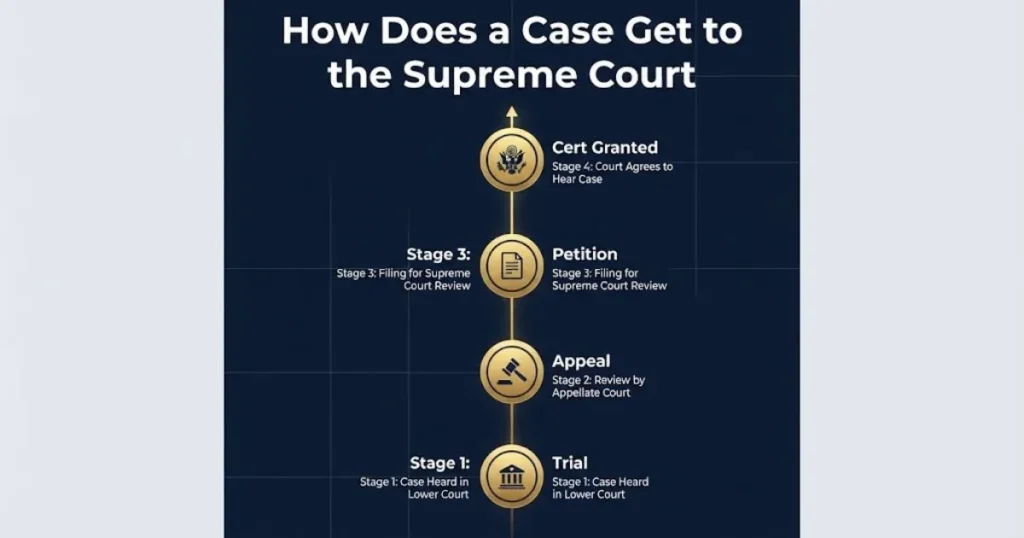
| Stage | What Happens |
|---|---|
| Trial Court | Case is first heard and decided |
| Appeals Court | Losing side appeals the ruling |
| Petition Filed | Losing side asks SCOTUS for review |
| Cert Granted | Four justices vote to hear the case |
| Oral Arguments | Lawyers present their case in person |
| Opinion Issued | Court publishes its final ruling |
Supreme Court Jurisdiction Explained
Supreme Court jurisdiction refers to the legal authority the Court has to hear and decide specific types of cases. Not every legal dispute falls under its power.
The Constitution grants the Court two types of jurisdiction. These are original jurisdiction and appellate jurisdiction. Each covers very different kinds of cases.
Original jurisdiction means the case starts at the Supreme Court. This is rare and applies to disputes between states or cases involving foreign ambassadors.
Appellate jurisdiction is far more common. It means the Court reviews decisions already made by lower federal courts or state supreme courts.
Congress has the power to shape the Court’s appellate jurisdiction. The Judiciary Act of 1925 gave the justices much more control over their own docket.
Before that law, the Court was required to hear almost every appeal. Now the justices choose which cases deserve their attention. This shift changed American law forever.
Key Fact: Over 99 percent of Supreme Court cases arrive through appellate jurisdiction, not original jurisdiction.
Supreme Court Original Jurisdiction vs Appellate
Original jurisdiction and appellate jurisdiction are the two pathways that bring cases before the Supreme Court. They differ in where the case begins and how it arrives.
Original jurisdiction cases skip every lower court entirely. The Supreme Court acts as the trial court. These cases almost always involve two or more states fighting over borders, water rights, or interstate commerce.
A recent example is Texas v. New Mexico, a water dispute that has stretched across multiple terms. The Court appointed a special master to gather evidence, much like a trial judge would.
Appellate jurisdiction cases travel upward through the court system first. A case starts in a federal district court or a state trial court. It then moves to an appeals court before reaching the Supreme Court.
| Feature | Original Jurisdiction | Appellate Jurisdiction |
|---|---|---|
| Where case starts | Supreme Court | Lower court |
| How common | Very rare (1 to 3 per year) | Very common (60 to 70 per year) |
| Typical parties | State vs. state | Individual or company vs. government |
| Trial process | Special master appointed | Trial already happened below |
| Example | Texas v. New Mexico | Dobbs v. Jackson |
The vast majority of cases you read about in the news arrive through appellate jurisdiction. Original jurisdiction cases are the exception, not the rule.
Key Takeaway: The Supreme Court has two types of authority, but nearly all cases reach it through the appellate path after lower courts have already ruled.
Can Anyone Appeal to the Supreme Court
Technically, any party who loses in a federal appeals court or a state supreme court can file a petition. There is no income requirement or special status needed.
However, filing a petition does not guarantee the Court will listen. The justices reject roughly 99 percent of all petitions they receive each term.
You must have “standing” to appeal. This means you suffered a real, concrete injury that the lower court decision caused. You cannot file on behalf of someone else without legal authority.
Pro se petitioners, meaning people who file without a lawyer, make up a large share of the docket. The Court receives thousands of these each year. Almost none are granted.
The odds improve significantly if you have experienced appellate counsel. Lawyers who specialize in Supreme Court practice know how to frame legal questions in ways that attract the justices’ attention.
Bold Stat: In the 2024 term, pro se petitions had a grant rate below 0.1 percent, compared to roughly 1.5 percent for paid petitions.
Supreme Court Appeal Process Steps
The supreme court appeal process follows a strict sequence of steps from the lower court ruling to the final opinion. Each step has its own deadline and procedural rules.
Step one begins when the lower court issues its final judgment. The clock starts ticking immediately. The losing party typically has 90 days to file a petition for certiorari.
Step two is the petition itself. This document must explain why the case matters beyond the individual parties involved. The justices want to see a broad legal question, not just a personal grievance.
Step three is the response. The winning party below files a brief arguing why the Court should deny the petition. This is called a brief in opposition.
Step four is the conference. The justices meet in private to discuss the petition and vote on whether to grant it. This happens behind closed doors every Friday during the term.
Step five is the order. If four justices vote yes, the Court issues an order granting cert. The case then moves to the merits stage with full briefing and oral arguments.
| Step | Action | Typical Timeline |
|---|---|---|
| 1 | Lower court final ruling | Day zero |
| 2 | Petition for cert filed | Within 90 days |
| 3 | Brief in opposition filed | 30 days after petition |
| 4 | Conference vote | 2 to 4 weeks later |
| 5 | Cert granted or denied | Order list published Monday |
Writ of Certiorari Explained
A writ of certiorari is a formal order from the Supreme Court directing a lower court to send up the record of a case for review. The term comes from Latin and means “to be informed.”
When the Court grants cert, it is not saying the lower court was wrong. It is saying the legal question is important enough to deserve a closer look.
The petition for certiorari is the document that asks the Court to issue this writ. It must be filed within 90 days of the lower court’s final judgment in most cases.
The petition should focus on one or two clear legal questions. Rambling petitions that raise dozens of issues almost always get denied. The justices value precision.
A strong cert petition highlights a “circuit split.” This means two or more federal appeals courts have reached opposite conclusions on the same legal issue. The Supreme Court exists partly to resolve these splits.
Quick Fact: The word “certiorari” is often shortened to “cert” by lawyers and legal journalists. You will see phrases like “cert granted” and “cert denied” on legal news sites.
Key Takeaway: A writ of certiorari is the formal mechanism that pulls a case from a lower court into the Supreme Court, and the petition must be filed within 90 days of the final ruling below.
How to File a Petition to the Supreme Court
Filing a petition to the Supreme Court requires following strict formatting rules and meeting hard deadlines. The process is governed by the Supreme Court Rules, specifically Rule 10 through Rule 16.
The petition must be filed within 90 days of the lower court judgment. You can request a 60-day extension from the circuit justice, but extensions are not automatic.
The document must be typeset in a specific booklet format. It must use a Century family font at 12-point size. The page limit is 30 pages for the main body.
You must file 40 copies of the booklet with the Clerk of the Court. Electronic filing through the Court’s system is also required as of 2023 and remains mandatory in 2026.
The filing fee is $300 for most petitions. In forma pauperis petitioners, meaning those who cannot afford the fee, can file for free with a motion to proceed IFP.
| Requirement | Detail |
|---|---|
| Deadline | 90 days from final judgment |
| Extension | Up to 60 additional days |
| Page limit | 30 pages |
| Font | Century family, 12-point |
| Copies | 40 booklets |
| Filing fee | $300 |
Most petitioners hire appellate specialists for this stage. The rules are unforgiving, and a formatting error alone can get your petition rejected.
Supreme Court Cert Pool Process
The supreme court cert pool is a system where the justices share the workload of reading thousands of petitions each year. It was created in 1972 to manage the growing docket.
Under this system, each petition is assigned to one law clerk from a participating justice’s chambers. That clerk reads the entire petition and writes a memo summarizing the case.
The memo recommends whether the Court should grant or deny the petition. All participating justices then read the same memo instead of having their own clerks review every case.
As of 2026, seven of the nine justices participate in the cert pool. Justice Alito and Justice Gorsuch have historically opted out, preferring their own clerks to screen petitions independently.
Critics argue the cert pool gives too much power to a single young law clerk. A 28-year-old clerk’s memo can effectively determine whether a case lives or dies.
Supporters say the system is the only practical way to handle 7,000 petitions per year. Without it, the justices would drown in paperwork.
Bold Stat: A single cert pool memo is typically 3 to 5 pages long and covers a case that may involve hundreds of pages of lower court records.
Rule of Four Supreme Court
The rule of four is an unwritten Supreme Court tradition stating that at least four of the nine justices must vote to grant a petition for certiorari. This rule has been in place since the 1920s.
It means a minority of the Court can force a case onto the docket. Five justices can decide the outcome of a case, but only four are needed to hear it in the first place.
The rule prevents the majority from blocking review of important legal questions. Even if five justices think a case is a loser, the other four can still demand a full hearing.
The vote happens during the justices’ private Friday conferences. No outsiders are present. Not even law clerks sit in on these discussions.
After the conference, the Court publishes an order list on Monday morning. Cases that received four votes appear as “cert granted.” The rest are listed as “cert denied.”
A cert denial does not mean the Court agrees with the lower ruling. It simply means fewer than four justices wanted to hear the case at this time.
Key Takeaway: The rule of four means a minority of justices can pull a case onto the docket, and a cert denial is not a ruling on the merits of the case.
How Many Cases Does the Supreme Court Hear Each Year
The Supreme Court hears roughly 60 to 70 cases per term on full review with oral arguments. This number has declined steadily over the past three decades.
In the 1980s, the Court regularly heard 150 or more cases per term. By the early 2020s, that number had dropped below 70. The 2025 term is on track to be similarly lean.
The total number of petitions filed, however, keeps climbing. The Court now receives between 6,500 and 7,500 petitions annually. The gap between filings and grants keeps widening.
| Term | Petitions Filed | Cases Heard | Grant Rate |
|---|---|---|---|
| 2021 | 6,581 | 66 | 1.0% |
| 2022 | 6,892 | 61 | 0.9% |
| 2023 | 7,104 | 63 | 0.9% |
| 2024 | 6,950 | 65 | 0.9% |
| 2025 | ~7,000 | ~65 | ~0.9% |
The decline in cases heard is partly strategic. The current Court prefers to take fewer cases and issue narrower rulings. Some legal scholars call this “minimalism.”
Others argue the Court is abdicating its duty to resolve circuit splits. When lower courts disagree and the Supreme Court stays silent, the law remains fractured across the country.
How Long Does It Take to Get to the Supreme Court
The entire journey from a trial court verdict to a Supreme Court opinion typically takes three to six years. Some cases move faster, but most crawl through the system.
The trial phase alone can last one to two years. Appeals to the circuit court add another 12 to 18 months. The Supreme Court stage takes roughly 8 to 12 months from cert grant to opinion.
If the case started in state court, add even more time. The case must work its way through the state appeals court and the state supreme court before it can reach the federal Supreme Court.
| Phase | Typical Duration |
|---|---|
| Trial court | 1 to 2 years |
| Federal appeals court | 12 to 18 months |
| Cert petition and review | 3 to 6 months |
| Merits briefing | 4 to 5 months |
| Oral argument to opinion | 3 to 6 months |
| Total | 3 to 6 years |
Emergency cases can move much faster. The Court’s “shadow docket” handles urgent requests in days or weeks. These include stay applications and emergency injunctions.
In 2025, the Court issued several shadow docket orders related to immigration enforcement and election rules within 48 hours of filing.
State Court to Supreme Court Path
A state court case can reach the Supreme Court, but only after exhausting all state-level appeals first. The path is longer and more complex than the federal route.
The case must begin in a state trial court. It then moves to a state intermediate appeals court, if one exists. After that, it reaches the state supreme court.
Only after the state supreme court issues a final ruling can the losing party petition the U.S. Supreme Court. The petition must raise a federal question, not just a state law issue.
A federal question means the case involves the U.S. Constitution, a federal statute, or a treaty. The Supreme Court does not review cases that turn purely on state law.
For example, a case about a state’s interpretation of its own contract law will not qualify. But a case about whether a state law violates the First Amendment absolutely can.
Quick Fact: Roughly 20 to 25 percent of the Supreme Court’s docket each term comes from state courts rather than federal courts.
Key Takeaway: A case from state court must exhaust all state appeals and raise a federal legal question before the Supreme Court will consider reviewing it.
Supreme Court Oral Arguments
Supreme court oral arguments are live sessions where lawyers for each side present their case directly to the nine justices. Each side typically gets 30 minutes to speak.
The arguments take place in the Supreme Court courtroom in Washington, D.C. Sessions run from October through April, usually on Mondays, Tuesdays, and Wednesdays.
The justices are not passive listeners. They interrupt frequently with pointed questions. A lawyer might get only two or three uninterrupted minutes before the first question hits.
The Solicitor General of the United States argues many of the most important cases. This lawyer represents the federal government and is sometimes called the “tenth justice” because of their frequent access to the Court.
Amicus curiae briefs, or “friend of the court” briefs, flood in before oral arguments. These come from outside parties who have an interest in the outcome. Major cases can attract 50 or more amicus briefs.
Audio recordings of oral arguments are posted on the Court’s website the same day. Transcripts follow within a few days. The public can listen to every argument for free.
| Detail | Info |
|---|---|
| Time per side | 30 minutes |
| Session months | October through April |
| Session days | Monday, Tuesday, Wednesday |
| Public access | Audio posted same day |
| Amicus briefs | 20 to 100+ per major case |
What Happens After the Supreme Court Hears a Case
After the Supreme Court hears a case, the justices vote in a private conference and assign one justice to write the majority opinion. This process takes several months.
The opinion is typically released between January and June of the following year. Major cases often drop in late June, right before the Court recesses for the summer.
Once the opinion is published, it becomes the law of the land. Every lower court in the country must follow the ruling. This is the principle of binding precedent.
If the Court reverses the lower court, the case is usually “remanded.” This means it goes back to the lower court for further proceedings consistent with the new ruling.
A remand can restart years of litigation. The lower court must apply the Supreme Court’s legal framework to the facts of the case. This can lead to new trials or new appeals.
In some cases, the Court issues a narrow ruling that resolves only the specific dispute. In others, it issues a sweeping opinion that reshapes entire areas of law for decades.
Bold Stat: The average time from oral argument to published opinion is roughly 90 to 120 days, but landmark cases can take longer.
Supreme Court Case Selection Criteria 2026
The Supreme Court case selection criteria in 2026 remain guided by Rule 10 of the Supreme Court Rules. This rule lists the factors the justices consider when deciding which petitions to grant.
The most important factor is a circuit split. When two federal appeals courts disagree on the same legal question, the Supreme Court steps in to create a uniform national rule.
The second major factor is whether the case involves an important federal question that has not been settled. This includes constitutional issues, federal agency authority, and civil rights questions.
The third factor is whether the lower court departed from accepted legal procedures. If an appeals court ignored binding precedent, the Supreme Court may step in to correct the error.
In 2026, hot topics driving case selection include artificial intelligence regulation, social media free speech, immigration enforcement authority, and environmental agency power.
| Selection Factor | Weight |
|---|---|
| Circuit split | Highest |
| Unsettled federal question | High |
| Departure from precedent | Moderate |
| National importance | High |
| Clean factual record | Moderate |
The Court avoids cases with messy facts or procedural complications. Justices prefer “clean vehicles,” meaning cases where the legal question is clear and not tangled up in technical issues.
Key Takeaway: In 2026, the Supreme Court prioritizes cases involving circuit splits, unsettled constitutional questions, and emerging technology disputes that affect millions of Americans.
Frequently Asked Questions
How hard is it to get a case to the Supreme Court?
It is extremely difficult. The Court grants fewer than 1 percent of the roughly 7,000 petitions it receives each year.
You need a compelling federal legal question and ideally a circuit split between lower courts.
Even with a strong case, the odds are roughly 1 in 100.
What types of cases does the Supreme Court hear most often?
The Court most often hears cases involving constitutional rights, federal agency authority, and criminal procedure.
In 2026, cases about technology regulation and immigration are also prominent on the docket.
Circuit splits on any federal question are the strongest driver of case selection.
Can the Supreme Court refuse to hear a case?
Yes, the Supreme Court refuses the vast majority of cases filed each year.
A cert denial means fewer than four justices voted to hear the case.
It does not mean the Court agrees with the lower court’s ruling.
How long does the Supreme Court take to make a decision?
The Court typically issues its opinion 90 to 120 days after oral arguments.
Major cases may take longer and often drop in late June before the summer recess.
The entire process from petition to opinion usually spans 8 to 12 months.
Do you need a lawyer to appeal to the Supreme Court?
You are not legally required to have a lawyer, but the odds without one are near zero.
Pro se petitions have a grant rate below 0.1 percent in most terms.
Experienced appellate counsel dramatically improves your chances of getting the Court’s attention.
The path to the Supreme Court is narrow, slow, and highly selective. Only cases with national legal significance tend to survive the journey from trial court to the highest bench in the country.
If you are involved in litigation that raises a major federal question, talk to an appellate specialist about your options. Stay informed about the 2026 term docket and follow the cases that could reshape the law.
Keep watching the Court’s order lists every Monday morning. That is where the next landmark decision begins.