
So, what is a person called who lost a case in court? The short answer is the losing party, though courts also use judgment debtor, appellant, or convicted defendant depending on the situation.
The label changes based on what kind of case it was. It also changes the second you file an appeal.
That matters more than people think. The name on the paperwork decides who can garnish your wages, who pays the filing costs, and who has 30 days to act.
Here is a number that surprises most people. Federal appeals courts reverse fewer than one in ten civil judgments. Losing at trial is usually the ballgame.
This guide breaks down every name for the losing side. You will also get real deadlines, real dollar figures, and the options that actually exist after a bad verdict.
What Is a Person Called Who Lost a Case in Court?
A person who lost a case in court is called the losing party. Courts and lawyers also say non-prevailing party, unsuccessful party, or the party against whom judgment was entered.
There is no single fancy Latin word for it. That disappoints people who expect something dramatic.
The plain term shows up in court rules constantly. Federal Rule of Civil Procedure 54(d) contrasts the “prevailing party” with everyone else.
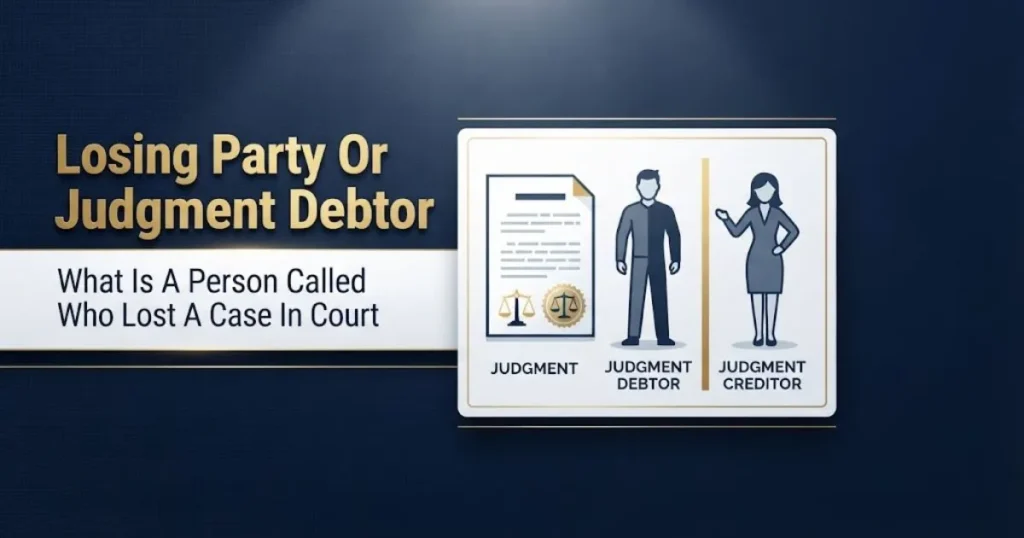
Once money is owed, the name upgrades. You become the judgment debtor. That is the term that shows up on collection paperwork.
File an appeal and you become the appellant. Lose a criminal trial and you are the convicted defendant or simply “the defendant found guilty.”
Quick Facts
| Situation | What the Loser Is Called |
|---|---|
| Civil trial, general use | Losing party |
| Money judgment entered | Judgment debtor |
| Appeal filed | Appellant |
| Criminal conviction | Convicted defendant |
| Formal court rule language | Non-prevailing party |
| Old-fashioned usage | Vanquished party (rare) |
Think of it like a job title that changes with the department. Same person, different paperwork.
Losing Party Meaning in Law
In law, the losing party refers to the side the court rules against on the main issues in dispute. That ruling gets recorded in a written judgment.
The definition is functional, not emotional. Judges do not ask who feels defeated. They ask who the judgment runs against.
That distinction gets messy in mixed outcomes. A plaintiff can win liability but recover almost nothing.
Courts handle this with a concept called partial success. Some judges declare no prevailing party at all when both sides win pieces.
Here is what determines the label:
- Entry of judgment under Rule 58 makes the outcome official
- The relief awarded matters more than the arguments won
- Dismissal with prejudice makes the plaintiff the losing party
- A defense verdict makes the plaintiff the losing party
- A nominal damages award can still make the defendant the loser
Bold stat: In federal court, roughly two-thirds of civil cases end without a trial verdict at all. Most losing parties lose on summary judgment or dismissal, not in front of a jury.
The word “party” is doing heavy lifting here. It covers people, companies, estates, and government agencies alike.
What Is the Winner of a Court Case Called?
The winner of a court case is called the prevailing party. That is the formal term used across federal and state rules.
You will also hear successful party and judgment creditor. The second one applies when money is owed to them.
Prevailing party status is not just bragging rights. It unlocks real financial benefits.
Under Rule 54(d)(1), costs other than attorney fees “should be allowed to the prevailing party.” Many contracts and statutes go further and shift attorney fees too.
Courts use a test to decide who prevailed. The side must win a material alteration of the legal relationship between the parties.
| Role | Civil Term | Money Term | Appeal Term |
|---|---|---|---|
| Winner | Prevailing party | Judgment creditor | Appellee or respondent |
| Loser | Losing party | Judgment debtor | Appellant |
A settlement complicates things. If a case settles, there is often no prevailing party at all.
That is why defendants sometimes push hard for settlement. It blocks a fee award that a verdict would trigger.
Key Takeaway: The losing party is the side judgment is entered against, while the prevailing party is the side that wins a real change in legal rights.
Judgment Debtor vs Judgment Creditor
A judgment debtor is the losing party who owes money under a court judgment. The judgment creditor is the winner who is owed that money.
These terms kick in after the verdict. They are enforcement labels, not trial labels.
The judgment creditor gets a legal toolkit. That toolkit includes wage garnishment, bank levies, and property liens.
The judgment debtor gets obligations. In many states, you must answer written questions about your assets under oath.
| Term | Who It Is | What They Can Do |
|---|---|---|
| Judgment creditor | The winner | Garnish wages, levy accounts, record liens |
| Judgment debtor | The loser | Pay, appeal, claim exemptions, negotiate |
Post-judgment interest starts running immediately. In federal cases, 28 U.S.C. 1961 ties the rate to the weekly one-year Treasury yield.
State rates are often much higher and fixed by statute. Several states still charge 9 to 12 percent annually on unpaid judgments.
That interest compounds the damage quietly. A $40,000 judgment at 10 percent grows by $4,000 a year while you argue about it.
Judgments also hit your credit indirectly. Public record reporting rules changed years ago, but lenders still find them through title and court searches.
What Is a Defendant Found Liable Called?
A defendant found liable is called the liable party, and in most contexts simply the losing defendant. Civil cases use “liable,” never “guilty.”
That word choice matters. Guilty belongs to criminal court. Liable belongs to civil court.
Mixing them up is the fastest way to sound like you learned law from television. Reporters get it wrong constantly.
Liability means the defendant legally caused harm and owes a remedy. The remedy is usually money damages.
Here is how the vocabulary splits:
- Civil case: found liable, adjudged liable, judgment entered against defendant
- Criminal case: found guilty, convicted, adjudicated guilty
- Administrative case: found in violation, sanctioned, cited
- Class action: liability finding against the defendant class-wide
Bold point: The civil standard is a preponderance of the evidence, meaning more likely than not. Criminal court demands beyond a reasonable doubt.
That gap explains why a defendant can be acquitted of a crime and still lose a civil suit over the same conduct. Different burden, different outcome.
A liable defendant can also be labeled a tortfeasor. That term shows up in personal injury and product liability cases.
What Is a Person Called Who Loses a Criminal Case?
A person who loses a criminal case is called the convicted defendant, or simply the convict after sentencing. Courts prefer “defendant” throughout.
Prosecutors do not “lose” in the same way. If the state fails, the defendant is acquitted and the case is over.
Double jeopardy protection means prosecutors usually cannot appeal an acquittal. That makes criminal appeals a one-way street.
| Outcome | Defendant’s Label | Can Appeal? |
|---|---|---|
| Guilty verdict | Convicted defendant | Yes |
| Guilty plea | Convicted defendant | Limited |
| Acquittal | Acquitted defendant | Not applicable |
| Hung jury | Defendant, case pending | Retrial possible |
After conviction, terminology shifts again. On appeal you are the appellant. In a habeas corpus petition you become the petitioner.
The state becomes the respondent at that stage. Federal criminal appeals run against the United States.
Deadline alert: Under FRAP 4(b), a criminal defendant has just 14 days after entry of judgment to file a notice of appeal. That is half a month, not a month.
Miss it and your options shrink to post-conviction relief. Those petitions face much tougher standards.
Key Takeaway: Civil losers are “liable” and become judgment debtors, while criminal losers are “convicted” and face a 14-day federal appeal clock.
Appellant vs Appellee: Who Is Who After a Loss?
The appellant is the losing party who files the appeal. The appellee is the winning party defending the judgment.
Some states swap “appellee” for respondent. California and New York both use respondent in various courts.
The roles can flip. If both sides appeal, one becomes the cross-appellant.
| Court Level | Loser Is Called | Winner Is Called |
|---|---|---|
| Trial court | Losing party / defendant | Prevailing party |
| Court of appeals | Appellant | Appellee or respondent |
| Supreme court (cert) | Petitioner | Respondent |
| Cross-appeal | Cross-appellant | Cross-appellee |
Being the appellant is harder than it sounds. You carry the burden of showing reversible error.
Appellate courts do not retry facts. They review legal rulings and apply deference to jury findings.
The standards of review decide most appeals:
- De novo review for pure legal questions, the friendliest standard
- Abuse of discretion for evidence and procedure rulings
- Clear error for a judge’s factual findings
- Substantial evidence for jury verdicts, the hardest to beat
Bold stat: Reversal rates in federal civil appeals hover around 8 to 12 percent in a typical year. Most appellants lose twice.
Losing Party vs Prevailing Party: Side-by-Side
The core difference is that the prevailing party obtains a judgment in its favor, while the losing party has judgment entered against it. Everything else flows from that one line.
Think of it as the scoreboard versus the highlight reel. Only the scoreboard counts.
| Factor | Losing Party | Prevailing Party |
|---|---|---|
| Court judgment | Entered against them | Entered in their favor |
| Taxable court costs | Usually pays | Usually recovers |
| Attorney fees | Pays own, sometimes both | May recover under statute |
| Right to appeal | Yes | Only if partially aggrieved |
| Post-judgment interest | Owes it | Earns it |
| Enforcement tools | None | Garnishment, liens, levies |
| Common alternate name | Judgment debtor | Judgment creditor |
Partial victories blur the line. A plaintiff who sought $2 million and won $8,000 technically prevailed.
Judges can still slash the fee award in that scenario. Proportionality is a real factor in fee litigation.
Rule 68 adds another twist. If a defendant makes a formal offer of judgment and the plaintiff wins less at trial, the plaintiff pays post-offer costs.
That rule punishes plaintiffs who refuse reasonable offers. It turns a technical win into a financial loss.
What Happens After You Lose a Court Case?
After you lose a court case, the court enters a written judgment and the enforcement clock starts. You become a judgment debtor if money is owed.
Nothing happens instantly. Federal Rule 62(a) gives an automatic 30-day stay of execution after judgment entry.
That window is your breathing room. Use it to decide between paying, appealing, or negotiating.
Here is the typical sequence:
| Stage | Timing After Verdict | What Happens |
|---|---|---|
| Judgment entered | Days 0 to 14 | Written judgment hits the docket |
| Automatic stay | Days 0 to 30 | Winner cannot execute yet |
| Bill of costs filed | Within 14 to 30 days | Winner itemizes recoverable costs |
| Post-trial motions | Within 28 days | Rule 59 new trial or amend motions |
| Notice of appeal | Within 30 days | Appellant files, deadline is jurisdictional |
| Enforcement begins | Day 31 onward | Garnishment, levies, liens |
Skipping the post-trial motion stage is a common mistake. Some appellate arguments must be preserved there first.
Bold warning: If you appeal without posting a supersedeas bond, the winner can start collecting anyway. The bond usually equals the judgment plus interest and costs.
That bond requirement stops many losing parties cold. Not everyone can post six figures overnight.
Key Takeaway: Losing triggers a 30-day stay, a 28-day post-trial motion window, and a 30-day appeal deadline that runs at the same time.
Does the Losing Party Pay Court Costs and Attorney Fees?
The losing party usually pays court costs but not the winner’s attorney fees. That split is called the American Rule.
Costs and fees are two different buckets. People conflate them and then get shocked.
Taxable costs are modest. They cover filing fees, transcripts, printing, copying, and witness fees.
Attorney fees are the big number. Under the American Rule, each side pays its own lawyer regardless of who wins.
| Expense Type | Who Pays | Typical Range |
|---|---|---|
| Court filing fees | Losing party | $50 to $450 |
| Deposition transcripts | Losing party | $500 to $5,000 |
| Witness fees | Losing party | $40 per day plus travel |
| Expert witness fees | Usually each side | $2,000 to $50,000 |
| Attorney fees | Each side, usually | Varies widely |
Exceptions exist and they bite hard:
- Contract fee clauses in leases, loans, and service agreements
- Fee-shifting statutes in civil rights, wage, and consumer protection cases
- Sanctions for frivolous filings under Rule 11
- Bad faith conduct findings by the judge
England and Wales run the opposite system. There, costs follow the event and the loser generally pays the winner’s legal bill.
Bold figure: A federal small-claims-level cost award often lands between $400 and $3,500. A contractual fee award can be ten to fifty times that.
Can the Losing Party Appeal the Decision?
Yes, the losing party can appeal, but only from a final judgment and only on legal grounds. New evidence and second opinions do not count.
Appeals are not do-overs. That is the single biggest misunderstanding in American civil procedure.
You must point to a specific error the trial judge made. You must also show the error affected the outcome.
Grounds that actually work:
- Misapplication of law by the trial judge
- Improper jury instructions that skewed deliberations
- Wrongly admitted or excluded evidence that mattered
- Insufficient evidence to support the verdict as a matter of law
- Jurisdictional defects in the case itself
Grounds that almost never work:
- You disagree with the jury’s credibility calls
- You found better evidence after trial
- Your lawyer performed poorly in a civil case
- The result feels unfair
Bold reality check: Around 80 to 90 percent of civil appeals end with the judgment affirmed. The appellant pays for the privilege of losing again.
Appeals also cost real money. Filing fees, transcript preparation, and appellate briefing frequently run $15,000 to $75,000 in a mid-sized civil case.
Weigh that against the judgment amount. Appealing a $20,000 judgment rarely pencils out.
How Long Does the Losing Party Have to Appeal?
In federal civil cases, the losing party has 30 days from entry of judgment to file a notice of appeal. That comes from FRAP 4(a)(1)(A).
The deadline is jurisdictional. Miss it by a day and the appellate court cannot help you.
Several timelines run in parallel. Knowing which clock applies saves cases.
| Filing Type | Federal Deadline | Rule |
|---|---|---|
| Civil notice of appeal | 30 days from judgment | FRAP 4(a)(1)(A) |
| Civil appeal, US is a party | 60 days | FRAP 4(a)(1)(B) |
| Criminal notice of appeal | 14 days | FRAP 4(b)(1) |
| Motion for new trial | 28 days | FRCP 59(b) |
| Motion to alter judgment | 28 days | FRCP 59(e) |
| Relief from judgment, fraud | 1 year | FRCP 60(b) |
| Cross-appeal | 14 days after first appeal | FRAP 4(a)(3) |
State deadlines vary widely. Many states use 30 days, but some use 20, 45, or 60.
Filing a timely Rule 59 motion resets the appeal clock. The 30 days restart when the court rules on that motion.
Bold warning: The clock starts at entry of judgment, not the verdict announcement. Those dates can differ by weeks.
Always check the docket entry date. That is the number the appellate clerk uses.
Key Takeaway: The American Rule means the loser pays costs but not the winner’s lawyer, and the federal appeal window is 30 days in civil cases.
What Is a Default Judgment and Who Is the Losing Party?
A default judgment is a ruling entered against a party who failed to respond or appear. That absent party is the losing party, even without a trial.
Losing by default is the most common way Americans lose lawsuits. Debt collection dockets run on it.
The process is simple and brutal. The plaintiff files, serves the defendant, and waits.
If no answer arrives in time, the clerk enters default. A judgment follows shortly after.
| Step | Typical Timeline |
|---|---|
| Complaint served | Day 0 |
| Answer due, federal | 21 days |
| Answer due, most states | 20 to 30 days |
| Entry of default | Day 22 to 45 |
| Default judgment entered | Day 30 to 90 |
| Motion to set aside filed | Usually within 30 days to 1 year |
Default judgments can be undone. Rule 60(b) and state equivalents allow relief for excusable neglect or bad service.
Courts favor deciding cases on the merits. Judges set aside defaults more often than people expect.
Bold stat: Consumer studies have found that more than 70 percent of debt collection lawsuits end in default judgment. Most defendants never file a single piece of paper.
Act fast if this happened to you. The longer the judgment sits, the harder it is to vacate.
What Happens if the Losing Party Cannot Pay?
If the losing party cannot pay, the judgment stays on the books and the creditor pursues collection. Nobody goes to jail for an unpaid civil judgment.
That last point calms a lot of people down. Debtors’ prisons were abolished long ago.
What can happen is asset seizure. The judgment creditor gets tools you cannot ignore.
Collection methods include:
- Wage garnishment through your employer
- Bank account levy freezing available funds
- Property liens recorded against real estate
- Writs of execution seizing non-exempt personal property
- Debtor examinations forcing you to disclose assets under oath
Federal law caps garnishment. Under the Consumer Credit Protection Act, creditors can take the lesser of 25 percent of disposable earnings or the amount above 30 times the federal minimum wage per week.
At $7.25 per hour, that protected floor sits at $217.50 weekly. States often protect more.
| State Approach | Effect on Wage Garnishment |
|---|---|
| Texas | Prohibited for most consumer judgments |
| Pennsylvania | Prohibited for most consumer judgments |
| North Carolina | Prohibited for most consumer judgments |
| South Carolina | Prohibited for most consumer judgments |
| Most other states | Allowed up to federal cap or lower |
Exemptions protect core assets. Homestead exemptions, retirement accounts, Social Security, and tools of the trade are commonly shielded.
Chapter 7 bankruptcy can discharge most money judgments. Fraud, intentional injury, and certain tax judgments survive it.
Can a Judgment Be Vacated or Overturned?
Yes, a judgment can be vacated by the trial court or reversed by an appellate court. They are different mechanisms with different standards.
Vacating means the judgment is erased and the case reopens. Reversing means a higher court undoes the trial result.
Rule 60(b) lists the grounds for vacating a federal judgment:
- Mistake, inadvertence, surprise, or excusable neglect
- Newly discovered evidence that diligence would not have found earlier
- Fraud, misrepresentation, or misconduct by the opposing party
- The judgment is void, often for lack of jurisdiction or bad service
- The judgment has been satisfied or is no longer equitable
- Any other reason justifying relief
| Motion Type | Deadline | Success Odds |
|---|---|---|
| Rule 59 new trial | 28 days | Low |
| Rule 60(b)(1) to (3) | 1 year maximum | Moderate for defaults |
| Rule 60(b)(4) void judgment | No fixed limit | Higher if service failed |
| Direct appeal | 30 days | 8 to 12 percent reversal |
Improper service is the strongest argument out there. If you were never properly served, the judgment may be void from the start.
Bold point: Courts vacate default judgments far more readily than judgments after full trials. A trial verdict has already been tested.
Even a reversal may not end things. Appellate courts often remand for a new trial rather than declaring a winner.
Key Takeaway: Default judgments dominate American civil courts, and they are also the easiest judgments to get vacated if you move quickly.
Who Is the Losing Party in a Class Action Lawsuit?
In a class action, the losing party can be the defendant company or the entire certified class, depending on the verdict. Absent class members are bound by the result.
This surprises people. You can lose a lawsuit you never knew existed.
Rule 23 makes it possible. Once a class is certified and notice goes out, silence equals participation.
| Outcome | Who Loses | Effect on Class Members |
|---|---|---|
| Defense verdict | The class | Claims barred by res judicata |
| Plaintiff verdict | The defendant | Class shares the award |
| Class decertified | Named plaintiffs | Individual suits still possible |
| Settlement approved | Nobody formally | Class releases claims |
Opting out is the escape hatch. In Rule 23(b)(3) damages classes, members get a deadline to exclude themselves.
Miss the opt-out date and you are locked in. A defense verdict then wipes out your individual claim too.
Bold figure: Opt-out rates in consumer class actions typically run below one percent. Almost nobody reads the notice.
Class representatives carry extra exposure. They are named parties and can face costs if the class loses.
Objectors are a separate category. They lose nothing personally when a court overrules their objection to a settlement.
Losing Party Rights and Next Steps in 2026
The losing party still has enforceable rights, including the right to appeal, to claim exemptions, and to seek relief from judgment. Losing is not the end of your legal standing.
Start with the calendar. Every meaningful option has a deadline attached.
Here is the practical order of operations:
| Priority | Action | Timing |
|---|---|---|
| 1 | Get the entered judgment from the docket | Immediately |
| 2 | Calendar the 28-day and 30-day deadlines | Day 1 |
| 3 | Decide on a post-trial motion | Within 28 days |
| 4 | File notice of appeal if pursuing | Within 30 days |
| 5 | Post a supersedeas bond if staying collection | Before day 31 |
| 6 | File exemption claims if garnished | State deadline, often 10 to 20 days |
| 7 | Negotiate a payment plan or lump-sum discount | Anytime |
Negotiation is underrated. Judgment creditors often accept 40 to 70 cents on the dollar for immediate cash.
Get any settlement in writing. Then confirm the creditor files a satisfaction of judgment with the court.
Bold reminder: An unsatisfied judgment can stay enforceable for 5 to 20 years depending on the state. Many can be renewed for another full term.
Track your credit and title records afterward. A lien that should have been released will otherwise haunt your next home sale.
Frequently Asked Questions
What is a person called who lost a case in court?
A person who lost a case in court is called the losing party.
They may also be called the judgment debtor, the appellant, or the convicted defendant depending on the case type.
There is no special one-word legal title beyond those.
Is the losing party always the defendant?
No, the losing party can be the plaintiff or the defendant.
A plaintiff whose case is dismissed or who loses at trial becomes the losing party.
A defendant found liable or guilty also becomes the losing party.
Does the losing party have to pay the winner’s attorney fees?
Usually no, because of the American Rule that each side pays its own lawyer.
Exceptions apply when a contract, a statute, or a sanctions order shifts fees.
The losing party does typically pay taxable court costs under Rule 54(d).
How many appeals actually get reversed?
Federal appellate courts reverse roughly 8 to 12 percent of civil judgments.
Most appeals end with the trial court decision affirmed.
Criminal appeal reversal rates are even lower in many circuits.
Can a judgment against you ever expire?
Yes, money judgments expire after 5 to 20 years depending on the state.
Most states let the judgment creditor renew the judgment before it lapses.
Renewed judgments can follow a judgment debtor for decades.
The label matters because it decides what happens next. Losing party today, judgment debtor tomorrow, appellant if you move fast enough.
Pull your entered judgment from the court docket this week. Circle the 28-day and 30-day deadlines on a calendar.
Then pick one path: appeal, vacate, negotiate, or claim your exemptions. Doing nothing is the only choice with no upside.