The fire foam lawsuit is one of the largest mass torts in American history. Over 8,000 individual injury claims are active in 2026. Billions have already been paid to water systems nationwide. Now the focus has shifted to individual payouts.
If you were exposed to AFFF firefighting foam and later developed cancer, you may qualify for compensation. Settlement amounts in 2026 range from $50,000 to over $300,000 depending on your diagnosis.
This article covers everything you need to know right now. You will learn about eligibility, payout tiers, filing deadlines, and the latest court developments. The landscape of this litigation has changed dramatically since the landmark 3M deal.
One striking fact: the EPA now classifies PFOA and PFOS as hazardous substances. That 2024 ruling supercharged the legal pressure on foam manufacturers.
Related: Aqueous Film Forming Foam Lawsuit: Full 2026 Guide
Fire Foam Lawsuit Overview in 2026
The fire foam lawsuit refers to thousands of legal claims against manufacturers of AFFF firefighting foam. These claims allege that PFAS chemicals in the foam caused serious diseases. The litigation is centralized in federal court in South Carolina.
Judge Richard Gergel oversees the multidistrict litigation known as MDL 2873. He has managed this massive docket since 2019. The case has grown into one of the most complex in federal court history.
Two major categories of claims exist in this litigation. The first involves public water systems contaminated by foam runoff. The second involves individual personal injury claims from exposed workers and residents.
The water system claims are largely resolved. The individual injury claims are the active battlefield in 2026. This distinction matters enormously for anyone considering filing.
| Claim Type | Status in 2026 | Total Value |
|---|---|---|
| Water Systems | Mostly resolved | $11.5 billion |
| Individual Injury | Active and growing | Pending |
| Property Damage | Early stages | Undetermined |
Fire Fighting Foam Lawsuit Background
The fire fighting foam lawsuit stems from decades of AFFF use at military bases and airports. AFFF stands for aqueous film forming foam. It was the gold standard for fighting fuel fires since the 1960s.
The problem is that AFFF contains PFAS chemicals. These are often called “forever chemicals” because they never break down. They accumulate in human blood and tissue over time.
Manufacturers like 3M and DuPont knew about the risks for decades. Internal documents revealed during discovery show early awareness of toxicity. Yet they continued selling the product without adequate warnings.
Think of it like the tobacco litigation of the 1990s. The companies had internal research showing harm. They chose profits over public safety. The legal reckoning is now fully underway.
Key Fact: The Department of Defense used AFFF at over 400 military installations across the United States.
AFFF Lawsuit 2026 Current Status
The AFFF lawsuit in 2026 is in a critical phase. Individual personal injury claims are moving toward bellwether trials. These test cases will set the tone for all remaining settlements.
Judge Gergel has scheduled the first individual injury bellwether trials for mid-2026. The outcomes will heavily influence settlement negotiations. Both sides are watching these dates closely.
The water system settlements are in their payment phase. 3M began distributing its $10.3 billion fund in late 2024. DuPont and its spinoffs are paying out their $1.185 billion share as well.
For individual claimants, the discovery process is accelerating. Plaintiffs are submitting medical records and exposure histories. Defendants are challenging causation in many cases.
- Active individual claims: Over 8,000
- Bellwether trials expected: Mid-2026
- Water settlement payments: Ongoing through 2026
- New claims filed monthly: Approximately 200 to 400
Key Takeaway: The fire foam litigation has split into two tracks, with water system payouts flowing and individual injury claims heading toward trial in 2026.
Fire Foam Lawsuit Settlement Amounts
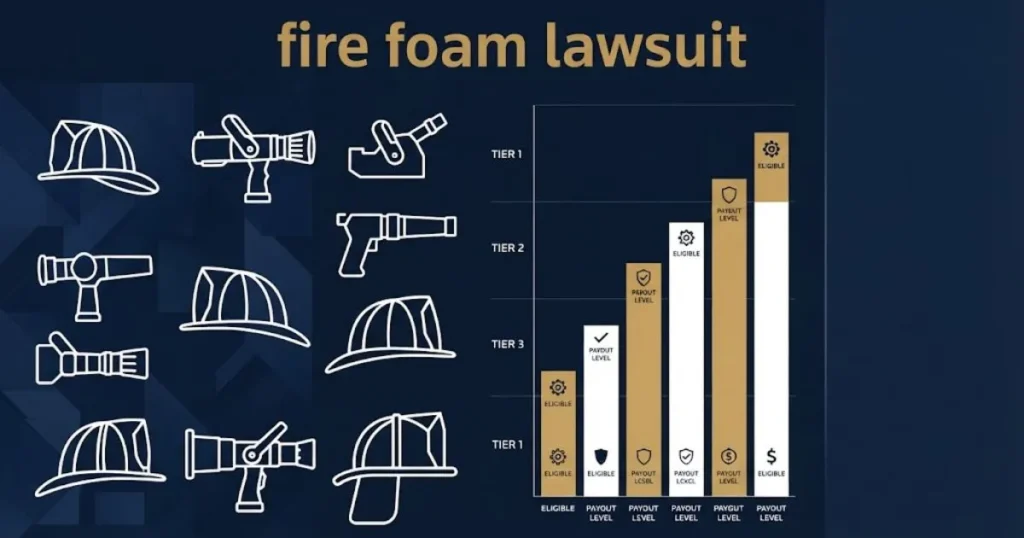
Fire foam lawsuit settlement amounts for individual claims are projected to range from $50,000 to $300,000 or more. The exact figure depends on your specific diagnosis and exposure history.
No individual settlement fund has been formally established yet. The numbers above are projections based on similar mass tort cases. The bellwether trial verdicts will shape the final payout structure.
Claimants with the most severe diagnoses will receive the highest amounts. A stage four kidney cancer diagnosis will pay far more than early-stage thyroid disease. The tier system rewards severity.
Here is how settlement amounts are expected to break down by diagnosis category. These figures are estimates based on current legal analysis.
| Diagnosis Tier | Condition Examples | Estimated Payout |
|---|---|---|
| Tier 1 (Highest) | Kidney cancer, testicular cancer | $200K to $300K+ |
| Tier 2 | Thyroid cancer, bladder cancer | $125K to $200K |
| Tier 3 | Thyroid disease, ulcerative colitis | $75K to $125K |
| Tier 4 (Lowest) | Elevated PFAS blood levels only | $50K to $75K |
PFAS Foam Lawsuit Settlement Breakdown
The PFAS foam lawsuit settlement landscape includes two resolved mega-deals and one pending category. Understanding this structure is essential for any potential claimant.
The 3M settlement of $10.3 billion covers public water systems across the country. Payments are distributed over 13 years through 2036. This deal resolved roughly 300 municipal claims.
The DuPont, Chemours, and Corteva settlement totals $1.185 billion. It also covers water system contamination. These payments began flowing in early 2025.
Individual personal injury claims remain unresolved as of early 2026. These are the claims that matter most to affected firefighters and residents. A global settlement for these claims could exceed $5 billion.
Bold Stat: Over 200 million Americans have detectable PFAS levels in their blood, according to CDC data.
- 3M water settlement: $10.3 billion (paying through 2036)
- DuPont water settlement: $1.185 billion (paying through 2028)
- Individual injury pool: Not yet established (projected $5B+)
Who Qualifies for Fire Foam Lawsuit Claims
You qualify for the fire foam lawsuit if you had direct exposure to AFFF and later developed a qualifying medical condition. The two requirements are exposure and diagnosis.
Direct exposure typically means you worked with or near AFFF foam regularly. This includes firefighters, military personnel, and airport workers. Residents near contaminated sites may also qualify.
Your medical diagnosis must be on the list of recognized PFAS-linked conditions. The strongest claims involve kidney cancer or testicular cancer. Other qualifying conditions include thyroid disease and ulcerative colitis.
Timing matters as well. Your exposure must have occurred before the manufacturer reformulated its products. Most qualifying exposure happened before 2018.
| Qualification Factor | What You Need |
|---|---|
| Exposure | Regular contact with AFFF foam |
| Diagnosis | Qualifying cancer or disease |
| Timeline | Exposure before 2018 |
| Documentation | Medical records and work history |
Key Takeaway: Settlement amounts are projected on a tiered system, with the most severe cancer diagnoses commanding payouts above $200,000.
Firefighting Foam Cancer Lawsuit Claims
The firefighting foam cancer lawsuit is the most active segment of the broader AFFF litigation. Cancer claims carry the highest potential payouts and the strongest scientific evidence.
Kidney cancer and testicular cancer have the clearest links to PFAS exposure. The International Agency for Research on Cancer classified PFOA as a Group 1 carcinogen in 2023. That was a major turning point.
Plaintiffs in these cases argue that manufacturers knew about the cancer risk. Internal 3M documents from the 1970s show early toxicity concerns. The company allegedly buried those findings for decades.
Defense attorneys argue that other factors could cause the cancers. They point to genetics, lifestyle, and other chemical exposures. Causation is the central battleground in every individual case.
Key Stat: Firefighters have a 9% higher risk of cancer diagnosis compared to the general population, per the National Institute for Occupational Safety and Health.
- Kidney cancer: Strongest PFAS link
- Testicular cancer: Strong PFAS link
- Bladder cancer: Moderate PFAS link
- Prostate cancer: Emerging evidence
- Liver cancer: Under investigation
Fire Foam Lawsuit Health Risks Explained
The fire foam lawsuit health risks extend well beyond cancer. PFAS chemicals disrupt multiple body systems over time. The damage is often invisible for decades before symptoms appear.
PFOA and PFOS interfere with hormone production in the thyroid gland. This can lead to hypothyroidism or hyperthyroidism. Many exposed firefighters report chronic fatigue and weight changes.
The immune system is another major target of PFAS toxicity. Studies show reduced vaccine effectiveness in people with high PFAS blood levels. Your body simply cannot fight infections as well.
Reproductive harm is also well documented. PFAS exposure is linked to low birth weight and developmental delays. Pregnant women near contaminated bases face elevated risks.
| Health Condition | PFAS Link Strength | Latency Period |
|---|---|---|
| Kidney cancer | Strong | 10 to 20 years |
| Testicular cancer | Strong | 10 to 15 years |
| Thyroid disease | Moderate | 5 to 15 years |
| Ulcerative colitis | Moderate | 5 to 10 years |
| High cholesterol | Moderate | 3 to 10 years |
| Immune suppression | Emerging | Variable |
Think of PFAS like a slow leak in a pipe. You do not notice the damage until the foundation cracks. By then, the exposure has been building for years.
AFFF Lawsuit Eligibility Requirements
AFFF lawsuit eligibility in 2026 requires three core elements. You need documented exposure, a qualifying diagnosis, and timely filing.
Documented exposure means you can prove you worked with or near AFFF. Military service records, employment files, and witness statements all count. The more specific your documentation, the stronger your claim.
Your diagnosis must come from a licensed physician. Self-reported symptoms are not enough. You need pathology reports, imaging results, and treatment records.
The statute of limitations varies by state. Most states give you two to three years from your diagnosis date. Missing this deadline can permanently bar your claim.
- Step 1: Gather your work and military service records
- Step 2: Obtain complete medical records for your diagnosis
- Step 3: Get a PFAS blood serum test
- Step 4: File your claim before your state deadline
Key Takeaway: The strongest individual claims involve firefighters or military personnel with kidney or testicular cancer and documented AFFF exposure before 2018.
Fire Foam Lawsuit Payout Estimates
Fire foam lawsuit payout estimates for 2026 depend heavily on your injury tier. The most severe cases could yield well over $300,000 in total compensation.
Compensation covers several categories of damages. Medical expenses, lost wages, and pain and suffering are the big three. Some claims also include punitive damages if manufacturer misconduct is proven.
Early settlements in similar PFAS cases provide useful benchmarks. The Teflon litigation against DuPont resulted in individual payouts averaging $80,000 to $150,000. AFFF cases involve higher exposure levels.
Wrongful death claims carry the highest potential payouts. Families of deceased firefighters may receive $500,000 or more. These cases require proof that PFAS exposure caused the fatal illness.
| Damage Category | What It Covers | Typical Range |
|---|---|---|
| Medical bills | Past and future treatment | $50K to $200K |
| Lost wages | Income you cannot earn | $25K to $100K |
| Pain and suffering | Physical and emotional harm | $50K to $150K |
| Punitive damages | Manufacturer misconduct | $100K+ (rare) |
3M Fire Foam Lawsuit Breakdown
The 3M fire foam lawsuit is the centerpiece of the entire AFFF litigation. 3M was the dominant manufacturer of AFFF for decades. Its products contained the highest concentrations of PFOS.
3M agreed to pay $10.3 billion to resolve water system claims in June 2023. This was the largest environmental settlement in U.S. history at the time. The payments are structured over 13 years.
Individual injury claims against 3M are still active and unresolved. These claims are separate from the water system deal. 3M has not agreed to a global personal injury settlement yet.
The company stopped manufacturing PFAS-based foam in 2023. It announced a full exit from PFAS production by the end of 2025. That exit does not shield it from past liability.
Bold Stat: 3M produced AFFF foam for the U.S. military from 1966 through 2023, a span of 57 years.
- 3M water settlement: $10.3 billion
- Payment period: 2024 through 2036
- Individual claims: Still pending
- PFAS production: Fully ceased by 2025
Firefighting Foam Lawsuit Update for 2026
The firefighting foam lawsuit update for 2026 centers on the upcoming bellwether trials. These are the first individual injury cases to go before a jury. The results will ripple through the entire litigation.
Judge Gergel has selected several kidney cancer cases for the first bellwether group. These plaintiffs are firefighters with decades of AFFF exposure. Their trials are expected to begin in the summer of 2026.
Both sides are filing pretrial motions at a rapid pace. Defense attorneys are challenging the admissibility of certain expert witnesses. Plaintiffs are pushing to include internal company documents as evidence.
The EPA’s 2024 designation of PFOA and PFOS as hazardous substances continues to strengthen plaintiff arguments. This regulatory action provides powerful ammunition in court.
| 2026 Milestone | Expected Date | Significance |
|---|---|---|
| Final discovery deadline | March 2026 | All evidence submitted |
| Daubert hearings | April 2026 | Expert witness rulings |
| First bellwether trial | Summer 2026 | Sets settlement benchmarks |
| Settlement conference | Fall 2026 | Potential global deal |
Key Takeaway: The 2026 bellwether trials will be the most important development in the AFFF litigation since the 3M water settlement, and their verdicts will directly shape individual payout amounts.
Fire Foam Lawsuit Filing Deadline
The fire foam lawsuit filing deadline depends on your state’s statute of limitations. Most states impose a two to three year window from the date of your diagnosis.
Some states use a “discovery rule” that starts the clock later. Under this rule, the deadline begins when you learn your illness was caused by foam exposure. This can extend your filing window significantly.
A few states have enacted special PFAS legislation that extends deadlines. New York, for example, revived expired claims for certain toxic exposure cases. Check your specific state rules carefully.
Waiting too long is the single biggest mistake potential claimants make. Once the statute of limitations expires, your claim is gone forever. No exceptions and no extensions.
| State | Statute of Limitations | Discovery Rule |
|---|---|---|
| California | 2 years | Yes |
| Texas | 2 years | Yes |
| Florida | 4 years | Yes |
| New York | 3 years | Yes |
| Pennsylvania | 2 years | Yes |
Bold Deadline: Many claimants face filing deadlines expiring in late 2026 or early 2027. Acting now is critical.
Military Firefighting Foam Lawsuit Claims
The military firefighting foam lawsuit represents the largest single group of claimants. The Department of Defense used AFFF at virtually every military installation for over 50 years.
Navy and Air Force personnel face the highest exposure levels. Navy sailors used AFFF extensively on aircraft carriers and submarines. Air Force crews used it at crash rescue training sites.
Military firefighters trained with live AFFF foam exercises weekly. They sprayed thousands of gallons onto training pits. Many did so without protective equipment or ventilation.
The Feres Doctrine complicates some military claims. This legal rule limits active duty service members from suing the government. However, claims against private manufacturers like 3M are not barred.
- Most affected branches: Navy, Air Force, Marines
- Highest exposure roles: Firefighters, crash rescue crews
- Key legal hurdle: Feres Doctrine (government claims only)
- Workaround: Sue the manufacturer, not the military
Key Stat: The Pentagon has identified PFAS contamination at over 700 military sites nationwide as of 2025.
AFFF Cancer Lawsuit Evidence Needed
The AFFF cancer lawsuit requires specific evidence to build a winning claim. You cannot simply allege exposure and expect a payout. The burden of proof rests on you.
Your medical records are the foundation of your case. You need a confirmed cancer diagnosis from an oncologist. Pathology reports and staging documents are essential.
Exposure evidence comes next. Military service records showing your job role and base assignments help enormously. Employment records from civilian firefighting jobs also count.
A PFAS blood serum test can strengthen your claim significantly. This test measures the concentration of PFOA and PFOS in your blood. Levels above the national average support your exposure argument.
| Evidence Type | What to Provide | Why It Matters |
|---|---|---|
| Medical records | Diagnosis, staging, treatment | Proves your injury |
| Service records | Duty stations, job codes | Proves your exposure |
| Blood test | PFAS serum levels | Links exposure to body |
| Witness statements | Coworker affidavits | Corroborates your story |
| Expert testimony | Causation opinion | Connects foam to cancer |
Think of your evidence like building a bridge. Each document is a support beam. Remove one and the whole structure weakens.
Frequently Asked Questions
How much money can I get from the fire foam lawsuit?
Most individual claimants can expect between $50,000 and $300,000. The exact amount depends on your diagnosis severity and exposure history. Final payout tiers will be set after the 2026 bellwether trials.
Is it too late to file a fire foam lawsuit in 2026?
No, it is not too late for most claimants. The statute of limitations typically runs two to three years from your diagnosis date. Many filing windows remain open through 2026 and into 2027.
What cancers are linked to firefighting foam exposure?
Kidney cancer and testicular cancer have the strongest scientific links to AFFF exposure. Bladder cancer, thyroid cancer, and liver cancer also show significant associations. The IARC classified PFOA as a known human carcinogen in 2023.
Do I need a blood test to join the AFFF lawsuit?
A PFAS blood serum test is not strictly required but strongly recommended. Elevated PFOA or PFOS levels in your blood significantly strengthen your claim. Your attorney can arrange testing through a qualified lab.
How long does a fire foam lawsuit take to settle?
Individual AFFF claims typically take two to four years from filing to resolution. The bellwether trials in 2026 may accelerate the timeline. A global settlement could begin paying claims by late 2027.
The fire foam lawsuit is reaching a defining moment in 2026. Bellwether trials will set the stage for individual payouts. The evidence against manufacturers has never been stronger.
If you were exposed to AFFF and developed a qualifying illness, now is the time to act. Gather your records, check your state deadline, and get your claim filed. The window will not stay open forever.