A salmonella lawsuit can pay between $10,000 and $500,000 depending on how sick you got. The CDC reports over 1.35 million salmonella infections every year in the United States.
Food companies are facing more pressure than ever in 2026. New FDA traceability rules mean contaminated products get tracked faster. That creates stronger evidence for your claim.
This guide covers everything you need to know. You will learn who qualifies, how much you can get, and the exact steps to file.
Roughly 26,500 people are hospitalized from salmonella each year. If you are one of them, you may have a strong case.
Salmonella Lawsuit 2026
A salmonella lawsuit in 2026 is a legal claim against a food company for selling contaminated products. The legal theory is usually strict product liability.
The food safety legal world has shifted significantly this year. The FDA’s Food Traceability Final Rule took full effect in January 2026. This rule requires companies to keep detailed records for high-risk foods.
That matters for your case. Better records mean faster traceback investigations. Faster tracebacks mean stronger proof that a specific product made you sick.
Courts are also seeing higher jury awards in 2026. Food safety juries tend to punish companies that ignore basic sanitation rules.
| Detail | 2026 Update |
|---|---|
| New FDA Rule | Food Traceability Final Rule active |
| Avg. Hospitalization Claim | $75,000 to $250,000 |
| Trend | Higher jury verdicts |
| Key Change | Digital recordkeeping required |
Key Takeaway: The 2026 FDA traceability rule makes it easier to prove which company sold you contaminated food.
Salmonella Food Poisoning Lawsuit
A salmonella food poisoning lawsuit is a personal injury claim tied to a diagnosed salmonella infection. You must have medical proof of the illness.
Salmonella bacteria attack your intestinal tract. Symptoms include severe diarrhea, fever, and stomach cramps. Most people recover in a week. Some do not.
About 420 people die from salmonella each year in the U.S. Those wrongful death cases produce the largest settlements.
Your lawsuit targets the company that produced or sold the tainted food. This could be a farm, a processor, a grocery chain, or a restaurant.
The legal standard is simple. You must show the food was contaminated and that it caused your illness.
- Stool culture confirming salmonella
- Medical records showing treatment dates
- Receipts or purchase records for the food
- CDC or local health department outbreak reports
Key Takeaway: Medical documentation is the backbone of every salmonella food poisoning lawsuit.
Can You Sue for Salmonella
Yes, you can sue for salmonella if contaminated food caused your illness. The law treats contaminated food as a defective product.
Think of it like buying a phone that explodes. The manufacturer is responsible for putting a dangerous product on the shelf. The same logic applies to tainted chicken or bagged salad.
Most states follow strict liability rules for food cases. That means you do not have to prove the company was careless. You only need to prove the food was contaminated and it hurt you.
Some states also allow negligence claims. This means the company failed to follow basic food safety standards.
| Legal Theory | What You Must Prove |
|---|---|
| Strict Liability | Food was defective and caused harm |
| Negligence | Company failed to follow safety rules |
| Breach of Warranty | Food was not fit for consumption |
Key Takeaway: You can sue under strict liability, which means you do not need to prove the company intended to harm anyone.
Who Qualifies for Salmonella Lawsuit
You qualify for a salmonella lawsuit if you ate contaminated food and got a confirmed salmonella diagnosis. A doctor must have documented the illness.
The strongest cases involve hospitalization. If you spent days in the hospital on IV fluids, your claim carries more weight.
Family members of people who died from salmonella also qualify. These wrongful death claims are filed by spouses, children, or parents.
Children and elderly victims tend to receive higher payouts. Their bodies are more vulnerable to severe dehydration and organ damage.
- Confirmed salmonella lab test
- Medical treatment records
- Proof you bought or ate the recalled product
- Illness dates matching the outbreak timeline
If you got sick but never went to a doctor, your case is harder to prove. Lab confirmation is the gold standard.
Key Takeaway: A confirmed lab test and medical records are the two things that determine whether you qualify.
Salmonella Lawsuit Requirements
Salmonella lawsuit requirements include medical proof, product identification, and a clear timeline linking the two. You need all three to build a viable case.
First, you need a positive stool culture or blood test. This proves salmonella was in your body. A doctor’s note about “stomach flu” is not enough.
Second, you need to identify the contaminated product. This is where the 2026 FDA traceability rule helps. Digital supply chain records can pinpoint the exact batch.
Third, your illness dates must match the known outbreak window. If the recall covers chicken sold in March and you got sick in March, that is a strong link.
| Requirement | Details |
|---|---|
| Medical Proof | Positive lab culture |
| Product ID | Receipt, barcode, or recall notice |
| Timeline Match | Illness within outbreak window |
| Damages | Medical bills, lost wages, pain |
Key Takeaway: You need a lab test, a product link, and a matching timeline to meet the basic lawsuit requirements.
Salmonella Outbreak Lawsuit
A salmonella outbreak lawsuit is a legal action tied to a multi-state or multi-person contamination event. These cases often involve dozens or hundreds of victims.
The CDC tracks salmonella outbreaks through its PulseNet system. PulseNet uses DNA fingerprinting to connect illnesses across state lines.
When PulseNet flags a cluster, the FDA launches a traceback investigation. That investigation identifies the source facility. Once the source is named, lawsuits follow quickly.
In 2024 and 2025, major outbreaks linked to deli meats, cantaloupes, and raw chicken triggered hundreds of claims. Those cases are still working through courts in 2026.
Outbreak lawsuits tend to settle faster than individual claims. The evidence is already gathered by federal investigators.
- CDC outbreak report with case counts
- FDA traceback findings
- Company recall announcements
- State health department alerts
Key Takeaway: Outbreak lawsuits benefit from federal investigation data, which makes proving your case significantly easier.
Salmonella Chicken Lawsuit
A salmonella chicken lawsuit targets poultry producers and processors for selling contaminated raw or undercooked chicken products. Chicken is the most common source of salmonella in the U.S.
The USDA estimates that roughly 25% of raw chicken pieces carry salmonella. That number has not dropped much in the last decade.
Major poultry companies have faced repeated litigation. Foster Farms settled a large case after an outbreak sickened over 600 people across 29 states.
In 2026, the USDA is considering stricter salmonella standards for chicken processing plants. Plants that exceed contamination thresholds could face shutdowns.
If you got sick from chicken bought at a grocery store, your claim targets the processor. The store may also share liability depending on state law.
| Poultry Risk Factor | Detail |
|---|---|
| Contamination Rate | About 25% of raw chicken |
| Most Common Strain | Salmonella Enteritidis |
| High Risk Products | Ground chicken, chicken parts |
| 2026 USDA Action | Stricter plant standards proposed |
Key Takeaway: Chicken is the top source of salmonella lawsuits, and new 2026 USDA rules may strengthen your claim.
Salmonella Food Contamination Lawsuit
A salmonella food contamination lawsuit covers any food product tainted with salmonella bacteria. This includes produce, eggs, dairy, spices, and processed snacks.
Produce outbreaks have surged in recent years. Bagged salads, tomatoes, and cucumbers have all triggered multi-state recalls and lawsuits.
Eggs remain a classic source. Salmonella Enteritidis can infect the inside of an egg before the shell forms. That means washing the shell does not help.
The legal theory is the same regardless of food type. The product was defective because it contained a dangerous pathogen. The company that sold it is liable.
- Leafy greens and bagged salads
- Raw eggs and egg products
- Fresh fruits like cantaloupe and papaya
- Spices, nut butters, and frozen meals
The 2026 traceability rule now covers most of these categories. Companies must log every step from farm to shelf.
Key Takeaway: Any contaminated food can trigger a lawsuit, and the new traceability rules cover more product categories than ever.
Salmonella Class Action Lawsuit
A salmonella class action lawsuit groups many victims into a single legal case against the same food company. One court handles all the claims together.
Class actions make sense when hundreds of people got sick from the same product. Instead of 500 separate trials, one judge manages the process.
However, class actions are not always the best path. Individual personal injury claims often produce higher payouts per person. Class actions split the settlement among everyone.
In 2026, several active class actions involve deli meat and produce recalls from 2024 and 2025. Courts in California, New York, and Illinois are hearing these cases.
| Class Action vs. Individual Claim | Detail |
|---|---|
| Class Action Payout | $50 to $2,000 per person |
| Individual Claim Payout | $10,000 to $500,000 |
| Speed | Class actions settle faster |
| Control | Individual claims give you more say |
If your injuries were severe, an individual claim is usually better. If you had mild symptoms, a class action may be the right fit.
Key Takeaway: Class actions are faster but pay less per person, while individual claims take longer but can produce much larger settlements.
How to File a Salmonella Lawsuit
To file a salmonella lawsuit, you need to contact a food safety attorney and provide your medical records. The attorney will evaluate your case for free in most situations.
The first step is gathering evidence. Collect your lab results, hospital bills, and any receipts from the food purchase.
Next, your attorney will send a demand letter to the food company. This letter outlines your injuries and states the compensation you want.
If the company refuses to settle, your attorney files a formal complaint in court. The case then enters the discovery phase, where both sides exchange evidence.
- Step 1: Get medical records and lab results
- Step 2: Save purchase receipts and recall notices
- Step 3: Contact a food safety attorney
- Step 4: Attorney sends demand letter
- Step 5: Negotiate or file in court
Most salmonella cases settle before trial. Only about 5% go to a jury verdict.
Key Takeaway: The filing process starts with evidence collection and a free attorney consultation, and most cases settle without a trial.
Salmonella Lawsuit Compensation
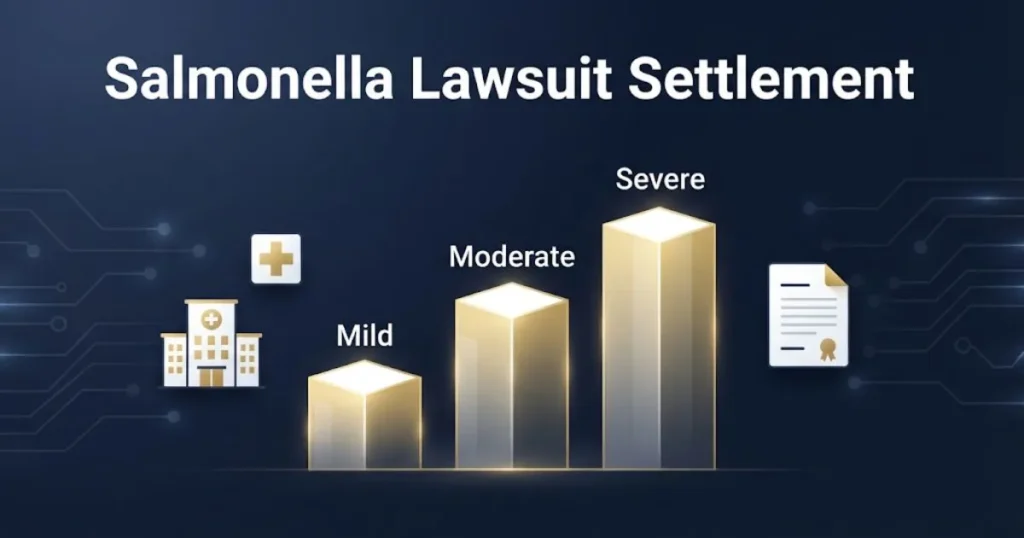
Salmonella lawsuit compensation covers medical bills, lost wages, pain and suffering, and sometimes punitive damages. The total depends on how severely the illness affected you.
Mild cases with a few days of illness may recover $10,000 to $30,000. This covers doctor visits, medication, and a few missed work days.
Hospitalized cases jump significantly. A week in the hospital with IV fluids and monitoring can produce $75,000 to $250,000 in damages.
Wrongful death cases are the highest. Families of salmonella victims have received $500,000 to over $1 million in some jury verdicts.
| Injury Severity | Compensation Range |
|---|---|
| Mild illness | $10,000 to $30,000 |
| Hospitalization | $75,000 to $250,000 |
| Long term complications | $250,000 to $500,000 |
| Wrongful death | $500,000 to $1,000,000+ |
Punitive damages are rare but possible. They apply when a company knew about the contamination and did nothing.
Key Takeaway: Compensation scales directly with illness severity, ranging from $10,000 for mild cases to over $1 million for wrongful death.
Salmonella Lawsuit Settlement Amounts
Salmonella lawsuit settlement amounts vary based on medical costs, lost income, and the strength of the evidence. There is no fixed payout schedule.
The average food poisoning settlement in the U.S. falls between $20,000 and $100,000. Salmonella cases sit in the middle to upper end of that range.
Settlements tend to be higher when the CDC has confirmed an outbreak. Federal confirmation removes doubt about the source of contamination.
Insurance companies for food producers usually handle the payouts. They prefer to settle quietly rather than face a public jury trial.
- Average mild case: $15,000 to $35,000
- Average hospitalization case: $100,000 to $200,000
- Reactive arthritis complication: $150,000 to $400,000
- Wrongful death: $500,000 to $1,000,000+
Your attorney will negotiate based on your specific damages. Two people in the same outbreak can receive very different amounts.
Key Takeaway: Settlement amounts depend on your individual damages, but most hospitalized victims receive between $100,000 and $200,000.
Salmonella Lawsuit Payout
A salmonella lawsuit payout is the final amount you receive after your claim is resolved through settlement or trial. The timeline from filing to payout varies.
Most settlements pay out within 3 to 6 months after the agreement is signed. Trial verdicts can take years if the company appeals.
Your attorney’s fee comes out of the payout. Most food safety lawyers work on contingency, taking 33% to 40% of the total recovery.
If you win $100,000, your attorney takes roughly $33,000 to $40,000. You keep the rest after medical liens are paid.
| Payout Factor | Detail |
|---|---|
| Settlement Timeline | 3 to 6 months after agreement |
| Trial Timeline | 1 to 3 years or longer |
| Attorney Fee | 33% to 40% contingency |
| Medical Liens | Paid from your share |
Some states cap punitive damages. Your attorney will explain how your state’s rules affect your final payout.
Key Takeaway: Expect to receive your payout within months of settling, but plan for attorney fees of about one-third of the total.
Salmonella Lawsuit Deadline
The salmonella lawsuit deadline is set by your state’s statute of limitations for personal injury claims. Most states give you 1 to 3 years from the date of illness.
Missing this deadline means you lose your right to sue forever. The clock starts on the day you got sick or the day you were diagnosed.
Some states have a “discovery rule.” This means the clock starts when you discover the link between your illness and the contaminated food.
Children often get extended deadlines. In many states, the clock does not start until the child turns 18.
| State | Deadline |
|---|---|
| California | 2 years |
| New York | 3 years |
| Texas | 2 years |
| Florida | 2 years |
| Illinois | 2 years |
Do not wait until the last minute. Evidence fades, witnesses forget, and records get lost. File as early as you can.
Key Takeaway: Most states give you 2 to 3 years to file, but acting quickly preserves evidence and strengthens your case.
Salmonella Lawsuit Lawyer
A salmonella lawsuit lawyer is a personal injury attorney who specializes in foodborne illness cases. You need one with specific food safety experience.
Not every personal injury lawyer handles food contamination claims. These cases require knowledge of FDA regulations, CDC outbreak data, and supply chain tracing.
Most food safety lawyers offer free initial consultations. They work on contingency, so you pay nothing upfront. They only get paid if you win.
When choosing a lawyer, ask about their track record with food poisoning cases. Ask how many salmonella claims they have handled.
- Years of food safety litigation experience
- Number of salmonella cases handled
- Past settlement and verdict amounts
- Familiarity with CDC and FDA processes
- Trial experience versus settlement only
A good lawyer will explain your options clearly. They should not pressure you into a quick settlement.
Key Takeaway: Choose a lawyer with specific foodborne illness experience, and make sure they work on contingency so you pay nothing upfront.
Frequently Asked Questions
How much money can you get from a salmonella lawsuit?
Most claimants receive between $10,000 and $250,000 depending on illness severity.
Hospitalized victims typically recover $75,000 to $250,000.
Wrongful death cases can exceed $1 million.
How long do you have to file a salmonella lawsuit?
Most states give you 2 to 3 years from the date of your illness.
The clock starts when you are diagnosed or discover the food link.
Missing this deadline permanently eliminates your right to sue.
Do you need a lawyer to file a salmonella claim?
You are not legally required to hire a lawyer, but it is strongly recommended.
Food safety cases involve complex evidence and corporate defense teams.
Most lawyers work on contingency and charge nothing upfront.
What evidence do you need for a salmonella food poisoning lawsuit?
You need a positive lab culture confirming salmonella infection.
Medical records, purchase receipts, and outbreak reports strengthen your case.
The 2026 FDA traceability rule makes product identification easier.
Can you join a salmonella class action lawsuit in 2026?
Yes, several active class actions are accepting claims in 2026.
Class actions pay less per person but resolve faster than individual suits.
If your injuries are severe, an individual claim usually produces a higher payout.
If you got sick from contaminated food, your next step is simple. Gather your medical records and contact a food safety attorney. The 2026 traceability rules are on your side. Evidence is stronger now than it has ever been. Do not let the statute of limitations expire. Act now while the proof is fresh and your rights are intact.