The capital one lawsuit landscape in 2026 involves at least five active cases. These cover a massive data breach, misleading savings rates, and illegal overdraft fees. Millions of customers may be owed money right now.
The biggest case stems from the 2019 hack that exposed 106 million records. But newer cases about savings account interest and overdraft charges are generating fresh payouts. Some deadlines are closing fast.
This guide breaks down every active case in plain English. You will learn which lawsuits apply to you. You will see exact dollar amounts and filing deadlines.
One surprising fact: the average Capital One customer lost over $200 in hidden fees. Most never noticed until the lawsuits surfaced.
Capital One Lawsuit 2026 Overview
Capital One faces five major lawsuits heading into 2026. These span data security, savings rates, overdraft fees, robocalls, and credit card interest.
The cases are spread across federal courts in Virginia, New York, and Illinois. Each one targets a different harm to consumers. Some are paying out now. Others are still in negotiation.
Think of it like a hospital with five emergency rooms. Each room treats a different injury. You need to know which room applies to your situation.
Quick Facts:
- Total active cases: 5 major lawsuits
- Total settlement funds: Over $500 million combined
- Affected customers: Estimated 130 million
- Primary court: Eastern District of Virginia
| Case Type | Status in 2026 | Court |
|---|---|---|
| Data Breach | Paying claims | E.D. Virginia |
| Savings Rates | Approved | D.D.C. |
| Overdraft Fees | Settling | N.D. Illinois |
| Robocalls | Active | S.D. New York |
| Credit Card Interest | Early stage | E.D. Virginia |
Capital One Class Action Settlement Status
Three Capital One class action settlements have received final court approval. Two more are still awaiting judge sign-off as of early 2026.
The data breach settlement is the furthest along. Checks began mailing in late 2025. The savings account case got final approval in mid-2025. Overdraft claims are expected to start processing this spring.
The robocall and credit card interest cases are still in earlier stages. Those may not pay out until late 2026 or into 2027. Patience is required for those two.
Settlement Status at a Glance:
- Data Breach: Paying out now
- Savings Account: Approved, payments pending
- Overdraft Fees: Settlement reached, awaiting distribution
- Robocalls: In negotiation
- Credit Card Interest: Pre-certification
Capital One Lawsuit Settlement Amount
The combined settlement amount across all Capital One cases exceeds $500 million. The data breach case alone set aside $190 million for consumer claims.
Individual payouts vary wildly depending on the case. Data breach victims received between $25 and $2,500. Savings account customers may see $50 to $500 per account.
The overdraft case is projected to pay $30 to $300 per affected customer. Robocall claims could yield $500 per illegal call under TCPA rules. That adds up fast if you got dozens of calls.
| Case | Total Fund | Per Person Range |
|---|---|---|
| Data Breach | $190 million | $25 to $2,500 |
| Savings Account | $190 million | $50 to $500 |
| Overdraft Fees | $80 million | $30 to $300 |
| Robocalls | $45 million | Up to $500/call |
| Credit Card Interest | TBD | TBD |
Key Takeaway: Capital One faces five active lawsuits in 2026 with over $500 million in combined settlements, and the data breach case is already paying out to eligible customers.
Capital One Lawsuit Eligibility Requirements
Eligibility depends entirely on which specific lawsuit applies to you. Each case has its own rules based on dates, account types, and documented harm.
For the data breach case, you need a Capital One account active between March 2019 and July 2019. Your personal data must have been part of the stolen records.
For the savings account case, you need a 360 Savings account opened before January 2020. You must have earned below-market interest rates during the class period.
Eligibility Checklist:
- Data Breach: Account active March to July 2019
- Savings: 360 Savings opened before January 2020
- Overdraft: Checking account charged fees between 2019 and 2023
- Robocalls: Received automated calls from Capital One after 2018
- Credit Card: Held a variable-rate card between 2020 and 2024
You can qualify for more than one case. Many customers were hit by both the breach and the overdraft fees. File separately for each.
Capital One Data Breach Lawsuit
The Capital One data breach lawsuit stems from a July 2019 hack by Paige Thompson. She stole personal data from over 106 million customers in the U.S. and Canada.
The stolen data included names, addresses, credit scores, and bank account numbers. About 140,000 Social Security numbers were exposed. Roughly 80,000 linked bank account numbers were also taken.
The case was consolidated into MDL 2915 in the Eastern District of Virginia. Judge Anthony Trenga oversaw the proceedings. The $190 million settlement was finalized in 2024.
What was stolen:
- Names and addresses
- Credit scores and limits
- Bank account numbers
- Social Security numbers (140,000)
- Transaction history fragments
| Detail | Info |
|---|---|
| Breach Date | July 2019 |
| People Affected | 106 million |
| Case Number | MDL 2915 |
| Settlement | $190 million |
| Court | E.D. Virginia |
Capital One Savings Account Lawsuit
The savings account lawsuit accuses Capital One of misleading 360 Savings customers about interest rates. The bank allegedly kept rates artificially low while advertising competitive yields.
The CFPB found that Capital One failed to raise rates on older accounts. New customers got better rates than loyal ones. This went on for several years.
The case resulted in a $190 million restitution order. Affected customers are expected to receive automatic payments. You may not need to file a claim for this one.
Key Detail: The average affected customer is owed roughly $150 to $350 in back interest.
| Detail | Info |
|---|---|
| Product | 360 Savings |
| Class Period | 2019 to 2023 |
| Restitution | $190 million |
| Claim Required | Possibly not |
| Payment Method | Direct deposit or check |
Capital One Overdraft Fee Lawsuit
The overdraft fee lawsuit targets Capital One’s practice of charging $35 fees on small transactions. Plaintiffs argue the bank reordered transactions to maximize overdraft charges.
This practice is sometimes called “high-to-low” posting. The bank processes your biggest purchase first. That drains your balance faster. Then smaller purchases each trigger a separate $35 fee.
A single day of debit card use could generate four or five overdraft fees. That means $140 to $175 in charges from a $200 shortfall. The lawsuit calls this predatory.
Overdraft Fee Facts:
- Fee per transaction: $35
- Average fees per customer per year: $250
- Class period: 2019 to 2023
- Settlement fund: Approximately $80 million
Key Takeaway: The data breach, savings account, and overdraft lawsuits each have distinct eligibility rules, so check your account history against every case to maximize your potential recovery.
Capital One Lawsuit Payout Amount
Your actual payout depends on which case you file under and how much harm you can document. There is no single flat payment across all lawsuits.
Data breach payouts range from $25 for basic claims to $2,500 for documented identity theft. If someone opened a fraudulent account in your name, you qualify for the higher tier.
Savings account payouts are calculated based on the interest you should have earned. The bank’s own records determine the gap. Most customers will see $50 to $500.
| Case | Low End | High End | Documentation Needed |
|---|---|---|---|
| Data Breach | $25 | $2,500 | ID theft proof |
| Savings | $50 | $500 | Account statements |
| Overdraft | $30 | $300 | Bank statements |
| Robocalls | $500 | $1,500 | Phone records |
| Credit Card | TBD | TBD | Card statements |
Overdraft payouts are simpler. The bank already has your fee history. Expect $30 to $300 based on how many fees you paid.
How to File a Capital One Lawsuit Claim
Filing a claim starts with identifying which lawsuit applies to you. Then you visit the official settlement website for that specific case.
Each case has its own claims administrator. The data breach case uses Epiq. The savings case uses Kroll. You cannot file all claims through one portal.
You will need your Capital One account number, your Social Security number, and a valid email address. Some cases require supporting documents like bank statements or credit reports.
Step-by-step filing process:
- Identify which case applies to your situation
- Find the official settlement website for that case
- Enter your account number and personal details
- Upload any required documentation
- Submit your claim before the deadline
- Save your confirmation number
Pro tip: File for every case you qualify for. Many customers skip the overdraft case because the amounts seem small. Those add up across multiple accounts.
Capital One Lawsuit Filing Deadline
Deadlines vary by case and some are approaching fast in 2026. Missing a deadline means you forfeit your right to payment permanently.
The data breach claim deadline was extended to June 30, 2026. This is a hard cutoff. No late claims will be accepted after that date.
The savings account case does not require a traditional claim form. Payments are automatic for identified customers. But you should verify your inclusion by April 2026.
| Case | Filing Deadline | Late Claims? |
|---|---|---|
| Data Breach | June 30, 2026 | No |
| Savings Account | Automatic (verify by April 2026) | N/A |
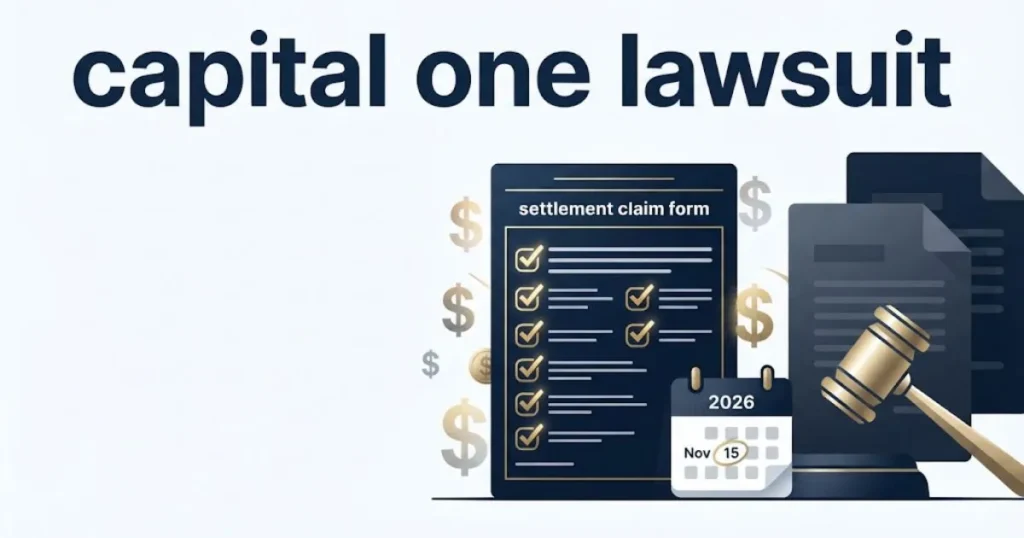
| Overdraft Fees | September 15, 2026 | No |
| Robocalls | TBD (likely late 2026) | TBD |
| Credit Card Interest | TBD | TBD |
Bold deadline alert: The overdraft fee deadline of September 15, 2026 is firm. Mark your calendar now.
Key Takeaway: Filing a claim requires visiting the correct settlement website for each case, and the data breach deadline of June 30, 2026 is the most urgent date on the calendar.
Capital One CFPB Enforcement Action
The CFPB enforcement action against Capital One is the regulatory backbone of the savings account lawsuit. The agency found the bank violated the Consumer Financial Protection Act.
Specifically, the CFPB determined Capital One misled customers about 360 Savings rates. The bank advertised high yields but failed to pass rate increases to existing holders.
The enforcement order required $190 million in restitution. It also imposed a $10 million civil penalty paid to the government. Capital One did not admit wrongdoing.
CFPB Action Summary:
- Agency: Consumer Financial Protection Bureau
- Violation: Deceptive interest rate practices
- Restitution: $190 million to customers
- Civil Penalty: $10 million to U.S. Treasury
- Date of Order: January 2024
This is separate from the private class actions. The CFPB case is a government enforcement matter. The class actions are filed by private attorneys on behalf of customers.
Capital One 360 Savings Lawsuit
The 360 Savings lawsuit is the consumer-facing side of the CFPB enforcement action. It was filed as a class action in the District of Columbia.
The core allegation is simple. Capital One promised competitive rates on its flagship savings product. Then it froze rates for older accounts while raising them for new ones.
A customer who opened a 360 Savings account in 2018 might have earned 0.30% APY. A new customer in 2022 earned 3.75% APY on the exact same product. That gap cost loyal customers hundreds of dollars.
Rate Comparison:
| Customer Type | Rate Earned | Rate Advertised | Gap |
|---|---|---|---|
| Pre-2020 accounts | 0.30% to 1.00% | 3.75% | Up to 3.45% |
| Post-2022 accounts | 3.75% | 3.75% | None |
The settlement covers roughly 6 million savings account holders. Payments will be calculated based on the interest shortfall during the class period.
Capital One TCPA Robocall Lawsuit
The TCPA robocall lawsuit accuses Capital One of making illegal automated calls to customers and non-customers. The Telephone Consumer Protection Act bans such calls without prior consent.
Plaintiffs allege Capital One used auto-dialers to call cell phones about credit card offers. Some recipients had never done business with the bank. Others had explicitly opted out.
Under the TCPA, each illegal call can trigger damages of $500 to $1,500. If you received 20 unwanted calls, your potential claim could reach $30,000. Most settlements pay less per call.
TCPA Case Details:
- Law: Telephone Consumer Protection Act
- Allegation: Unsolicited auto-dialed calls
- Damages per call: $500 to $1,500
- Settlement fund: Approximately $45 million
- Court: Southern District of New York
This case is still in active negotiation. A final settlement is expected by late 2026. Keep your phone records if you received repeated calls from Capital One numbers.
Capital One Credit Card Interest Lawsuit
The credit card interest lawsuit is the newest case in the group. Filed in late 2024, it challenges how Capital One calculates variable APRs on its consumer cards.
Plaintiffs argue the bank used an inflated index rate to set interest charges. This allegedly caused customers to pay more than their card agreements allowed. The case targets cards like Venture and Quicksilver.
This lawsuit is still in the early pre-certification stage. No settlement has been reached yet. A class certification hearing is expected in mid-2026.
What to know right now:
- Cards affected: Variable-rate consumer cards
- Timeframe: 2020 to 2024
- Status: Pre-certification
- Settlement: None yet
- Action needed: Save your monthly statements
Key Takeaway: The CFPB enforcement action, 360 Savings lawsuit, and TCPA robocall case each address different harms, and the credit card interest lawsuit is the newest case to watch in 2026.
Capital One Lawsuit Update 2026
The most important 2026 update is that data breach payments are actively being distributed. If you filed a claim in 2024 or 2025, your check should arrive soon.
The savings account restitution is moving through the payment pipeline. The CFPB is overseeing distribution to ensure all 6 million affected customers get paid.
The overdraft settlement received preliminary approval in late 2025. Final approval is expected by spring 2026. Claims will open shortly after that ruling.
2026 Timeline:
| Quarter | Expected Event |
|---|---|
| Q1 2026 | Data breach payments continue |
| Q2 2026 | Overdraft claims open |
| Q3 2026 | Overdraft deadline passes |
| Q4 2026 | Robocall settlement expected |
Stay alert for official notices by mail or email. Scammers often create fake settlement sites. Only use court-approved claims administrators.
Key Takeaway: Data breach payments are actively going out in 2026, overdraft claims will open this spring, and the robocall case should settle by year-end, so staying informed about each timeline is essential.
Frequently Asked Questions
How much money can I get from the Capital One lawsuit?
Most claimants receive between $25 and $2,500 depending on the case.
Data breach victims with documented identity theft get the highest payouts.
Savings account customers typically see $50 to $500 in back interest.
Am I eligible for the Capital One data breach settlement?
You are eligible if you had a Capital One account active between March and July 2019.
Your personal data must have been part of the 106 million records stolen.
You can verify eligibility on the official settlement website using your account number.
What is the deadline to file a Capital One lawsuit claim?
The data breach claim deadline is June 30, 2026.
The overdraft fee deadline is September 15, 2026.
Other cases have not yet set final deadlines as of early 2026.
How do I check my Capital One settlement status?
Visit the official claims administrator website for your specific case.
Enter your claim ID or account number to see your payment status.
Epiq handles data breach claims and Kroll handles savings account claims.
Can I file a Capital One lawsuit claim for multiple cases?
Yes, you can file separate claims for each lawsuit you qualify for.
Many customers are eligible for both the data breach and overdraft cases.
Each case requires its own claim form through a different administrator.
If you held a Capital One account at any point between 2018 and 2024, you likely qualify for at least one of these lawsuits. Check your account history against the eligibility requirements above. File your claims before the June and September deadlines pass. Keep your statements and phone records handy in case the newer cases open for claims later this year.