

Latest update (November 18, 2026): We found no confirmed It Works settlement, payout or claim form. The best-documented case is Brooks v. It Works Marketing, a proposed class action in federal court in California over ThermoFight marketing and auto-billing. On June 9, 2022, the judge denied the company’s motion to compel arbitration. We found no class certification ruling or settlement since.
What’s next: Watch the court docket for any class certification ruling or settlement notice. Until one is announced, there is no payout amount, claim form or filing deadline to act on. We’ll update this page if new details emerge.
Last updated: November 2026
The It Works lawsuit refers to legal claims and consumer complaints against It Works! Global, a Florida direct-selling company. Critics allege deceptive marketing and a pyramid-style pay plan. The company disputes those allegations, and no court has ruled that it is a pyramid scheme.
It Works Lawsuit Overview
The It Works lawsuit refers to a collection of legal actions filed against It Works! Global, a multi-level marketing company based in Palmetto, Florida. These cases allege fraud, deceptive marketing, and an illegal business structure.
It Works! launched in 2001 and built its brand around body wraps, supplements, and skinny coffees. The company recruited hundreds of thousands of independent distributors who sold products through social media.
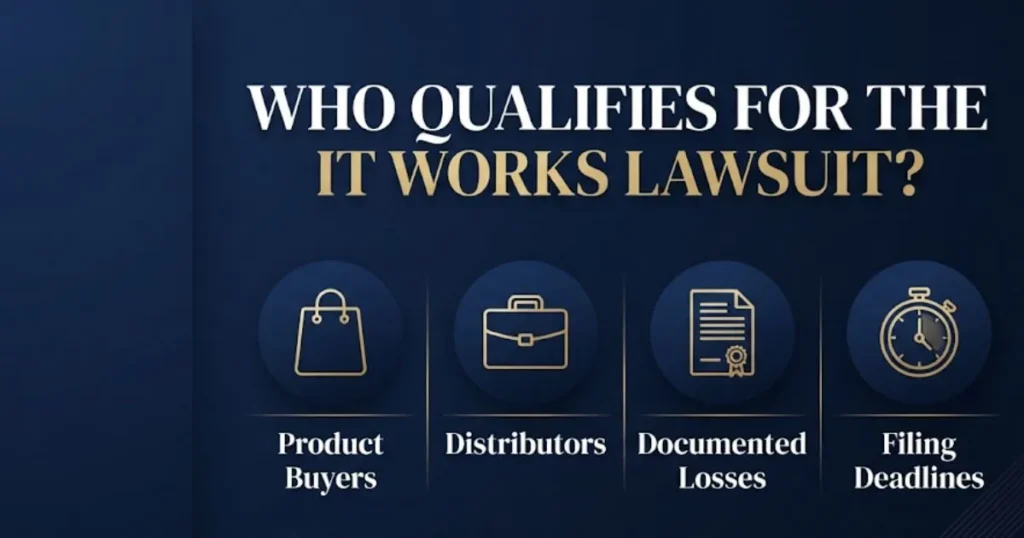
The lawsuits fall into several categories. Product buyers claim false advertising. Distributors claim they were lured into a rigged compensation plan. Consumer advocacy groups have filed formal complaints with federal regulators.
| Detail | Info |
|---|---|
| Company | It Works! Global (It Works! Marketing Inc.) |
| Headquarters | Palmetto, Florida |
| Founded | 2001 |
| Primary Products | Body wraps, supplements, skinny coffee |
| Types of Legal Claims | Pyramid scheme, false advertising, product liability |
| Regulatory Complaints | FTC, state attorneys general, BBB |
Scrutiny of It Works! has built over several years through consumer complaints, advocacy-group reports and at least one proposed class action. We could not confirm any coordinated or multi-case litigation beyond that.
The core question across all these cases is simple. Did It Works! make money by selling products, or by recruiting new distributors into a system designed to fail?
It Works Lawsuit 2026: What You Need to Know
The It Works lawsuit picture in 2026 is mostly unchanged: a proposed consumer class action filed in 2021 and ongoing advocacy-group scrutiny. No settlement, payout or turning point has been announced.
Some things to keep in mind. Statutes of limitations vary by state and claim type. Whether the proposed class is ever certified is a question for the court. Advocacy groups such as TINA.org have submitted evidence to regulators, but no public enforcement action has followed.
The direct selling industry has also faced pressure from regulators. The FTC sent warning letters to multi-level marketing companies about health and income claims in 2020.
| Date | Verified Event |
|---|---|
| 2020 | FTC warning letters to MLMs; TINA.org publishes It Works income claims database |
| 2021 | Brooks v. It Works Marketing filed in E.D. Cal. |
| June 9, 2022 | Court denies motion to compel arbitration |
| 2026 | No settlement, certification ruling or claim form found |
Former distributors should keep their records. Filing deadlines depend on your state and the type of claim, so a lawyer can tell you whether any time limit applies to you.
There is no open claim form to join. If you are considering action, speak with a consumer protection attorney rather than relying on any single deadline.
Morgan McIntyre and the It Works Lawsuit
Morgan McIntyre is a central figure in the It Works lawsuit because of her role as a top leader within the company’s distributor network and her high-profile promotion of the business opportunity.
McIntyre became one of the most visible faces of It Works! on social media. She recruited aggressively and promoted income claims that plaintiffs say were misleading. Her posts painted a picture of luxury, freedom, and effortless wealth.
The reality for most recruits looked nothing like that picture. Court filings reference the type of income testimonials McIntyre and other top earners shared as evidence of deceptive recruiting practices.
Her involvement matters because lawsuits don’t just target the corporate entity. Individual promoters who made specific income claims can face personal liability. The Morgan McIntyre It Works lawsuit connection highlights how top distributors may share legal exposure.
- McIntyre promoted income claims on social media platforms
- Her recruitment efforts brought in large numbers of new distributors
- Plaintiffs argue her testimonials created false expectations
- Top earner income claims are a key piece of evidence in pyramid scheme cases
Think of it this way. If a car dealership lets its salespeople promise the cars get 100 miles per gallon, the dealership is liable. But the salesperson who made the promise isn’t off the hook either.
That same logic applies to MLM promoters who made bold financial claims to recruit people into a system where most participants lost money.
Key Takeaway: The It Works lawsuit allegations span several claim types, and promoter income claims are a recurring criticism. No court has found that any individual promoter is liable.
It Works Class Action Lawsuit Explained
An It Works class action lawsuit is a legal case where a group of people with similar claims sue the company together instead of filing hundreds of individual lawsuits. This approach gives small claimants real power.
Class actions can suit consumer cases because individual losses are often small. Few people hire a lawyer over a few hundred dollars of product, but a group can pursue the claim together. The Brooks case is a proposed class action, and no class has been certified that we could confirm.
For a class action to proceed, a court must certify the class. This means the judge agrees that the claims are similar enough and the group is large enough to justify collective treatment.
| Class Action Element | How It Applies to It Works |
|---|---|
| Commonality | All plaintiffs allege deceptive business practices |
| Numerosity | Plaintiffs must show the class is large enough; not yet decided |
| Typicality | Lead plaintiffs’ claims mirror the group’s experience |
| Adequacy | Proposed class representatives can fairly represent all members |
Potential class members don’t usually need to do anything to join at the early stages. If the class gets certified, notice goes out. You then decide whether to stay in or opt out.
Opting out means you can file your own lawsuit later. Staying in means you share whatever settlement the group negotiates. Most people stay in because it’s easier and costs nothing upfront.
It Works Pyramid Scheme Lawsuit Claims
The It Works pyramid scheme lawsuit alleges that the company’s business model rewards recruitment over actual product sales, which is the legal definition of a pyramid scheme.
Here’s the test courts use. If distributors make more money by signing up new recruits than by selling products to real customers, the structure looks like a pyramid. Plaintiffs argue It Works! fails this test badly.
Income disclosure statements support that argument. In multiple years, the vast majority of It Works! distributors earned little to no commission. Meanwhile, a tiny percentage at the top earned six and seven figures.
- Over 70% of distributors reported zero income in certain years
- Top 1% of earners collected the majority of total commissions
- Recruitment bonuses made up a large share of compensation
- Product purchases were often required to maintain distributor status
The Herbalife case from 2016 set an important precedent here. The FTC found Herbalife’s structure rewarded recruitment over retail sales and imposed a $200 million settlement. Critics of It Works! point to that precedent, though it is a different company and case.
The distinction between a legal MLM and an illegal pyramid scheme comes down to one thing: where the money actually comes from. If it comes from selling products to outside customers, it’s legal. If it comes from the wallets of new recruits, it’s a pyramid.
It Works Lawsuit Settlement Details
No It Works lawsuit settlement has been announced. A settlement would be an agreement between the company and plaintiffs to resolve claims without trial. We found no public report of settlement talks, a settlement fund or a claim form as of November 2026.
Settlements in MLM cases typically involve a fund. The company pays a lump sum into the fund. A claims administrator then distributes money to qualified claimants based on documented losses.
For context only, the FTC’s Herbalife settlement involved $200 million and AdvoCare paid $150 million to settle FTC charges. Those were government cases against other companies and say nothing about what It Works might pay.
| Company | Settlement Amount | Year |
|---|---|---|
| Herbalife | $200 million | 2016 |
| AdvoCare | $150 million | 2019 |
| LuLaRoe | $4.75 million (Washington state) | 2021 |
| It Works! | No settlement announced | 2026 |
Settlement terms usually include more than just money. Companies often agree to change their business practices, revise income disclosures, and stop making certain product claims.
There is currently no claimant list or claim form for an It Works settlement. Beware of any website that claims otherwise or asks for personal details to register.
Key Takeaway: No It Works settlement has been announced, so there is nothing to claim yet. Keep your purchase records in case that changes.
It Works Lawsuit Payout Amounts
There are no It Works lawsuit payout amounts because no settlement exists. If one is ever reached, payouts would depend on the claim type, documented losses and the size of the fund.
Distributors often spent more overall than product-only buyers, between starter kits, monthly autoship orders and event tickets, so their documented losses may be larger. That is not a promise of any payout.
A distributor who spent $5,000 over three years has more to document than a customer who bought one box of body wraps for $99. Neither currently has a claim process to use.
| Claimant Type | Payout Status | What to Keep |
|---|---|---|
| Product-only customer | No payout available | Receipts and order history |
| Short-term distributor (under 1 year) | No payout available | Starter kit and autoship records |
| Long-term distributor (1 to 3 years) | No payout available | Bank statements and commission reports |
| High-volume distributor (3+ years) | No payout available | Full spending and recruitment-cost records |
Any payout would require a settlement approved by a court, and none exists today.
Keep every receipt, bank statement, and screenshot you have. Documentation is everything. Claimants with strong paper trails always receive higher payouts than those who file with no proof.
Who Qualifies for the It Works Lawsuit
No settlement class or claim process is open, so no one can currently “qualify” for a payout. The points below describe who might have a legal claim and should speak with a lawyer.
The broadest category includes product buyers. If you purchased any It Works! product based on health or weight loss claims that turned out to be exaggerated or false, you have a potential claim.
Distributors have an even stronger case in most situations. If you signed up, paid for a starter kit, maintained autoship orders, and earned little or nothing in commissions, your financial loss is clear and documented.
You likely qualify if:
- You purchased It Works! products between 2015 and 2025
- You signed up as a distributor and paid for a starter kit
- You maintained required monthly autoship orders
- You were shown income claims or testimonials that influenced your decision
- You lost money overall despite following the company’s recommended business plan
You may not qualify if:
- You never purchased any products or joined the company
- You earned a net profit as a distributor
- Your claims fall outside the statute of limitations for your state
State laws vary on filing deadlines, and many consumer claims have time limits of a few years. A lawyer can tell you whether a limit applies to your situation.
How to File an It Works Lawsuit Claim
There is no It Works claim form today. Preparing to pursue a claim involves gathering your evidence and speaking with a consumer protection attorney. A claim form would exist only if a settlement is approved.
Start by collecting your financial records. Pull credit card statements, bank records, PayPal transactions, and any emails or receipts from It Works!. Screen capture your distributor back office if you still have access.
Next, document the promises that were made to you. Save social media posts, screenshots of income testimonials, training videos, and any messages from your upline about how much money you could earn.
Step-by-step filing process:
- Gather all financial records showing money spent on It Works!
- Document income claims and marketing promises you received
- Calculate your total net loss (money spent minus any commissions earned)
- Contact a consumer protection attorney or a firm handling MLM class actions
- Submit your information for a free case review
- Check official court dockets for any settlement notice before sharing personal information
| Document Type | Why It Matters |
|---|---|
| Bank/credit card statements | Proves how much money you spent |
| Distributor agreement | Shows the terms you agreed to |
| Income claim screenshots | Proves misleading promises were made |
| Commission statements | Shows how little you actually earned |
| Autoship records | Documents required monthly purchases |
Most firms handling these cases work on contingency. That means you pay nothing upfront. The attorney gets paid only if you win or settle.
Key Takeaway: No claim process is open right now, but documented losses from product purchases or distributor participation are what a lawyer would want to see first.
It Works Distributor Lawsuit Claims
The It Works distributor lawsuit focuses specifically on people who signed up as independent distributors and lost money through the company’s compensation plan. These claims are among the strongest in the case.
Distributors were required to buy a starter kit, often priced between $99 and $199. On top of that, most were required to maintain a monthly autoship order of $80 to $120 to stay “active” and eligible for commissions.
The math never worked for most people. Monthly costs of $100 or more, combined with the difficulty of actually selling products to outside customers, meant most distributors operated at a loss every single month.
Distributor claims typically allege:
- Misrepresentation of the income opportunity
- Required product purchases disguised as “personal use” inventory
- A compensation plan that mathematically guaranteed losses for the majority
- Pressure to recruit rather than sell products
- Lack of meaningful retail customer base
The company’s own income disclosure statements are damning evidence. When 70% or more of your sales force earns nothing, the “business opportunity” starts looking more like a money transfer from the bottom to the top.
Former distributors who kept records of their monthly spending, commission checks, and upline communications have the best chance of recovering their losses. The more detail you can provide, the stronger your claim becomes.
It Works False Advertising Lawsuit
The It Works false advertising lawsuit targets the company’s product marketing claims, particularly around weight loss, body contouring, and health benefits. Plaintiffs say these claims were exaggerated, unproven, or outright false.
The flagship product was the Ultimate Body Applicator, a body wrap that supposedly tightened, toned, and firmed skin in just 45 minutes. That claim drew massive skepticism from doctors and scientists who said a topical wrap cannot produce lasting fat loss or body contouring.
Other products carried similar bold claims. Skinny Brew and Keto Coffee promised weight loss. It Works! Greens claimed to alkalize and detoxify the body. ThermoFight was marketed as a thermogenic fat burner.
| Product | Advertising Claim | Criticism |
|---|---|---|
| Ultimate Body Applicator | Tightens, tones, firms in 45 minutes | No scientific evidence for lasting results |
| Skinny Brew | Promotes weight loss | Insufficient clinical backing |
| It Works! Greens | Alkalizes and detoxifies | “Alkalizing” the body is a debunked concept |
| ThermoFight | Burns fat thermogenically | Modest ingredient evidence, overstated claims |
False advertising claims in lawsuits like this rely on a simple standard. Would a reasonable consumer be misled by the claim? If the answer is yes, and the company cannot back up the claim with solid evidence, the claim is false advertising.
Truth in Advertising (TINA.org) compiled a database of hundreds of deceptive marketing examples from It Works! distributors. The database documents examples of the claims advocacy groups have criticized.
It Works Income Claims Lawsuit
The It Works income claims lawsuit challenges the earnings representations made by the company and its top distributors. Plaintiffs argue these income claims painted a fantasy that had no basis in reality for the average participant.
Income claims came in many forms. Social media posts showing luxury cars. Photos of big commission checks. Testimonials about quitting day jobs. Captions like “this business changed my life” paired with images of expensive vacations.
The problem is that these testimonials came almost exclusively from the tiny fraction of top earners. The average distributor’s experience looked nothing like those posts.
- Top earners represented roughly 1% of the distributor base
- Their income came heavily from recruitment bonuses, not product sales
- Average distributor income was near zero or negative after expenses
- Required product purchases were not deducted from “income” figures in official disclosures
The FTC has been clear on this issue. Companies and their representatives cannot make income claims unless those claims are typical and substantiated. Showing the lifestyle of the top 1% without disclosing that 99% earn almost nothing is deceptive.
Income claims are particularly powerful evidence in pyramid scheme litigation. They show that the company’s primary recruiting tool was the promise of money, not the value of the products themselves.
Key Takeaway: Distributor financial losses, false product advertising, and misleading income claims form the three pillars of the It Works lawsuit, and each is backed by the company’s own data and public marketing materials.
It Works Product Liability Claims
It Works product liability claims allege that certain products caused adverse health effects or failed to perform as advertised, causing financial harm. These claims add a personal injury dimension to the broader litigation.
Some consumers reported skin irritation, allergic reactions, and rashes from the body wraps. Others experienced digestive issues from supplements like It Works! Greens and ThermoFight.
The dietary supplement industry has less FDA oversight than pharmaceuticals. Products can reach the market without proving safety or efficacy first. This regulatory gap means consumers sometimes discover problems only after using a product.
| Reported Issue | Products Involved | Type of Claim |
|---|---|---|
| Skin irritation and rashes | Ultimate Body Applicator | Product liability, failure to warn |
| Digestive problems | Greens, ThermoFight | Product liability, defective product |
| No weight loss results | Skinny Brew, Keto Coffee | Breach of warranty, false advertising |
| Allergic reactions | Various supplements | Failure to warn, negligence |
Product liability claims require showing that the product was defective, that it caused harm, and that the company failed to warn about risks. Medical records and doctor visits strengthen these claims significantly.
If you experienced health issues from any It Works! product, document everything. Medical bills, photos of skin reactions, and records of symptoms all serve as evidence. Save the product packaging too, since ingredient lists and batch numbers can be important.
It Works FTC Investigation
The FTC has scrutinized multi-level marketing health and income claims generally, and It Works! has been named in advocacy-group reports. We found no public confirmation of a formal FTC investigation of the company.
In 2020, after the FTC sent warning letters to multi-level marketers, TINA.org published a database of health and income claims made by It Works! and its distributors. The FTC letters did not announce any enforcement action against the company.
The FTC has not announced a formal enforcement action against It Works! as of November 2026, and we found no confirmation of an investigation. The FTC took action against Herbalife in 2016 and AdvoCare in 2019, but those cases involved other companies.
Signs the FTC is watching It Works!:
- Formal complaint filed by TINA.org with supporting evidence database
- Consumer complaints submitted through the FTC complaint portal
- Pattern matches with companies the FTC has already taken action against
- Company’s income disclosure data mirrors patterns seen in confirmed pyramid schemes
When the FTC does act against a company, outcomes can include refunds to consumers, penalties and required changes to business practices.
No FTC action against It Works! has been announced, so private plaintiffs have no such support at this time.
It Works Body Wraps Lawsuit
The It Works body wraps lawsuit specifically targets the company’s signature product, the Ultimate Body Applicator, which was marketed as a revolutionary body contouring treatment. Plaintiffs say the product simply does not work as advertised.
The body wraps were It Works!’ biggest seller. Distributors marketed them aggressively on Instagram, Facebook, and TikTok. Before-and-after photos flooded social media feeds, showing dramatic results in just 45 minutes.
Medical professionals consistently disputed these claims. Dermatologists and plastic surgeons pointed out that a topical wrap cannot remove fat, permanently tighten skin, or produce the kind of body contouring results shown in marketing photos.
| Claim | Reality |
|---|---|
| “Tightens and tones in 45 minutes” | Temporary water loss may reduce measurements briefly |
| “Permanently reduces body fat” | No topical product can target or reduce fat cells |
| “Works on cellulite” | No clinical evidence supports this claim |
| Before/after photos show dramatic change | Photos often taken with different lighting, posture, and angles |
The body wraps typically sold for $25 to $30 per applicator, or $59 to $99 for a pack of four. Millions of units were sold over the company’s history.
Customers who purchased body wraps based on these claims and saw no results have a strong false advertising case. The gap between what was promised and what was delivered is wide enough to drive a truck through.
Key Takeaway: Criticism of It Works! comes from several angles, including product claims, income claims and advocacy-group reports, but none has produced a confirmed settlement or FTC action.
Is It Works a Pyramid Scheme?
Whether It Works is a pyramid scheme depends on whether its compensation structure rewards recruitment over genuine product sales. Based on available evidence, many legal experts and consumer advocates argue it meets the legal criteria.
The FTC defines a pyramid scheme as a business where participants earn money primarily by recruiting new members rather than selling products to end consumers. The key question is always: who’s actually buying the products?
In It Works!’ case, a significant portion of product purchases came from distributors themselves, not outside customers. Monthly autoship requirements meant distributors were often their own best customers. That’s a red flag regulators look for.
Pyramid scheme warning signs present in It Works!:
- High percentage of revenue from distributor purchases, not retail customers
- Income concentration at the top of the structure
- Required monthly product purchases to maintain active status
- Heavy emphasis on recruitment in training and compensation
- Income claims focused on the earning potential of the “opportunity”
- Majority of participants earning zero or losing money
Compare it to a legitimate retail business. If you opened a shoe store, you’d make money by selling shoes to people who walk in. You wouldn’t make money by convincing other people to open shoe stores underneath you and buy shoes from your warehouse every month.
That’s the difference. And it’s the exact argument plaintiffs are making in court.
The legal determination hasn’t been finalized in all pending cases. But the data patterns match what regulators found in Herbalife, AdvoCare, and other companies that were ultimately classified as pyramid schemes or forced to restructure.
It Works Lawsuit Update 2026
The latest verified It Works lawsuit update is the June 9, 2022 ruling in Brooks denying arbitration. We found no newer ruling, settlement or court date as of November 2026.
Developments worth watching include any class certification ruling in the Brooks case and any new filings by consumers or regulators. We have not verified reports of depositions or discovery rulings.
The company disputes the allegations, and the court has not decided the merits of the claims.
2026 Key Dates and Developments:
| Event | Status |
|---|---|
| Class certification ruling | None found |
| Settlement | None announced |
| Claim form | None available |
| Filing deadline | None set; time limits vary by state |
| FTC action | None announced |
If a class were certified, the case would gain momentum, but that has not been reported and a settlement is not guaranteed.
We cannot say when, or whether, a settlement or trial date will be announced.
Stay current on developments by checking the court docket and reliable news sources, and be cautious of sites that promise payouts.
Frequently Asked Questions
How much money can I get from the It Works lawsuit?
There is no payout to claim because no It Works settlement has been announced.
Any future payout would depend on a settlement approved by the court.
Keep your receipts and records in case that changes.
Is It Works still facing lawsuits in 2026?
The best-documented case is the proposed class action Brooks v. It Works Marketing in California federal court.
We found no class certification ruling or settlement as of November 2026.
Check the court docket for current status.
Can former It Works distributors file a claim?
Former distributors who suffered a net financial loss are among the strongest potential claimants.
You should gather bank statements, autoship records, and commission histories as evidence.
Contact a consumer protection attorney handling MLM cases to submit your information for review.
What did Morgan McIntyre have to do with the It Works lawsuit?
Morgan McIntyre was a high-profile It Works! promoter whose income claims and recruitment tactics are cited in lawsuit filings.
Plaintiffs argue her social media posts created false expectations about earning potential.
Top distributors who made specific income representations may face personal legal exposure alongside the company.
How long does the It Works lawsuit settlement process take?
No settlement has been announced, so there is no payout timeline.
Class action cases can take years from filing to resolution.
The timeline depends on court schedules, appeals and any claims review process.
The It Works lawsuit remains unresolved, and no settlement or payout exists in 2026. Whether you bought products that didn’t work or lost money as a distributor, the first step is keeping good records.
Gather your records now and consider speaking with a consumer protection attorney about your options.
We’ll keep this page updated as the case develops.







