The unemployment lawsuit update today for 2026 shows several major cases still active across multiple states, with new settlements reaching workers who were wrongly denied or overcharged. If your state unemployment agency messed up your benefits during or after the pandemic, you might be owed money.
Right now, class action lawsuits in states like California, Florida, Ohio, and Illinois are moving through courts. Some have already produced payouts. Others are heading toward trial dates later this year.
This article breaks down every active unemployment lawsuit in 2026. You will learn who qualifies, how much money is on the table, and what steps to take. One surprising number: an estimated 18 million workers received overpayment notices since 2020, and many of those notices were sent in error.
If you are one of them, keep reading.
Unemployment Lawsuit Update Today
The latest unemployment lawsuit update today shows that 2026 is a turning point for several long-running cases. Courts in at least six states have active class action or individual lawsuits challenging how unemployment agencies handled claims during and after the pandemic.
In early 2026, a federal judge in California allowed a class action against the Employment Development Department (EDD) to proceed to discovery. The case involves an estimated 1.4 million claimants who experienced wrongful benefit denials between 2020 and 2023.
Florida’s Department of Economic Opportunity (DEO) is facing a separate lawsuit over its CONNECT system, which crashed repeatedly and locked claimants out of their accounts. That case has a hearing scheduled for mid-2026.
Ohio’s class action against the Ohio Department of Job and Family Services (ODJFS) over erroneous overpayment demands is also in active litigation. Plaintiffs allege the state used flawed automated systems to flag legitimate claims as fraud.
| State | Agency | Case Status | Key Issue |
|---|---|---|---|
| California | EDD | Discovery phase | Wrongful denials |
| Florida | DEO | Hearing mid-2026 | System failures |
| Ohio | ODJFS | Active litigation | False overpayment flags |
| Illinois | IDES | Settlement talks | Delayed payments |
| Texas | TWC | Pre-trial motions | Identity verification errors |
| Michigan | UIA | Pending ruling | Automated fraud accusations |
These cases are not stale news. They are alive and moving right now.
What Is an Unemployment Lawsuit
An unemployment lawsuit is a legal action filed against a state unemployment agency or employer for wrongfully denying, delaying, or clawing back unemployment benefits. These lawsuits argue that workers were harmed by government mistakes, system failures, or illegal procedures.
Think of it this way. You applied for benefits you were legally owed. The state said no, or said yes and then demanded the money back. A lawsuit is your way of fighting that through the courts.
These cases can be filed individually or as class actions. Class actions are more common because thousands (sometimes millions) of workers experienced the same problem at the same time.
Common types of unemployment lawsuits include:
- Wrongful denial of valid claims
- Overpayment demands based on agency errors
- System crashes that prevented timely filing
- Identity verification failures that locked out legitimate claimants
- Fraud accusations without proper investigation
Not every bad experience with unemployment qualifies for a lawsuit. But when an agency violates your due process rights or breaks state and federal law, legal action becomes a real option.
Unemployment Class Action Lawsuit 2026
The unemployment class action lawsuit landscape in 2026 features at least five major cases with certified or pending class status. A class action allows one lawsuit to represent thousands of people who share the same legal complaint against the same defendant.
The biggest case right now is in California. Filed against EDD, it represents workers who were wrongfully denied benefits and then hit with overpayment notices. The class could include over 1 million people.
Illinois has a separate class action against the Illinois Department of Employment Security (IDES). Plaintiffs say the agency took months to process claims and failed to provide timely hearings when benefits were denied.
| Case | State | Class Size (Est.) | Filing Year | 2026 Status |
|---|---|---|---|---|
| EDD Denial Class Action | California | 1.4 million | 2022 | Discovery |
| IDES Delay Lawsuit | Illinois | 300,000+ | 2023 | Settlement talks |
| DEO System Crash Suit | Florida | 800,000+ | 2021 | Pre-trial hearing |
| ODJFS Overpayment Case | Ohio | 500,000+ | 2023 | Active litigation |
| UIA Fraud Flag Suit | Michigan | 400,000+ | 2022 | Pending class cert |
To qualify for a class action, you typically do not need to do anything upfront. If the class gets certified and wins, you will be notified about how to claim your share.
Key Takeaway: Multiple unemployment class action lawsuits are active in 2026, covering millions of workers across California, Florida, Ohio, Illinois, and Michigan.
Unemployment Benefits Lawsuit Settlement
Unemployment benefits lawsuit settlements in 2026 range from small individual payouts to multi-million-dollar deals covering entire states. Settlement means the parties agreed to resolve the case without going to a full trial.
One of the most notable settlements so far came in Illinois. IDES agreed to a $45 million fund to compensate claimants whose benefits were delayed by more than 90 days. Individual payouts from that fund are expected to range from $200 to $2,500 depending on how long each claimant waited.
California’s EDD case has not settled yet, but legal analysts expect a potential settlement in late 2026 or early 2027 if discovery produces damaging internal documents.
Michigan’s UIA reached a partial settlement in 2025 over its automated fraud detection system. That settlement included a $20 million restitution fund and a requirement that the agency reform its procedures.
Key settlement factors that determine payout size:
- Length of benefit delay or denial
- Total dollar amount of benefits wrongfully withheld
- Whether the claimant received an erroneous overpayment notice
- Proof of financial hardship caused by the error
- Whether the claimant already repaid an overpayment demand
Settlements are not guaranteed. But when agencies know they messed up on a massive scale, settling often costs less than losing at trial.
Unemployment Overpayment Lawsuit
Unemployment overpayment lawsuits challenge demands from state agencies that say claimants received too much in benefits and must pay the money back. In many cases, these demands were based on automated system errors, not actual fraud or mistakes by the claimant.
Here is the core problem. During the pandemic, states rushed billions of dollars out the door. Later, their systems flagged millions of claims as overpayments. Workers who followed every rule still got letters demanding $5,000, $10,000, even $20,000 in repayment.
Ohio’s ODJFS overpayment lawsuit is one of the largest. Plaintiffs allege the state sent overpayment notices to over 500,000 claimants without adequate review. Many of those notices were triggered by software glitches, not fraud.
In some states, agencies withheld tax refunds and garnished wages to collect on disputed overpayments. Lawsuits argue this violated due process because claimants were never given a fair hearing before collection began.
| Overpayment Issue | States Affected | Lawsuit Status |
|---|---|---|
| Automated fraud flags | Ohio, Michigan, Indiana | Active |
| Tax refund offsets | Texas, Florida, Colorado | Pre-trial |
| Wage garnishment | California, Pennsylvania | Discovery |
| PUA overpayment clawback | Multiple states | Various stages |
If you received an overpayment notice you believe was wrong, an active lawsuit in your state could result in that demand being waived or reduced.
Unemployment Lawsuit Payout
Unemployment lawsuit payouts in 2026 vary widely depending on the case, the state, and how badly you were affected. Most class action payouts range from $100 to $5,000 per claimant, though individual lawsuits can result in much higher awards.
The Illinois IDES settlement fund of $45 million is expected to distribute payments in mid to late 2026. With an estimated 300,000 eligible claimants, individual shares could average around $150 to $2,500.
Michigan’s UIA restitution fund has already started making payments. Early reports suggest checks averaging $800 to $1,200 for claimants who were falsely accused of fraud.
Factors that affect your payout amount:
- How many weeks of benefits were denied or delayed
- The weekly benefit amount you were entitled to
- Whether you repaid an erroneous overpayment
- The total settlement fund size divided by number of claimants
- Whether you submit proof of harm (receipts, financial statements)
It is worth understanding that class action payouts are almost always less than what you actually lost. That is the trade-off of class actions. You get something without paying for your own lawyer, but you will not get made completely whole.
Key Takeaway: Unemployment lawsuit payouts in 2026 range from about $100 to $5,000 for class action members, with individual cases potentially recovering much more.
How to Join an Unemployment Lawsuit
Joining an unemployment lawsuit in 2026 depends on whether the case is a class action, a mass action, or an individual claim. For most class actions, you do not need to actively sign up. If the class is certified and you fit the definition, you are automatically included.
Here is how the process typically works for class actions:
- The court certifies the class (defines who is included)
- If the case settles or wins, a settlement administrator sends notices
- You receive a notice by mail or email explaining how to file a claim
- You submit a claim form with any required documentation
- You receive your payment after the claims period closes
For cases that are not class actions, or if you want to file your own individual lawsuit, you would need to contact an attorney who handles employment law or unemployment disputes in your state.
Some states also have legal aid organizations that take unemployment cases for free if you meet income requirements. The National Employment Law Project (NELP) maintains a directory of state-level legal resources for unemployment claimants.
| Step | What Happens | Your Role |
|---|---|---|
| Class certified | Court defines eligible class | Nothing yet |
| Notice sent | You receive mail or email | Check your mail |
| Claim period opens | Submit claim form | Fill out and return form |
| Review period | Administrator verifies claims | Wait |
| Payment issued | Checks or deposits sent | Receive money |
Do not ignore any mail from a court or settlement administrator. That letter could be your ticket to a payout.
Unemployment Claim Lawsuit Eligibility
Eligibility for an unemployment claim lawsuit in 2026 depends on the specific case and what went wrong with your benefits. Each lawsuit defines its own class of eligible claimants based on the legal claims being made.
General eligibility criteria for most cases include:
- You filed for unemployment benefits in the state where the lawsuit is pending
- Your claim was denied, delayed, or flagged for overpayment during the relevant time period (usually 2020 to 2024)
- You experienced financial harm because of the agency’s error or system failure
- You did not commit actual fraud
For the California EDD class action, eligible claimants are those who filed between March 2020 and September 2023 and were either wrongfully denied or received an erroneous overpayment notice.
Ohio’s ODJFS case covers claimants who received overpayment demands generated by the state’s automated system between 2020 and 2022.
You do not need to prove you were perfect. You just need to show you filed in good faith and got hurt by the system.
States define fraud very specifically. If you honestly reported your information and the state still flagged you, that is exactly the kind of situation these lawsuits address.
PUA Lawsuit Update
The PUA (Pandemic Unemployment Assistance) lawsuit update for 2026 shows ongoing legal battles in multiple states over how agencies handled this federal program. PUA was created under the CARES Act to cover gig workers, freelancers, and self-employed people who did not qualify for regular unemployment.
The problem was that PUA had almost no verification systems when it launched. States paid out billions. Then, when they tried to clean up, they accused legitimate claimants of fraud.
Michigan’s lawsuit against UIA centers heavily on PUA claimants. The state’s automated system flagged an estimated 400,000 PUA claims as fraudulent without human review. Many of those claimants lost their benefits and received massive repayment demands.
A similar PUA-focused case in Indiana challenges the Department of Workforce Development’s decision to end PUA early and then demand repayment from claimants who received benefits during the program’s final weeks.
PUA lawsuit issues by state:
- Michigan: Automated fraud flags on legitimate PUA claims
- Indiana: Early program termination and retroactive clawbacks
- California: PUA denials based on identity verification failures through ID.me
- Florida: PUA system lockouts during peak filing periods
- Ohio: PUA overpayment notices sent without hearings
The federal government left cleanup to the states. And the states, in many cases, botched it.
Key Takeaway: PUA lawsuits remain some of the most active unemployment cases in 2026, with millions of gig workers and freelancers still fighting false fraud charges and overpayment demands.
Wrongful Denial of Unemployment Lawsuit
A wrongful denial of unemployment lawsuit argues that a state agency illegally rejected a valid claim for benefits. These cases rest on the idea that the claimant met every eligibility requirement but was denied anyway, often because of administrative errors, system problems, or misapplied rules.
During the pandemic surge, many states could not keep up with the volume. Applications sat in queues for months. Automated systems kicked out valid claims because of minor discrepancies. Call centers were unreachable.
In California, the EDD wrongful denial class action covers claimants who were denied benefits due to identity verification failures. The state contracted with ID.me to verify identities, but the system rejected many legitimate applicants, particularly older adults and people without smartphones.
Common reasons for wrongful denial:
- Identity verification failure
- Employer contest of the claim without valid grounds
- System error in calculating base period wages
- Miscategorization of separation reason (quit vs. fired vs. laid off)
- Failure to process a timely appeal
If you were denied benefits and you believe the denial was wrong, you may have a claim. Especially if you can show you met the eligibility requirements at the time you applied.
Unemployment Fraud Lawsuit
Unemployment fraud lawsuits in 2026 work in two directions. Some are brought by states against individuals accused of fraud. Others are brought by individuals against states that falsely accused them of fraud.
The second type is far more relevant to most people reading this. Millions of workers received fraud allegations from state agencies based on automated reviews, not actual evidence of wrongdoing.
Michigan’s “MiDAS” system was an early example. The state’s automated fraud detection system had a 93% error rate in its fraud determinations, according to a state audit. Hundreds of thousands of people were falsely accused.
Similar patterns have emerged in other states. Texas used automated cross-referencing that flagged claimants whose employers reported slightly different information than what the claimant provided. Even small data mismatches triggered fraud allegations.
| State | Fraud Detection Method | Error Rate (Est.) | Lawsuit Status |
|---|---|---|---|
| Michigan | MiDAS automated system | 93% | Partial settlement |
| Texas | Employer data cross-reference | Unknown | Pre-trial |
| Florida | Third-party identity check | High | Active |
| Ohio | Automated review | Significant | Active |
Being accused of unemployment fraud can wreck your credit, cost you future benefits, and lead to criminal referrals. Lawsuits challenging these false accusations are fighting to clear names and return money.
Unemployment System Failure Lawsuit
Unemployment system failure lawsuits target the actual technology infrastructure that states used to process claims. When those systems crashed, froze, or malfunctioned, millions of workers could not file claims, certify for benefits, or access their accounts.
Florida’s CONNECT system became the poster child for this problem. Built on outdated technology, it collapsed under pandemic-era filing volumes. Workers reported waiting on hold for hours, getting kicked out mid-application, and losing weeks of benefits because the system would not let them file on time.
A class action against Florida’s DEO argues that the state knew the system was broken before the pandemic. A 2019 audit had flagged serious problems. The state did nothing.
Other system failures cited in lawsuits:
- California EDD’s system crashing during peak hours
- New Jersey’s mainframe running on 40-year-old COBOL code
- Nevada’s system failing to process backdated claims properly
- Pennsylvania’s system assigning incorrect benefit amounts
These are not just inconveniences. When a system failure prevents you from filing on time, you lose money. Sometimes thousands of dollars in benefits you were owed and can never get back.
The lawsuits argue that states have a legal obligation to maintain functional systems. Failing to do so violates claimants’ due process rights.
Key Takeaway: System failure lawsuits hold states accountable for broken technology that prevented workers from accessing benefits they were legally owed.
Unemployment Overpayment Clawback Lawsuit
An unemployment overpayment clawback lawsuit specifically challenges the collection methods states use to recover alleged overpayments. Clawback means the state takes back money it already paid you, often by intercepting your tax refund, garnishing your wages, or reducing future benefit payments.
The legal issue is straightforward. Did the state give you a chance to dispute the overpayment before it started taking your money? In many cases, the answer is no.
Ohio’s case is a prime example. The state sent overpayment notices and then immediately referred accounts to the state’s tax offset program. Claimants had their state and federal tax refunds seized before they could even file an appeal.
Clawback methods challenged in 2026 lawsuits:
- State tax refund interception
- Federal tax refund offset through the Treasury Offset Program
- Wage garnishment orders
- Reduction of future unemployment benefit payments
- Referral to private collection agencies
The U.S. Department of Labor issued guidance in 2021 encouraging states to waive overpayments caused by agency error. Some states followed that guidance. Others ignored it and kept collecting.
| Clawback Method | Constitutional Issue | States Using This |
|---|---|---|
| Tax refund offset | No hearing before seizure | OH, TX, FL, CO |
| Wage garnishment | Due process violation | CA, PA, IN |
| Future benefit reduction | Penalty without adjudication | MI, IL, NJ |
| Private collection | No government oversight | FL, TX |
If your tax refund was seized or your wages were garnished over a disputed overpayment, you may have strong legal standing in one of these cases.
Unemployment Lawsuit Filing Deadline
Unemployment lawsuit filing deadlines in 2026 vary by state and by the type of legal claim being made. Missing a deadline can permanently bar you from participating in a case, so knowing your window matters.
For class actions, the filing deadline usually refers to the claims deadline, meaning the date by which you must submit your claim form to receive a payout from a settlement. These deadlines are set by the court after a settlement is approved.
For individual lawsuits, statutes of limitations apply. These are the legal time limits for bringing a case.
Typical deadlines to watch in 2026:
- Illinois IDES settlement: Claims deadline expected Q3 2026
- Michigan UIA restitution: Ongoing claims period through December 2026
- Ohio ODJFS class action: If settled, claims period likely late 2026 or early 2027
- California EDD case: No settlement yet; individual claims still viable
- Florida DEO lawsuit: Pre-trial; no claims deadline yet
| Deadline Type | Typical Timeframe | What Happens If You Miss It |
|---|---|---|
| Class action claims deadline | 60 to 120 days after settlement approval | You lose your payout |
| Statute of limitations (state claims) | 1 to 6 years depending on state | You cannot file a lawsuit |
| Statute of limitations (federal claims) | 2 to 3 years for due process claims | You cannot file a lawsuit |
| Appeal deadline (administrative) | 10 to 30 days from denial notice | You waive your right to appeal |
Do not assume you have unlimited time. If you believe you have a claim, figure out your deadline and act before it passes.
Key Takeaway: Filing deadlines for unemployment lawsuits in 2026 vary widely, and missing them can permanently eliminate your right to recover money.
Can I Sue for Denied Unemployment Benefits
Yes, you can sue for denied unemployment benefits, but only after you have exhausted your administrative remedies. That means you must go through the state’s appeal process before filing a lawsuit in court.
Every state has an unemployment appeals process. Typically, you get a hearing before an administrative law judge within 30 to 60 days of your denial. If you lose that hearing, you can appeal to a higher board or commission.
Only after the appeals process is complete can you take the case to court. Filing a lawsuit without appealing first will almost certainly get your case thrown out.
Steps before you can sue:
- Receive your denial notice
- File an appeal within the deadline (usually 10 to 30 days)
- Attend your hearing and present your case
- If you lose, file a further appeal to the state review board
- If you exhaust all administrative appeals, file a lawsuit in state or federal court
The exception is class actions. If a class action already covers your situation, you do not need to exhaust appeals individually. The class representatives did that on behalf of everyone.
There are also situations where the denial was so egregious that a civil rights claim (like a due process violation under the 14th Amendment) can be filed directly in federal court. But these cases are harder to win and usually require an attorney.
Unemployment Appeal vs Lawsuit
An unemployment appeal and a lawsuit are two different legal processes. An appeal is an administrative hearing within the state’s unemployment system. A lawsuit is a case filed in an actual court with a judge (and sometimes a jury).
Think of it like complaining to a store manager versus taking the store to court. The appeal is the internal process. The lawsuit is the external one.
| Feature | Appeal | Lawsuit |
|---|---|---|
| Where it happens | State unemployment agency | State or federal court |
| Who decides | Administrative law judge | Judge or jury |
| Cost to you | Free | Attorney fees (often contingency) |
| Timeline | Weeks to months | Months to years |
| What you can win | Reinstatement of benefits | Benefits plus damages |
| Required first? | Yes (usually) | Only after appeals exhausted |
Appeals are faster and free. You can represent yourself. The hearing is informal compared to a courtroom proceeding.
Lawsuits take longer and cost more, but they can award damages beyond just your lost benefits. That includes compensation for financial hardship, emotional distress (in some cases), and attorney fees.
When a lawsuit makes more sense than an appeal:
- The state’s entire system was broken, affecting thousands
- You were falsely accused of fraud and suffered serious consequences
- The state violated your constitutional rights
- You want to force systemic changes, not just get your own benefits back
Most people should start with an appeal. If the system fails you, a lawsuit becomes the next step.
Unemployment Lawsuit Timeline
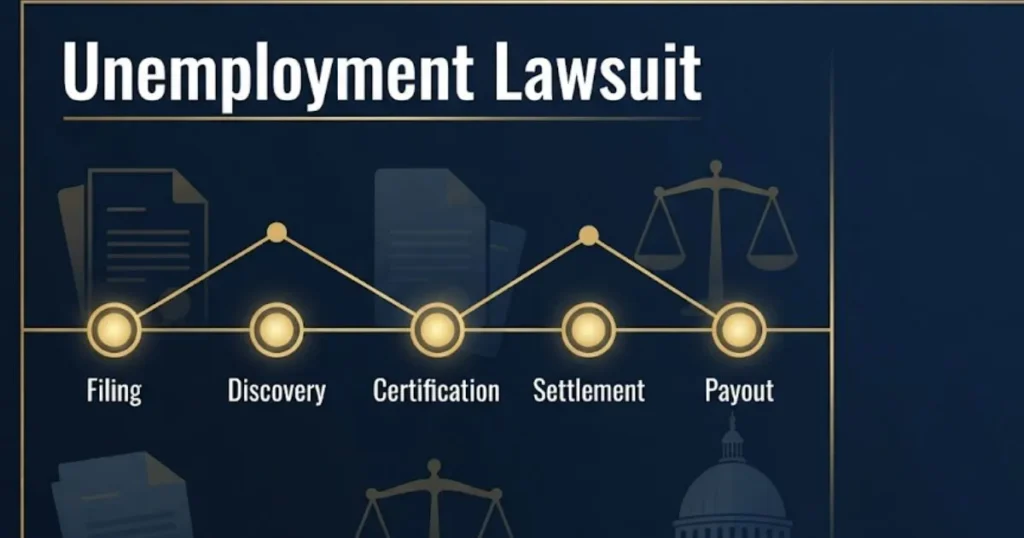
A typical unemployment lawsuit timeline from filing to resolution can take anywhere from one to five years. Class actions tend to take longer because of the complexity of certifying a class and managing thousands of claims.
Here is a general timeline for how these cases move through the courts:
| Phase | Typical Duration | What Happens |
|---|---|---|
| Pre-filing investigation | 1 to 6 months | Attorneys gather evidence and identify plaintiffs |
| Complaint filed | Day 1 in court | Lawsuit officially begins |
| Motion to dismiss | 2 to 6 months | Defendant tries to get case thrown out |
| Discovery | 6 to 18 months | Both sides exchange documents and take depositions |
| Class certification | 3 to 12 months | Court decides if case can proceed as class action |
| Settlement negotiations | Ongoing | Can happen at any stage |
| Trial | 1 to 4 weeks | If no settlement, case goes before judge or jury |
| Appeals | 6 to 24 months | Losing side can appeal the verdict |
| Payment distribution | 3 to 12 months | Settlement administrator sends checks |
Some of the 2026 cases were filed as far back as 2021. They are just now reaching the discovery or settlement phase.
Patience matters. These cases move slowly. But when they resolve, the payouts can be significant for people who were wrongly denied benefits or hit with bogus repayment demands.
Key Takeaway: Unemployment lawsuits typically take one to five years from filing to payout, and several cases filed between 2021 and 2023 are expected to resolve in 2026.
State Unemployment Agency Lawsuit 2026
State unemployment agency lawsuits in 2026 target the government entities that administer unemployment insurance. These agencies are the defendants. They are being sued by the people they were supposed to serve.
Every state runs its own unemployment system. That means every state has its own set of problems, lawsuits, and legal exposure.
States facing the most significant unemployment lawsuits in 2026:
- California (EDD): Multiple lawsuits over denials, delays, and overpayments. Largest potential class.
- Florida (DEO): System failure lawsuit and PUA clawback case. Hearing scheduled mid-2026.
- Ohio (ODJFS): Overpayment and false fraud allegation cases. Active litigation.
- Michigan (UIA): Partial settlement reached; additional cases pending on PUA fraud flags.
- Illinois (IDES): $45 million settlement fund for delayed benefits. Claims period opening in 2026.
- Texas (TWC): Identity verification lawsuit and overpayment collection case. Pre-trial.
- Indiana (DWD): PUA early termination and clawback lawsuit. Discovery phase.
- Pennsylvania (UC): System failure and incorrect benefit calculation case. Early stages.
These lawsuits matter because they do not just help individual claimants. They force agencies to fix broken systems, reform unfair procedures, and stop punishing people for government mistakes.
When a state settles or loses, it sends a signal. Other states pay attention. Reforms happen. The legal process, slow as it is, creates pressure for change that protests and media coverage alone cannot achieve.
| State | Agency | Number of Active Lawsuits | Biggest Issue |
|---|---|---|---|
| California | EDD | 3+ | Wrongful denials |
| Florida | DEO | 2+ | System crashes |
| Ohio | ODJFS | 2+ | Overpayment demands |
| Michigan | UIA | 2+ (1 settled) | False fraud flags |
| Illinois | IDES | 1 (settling) | Benefit delays |
| Texas | TWC | 2+ | ID verification |
Stay informed about your state. The case affecting you could be heading toward resolution right now.
Frequently Asked Questions
How much money can I get from an unemployment lawsuit in 2026?
Most class action payouts range from $100 to $5,000 per claimant.
The exact amount depends on the settlement size, number of claimants, and how severely you were affected.
Individual lawsuits can recover larger amounts, sometimes tens of thousands of dollars.
How do I join an unemployment class action lawsuit?
For most class actions, you are automatically included if you meet the class definition.
You do not need to sign up in advance.
When a settlement is reached, you will receive a notice with instructions for filing a claim.
What is the deadline to file an unemployment lawsuit in 2026?
Deadlines vary by state and case type, with statutes of limitations ranging from one to six years.
Class action claims deadlines are set by the court after settlement approval.
Check your state’s specific case for exact dates.
Can I sue my state for denying unemployment benefits?
Yes, but you must first exhaust your administrative appeal rights.
After completing the appeals process, you can file a lawsuit in state or federal court.
Class actions may already cover your situation, so check for active cases in your state.
What is the difference between an unemployment appeal and a lawsuit?
An appeal is a free administrative hearing within the state unemployment system.
A lawsuit is a court case that can award damages beyond just reinstating your benefits.
You generally must complete the appeal process before filing a lawsuit.
This is the year to pay attention. Unemployment lawsuits in 2026 are producing real results for workers who were wronged by state agencies. If you were denied benefits, hit with a false fraud charge, or forced to repay money you legitimately received, an active case may cover you.
Check your state’s case status. Watch your mail for settlement notices. Do not let a deadline pass without acting.
Your benefits were earned. Getting them back is not charity. It is your right.