

The McDonald’s coffee lawsuit payout is one of the most misunderstood legal outcomes in American history. Stella Liebeck’s case resulted in a $2.86 million jury verdict in 1994, but the actual payout was far less than that headline number.
Most people think this was a joke lawsuit. It wasn’t. A 79-year-old woman suffered third-degree burns across 16% of her body from coffee served at nearly 190 degrees Fahrenheit.
This article breaks down every dollar of the payout. You’ll learn what the jury awarded, what the judge reduced it to, and what Liebeck likely received in her confidential settlement. You’ll also find out whether you can file your own burn injury claim in 2026.
The facts of this case have been distorted for three decades. Here’s the truth.
McDonald’s Coffee Lawsuit Payout
The McDonald’s coffee lawsuit payout refers to the money Stella Liebeck received after suing McDonald’s for serving dangerously hot coffee that caused severe burns. The jury initially awarded $2.86 million, but the final payout was significantly less.
Here’s why the number changed. The trial judge used a legal tool called remittitur to reduce the punitive damages. After that reduction, the case settled privately before an appeal could move forward.
The exact settlement figure was never made public. Legal experts estimate Liebeck received somewhere between $400,000 and $600,000 after all reductions, legal fees, and negotiations.
| Payout Stage | Amount |
|---|---|
| Jury Compensatory Damages | $200,000 |
| Jury Punitive Damages | $2.7 million |
| Total Jury Verdict | $2.86 million (approx.) |
| Judge’s Reduced Total | $640,000 |
| Estimated Final Settlement | $400,000 to $600,000 |
That’s a massive gap between what people think she got and what she actually received. Liebeck’s medical bills alone topped $10,000 in 1992, and she needed skin graft surgery.
The payout barely covered her long-term care costs. This wasn’t a woman getting rich off a coffee spill. This was an elderly burn victim fighting for basic medical compensation.
How Much Did the McDonald’s Coffee Lawsuit Settle For
The McDonald’s coffee lawsuit settled for a confidential amount after the trial judge reduced the jury’s award to $640,000. The final confidential settlement is widely estimated to have been under $600,000.
To understand the math, start with the jury’s decision. They awarded Liebeck $200,000 in compensatory damages for her injuries. Then they hit McDonald’s with $2.7 million in punitive damages, which equaled about two days of McDonald’s coffee revenue at the time.
But Judge Robert H. Scott reduced the punitive portion to $480,000, bringing the total down to $640,000.
Before the appeals process could play out, both sides agreed to a private settlement. Neither party disclosed the number.
- The compensatory damages covered medical bills and lost income
- The punitive damages were meant to punish McDonald’s for knowingly serving dangerously hot coffee
- The judge’s reduction followed New Mexico legal guidelines for punitive-to-compensatory ratios
- The final settlement likely factored in appeal risk for both sides
So when someone says “she got millions,” that’s simply not accurate. The real payout was a fraction of the jury’s original number.
Stella Liebeck Settlement Amount
Stella Liebeck’s settlement amount was never officially disclosed, but it is estimated to fall between $400,000 and $600,000 based on the judge’s reduced verdict of $640,000 and standard settlement negotiations.
Liebeck was 79 years old when the incident happened on February 27, 1992. She was a passenger in a parked car at a McDonald’s drive-through in Albuquerque, New Mexico. She placed the coffee cup between her knees to add cream and sugar, and the entire cup spilled.
Before filing suit, Liebeck asked McDonald’s for just $20,000 to cover her medical expenses. McDonald’s countered with $800. That refusal is what pushed the case to trial.
| Request / Outcome | Amount |
|---|---|
| Liebeck’s Initial Request | $20,000 |
| McDonald’s Counter Offer | $800 |
| Pre-Trial Mediation Recommendation | $225,000 |
| Jury Award | $2.86 million |
| Judge’s Reduced Award | $640,000 |
| Estimated Settlement | $400,000 to $600,000 |
After paying attorney fees (typically 33% to 40% in contingency cases), Liebeck’s take-home amount may have been closer to $250,000 to $350,000. For a woman who spent eight days in a hospital burn unit and endured multiple skin grafts, that number tells a very different story than the media version.
Key Takeaway: The McDonald’s coffee lawsuit payout was never millions of dollars; after judicial reductions, legal fees, and settlement negotiations, Stella Liebeck likely received a modest sum that barely covered her long-term medical needs.
McDonald’s Coffee Lawsuit Jury Verdict
The McDonald’s coffee lawsuit jury verdict came on August 18, 1994, when a twelve-person jury in Bernalillo County District Court awarded Stella Liebeck a total of approximately $2.86 million in damages.
The jury split the award into two parts. They granted $200,000 in compensatory damages to cover Liebeck’s medical expenses, pain, suffering, and lost income. However, they also found Liebeck 20% at fault for the spill, so the compensatory portion was reduced to $160,000.
The bigger piece was punitive damages. The jury awarded $2.7 million, a figure deliberately chosen to represent roughly two days of McDonald’s coffee sales revenue across all its U.S. restaurants.
Punitive damages exist to send a message. In this case, the jury wanted to tell McDonald’s that knowingly serving coffee at temperatures capable of causing third-degree burns was unacceptable.
- Compensatory damages (adjusted): $160,000
- Punitive damages: $2.7 million
- Total jury verdict: approximately $2.86 million
- Liebeck’s comparative fault: 20%
The jury deliberated for about four hours. Seven jurors later said the evidence of McDonald’s internal complaints about burn injuries was the deciding factor. McDonald’s had received more than 700 burn complaints in the decade before Liebeck’s case, yet the company never lowered its serving temperature.
McDonald’s Hot Coffee Case Facts
The McDonald’s hot coffee case (Liebeck v. McDonald’s Restaurants, P.T.S., Inc., Case No. D-202 CV-93-02419) was a 1994 product liability trial in Albuquerque, New Mexico, that became one of the most famous lawsuits in American history.
Here are the core facts that most people never hear:
- Stella Liebeck, age 79, bought coffee from a McDonald’s drive-through on February 27, 1992
- She was a passenger; her grandson was driving
- The car was parked, not moving, when she opened the lid to add cream
- The coffee was between 180 and 190 degrees Fahrenheit
- At that temperature, coffee can cause third-degree burns in 2 to 7 seconds
- Liebeck suffered burns across 6% of her body at full thickness (third-degree) and 16% total
- She was hospitalized for 8 days and underwent skin graft surgery
- McDonald’s quality assurance manager testified that the company knew its coffee was too hot to drink when served
- McDonald’s had received over 700 complaints of coffee burns before Liebeck’s incident
- The company’s own research showed coffee should be served at 135 to 140 degrees for safe consumption
The gap between what McDonald’s knew and what McDonald’s did is what made this a winning case. They had the data. They had the complaints. They chose profit over safety.
Stella Liebeck Medical Injuries
Stella Liebeck’s medical injuries from the coffee spill were severe, painful, and life-altering. She suffered third-degree burns on her inner thighs, groin, and buttocks, with burns covering 16% of her total body surface area.
Third-degree burns destroy every layer of skin. They kill nerve endings, which is why the surrounding second-degree burns were actually more painful. Liebeck’s injuries required eight days of hospitalization in a burn unit.
During her hospital stay, she underwent skin graft surgery to replace the destroyed tissue. The recovery process lasted approximately two years, including follow-up procedures and physical therapy.
| Injury Detail | Specifics |
|---|---|
| Burn Degree | Third-degree (full thickness) |
| Body Areas Affected | Inner thighs, groin, buttocks |
| Total Body Surface Burned | 16% |
| Third-Degree Coverage | 6% |
| Hospital Stay | 8 days |
| Surgeries | Skin grafts (multiple) |
| Recovery Period | Approximately 2 years |
| Weight Loss During Recovery | Approximately 20 pounds |
| Age at Time of Injury | 79 years old |
Liebeck lost about 20 pounds during recovery, dropping to around 83 pounds. She was partially disabled for the remaining years of her life. The injury photographs shown to the jury were graphic enough that several jurors visibly reacted.
This was not a minor inconvenience. This was a catastrophic burn injury to an elderly woman caused by a product served at a temperature that McDonald’s own experts admitted was unsafe for consumption.
Key Takeaway: Stella Liebeck’s injuries were catastrophic, including third-degree burns, skin graft surgery, two years of recovery, and permanent disability, not the minor coffee spill the media portrayed.
McDonald’s Coffee Burn Injuries
McDonald’s coffee burn injuries were not limited to Stella Liebeck’s case. Before the 1994 trial, McDonald’s had documented more than 700 reports of customers burned by its coffee, including children and elderly people.
Burns from hot liquids are called scald burns. The severity depends on temperature and contact time. At the temperatures McDonald’s served its coffee (180 to 190 degrees Fahrenheit), a full-thickness burn can happen in as little as 2 seconds.
For comparison, coffee brewed at home typically reaches about 135 to 150 degrees when it hits your cup. That temperature can still cause burns, but they take much longer and are far less severe.
- 190 degrees F: Full-thickness burn in 2 to 3 seconds
- 180 degrees F: Full-thickness burn in 5 to 7 seconds
- 160 degrees F: Full-thickness burn in about 20 seconds
- 140 degrees F: Full-thickness burn takes several minutes
- 130 degrees F: Safe for drinking; burn risk is minimal
McDonald’s quality assurance manager, Christopher Appleton, testified during the trial that the company was aware its coffee could not be consumed at the temperature it was served. He acknowledged the burn risk but said McDonald’s had no plans to lower the temperature.
The 700-plus complaints included burns to mouths, throats, laps, and hands. Some victims were children burned through cup failures. McDonald’s paid settlements in some of those cases but never altered its temperature policy before the Liebeck verdict.
McDonald’s Coffee Temperature Policy
McDonald’s coffee temperature policy required franchises to serve coffee at 180 to 190 degrees Fahrenheit, a range the company maintained was necessary for “optimal taste” despite the known burn risks.
The National Coffee Association recommends brewing at 195 to 205 degrees but serving at lower temperatures once the coffee is in the cup. Most coffee experts say the ideal drinking temperature is between 120 and 140 degrees.
McDonald’s own consultants testified that coffee at 180 degrees was “not fit for consumption” at the time of service. The company’s position was that customers would not drink it immediately and that it would cool during the drive.
| Standard | Temperature |
|---|---|
| McDonald’s Serving Temp (1992) | 180 to 190 degrees F |
| Ideal Drinking Temperature | 120 to 140 degrees F |
| Home Brewed Coffee (typical) | 135 to 150 degrees F |
| Starbucks Serving Temp (current) | 150 to 170 degrees F |
| Temperature Causing 3rd-Degree Burns in 2 Seconds | 190 degrees F |
After the Liebeck verdict, McDonald’s reportedly lowered its coffee temperature by about 10 degrees at many locations. However, independent tests conducted over the years have shown that McDonald’s coffee is still served hotter than most competitors, often in the range of 170 to 180 degrees.
The company never publicly admitted fault or issued a formal change to its temperature policy. Warning labels on cups became more prominent, but the fundamental temperature issue remains a point of debate among food safety advocates.
Was the McDonald’s Coffee Lawsuit Frivolous
The McDonald’s coffee lawsuit was not frivolous. It was a legitimate product liability case backed by extensive evidence of corporate negligence, hundreds of prior burn complaints, and catastrophic injuries to the plaintiff.
The “frivolous lawsuit” label came from media coverage and corporate-funded tort reform campaigns. Talk show hosts and newspaper columnists mocked the case without reporting the facts. The narrative became “woman spills coffee, wins millions,” which stripped away every important detail.
Here’s what the media left out:
- The coffee was 40 to 50 degrees hotter than coffee served at most other restaurants
- Liebeck suffered third-degree burns requiring skin grafts
- She initially asked for only $20,000 to cover medical bills
- McDonald’s refused and offered $800
- McDonald’s had 700+ prior burn complaints on file
- McDonald’s own expert admitted the coffee was too hot to drink when served
The American Association for Justice later identified the Liebeck case as one of the most distorted legal stories in media history. The 2011 documentary “Hot Coffee” dedicated significant attention to correcting the public record.
Calling this case frivolous ignores the evidence, the injuries, and the jury’s careful reasoning. Twelve jurors heard all the testimony and unanimously found McDonald’s liable. Their decision was based on facts, not feelings.
Key Takeaway: The McDonald’s coffee lawsuit was never frivolous; it was a well-supported product liability case that the media and tort reform lobbyists deliberately mischaracterized to turn public opinion against injured consumers.
McDonald’s Coffee Lawsuit Public Misconceptions
The biggest misconception about the McDonald’s coffee lawsuit is that Stella Liebeck got rich from a minor injury. In reality, she received a modest settlement and lived with burn-related disabilities until her death in 2004 at age 91.
Here are the most common myths versus the facts:
| Myth | Reality |
|---|---|
| She was driving when she spilled | The car was parked |
| She just wanted easy money | She asked for $20,000 for medical bills |
| She got $2.86 million | She likely received under $600,000 |
| The burns were minor | Third-degree burns, skin grafts, 2-year recovery |
| The lawsuit was a joke | 700+ prior complaints; McDonald’s knew the risk |
| She spilled coffee on purpose | She was adding cream and sugar, a normal action |
Another misconception is that Liebeck’s case opened the floodgates for frivolous lawsuits. The opposite happened. Tort reform movements used the distorted version of her story to pass laws limiting jury awards and restricting consumer access to courts in multiple states.
The real lesson of the Liebeck case is about corporate accountability. A massive corporation knew its product was injuring customers and chose not to fix the problem because the cost of settlements was cheaper than lowering the temperature.
Public perception of this case was shaped by lobbyists, not by journalists who read the court records. Anyone who reviews the actual trial evidence walks away with a completely different understanding.
McDonald’s Coffee Lawsuit Timeline
The McDonald’s coffee lawsuit timeline spans from the original injury in 1992 through the confidential settlement in 1994. Here is every major date in the case.
| Date | Event |
|---|---|
| February 27, 1992 | Stella Liebeck burned by McDonald’s coffee in Albuquerque, NM |
| 1992 to 1993 | Liebeck requests $20,000 from McDonald’s; company offers $800 |
| 1993 | Liebeck hires attorney Reed Morgan; lawsuit filed |
| Early 1994 | Pre-trial mediation recommends $225,000 settlement; McDonald’s refuses |
| August 1994 | Trial begins in Bernalillo County District Court |
| August 18, 1994 | Jury awards $2.86 million (compensatory + punitive) |
| September 1994 | Judge Robert H. Scott reduces award to $640,000 via remittitur |
| Late 1994 | Both sides appeal; case settles confidentially before appeal hearing |
| 2004 | Stella Liebeck dies at age 91 |
| 2011 | Documentary “Hot Coffee” corrects public misconceptions about the case |
The entire legal process took roughly two and a half years from filing to settlement. The trial itself lasted about seven days. Jury deliberation took approximately four hours.
What stands out is the pre-trial phase. McDonald’s had multiple chances to resolve this for a fraction of the eventual cost. Their refusal to offer even $20,000 turned a simple medical compensation request into a nationally famous product liability case.
McDonald’s Coffee Lawsuit Payout Adjusted for Inflation
The McDonald’s coffee lawsuit payout adjusted for inflation gives a clearer picture of what the settlement would be worth in 2026 dollars. The estimated payout of $400,000 to $600,000 in 1994 would equal approximately $850,000 to $1.27 million in 2026 dollars.
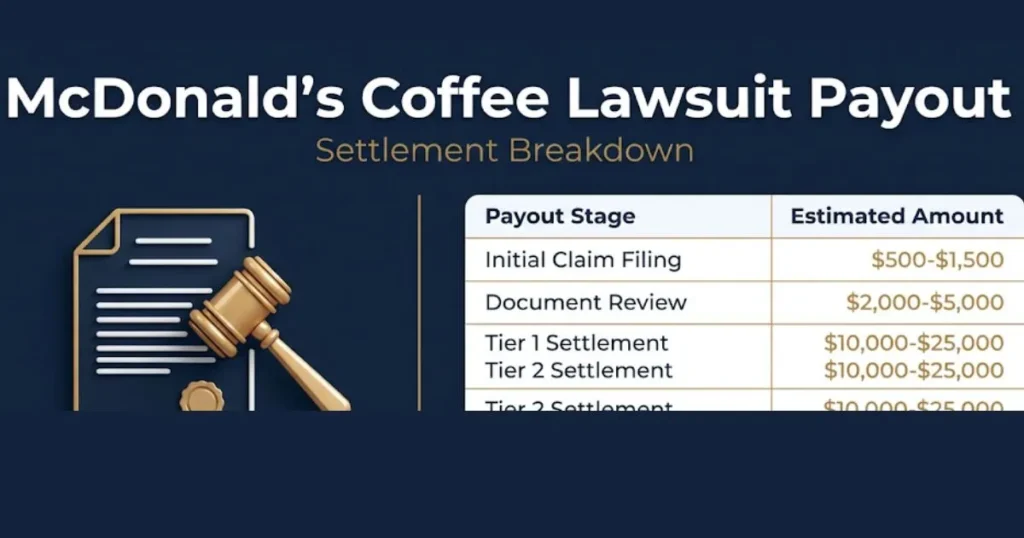
The original jury verdict of $2.86 million would be worth approximately $6.1 million in 2026 after adjusting for inflation using the Bureau of Labor Statistics Consumer Price Index.
| Amount (1994) | Inflation-Adjusted (2026) |
|---|---|
| $800 (McDonald’s offer) | Approximately $1,700 |
| $20,000 (Liebeck’s request) | Approximately $42,500 |
| $200,000 (compensatory damages) | Approximately $425,000 |
| $640,000 (judge’s reduced total) | Approximately $1.36 million |
| $2.86 million (jury verdict) | Approximately $6.1 million |
| $400,000 to $600,000 (est. settlement) | Approximately $850,000 to $1.27 million |
Even with inflation adjustment, Liebeck’s likely payout remains modest compared to modern product liability verdicts. In recent years, burn injury verdicts against corporations have regularly exceeded $5 million to $20 million when negligence is clearly established.
The fact that McDonald’s could have resolved the entire situation for the inflation-adjusted equivalent of $1,700 is still remarkable. Their refusal to pay a reasonable medical claim turned into a case that cost them millions in legal fees, public relations damage, and the verdict itself.
Key Takeaway: Adjusted for inflation, the McDonald’s coffee lawsuit payout would be worth roughly $850,000 to $1.27 million in 2026 dollars, still a modest amount given the severity of Liebeck’s injuries and McDonald’s documented negligence.
Can You Still Sue McDonald’s for Hot Coffee
Yes, you can still sue McDonald’s for hot coffee burns in 2026 if you suffer injuries due to unreasonably dangerous serving temperatures, defective cups, or failure to warn. The Liebeck case does not prevent new lawsuits.
Each burn injury case is evaluated on its own facts. To win a hot coffee burn lawsuit against McDonald’s or any restaurant, you generally need to prove these elements:
- Defective product or practice: The coffee was served at an unreasonably dangerous temperature
- Failure to warn: The cup or lid did not adequately warn about the burn risk
- Causation: The hot coffee directly caused your injuries
- Damages: You have documented medical injuries and expenses
Since 1994, several customers have filed burn lawsuits against McDonald’s and other fast food chains. Some have resulted in settlements, though most are resolved privately.
| Factor | What You Need |
|---|---|
| Evidence of Temperature | Receipt, witness testimony, or temperature measurement |
| Medical Documentation | Hospital records, burn unit reports, photos |
| Proof of Negligence | Coffee temperature above safe serving range |
| Statute of Limitations | Varies by state; typically 1 to 3 years from injury |
| Attorney | Product liability or personal injury lawyer |
The biggest challenge in 2026 is that McDonald’s now prints burn warnings on its cups. That warning makes it harder (but not impossible) to prove “failure to warn.” However, if the coffee is served at temperatures that cause instant third-degree burns, a warning label alone may not shield the company from liability.
Recent Hot Beverage Burn Lawsuits 2026
Recent hot beverage burn lawsuits in 2025 and 2026 show that coffee and tea burn injuries remain an active area of litigation against restaurants, coffee chains, and fast food companies.
In recent years, several notable cases have been filed or resolved:
- A Starbucks customer filed suit after a defective lid caused a hot tea spill that burned her lap and legs. The case settled for an undisclosed amount.
- Multiple Dunkin’ customers have filed burn claims related to cup and lid failures.
- A McDonald’s customer in Florida filed a lawsuit claiming coffee served through the drive-through was at an unsafe temperature and caused second-degree burns to her hand and wrist.
- Several hospital burn unit studies published in 2024 and 2025 documented ongoing scald burn admissions linked to fast food beverages.
| Chain | Recent Claim Type | Status |
|---|---|---|
| Starbucks | Defective lid, hot tea burn | Settled (undisclosed) |
| Dunkin’ | Cup failure, coffee burn | Active litigation |
| McDonald’s | Excessive temperature, drive-through burn | Filed 2024/2025 |
| Panera Bread | Hot beverage spill, burn injury | Settled 2023 |
The legal theory in most of these cases is the same as Liebeck’s: the beverage was served at an unreasonably dangerous temperature, and the company knew or should have known about the risk.
Burn injury attorneys report that hot beverage cases are among the most common product liability claims they handle. The pattern from the 1992 Liebeck incident has not gone away, even with better warning labels and slightly reduced temperatures.
Product Liability Lawsuits Against Fast Food
Product liability lawsuits against fast food companies cover a wide range of claims beyond hot coffee, including food contamination, allergen failures, foreign objects in food, and deceptive marketing practices.
In product liability law, a company can be held liable if its product is defective or unreasonably dangerous when it reaches the consumer. There are three main types of product liability claims:
- Design defect: The product was inherently dangerous as designed (e.g., coffee served at scalding temperatures)
- Manufacturing defect: Something went wrong during preparation (e.g., contaminated food)
- Marketing defect (failure to warn): The company did not adequately warn about risks (e.g., missing allergen labels)
Fast food companies face thousands of these claims every year. Most settle quietly.
| Claim Type | Example | Common Fast Food Defendants |
|---|---|---|
| Burn Injuries | Hot beverages, hot grease | McDonald’s, Starbucks, Dunkin’ |
| Foreign Objects | Metal, glass, or plastic in food | Various chains |
| Food Contamination | E. coli, Salmonella, Listeria | Chipotle, Subway, others |
| Allergen Failure | Peanut or dairy exposure | Multiple chains |
| Deceptive Marketing | False health claims | Subway (footlong case) |
The Liebeck case set an important precedent. It showed that juries will hold fast food corporations accountable when internal documents prove the company prioritized cost savings over customer safety.
If you were injured by a fast food product in 2026, product liability law likely provides a path to compensation. The key is documenting your injury, preserving the evidence, and acting within your state’s statute of limitations.
Key Takeaway: Product liability lawsuits against fast food chains remain common in 2026, covering everything from burn injuries to food contamination, and the legal principles established in the Liebeck case still guide how courts evaluate corporate responsibility.
How to File a Burn Injury Lawsuit
To file a burn injury lawsuit, you need documented medical evidence of your injuries, proof that the product or company caused the burn, and a personal injury or product liability attorney to handle the legal process.
Here is the general step-by-step process for filing a burn injury lawsuit in 2026:
Step 1: Get Medical Treatment Immediately.
Go to a hospital or burn center right away. Medical records from the day of injury are the strongest evidence in your case.
Step 2: Preserve Evidence.
Keep the product that caused the burn (cup, lid, container). Take photographs of your injuries. Save your receipt. Get contact information from any witnesses.
Step 3: Document Everything.
Write down exactly what happened while it’s fresh in your memory. Note the date, time, location, and names of any employees involved.
Step 4: Contact an Attorney.
Find a personal injury attorney who handles burn or product liability cases. Most work on contingency, meaning you pay nothing upfront.
Step 5: File the Claim.
Your attorney will file the complaint in the appropriate court, serve the defendant, and begin the discovery process.
| Step | Action | Why It Matters |
|---|---|---|
| 1 | Seek medical care | Creates official injury documentation |
| 2 | Preserve the product and receipt | Physical evidence supports your claim |
| 3 | Photograph injuries | Visual proof of damage |
| 4 | Hire an attorney | Legal expertise is needed for product liability cases |
| 5 | File within statute of limitations | Missing the deadline kills your case |
The statute of limitations for personal injury varies by state. Most states give you 1 to 3 years from the date of injury. Miss that window and your case is gone, no matter how strong the evidence.
Attorney fees in contingency cases typically run 33% to 40% of any settlement or verdict. You don’t pay if you don’t win.
Frequently Asked Questions
How much did Stella Liebeck get from McDonald’s?
Stella Liebeck’s exact settlement amount was never publicly disclosed.
The jury awarded $2.86 million, but the judge reduced it to $640,000, and the case then settled privately for an estimated $400,000 to $600,000.
After attorney fees, her take-home amount was likely between $250,000 and $350,000.
Was the McDonald’s coffee lawsuit thrown out?
No, the McDonald’s coffee lawsuit was not thrown out.
The case went to a full jury trial in August 1994, and the jury found McDonald’s liable.
The award was later reduced by the judge, but the verdict stood, and the case settled before appeal.
How hot was the coffee that burned Stella Liebeck?
McDonald’s served its coffee at 180 to 190 degrees Fahrenheit.
At that temperature, liquid causes third-degree burns in as little as 2 to 7 seconds of skin contact.
The ideal safe drinking temperature for coffee is between 120 and 140 degrees.
Can I sue McDonald’s if their coffee burns me in 2026?
Yes, you can file a burn injury lawsuit against McDonald’s in 2026 if their coffee causes you harm.
You will need medical records, evidence of the coffee’s temperature, and proof that the company was negligent.
Each state has its own statute of limitations, typically 1 to 3 years from the date of injury.
What did McDonald’s change after the coffee lawsuit?
McDonald’s reportedly lowered its coffee serving temperature by about 10 degrees and added more prominent warning labels to its cups.
However, independent tests show McDonald’s coffee is still served hotter than most competitors.
The company never publicly admitted fault or issued a formal temperature policy change.
The McDonald’s coffee lawsuit payout story is about corporate accountability, not a frivolous cash grab. Stella Liebeck suffered real injuries because a company chose profits over safety.
If you’ve been burned by an unreasonably hot beverage, the law may be on your side. Document your injury, save the evidence, and speak with a product liability attorney.
This case changed how Americans think about consumer rights. Thirty years later, the facts still matter more than the myths.







