

An MDL lawsuit is a federal legal tool that groups hundreds or thousands of similar cases before one judge for pretrial work. If you’ve been hurt by a defective product, dangerous drug, or toxic chemical, there’s a good chance your case falls under one of these consolidated actions.
In 2026, more than 180,000 pending cases sit in active MDL dockets across the country. That number keeps climbing. From PFAS contamination to social media harm claims, new MDLs are forming while older ones push toward settlement.
This guide breaks down how MDL litigation works, who qualifies, what settlements and payouts look like, and which cases matter most in 2026. You’ll get specific numbers, real deadlines, and practical steps.
Whether you’re already part of an MDL or just learning the term for the first time, this is the only resource you need.
What Is an MDL Lawsuit
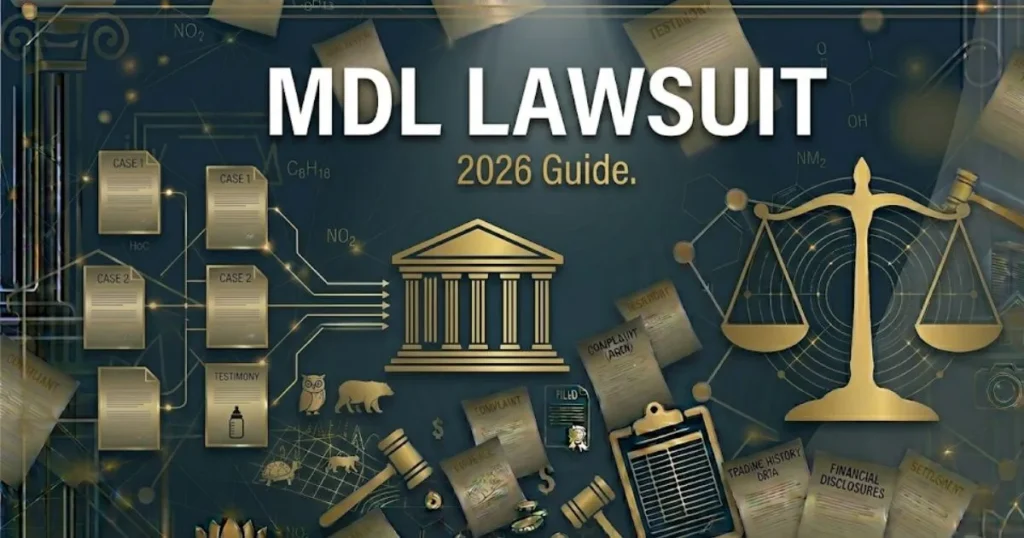
An MDL lawsuit is a type of federal court proceeding where similar individual cases are grouped together for pretrial handling. MDL stands for multidistrict litigation. It exists to prevent dozens of federal judges from ruling differently on the same evidence.
When many people file lawsuits against the same defendant for the same reason, a special judicial panel can transfer those cases to a single court. That court handles all the shared pretrial work: discovery, depositions, expert testimony, and motions.
Each person in the MDL still has their own individual case. You don’t give up your rights when your lawsuit gets transferred. If the cases don’t settle, they get sent back to their original courts for trial.
Think of it like sorting mail at a central hub. All the packages go to one place for processing, then get delivered to their final destination.
| Detail | Info |
|---|---|
| Full Name | Multidistrict Litigation |
| Governed By | 28 U.S.C. Section 1407 |
| Purpose | Consolidate pretrial proceedings |
| Individual Rights | Preserved for each plaintiff |
| Where Cases Go | Single federal “transferee” court |
The MDL system handles roughly 50% of all pending federal civil cases as of early 2026. That’s a staggering share of the federal docket.
MDL Lawsuit Meaning
The term MDL lawsuit means a lawsuit that has been consolidated with other similar federal cases for coordinated pretrial proceedings. The “multidistrict” part refers to the fact that these cases come from multiple federal court districts across the country.
Congress created this system in 1968 through 28 U.S.C. Section 1407. The original motivation was asbestos litigation, where thousands of similar claims were clogging courts nationwide.
The word “litigation” here covers everything from initial filings through discovery and motions practice. It does not automatically mean trial. Most MDL cases resolve through settlement negotiations that happen during the pretrial phase.
Here’s what matters: the MDL label doesn’t change the substance of your claim. It’s a procedural tool. Your injuries, your damages, and your right to a fair outcome remain the same.
- Multi = many cases from many courts
- District = federal court districts across the U.S.
- Litigation = the legal proceedings themselves
People sometimes confuse MDL with class action lawsuits. They’re different animals entirely, and we’ll cover that distinction in detail below.
How Does MDL Litigation Work
MDL litigation works by transferring similar federal lawsuits to one judge who manages all shared pretrial tasks. The Judicial Panel on Multidistrict Litigation, known as the JPML, decides when and where to consolidate cases.
The process starts when enough similar cases pile up in different courts. Any party, or even the JPML itself, can request consolidation. The panel holds a hearing, reviews the cases, and decides whether transfer makes sense.
Once consolidated, a single judge oversees everything that happens before trial. That includes:
- Discovery: Both sides exchange evidence, documents, and data
- Depositions: Witnesses and experts give sworn testimony
- Daubert hearings: The judge rules on whether expert testimony is admissible
- Motions: Summary judgment, dismissal, and procedural motions get decided
- Settlement talks: Mediation and negotiation happen under the transferee judge’s supervision
If the MDL doesn’t produce a global settlement, individual cases get “remanded” back to their original courts for trial. In practice, most MDLs settle before that happens.
The transferee judge also appoints a Plaintiffs’ Steering Committee. This small group of experienced attorneys makes strategic decisions for the whole plaintiff group. They pick bellwether cases, coordinate discovery, and negotiate with defendants.
Key Takeaway: An MDL lawsuit consolidates similar federal cases before one judge for pretrial work, but every plaintiff keeps their individual case and legal rights intact.
MDL Lawsuit Process
The MDL lawsuit process follows a predictable series of steps from initial filing through resolution. Most cases move through these stages over a period of two to five years.
Here’s the step-by-step breakdown:
| Stage | What Happens | Typical Duration |
|---|---|---|
| 1. Filing | Individual lawsuits filed in federal courts | Ongoing |
| 2. JPML Motion | Party requests consolidation | 1 to 3 months |
| 3. Transfer Order | JPML transfers cases to one judge | 1 to 2 months |
| 4. Steering Committee | Judge appoints lead plaintiff attorneys | 1 to 3 months |
| 5. Master Complaint | Unified complaint filed on behalf of all plaintiffs | 2 to 4 months |
| 6. Discovery | Evidence exchange, depositions, document review | 12 to 24 months |
| 7. Daubert Hearings | Judge rules on expert testimony admissibility | 3 to 6 months |
| 8. Bellwether Trials | Test cases go to trial | 6 to 12 months |
| 9. Settlement or Remand | Cases settle globally or return to original courts | Varies widely |
Not every MDL hits all nine stages. Some settle quickly after discovery reveals damaging evidence. Others drag on for years through bellwether trials and appeals.
Your role as a plaintiff during most of this process is limited. Your attorney handles filings and strategy. You may need to provide medical records, purchase receipts, or give a deposition.
The biggest variable is timing. Complex pharmaceutical MDLs with scientific disputes often take longer than product liability cases with clear defect evidence.
MDL vs Class Action Lawsuit
An MDL and a class action lawsuit are two different legal mechanisms, even though people mix them up constantly. The core difference is that MDL plaintiffs are individuals with separate cases, while class action members are treated as one group.
| Feature | MDL Lawsuit | Class Action |
|---|---|---|
| Individual claims | Yes, each person has their own case | No, one case represents everyone |
| Separate settlements | Possible, based on individual harm | One settlement covers the whole class |
| Opt-in required | Yes, you must file your own lawsuit | Usually opt-out (you’re included unless you leave) |
| Court level | Federal courts only | Federal or state courts |
| Pretrial consolidation | Yes, for efficiency | Not applicable in the same way |
| Trial rights | Each case can go to trial individually | Class representatives go to trial for everyone |
| Payout variation | Payouts differ based on individual damages | Same payout for all class members (usually) |
Here’s the simplest way to think about it. A class action is like everyone riding the same bus. An MDL is like everyone driving their own car on the same highway, following the same traffic rules.
In an MDL, your compensation depends on your specific injuries and evidence. One plaintiff might receive $500,000 while another gets $50,000 in the same MDL. That doesn’t happen in a typical class action where everyone gets the same check.
If your injuries are serious or unique, an MDL usually works more in your favor than a class action.
How to Join an MDL Lawsuit
You join an MDL lawsuit by filing your own individual federal lawsuit, which then gets transferred into the consolidated MDL. You cannot simply “sign up” for an MDL the way you join a class action.
The process works like this:
- Step 1: Contact an attorney who handles the specific type of case covered by the MDL
- Step 2: Your attorney files a complaint in federal court on your behalf
- Step 3: The JPML issues a conditional transfer order moving your case to the MDL court
- Step 4: Your case becomes part of the MDL for pretrial proceedings
You need a lawyer for this. MDL cases involve complex federal procedure, coordinated discovery, and strategic decisions that require experienced mass tort counsel.
Most mass tort attorneys work on contingency. That means you pay nothing upfront. They collect a percentage of your settlement or verdict, typically 30% to 40%.
Timing matters. Some MDLs have practical filing deadlines even if the statute of limitations hasn’t technically expired. Waiting too long can mean missing out on bellwether trial selection or early settlement rounds.
The best time to file is as soon as you realize you’ve been harmed by a product, drug, or situation that’s already the subject of an MDL.
Key Takeaway: You join an MDL by filing your own federal lawsuit through an attorney; there’s no sign-up form, and most mass tort lawyers charge nothing unless you win.
MDL Lawsuit Eligibility
MDL lawsuit eligibility depends on whether your claim involves the same defendant, the same product or issue, and the same type of harm as the other cases in the MDL. There’s no universal checklist because each MDL targets a specific problem.
General eligibility factors include:
- You used or were exposed to the product, drug, device, or substance at issue
- You suffered harm that is consistent with the claims in the MDL (injury, illness, financial loss)
- Your case falls within the statute of limitations for your state
- Your claim involves federal jurisdiction (diversity of citizenship or federal question)
| MDL Type | Who Typically Qualifies |
|---|---|
| Pharmaceutical | Patients who took the drug and experienced specific side effects |
| Medical Device | Patients implanted with or using the device who had complications |
| Product Liability | Consumers who purchased and were harmed by a defective product |
| Environmental/Toxic Tort | Residents or workers exposed to contamination |
| Data Breach/Privacy | Individuals whose personal data was compromised |
Some MDLs set up census registries where potential plaintiffs register their claims. Others use “short form complaints” that simplify the filing process.
The most important thing is documentation. Medical records, purchase receipts, employment records, and any evidence connecting you to the product and the harm will strengthen your eligibility.
MDL Lawsuit Settlement
An MDL lawsuit settlement is an agreement between the defendant and a group of plaintiffs to resolve claims without going to full trial. Most MDLs end in settlement because the cost and risk of trying thousands of individual cases would be enormous for both sides.
Settlements in MDLs can take two forms:
- Global settlement: The defendant offers a total dollar amount to resolve all or most claims in the MDL
- Individual settlements: Specific plaintiffs negotiate their own deals based on the strength of their evidence
In a global settlement, a claims administrator typically creates a points-based system. Your payout depends on factors like injury severity, duration of exposure, medical costs, and supporting documentation.
Here’s a simplified example of how a tiered settlement might work:
| Injury Tier | Description | Estimated Payout Range |
|---|---|---|
| Tier 1 | Minor injury, short-term harm | $5,000 to $25,000 |
| Tier 2 | Moderate injury, ongoing treatment | $25,000 to $150,000 |
| Tier 3 | Severe injury, permanent damage | $150,000 to $500,000 |
| Tier 4 | Catastrophic injury or death | $500,000 to $2,000,000+ |
Not every plaintiff in an MDL has to accept the settlement. You can reject it and take your individual case to trial. But doing so means more time, more risk, and more expense.
Settlement funds are usually distributed after a court-supervised claims process. Expect to wait 6 to 18 months after settlement approval before receiving payment.
MDL Lawsuit Payout
MDL lawsuit payouts vary dramatically depending on the case, the injuries, and the evidence. There is no standard payout for all MDL plaintiffs. Some people receive a few thousand dollars, while others collect millions.
The factors that determine your individual payout include:
- Severity of injury: More serious harm equals higher compensation
- Strength of evidence: Medical records, expert opinions, and documentation matter
- Duration of exposure or use: Longer exposure often means higher damages
- Economic losses: Lost wages, medical bills, and out-of-pocket costs
- Non-economic damages: Pain, suffering, and diminished quality of life
| MDL Case Example | Average Payout Range | Highest Known Awards |
|---|---|---|
| 3M Earplug | $50,000 to $300,000 | Over $7.1 million (individual verdict) |
| Roundup Herbicide | $100,000 to $2 million | $2.25 billion (jury verdict, later reduced) |
| Talcum Powder | $50,000 to $700,000 | $4.69 billion (jury verdict, overturned) |
| AFFF/PFAS Water | TBD (ongoing) | Municipal settlements: $10 billion+ (aggregate) |
Attorney fees reduce your take-home amount. Most contingency agreements take 33% to 40% of the gross settlement. Court costs and case expenses are deducted separately.
Some MDLs use lien resolution programs to handle Medicare and Medicaid repayment obligations. If the government paid for treatment related to your injury, those costs get subtracted from your payout before you receive it.
Key Takeaway: MDL payouts depend entirely on your individual injuries and evidence; severe harm with strong documentation leads to the highest compensation.
MDL Lawsuit Timeline
An MDL lawsuit timeline typically spans two to five years from consolidation to settlement. Some complex cases stretch beyond a decade. Speed depends on the number of plaintiffs, the complexity of the science, and the defendant’s willingness to negotiate.
Here’s a realistic timeline for a mid-sized MDL:
| Phase | Estimated Time After Consolidation |
|---|---|
| JPML Transfer | Month 0 |
| Steering Committee Appointed | Months 1 to 3 |
| Initial Discovery | Months 3 to 18 |
| Daubert Hearings | Months 18 to 24 |
| Bellwether Trials | Months 24 to 36 |
| Settlement Negotiations | Months 30 to 48 |
| Claims Processing | Months 48 to 60 |
| Payout Distribution | Months 54 to 72 |
Some MDLs move faster. The 3M earplug MDL, one of the largest in history, went from formation in 2019 to a $6.01 billion settlement announced in 2023, with payments beginning in 2024 and continuing into 2026.
Others move much slower. The Roundup MDL has been active since 2016, with ongoing litigation in 2026 despite Bayer setting aside more than $16 billion for settlements.
Your personal timeline also matters. If you file early in the MDL’s life, you may wait longer for resolution. If you file after bellwether trials have already occurred, the path to settlement can be shorter.
Patience is part of the process. But staying in contact with your attorney and responding quickly to document requests can prevent unnecessary delays.
MDL Bellwether Trial
An MDL bellwether trial is a test case selected from the larger pool of consolidated lawsuits to go to trial first. The outcome helps both sides gauge the strength of their arguments and informs settlement negotiations.
The word “bellwether” comes from shepherding. The bellwether sheep wears a bell and leads the flock. In legal terms, bellwether trials lead the way for thousands of other cases.
Here’s how bellwether selection works:
- The transferee judge and attorneys from both sides pick a small group of representative cases
- These cases reflect different injury types, evidence levels, and plaintiff demographics
- Typically 10 to 30 cases are selected, and 3 to 6 go to trial
| Bellwether Outcome | What It Means for the MDL |
|---|---|
| Plaintiff wins big verdict | Pressure on defendant to settle for higher amounts |
| Defendant wins | Pressure on plaintiffs to accept lower settlement offers |
| Mixed results | Both sides use results to negotiate middle-ground settlement |
Bellwether verdicts are not binding on other plaintiffs. Your case doesn’t automatically win or lose based on the bellwether outcome. But the results heavily influence how much money ends up on the settlement table.
In the 3M earplug MDL, plaintiffs won 10 out of 16 bellwether trials before the global settlement was reached. Those jury verdicts ranged from $1.7 million to $77.5 million.
If your case is selected as a bellwether, your attorney will prepare it for a full trial. That means more work for you, including depositions and court appearances. But being a bellwether plaintiff can sometimes lead to a faster, larger individual settlement.
JPML MDL Transfer
The JPML MDL transfer is the formal process by which the Judicial Panel on Multidistrict Litigation moves similar cases from multiple federal courts to one transferee court. The JPML is the gatekeeper of the entire MDL system.
The panel consists of seven federal judges appointed by the Chief Justice of the United States. They meet roughly every two months at different locations around the country to hear transfer motions.
To grant a transfer, the JPML must find two things:
- Common questions of fact exist across the cases
- Transfer will promote convenience and efficiency for the parties and witnesses
| JPML Fact | Detail |
|---|---|
| Panel Size | 7 federal judges |
| Governing Statute | 28 U.S.C. Section 1407 |
| Meeting Frequency | Approximately every 2 months |
| Power | Can transfer and consolidate; cannot try cases |
| 2025 Active MDLs | Over 190 active MDL dockets |
The JPML chooses the transferee court based on several factors: where most cases are filed, the experience of available judges, and logistical convenience. Popular transferee courts include the Eastern District of Pennsylvania, Northern District of California, and Southern District of New York.
As of early 2026, the JPML has been especially active with new transfers involving PFAS contamination, social media youth harm, hair relaxer products, and artificial intelligence data scraping. These emerging categories reflect shifting consumer safety concerns.
Once your case is transferred, it stays with the MDL judge for all pretrial work. The transfer is usually automatic through a conditional transfer order, though you have the right to object.
Key Takeaway: The JPML is the seven-judge panel that decides which cases get consolidated into MDLs, where they go, and when; its transfer decisions shape the entire trajectory of mass tort litigation.
Active MDL Lawsuits 2026
Active MDL lawsuits in 2026 span a wide range of products, chemicals, and corporate conduct. The federal court system is managing more than 190 active MDL dockets, with some containing tens of thousands of individual cases.
Here are the most significant active MDLs as of 2026:
| MDL Name | Court | Pending Cases (Est.) | Status |
|---|---|---|---|
| AFFF/PFAS Water Contamination | D. South Carolina | 9,000+ | Settlement in progress for public water suppliers; individual claims ongoing |
| Social Media Youth Harm | N.D. California | 5,000+ | Discovery phase; bellwether selection underway |
| Hair Relaxer Products | N.D. Illinois | 8,000+ | Daubert hearings expected mid-2026 |
| Tylenol/Acetaminophen (Prenatal) | S.D. New York | 1,000+ | Daubert ruling partially unfavorable; appeals pending |
| Philips CPAP | W.D. Pennsylvania | 800+ | Settlement discussions ongoing |
| Camp Lejeune Water | E.D. North Carolina | 3,000+ (CLJA claims) | Administrative claim process; trials starting |
| Zantac/Ranitidine | S.D. Florida | Remanded/State court | Federal MDL largely dismissed; state court cases continue |
| NEC Baby Formula | N.D. Illinois | 1,500+ | Bellwether trials expected late 2026 |
The AFFF/PFAS MDL is one of the most closely watched. In 2023, a $10.3 billion settlement was reached with public water systems, but individual personal injury claims from firefighters and residents are still being litigated.
The social media MDL involving Meta, TikTok, Snapchat, and other platforms is relatively new but growing fast. Schools and parents across the country are filing claims alleging platforms caused mental health harm to minors.
New MDL petitions are expected throughout 2026 for emerging issues including AI-generated content harms and contaminated dietary supplements.
MDL Lawsuit Update 2026
The latest MDL lawsuit updates for 2026 show several major cases reaching critical stages while new ones form. This year is shaping up to be one of the most active in MDL history.
Key developments to watch:
- Hair Relaxer MDL (MDL No. 3060): Judge Mary Rowland in the Northern District of Illinois is expected to rule on Daubert motions by mid-2026. If plaintiff experts survive these challenges, settlement pressure on L’Oreal, Revlon, and other defendants will increase significantly.
- Social Media Youth Harm MDL (MDL No. 3047): Judge Yvonne Gonzalez Rogers is overseeing discovery. Bellwether case selection is anticipated in the first half of 2026. Internal documents from Meta and other platforms are expected to become public during this phase.
- AFFF/PFAS MDL (MDL No. 2873): Individual personal injury claims from firefighters are progressing toward bellwether trials. Judge Richard Gergel continues to manage the massive docket in South Carolina.
- NEC Baby Formula MDL (MDL No. 3026): Trials involving Abbott Laboratories and Mead Johnson are expected in late 2026. These cases allege that cow’s milk-based formula caused necrotizing enterocolitis in premature infants.
- Camp Lejeune: While technically handled under the Camp Lejeune Justice Act rather than a traditional MDL, thousands of claims are being processed through the Eastern District of North Carolina with trials starting in 2026.
| Case | 2026 Milestone |
|---|---|
| Hair Relaxer | Daubert rulings expected mid-2026 |
| Social Media | Bellwether selection, early to mid-2026 |
| AFFF/PFAS | Individual injury bellwether trials |
| NEC Baby Formula | First trials expected late 2026 |
| Camp Lejeune | Trial track begins |
Stay in touch with your attorney if you have a case in any of these MDLs. Deadlines for submitting documentation and short form complaints can change quickly.
Largest MDL Lawsuits
The largest MDL lawsuits in U.S. history have produced some of the biggest settlements ever recorded. These cases reshaped entire industries and changed how companies approach product safety.
| MDL Case | Total Settlement Value | Approximate Plaintiff Count |
|---|---|---|
| 3M Combat Arms Earplugs | $6.01 billion | 250,000+ |
| Roundup Herbicide (Bayer) | $16+ billion (and counting) | 100,000+ |
| Opioid Litigation | $50+ billion (combined) | Thousands of government entities |
| BP Deepwater Horizon | $20.8 billion | 130,000+ claimants |
| Vioxx (Merck) | $4.85 billion | 50,000+ |
| Volkswagen Diesel Emissions | $14.7 billion | 475,000+ vehicles |
The opioid MDL stands as the most far-reaching in terms of total dollars. Multiple manufacturers, distributors, and pharmacy chains have collectively committed more than $50 billion in settlements with state governments, counties, cities, and tribal nations.
The 3M earplug MDL holds the record for the most individual cases ever consolidated. At its peak, more than 300,000 claims were pending. The $6.01 billion settlement announced in 2023 is being distributed through 2026.
What makes these cases significant isn’t just the money. They forced companies to change products, reformulate chemicals, and implement safety warnings. The Roundup litigation led Bayer to announce it would remove glyphosate from residential products by 2023.
Size alone doesn’t determine whether an MDL succeeds. The quality of scientific evidence, the skill of lead counsel, and the rulings of the transferee judge matter just as much.
Key Takeaway: The largest MDL lawsuits have recovered tens of billions of dollars and driven real changes in product safety, proving that consolidated litigation can hold even the biggest corporations accountable.
MDL Lawsuit Examples
MDL lawsuit examples cover nearly every area of consumer harm, from defective medical devices to contaminated drinking water. Looking at real cases helps you understand how the system works in practice.
Pharmaceutical MDL Example: Zantac (Ranitidine)
Plaintiffs alleged that the heartburn drug Zantac contained a carcinogen called NDMA. The MDL was centralized in the Southern District of Florida under Judge Robin Rosenberg. In late 2022, the judge excluded plaintiffs’ expert testimony on general causation and dismissed most federal claims. Many plaintiffs shifted to state court litigation, which continues in 2026.
Medical Device MDL Example: Philips CPAP
Philips recalled millions of CPAP and BiPAP machines in 2021 due to degrading sound abatement foam. Plaintiffs allege the foam released toxic particles and gases. The MDL is pending in the Western District of Pennsylvania. Settlement discussions are active in 2026, with affected users seeking compensation for cancer, respiratory injuries, and economic losses.
Environmental MDL Example: AFFF/PFAS
Firefighters and communities filed claims over PFAS contamination from aqueous film-forming foam used at military bases and airports. The MDL in South Carolina has produced a $10.3 billion settlement for public water systems and is moving toward individual personal injury trials.
Consumer Product MDL Example: Hair Relaxer
Women who used chemical hair straightening products filed claims alleging links to uterine cancer, endometrial cancer, and other reproductive harms. The MDL in the Northern District of Illinois is in its discovery and Daubert phase in 2026.
Each of these examples follows the same basic MDL structure but involves completely different products, injuries, and legal theories. The common thread is that many people were harmed by the same thing.
Benefits of MDL Lawsuit
The benefits of an MDL lawsuit include efficiency, reduced costs, stronger negotiating power, and access to experienced attorneys. For individual plaintiffs, MDL consolidation often means a better outcome than going it alone.
Here are the specific advantages:
- Shared discovery costs: Millions of dollars in legal research, expert witnesses, and document review are split across all cases
- Experienced lead counsel: The best mass tort attorneys in the country are appointed to lead the litigation
- Coordinated strategy: Instead of thousands of attorneys working in isolation, one unified team builds the strongest possible case
- Judicial efficiency: One judge becomes an expert on the issues, leading to faster and more consistent rulings
- Settlement leverage: Defendants face pressure from the sheer volume of claims, making settlement more attractive than fighting every case individually
| Benefit | How It Helps You |
|---|---|
| Lower cost | You don’t pay for discovery out of pocket |
| Better attorneys | Top lawyers are selected to lead your case |
| Stronger evidence | Shared research produces better expert testimony |
| Faster resolution | Coordinated process avoids duplicated work |
| Higher payouts | Volume creates negotiating leverage for bigger settlements |
The MDL system isn’t perfect. Your case may get less individual attention than a standalone lawsuit. You rely on lead counsel to make strategic decisions that affect everyone. And the timeline can stretch for years.
But for most people, especially those with moderate claims who couldn’t afford to hire a top attorney individually, the MDL structure provides access to justice they wouldn’t otherwise have.
It’s like the difference between one person shouting at a corporation and ten thousand people speaking through a coordinated legal team. The volume changes the conversation.
Key Takeaway: MDL lawsuits give individual plaintiffs the power of collective legal action while preserving their right to individual compensation based on their specific injuries.
Frequently Asked Questions
What is the difference between an MDL lawsuit and a class action?
In an MDL, each plaintiff keeps their own individual case with separate damages.
In a class action, one or a few plaintiffs represent the entire group, and everyone gets the same outcome.
MDL plaintiffs can receive different payout amounts based on their specific injuries and evidence.
How long does an MDL lawsuit take to settle?
Most MDL lawsuits take two to five years from consolidation to settlement.
Complex cases involving scientific disputes or massive plaintiff counts can take longer.
The 3M earplug MDL took roughly four years from formation to global settlement announcement.
How much money can you get from an MDL lawsuit?
Payouts range from a few thousand dollars to several million, depending on injury severity.
Tier-based settlement systems assign point values to different types and levels of harm.
Attorney fees, typically 33% to 40%, are deducted before you receive your share.
Can I still join an MDL lawsuit in 2026?
Yes, many active MDLs are still accepting new cases in 2026.
You need to file an individual federal lawsuit through a qualified mass tort attorney.
Check statutes of limitations in your state because waiting too long could bar your claim.
What happens to my case after an MDL bellwether trial?
Bellwether trial results influence settlement negotiations but do not decide your individual case.
If a global settlement is reached, you’ll be offered a payout based on your claim’s tier.
If no settlement happens, your case gets sent back to your original court for a separate trial.
This is a year that could reshape the MDL system. With hair relaxer trials, social media bellwethers, and PFAS personal injury claims all advancing through 2026, there’s never been a more active time for multidistrict litigation.
If you think you qualify for an active MDL, reach out to a mass tort attorney now. Document your injuries, gather your records, and get your case on file before deadlines pass.
The system is built to help people like you. Use it.







