

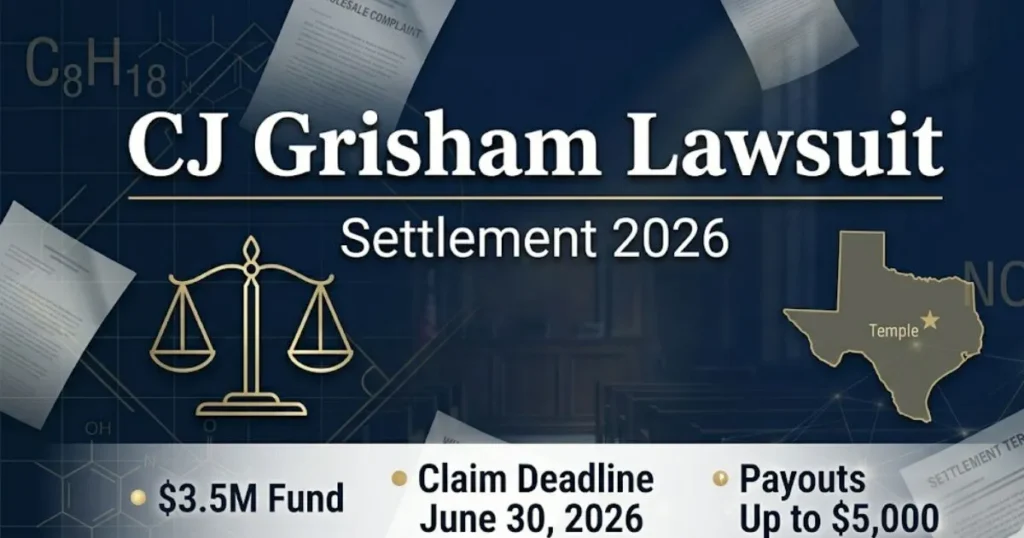
The CJ Grisham lawsuit ended with a final $3.5 million class action settlement in early 2026. If you were arrested or detained by Temple police for openly carrying a firearm during the class period, you can now file a claim for a cash payment. The deadline to do that is June 30, 2026.
This case began with an Army veteran’s arrest during a hike with his son. It grew into a major civil rights fight that tested open carry rights in Texas. Now it is a settlement fund that will pay people who had similar experiences.
This article explains exactly who qualifies, how much money you might receive, and how to file your claim before the deadline. You will also find a complete timeline, a breakdown of required proof, and answers about taxes and attorney representation.
More than 800 people are expected to receive checks from this settlement. Average payments will range from a few hundred dollars to several thousand, depending on the specifics of each arrest.
CJ Grisham Lawsuit Settlement 2026
The CJ Grisham lawsuit settlement in 2026 provides a $3.5 million fund to resolve a class action against the City of Temple, Texas, and several police officers. The money is meant to compensate people whose constitutional rights were violated during open carry arrests.
The settlement received final approval from U.S. District Judge Alan D. Albright on January 15, 2026. This approval came after years of litigation that included a pivotal Fifth Circuit ruling in 2019. The court found that CJ Grisham had a valid First Amendment retaliation claim and that officers lacked probable cause to arrest him under Texas law at the time.
The settlement fund covers all valid claims, class representative service awards, attorney fees, and administration costs. The net amount available for class members after deductions is roughly $2.2 million. Payments will be distributed based on a tiered system that considers the duration of detention, whether charges were filed, and the extent of harm each class member suffered.
The settlement does not require the City of Temple to admit liability. However, the city agreed to revise its officer training on First Amendment activities and open carry encounters. That policy change went into effect in February 2026.
Key Takeaway: A $3.5 million settlement is now final, and money is available for eligible class members who act before the claim deadline.
CJ Grisham v City of Temple Class Action
CJ Grisham v City of Temple is a certified class action lawsuit filed in the Western District of Texas under case number 1:14-cv-00867. The class action status means the case represents not just Grisham but a defined group of individuals who experienced similar treatment by Temple police.
The class definition includes all persons who were arrested or detained by officers of the Temple Police Department for openly carrying a firearm in public between January 1, 2013, and December 31, 2015. The class specifically includes people whose charges were later dismissed, who were acquitted at trial, or who were convicted but had their convictions overturned on appeal.
You do not need to have been a member of Open Carry Texas to be part of the class. The class covers anyone who interacted with Temple police under the circumstances described in the settlement agreement, regardless of organizational affiliation.
The court appointed CJ Grisham as the class representative. His experiences, from the initial traffic stop to the retaliation he faced after complaining, formed the factual core of the litigation. The certified class allows the settlement to resolve claims for hundreds of people at once rather than requiring each person to file a separate lawsuit.
| Class Detail | Information |
|---|---|
| Court | U.S. District Court, Western District of Texas |
| Case Number | 1:14-cv-00867 |
| Class Period | January 1, 2013 to December 31, 2015 |
| Class Representative | CJ Grisham |
| Settlement Fund Total | $3,500,000 |
CJ Grisham Lawsuit Payout Per Person
Payout amounts in the CJ Grisham lawsuit settlement vary based on a points system outlined in the distribution plan. The estimated payout per person ranges from $50 to $5,000, with most class members falling in the middle.
The claims administrator, Epiq Class Action & Claims Solutions, assigns points to each claim. Points are awarded based on three factors. First, whether you were merely detained or actually arrested and booked. Second, the length of time you were held. Third, whether you suffered additional harm such as property loss, missed work, or physical injury during the encounter.
A person who was stopped and detained for less than an hour with no formal charges will typically receive between $50 and $300. Someone who was arrested, held overnight, and had to hire a lawyer may receive $800 to $2,000. Class members who spent multiple days in jail and faced extended court proceedings may receive up to $5,000.
The exact dollar-per-point value cannot be calculated until all claims are submitted. Once the claims period closes, the administrator totals all approved points and divides the net settlement fund by that total. That is why final payout amounts are estimates until distribution occurs.
A claim for a short detention with no arrest might look like this.
| Scenario | Estimated Payout Range |
|---|---|
| Detained less than one hour, no charges filed | $50 to $300 |
| Arrested, booked, held less than 24 hours | $500 to $1,200 |
| Arrested, held 24 to 48 hours, criminal charges filed | $1,200 to $2,500 |
| Multiple days in custody, conviction overturned | $2,500 to $5,000 |
Key Takeaway: Payouts are not flat; they depend on what happened to you. The more significant the harm, the larger the check.
CJ Grisham Lawsuit Eligibility
Eligibility for the CJ Grisham lawsuit settlement is defined strictly by the court-approved class definition. You must have been arrested or detained by a Temple, Texas police officer for openly carrying a firearm during the class period of January 1, 2013 through December 31, 2015.
The open carry act itself is the key. Texas law at the time prohibited the open carry of handguns, but the law on long guns was less settled. Many people, including Grisham, carried rifles openly as a form of protest and political expression. Temple police interpreted those actions as disorderly conduct or interference with public duties. If that describes your encounter, you likely meet the basic eligibility requirement.
A conviction alone does not automatically exclude you. If your conviction was later overturned on appeal, or if you received a pardon, you are still eligible. The settlement covers people whose charges were dismissed, who were found not guilty, or whose cases were resolved without a final conviction that remains on their record.
People who were only issued a citation without physical detention are not covered by the settlement. The class definition requires some form of restraint on your liberty, meaning handcuffing, being placed in a patrol car, or being taken to a police station. A simple ticket with no further restraint does not qualify.
- Arrested or physically detained by Temple police
- Reason for detention was openly carrying a firearm
- Incident occurred between January 1, 2013 and December 31, 2015
- Criminal case ended without a final standing conviction
Open Carry Lawsuit 2026
The open carry lawsuit in 2026 refers specifically to the Grisham class action, but it also sits within a broader movement of legal challenges that reshaped Texas gun laws. This settlement arrives a decade after open carry of handguns became legal in Texas in 2016, a change many advocates tie directly to cases like Grisham’s.
The lawsuit was never just about one man. It challenged the pattern of Temple police stopping, detaining, and charging people who were exercising what they believed to be their legal right to carry long guns in public. The Fifth Circuit’s 2019 ruling made clear that openly carrying a rifle for political expression is protected First Amendment activity, and arresting someone in retaliation for that expression violates clearly established law.
The 2026 settlement brings that legal principle into a concrete fund. It is one of the first large class action settlements to pay money directly to individuals whose gun rights demonstrations led to arrest. For communities that have followed open carry activism, the settlement is a significant marker.
The City of Temple did not fight the settlement at the final approval hearing. City officials stated that the revised training protocols and the settlement resolution allow the community to move forward without additional litigation costs. For class members, the resolution finally puts cash in their pockets.
Key Takeaway: The 2026 open carry settlement turns a decade-old constitutional fight into real compensation for hundreds of affected people.
How to File a Claim for CJ Grisham Settlement
Filing a claim for the CJ Grisham settlement requires completing a claim form and submitting proof of your arrest or detention. The process is paper-based and handled entirely through the settlement administrator, not the court or the city.
You can obtain the claim form by contacting Epiq Class Action & Claims Solutions at the toll-free number listed on the official settlement notice or by requesting a form by mail. The form asks for your full name, contact information, the date of the incident, and a description of what happened.
The most critical part is the proof requirement. You must attach documentation that verifies you were detained or arrested by Temple police for open carry during the class period. Acceptable documents include a copy of the police report, arrest record, booking sheet, court docket showing the charge and disposition, or a letter from the district attorney’s office confirming dismissal.
You do not need a lawyer to file a claim. The form is designed for self-representation. However, if you have difficulty obtaining your records, you can ask the administrator for assistance in verifying your class membership through police department databases that are part of the settlement’s discovery materials.
- Request a claim form from Epiq Class Action & Claims Solutions
- Complete all sections with your personal information and arrest details
- Attach proof such as a police report, arrest record, or court disposition
- Mail the completed form and documents to the address on the form
- Ensure your envelope is postmarked by June 30, 2026
CJ Grisham Lawsuit Deadline
The deadline to file a claim in the CJ Grisham lawsuit settlement is June 30, 2026. This is a hard postmark deadline with no extensions.
If you want to receive money from the settlement fund, your claim form and supporting documents must be postmarked on or before that date. Late claims will be rejected by the administrator, and you will lose your right to any payment. There is no hardship exception and no option to file electronically after the deadline.
In addition to the claim filing deadline, there are two other important dates. The deadline to opt out of the settlement and preserve your right to sue individually was March 2, 2026. That date has already passed. If you did not opt out, you are bound by the settlement terms and cannot file a separate lawsuit over the same incident. The deadline to object to the settlement also passed in March 2026.
Because the opt-out period has ended, the only action that remains for class members who want compensation is to submit a completed claim form by June 30. The settlement website provides a downloadable calendar reminder and a checklist to help you meet the deadline.
| Key Date | Action |
|---|---|
| March 2, 2026 | Deadline to opt out or object (passed) |
| June 30, 2026 | Claim form postmark deadline |
| Late 2026 | Distribution of settlement checks begins |
Key Takeaway: June 30, 2026 is the final day to mail your claim. Missing it means missing out on any payment.
CJ Grisham Lawsuit Timeline
The CJ Grisham lawsuit timeline stretches from a 2013 arrest to a 2026 settlement distribution. Understanding this timeline helps class members see where their own experience fits within the case and when they can expect a check.
The case began on March 16, 2013, when Temple police stopped CJ Grisham while he was walking with his son and carrying an AR-15 rifle. He was arrested and charged with interference with public duties. A jury convicted him in 2014, but that conviction was later overturned.
Grisham filed his federal civil rights lawsuit later in 2014. The case went through several years of motions and an appeal to the Fifth Circuit. In August 2019, the appellate court issued a landmark opinion holding that Grisham’s First Amendment retaliation claim could proceed and that the officers were not entitled to qualified immunity at the summary judgment stage.
Following that ruling, the parties entered mediation. Settlement discussions intensified in 2024 and produced a tentative agreement in mid-2025. Preliminary approval was granted in September 2025. Final approval came on January 15, 2026. Claims processing will run through June 2026, with payments expected to begin in October 2026.
- March 2013: CJ Grisham arrested in Temple, Texas
- 2014: Federal civil rights lawsuit filed
- August 2019: Fifth Circuit rules in Grisham’s favor on key claims
- September 2025: Preliminary settlement approval
- January 15, 2026: Final approval and class notice begins
- March 2, 2026: Opt-out and objection deadline
- June 30, 2026: Claim form filing deadline
- October 2026: Estimated start of settlement check distribution
CJ Grisham Lawsuit Update 2026
The latest CJ Grisham lawsuit update as of June 2026 is that the claims period is open and class members are actively filing. The settlement administrator has already received several hundred completed claim forms. Processing and verification are underway.
This update matters because a high percentage of claims are being initially marked as deficient due to missing proof. The administrator has sent deficiency notices to roughly one third of filers, asking them to supply arrest records or court documents. If you receive such a notice, you have thirty days to respond with the missing paperwork. Do not ignore the letter. Your claim will be denied if you fail to cure the deficiency.
On the city side, the court-appointed monitor has confirmed that Temple police have implemented the required training changes on First Amendment encounters. The department has also purged certain arrest records from its internal system that were tied to the class period, making it easier for former detainees to request their documentation without triggering background check flags.
No appeals were filed against the final approval order. The settlement is now completely final and binding. No further litigation can alter the terms. That certainty means payment projections are stable and the distribution timeline is solid.
CJ Grisham Open Carry Settlement Details
The CJ Grisham open carry settlement includes several structural details beyond the headline fund amount. The settlement agreement is a 47-page document that specifies exactly how the $3.5 million is allocated.
Attorney fees were set at 25% of the total fund, or $875,000, as approved by the court. The class representative service award for CJ Grisham is $25,000, recognizing his decade-long role in the litigation. Administration costs paid to Epiq are estimated at $400,000, covering notice, claims processing, and distribution.
After those deductions, approximately $2.2 million remains for distribution to class members. The settlement also requires the City of Temple to maintain its revised use-of-force and First Amendment training policies for a period of four years, with annual compliance reports to the court monitor.
The settlement does not include a reversion clause. Any unclaimed funds will not return to the city. Instead, the residual will be distributed proportionally to class members who filed valid claims, increasing each person’s check slightly. This means every filed and approved claim benefits from a higher participation rate.
| Settlement Component | Amount |
|---|---|
| Total Settlement Fund | $3,500,000 |
| Attorney Fees (25%) | $875,000 |
| Class Representative Award | $25,000 |
| Administration Costs (est.) | $400,000 |
| Net Fund for Class Members | $2,200,000 |
Key Takeaway: Roughly $2.2 million is set aside for class member payouts, with no money going back to the city if funds remain unclaimed.
CJ Grisham Lawsuit Proof Requirements
Proof requirements are the most common point of confusion in the CJ Grisham lawsuit settlement. To get paid, you must show documentation that you were arrested or detained by Temple police for openly carrying a firearm.
The best proof is a certified copy of your arrest report or incident report from the Temple Police Department. You can request this record directly from the department’s records division. If the arrest led to a criminal case, the court docket sheet, charging instrument, and final disposition from the municipal court or county court also serve as strong proof.
If you were detained but never formally booked, you might not have a standard arrest record. In that case, you need any document that places you in police custody during the class period. A witness statement or an attorney representation letter from that time can help, but the administrator will give the most weight to official records. If you no longer have any records, contact the administrator. They can cross-check your name and incident date against police records produced in discovery.
Do not send originals. Send clear photocopies. If you send original documents, they will not be returned. The claim form instructions specify exactly what is accepted. If you submit a claim without any proof, your claim will be rejected unless the administrator can independently verify your eligibility through existing databases.
CJ Grisham Lawsuit Tax Implications
Settlement payments from the CJ Grisham lawsuit may be taxable, but exactly how depends on the nature of the harm you experienced. The IRS treats lawsuit settlements differently based on whether the payment is for physical injury, emotional distress, or lost wages.
In this case, the settlement resolves civil rights claims for violations of the First and Fourth Amendments. The portion of your payment that compensates you for physical injury, if any, is generally tax-free under Section 104(a)(2) of the Internal Revenue Code. Payments for emotional distress alone, without a physical injury, are taxable as income.
Most class members did not suffer physical injury. Therefore, for the typical claimant, the settlement check will be considered taxable income. You should receive a Form 1099-MISC from the claims administrator if your payment totals $600 or more in a calendar year. Set aside a portion of your settlement to cover the tax liability. A common recommendation is 20% to 30% for federal and state taxes combined, though your exact rate depends on your tax bracket.
This is a general explanation, not tax advice. A tax professional can review your specific situation and the exact characterization of your payment on the 1099 form. The settlement agreement itself includes language that requires the administrator to report payments to the IRS as required by law.
Key Takeaway: For most recipients, the settlement check will be taxable income. Plan to receive a 1099 and budget for taxes.
CJ Grisham Lawsuit Attorneys
The CJ Grisham lawsuit attorneys who represented the class are from the national firm Anapol Weiss. Lead counsel Jason Weiss and his team handled the litigation from the trial court through the Fifth Circuit and into settlement negotiations.
Class counsel did not charge class members any direct fees. Their payment came from the court-approved percentage of the settlement fund. You do not need to hire your own attorney to receive a settlement payment. The claim form is straightforward, and class counsel’s role was to negotiate the overall settlement terms, not to file individual claims.
If you have a particularly complex situation, such as a conviction that you believe was wrongly left standing, you might benefit from speaking with an independent lawyer. However, for most people, filing a claim does not require legal help. The administrator’s support line can answer procedural questions.
You can verify the attorneys and their credentials through the settlement website or by reviewing the final approval order, which is a public court record. The court found the legal representation to be adequate and the fee request reasonable given the ten-year duration of the case and the favorable result.
Who Is CJ Grisham
CJ Grisham is a retired Army sergeant, founder of Open Carry Texas, and the named plaintiff in the class action lawsuit against the City of Temple. His arrest in 2013 became a flashpoint in the national debate over gun rights and police authority.
Grisham was walking with his son along a road in Temple when he was stopped by police. He was legally carrying an AR-15 rifle, which Texas law permitted at the time for long guns. The officer demanded his identification, and when Grisham questioned the basis for the stop, he was arrested for interference with public duties. A jury convicted him, but that conviction was overturned on appeal.
After his exoneration, Grisham became a prominent advocate for open carry legislation. He founded Open Carry Texas, organized armed demonstrations, and pushed for the law that ultimately legalized licensed open carry of handguns in 2016. His individual lawsuit grew into a class action that now compensates hundreds of people.
The court recognized Grisham as an adequate class representative because his claims were typical of the class and he demonstrated a commitment to pursuing the case for the benefit of the group. His service award acknowledges that personal effort.
Temple Police Open Carry Lawsuit
The Temple police open carry lawsuit is the underlying case that led to the 2026 settlement. The core allegation is that the Temple Police Department engaged in a pattern of stopping, detaining, and arresting individuals solely for openly carrying firearms as a form of political expression.
Police reports from the class period show a recurring set of charges: interference with public duties, disorderly conduct, and resisting arrest. Many of those charges were later dropped or dismissed. The Fifth Circuit found that such arrests, when made in retaliation for protected speech, violate the First Amendment.
The lawsuit specifically named several officers as defendants. Settlement funds come from the City of Temple’s insurance and municipal budget, not from the individual officers. The city’s decision to settle was driven by the risk of a larger judgment at trial and the cost of continued litigation.
Temple police training now includes explicit instruction that openly carrying a long gun, without more, does not constitute reasonable suspicion of a crime. Officers are also trained that protected First Amendment activity, even if it makes some people uncomfortable, cannot be the basis for detention. This policy change is a direct outcome of the lawsuit.
Texas Gun Rights Settlement 2026
The Texas gun rights settlement of 2026, of which the Grisham case is the centerpiece, marks one of the few times a police department has paid a class-wide settlement for open carry arrests. It arrives at a moment when gun rights remain a deeply contested legal and political issue.
For the class members, the settlement is more than a political statement. It is a tangible financial recovery for time spent in custody, legal fees, lost work, and the stress of wrongful prosecution. The $2.2 million net distribution pool represents real compensation flowing to individuals, not advocacy groups.
The settlement also influences how other Texas cities approach open carry encounters. While the settlement does not set binding legal precedent for non-parties, municipal risk managers across the state have taken note. Several cities revised their policies in early 2026 to avoid similar lawsuits.
For the everyday Texan who exercises the right to carry, the case reinforces that the First Amendment protects expressive gun carry. The settlement fund is open now. The only step left for those who lived through the Temple enforcement era is to file their claim and receive the payment they are owed.
Key Takeaway: The 2026 settlement puts money directly into the hands of gun rights advocates who were wrongfully arrested, setting a practical precedent for police accountability.
Frequently Asked Questions
How much money can I get from the CJ Grisham settlement?
Most class members will receive between $50 and $5,000.
The exact amount depends on the details of your arrest, detention length, and harm suffered.
The claims administrator assigns points to each approved claim and divides the net fund accordingly.
Who qualifies for the Grisham v. Temple settlement?
You qualify if you were arrested or detained by Temple police for openly carrying a firearm between January 1, 2013 and December 31, 2015.
Your criminal case must have ended in dismissal, acquittal, or an overturned conviction.
A simple citation without physical detention does not qualify.
When is the deadline to file a claim?
The postmark deadline for claim forms is June 30, 2026.
Late submissions will not be accepted under any circumstances.
Mailed claims must reach the administrator with the correct documentation by that date.
Do I need a lawyer to submit a claim?
No, you do not need a lawyer to submit a claim.
The form is designed for self-representation and the administrator can answer procedural questions.
If your situation is unusually complex, a private attorney may help, but it is not required.
Will I have to pay taxes on my settlement check?
Most settlement payments are taxable as income unless you suffered physical injury.
You will likely receive a Form 1099-MISC for payments of $600 or more.
Consult a tax professional for advice specific to your financial situation.
This settlement closes a hard chapter for hundreds of Texans who were arrested simply for carrying a firearm in a way the law allowed. The money is available now, but only for those who submit a complete claim form before June 30, 2026. Do not wait. Gather your records, request the form from Epiq, and mail it in. The settlement fund is not going to grow larger next year. It is only available right now. If you were swept up in Temple’s open carry enforcement a decade ago, this is the moment to claim what the court has set aside for you







