Latest update (November 10, 2026): Two federal class actions over General Motors V8 engines are pending in the Eastern District of Michigan, and no settlement or claim deadline has been announced. In Harrison v. General Motors, a judge denied a request to split the AFM and DFM claims in early 2026. In Powell v. General Motors (No. 4:25-cv-10479), GM moved to dismiss claims over the 6.2L L87 V8, as reported in June 2026.
What’s next: Watch for a ruling on GM’s motion to dismiss in Powell, further orders in Harrison, and NHTSA’s review of the 2025 6.2L V8 recall. We’ll update this page if new details emerge.
Last updated: November 2026
The GM pickups SUVs engine recall lawsuit is really two federal class actions over General Motors V8 engines, both pending in the Eastern District of Michigan. No settlement, payout or claim form has been announced. This is not just a recall about getting your vehicle fixed at no cost. Owners allege that GM sold trucks and SUVs with defective engines and then made them pay the price, and GM denies wrongdoing.
The engine problems at the center of this case range from excessive oil consumption to catastrophic lifter failures. Some owners describe engines that started knocking, stalling, or losing power with little warning.
This guide covers the verified details: which vehicles are named, what the lawsuits claim, where each case stands, and what owners can do now while no claim deadline exists.
GM Pickups SUVs Engine Recall Lawsuit: What Is Happening Right Now
The GM pickups SUVs engine recall lawsuit refers to ongoing federal class actions over alleged V8 engine defects in General Motors trucks and SUVs. Harrison v. General Motors covers 5.3L, 6.0L and 6.2L V8 engines with cylinder deactivation, and Powell v. General Motors covers the 6.2L L87 V8 recalled in 2025. Neither case has been resolved.
The core allegation is straightforward: plaintiffs say GM sold vehicles with engines prone to premature failure and left owners with large repair bills. These are allegations, not court findings.
The complaints cover vehicles sold across many model years. GM disputes the claims. In Powell it has asked the court to dismiss the case, arguing that the recall fixes the issue and that only a small share of engines were defective.
| Key Detail | Current Status (2026) |
|---|---|
| Lawsuit Type | Class Action / Product Liability |
| Primary Defendant | General Motors LLC |
| Primary Defect Alleged | V8 Engine Lifter Failure, Oil Consumption |
| Court | U.S. District Court, Eastern District of Michigan |
| Settlement Status | No settlement announced |
| Claim Filing | Not open; no claim form exists |
This is a live case. The situation has changed significantly from earlier years, and 2026 updates matter.
GM Engine Recall Lawsuit 2026: What Has Changed This Year
In 2026, the GM engine recall lawsuits saw procedural rulings but no final outcome. In Harrison, the judge denied a request to split the AFM and DFM claims, keeping them together in one proposed class action. We have not found a report of class certification in either case.
Class certification is the step where a judge decides whether owners can sue together as a group. Until that happens, these cases remain proposed class actions.
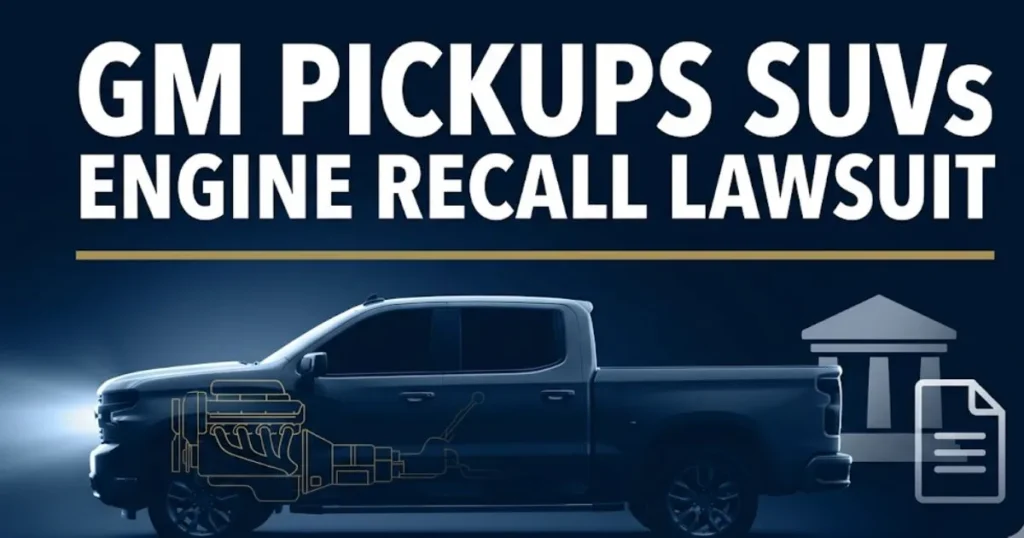
In Powell, plaintiffs allege the L87 engines have a design that causes insufficient lubrication between the bearings and the crankshaft, which can lead to spun bearings, broken connecting rods and engine failure. GM attributes problems to supplier manufacturing and quality issues.
2026 developments at a glance:
- Harrison: motion to sever AFM and DFM claims denied (reported February 2026)
- Powell: GM filed a motion to dismiss (reported June 2026); no ruling reported
- No class settlement announced in either case
- NHTSA opened a recall query in January 2026 on engine problems in recalled vehicles
- GM’s April 2025 recall covers about 600,000 trucks and SUVs with the 6.2L V8
These rulings matter, but none of them means money is available to owners yet.
What Is the GM Engine Defect Class Action Lawsuit
The GM engine defect class action lawsuit is a legal claim that General Motors designed, manufactured, and sold vehicles with V8 engines that have a known tendency to fail prematurely due to defects in the Active Fuel Management and Dynamic Fuel Management systems.
Think of it like selling a refrigerator you know will break in two years. The manufacturer does not get to charge you full price for a product it knows is defective.
The lawsuits allege GM violated consumer protection laws in multiple states, breached implied warranty obligations, and engaged in fraudulent concealment by not disclosing the defects to buyers. The two main cases, Harrison v. General Motors and Powell v. General Motors, are both pending in the U.S. District Court for the Eastern District of Michigan.
The defects primarily involve engine lifters collapsing under the AFM and DFM systems, which cycle cylinders on and off to improve fuel economy. The side effect, according to plaintiffs, is accelerated wear and eventual failure.
What the lawsuit claims GM did wrong:
- Sold vehicles with engines it knew were defective
- Failed to disclose the defect at the point of sale
- Issued inadequate recalls that did not fully fix the problem
- Made owners pay out of pocket for repairs covered under warranty
The plaintiffs seek compensation such as repair costs and diminished vehicle value; the exact relief depends on each complaint.
Key Takeaway: The GM engine defect class action is about more than a recall fix. It is about whether owners can recover money for problems they say GM should have prevented.
Which GM Trucks and SUVs Are Affected by the Engine Recall
The affected vehicles span a wide range of GM’s most popular models. If you own a full-size GM pickup truck or SUV built within the last several years, there is a reasonable chance your vehicle falls within the scope of the litigation.
Two engine families are at issue. The 2025 recall and the Powell case involve the 6.2-liter EcoTec3 V8 (L87). Harrison involves 5.3L, 6.0L and 6.2L V8 engines with Active Fuel Management or Dynamic Fuel Management.
| Vehicle | Engine | Model Years Cited |
|---|---|---|
| Chevrolet Silverado 1500 | 5.3L / 6.2L V8 | 2014 to present (Harrison); 2019 to 2024 (6.2L recall) |
| GMC Sierra 1500 | 5.3L / 6.2L V8 | 2014 to present (Harrison); 2019 to 2024 (6.2L recall) |
| Chevrolet Tahoe | 5.3L / 6.2L V8 | 2014 to present (Harrison); 2021 to 2024 (6.2L recall) |
| Chevrolet Suburban | 5.3L / 6.2L V8 | 2014 to present (Harrison); 2021 to 2024 (6.2L recall) |
| GMC Yukon / Yukon XL | 5.3L / 6.2L V8 | 2014 to present (Harrison); 2021 to 2024 (6.2L recall) |
| Cadillac Escalade / Escalade ESV | 6.2L V8 | 2014 to present (Harrison); 2021 to 2024 (6.2L recall) |
| Cadillac CTS-V | 6.2L V8 | 2016 to 2019 (Harrison) |
Harrison also names some Chevrolet Corvette, Camaro and Avalanche models. Not every model year within these ranges is automatically covered. Coverage depends on the specific engine configuration, trim level, and whether a particular defect applied.
Check your Vehicle Identification Number against recall databases to confirm your specific vehicle’s status.
GM 6.2L and V8 Engine Defects Explained
The central defect in the GM V8 engine lawsuit involves the Active Fuel Management system, commonly called AFM, and the newer Dynamic Fuel Management system, DFM. These systems deactivate certain cylinders while driving at highway speeds to save fuel. Plaintiffs in Harrison allege that the lifters responsible for this switching mechanism wear out far faster than they should.
When a lifter collapses or fails, it can send metal debris through the entire engine. In severe cases, the engine requires full replacement. Owners report that this repair can cost thousands of dollars at a dealership.
Oil consumption is a related problem. Some owners report heavy oil consumption between changes, which is far more than a buyer would expect from a new truck.
Common symptoms reported by owners:
- Engine ticking or knocking noises, especially at startup
- Rapid oil consumption without visible leaks
- Loss of power or rough idling
- “Reduced Engine Power” warning light
- Engine misfires under acceleration
- Complete engine failure in severe cases
These are not minor issues. An engine that starts ticking on the highway is a safety problem, not just an inconvenience. The lawsuit argues GM treated it as an inconvenience to avoid costly recalls.
Who Qualifies for the GM Engine Recall Lawsuit
No class has been certified and no settlement exists, so no one can file a claim yet. Owners who bought or leased a covered vehicle and had V8 engine problems may belong to the proposed classes if a class is certified later. Eligibility will depend on the specific lawsuit or settlement.
The proposed groups generally include owners who:
- Purchased or leased a qualifying GM vehicle within covered model years
- Experienced AFM or DFM lifter failures, oil consumption, or engine failure
- Paid out of pocket for engine repairs GM should have covered
- Received an inadequate recall repair that did not resolve the problem
Some complaints also seek relief for owners who have not yet experienced a failure.
| Eligibility Factor | Details |
|---|---|
| Vehicle Ownership | Purchased or leased a qualifying model |
| Model Year Range | Varies by case: 2014 to present in Harrison; 2019 to 2024 in the 6.2L recall |
| Engine Type | 5.3L or 6.2L V8 with AFM or DFM |
| Defect Experienced | Lifter failure, oil burn, engine knock, or related |
| Out-of-Pocket Costs | Not required but strengthens your claim |
| Residency | U.S. owners; some states have stronger protections |
You do not need to have already paid for repairs to be part of a proposed class. But if you did pay, those receipts are valuable evidence.
Key Takeaway: Keep your records. If a class is certified or a settlement is reached, they will matter even if your dealer called the problem normal wear.
GM Engine Recall vs Class Action Lawsuit: What Is the Difference
These are two separate legal processes with different outcomes, and confusing them is one of the biggest mistakes GM owners make. The recall is a government-mandated repair program. The class action lawsuit is a civil legal case seeking money damages.
When GM issues a recall, it is responding to NHTSA pressure or its own safety findings. In the April 2025 6.2L V8 recall, vehicles that failed an inspection got a free engine replacement, and vehicles that passed got 0W-40 oil, a new fill cap and a new oil filter, plus a 10-year or 150,000-mile extended engine warranty, according to reports on the Powell case.
The class action lawsuit goes further. It argues that the recall repair was insufficient, that you deserve compensation for the time your vehicle was out of commission, diminished resale value, and any costs you paid before or during the recall period.
| Aspect | Recall | Class Action Lawsuit |
|---|---|---|
| Who Runs It | NHTSA / GM | Federal Court / Plaintiffs’ Attorneys |
| What You Get | Free repair | Possible compensation if the class wins or settles |
| Do You Have to Opt In | No, just bring vehicle in | Not now; a claim step comes only if a settlement is approved |
| Can You Do Both | Yes | Yes, in most cases |
| Time Required | Days | Months to years |
| Legal Representation | Not needed | Helpful but not always required |
The key point: getting your vehicle repaired under the recall does not automatically get you money from the lawsuit. Those are two separate tracks.
NHTSA Investigation Into GM Engine Failures
NHTSA, the National Highway Traffic Safety Administration, has been investigating GM engine failures for several years. These investigations laid the foundation for both formal recalls and the civil litigation that followed. NHTSA closed its original L87 investigation in October 2025, opened a follow-up on whether the recall covered all affected vehicles, and in January 2026 opened a recall query into engine problems in recalled vehicles.
A Preliminary Evaluation is NHTSA’s first formal step toward a recall. If it finds enough evidence of a safety risk, it escalates to an Engineering Analysis. From there, it can demand a recall or accept GM’s voluntary recall proposal.
NHTSA complaint databases show tens of thousands of consumer complaints related to GM V8 engine failures. That volume of complaints is one of the things courts look at when deciding whether a defect is widespread enough to warrant class action treatment.
Key NHTSA actions related to GM engines:
- Original L87 investigation closed in October 2025 after the recall
- Follow-up review of whether the recall covered all affected vehicles
- Recall query opened in January 2026 on engines failing in recalled vehicles
- NHTSA recall database entries for related GM powertrain issues
NHTSA records are public. Owners can search their VIN at the NHTSA website to see if any open recalls or investigations apply to their specific vehicle.
GM Engine Recall Lawsuit Settlement 2026
No settlement has been announced in Harrison or Powell, and there is no settlement administrator, claim website or payout schedule for either case. Be careful with any site that says you can file a GM engine claim now.
If a settlement is reached later, vehicle defect settlements often pay more to owners with documented major repairs than to owners with minor or no costs. The table below is only an illustration of how such categories could look.
| Possible Category | Type of Harm | Compensation |
|---|---|---|
| Category 1 | Full engine replacement | Not set; no settlement exists |
| Category 2 | Major repair costs paid out of pocket | Not set; no settlement exists |
| Category 3 | Minor documented repair costs | Not set; no settlement exists |
| Category 4 | Vehicle ownership only (no repair costs) | Not set; no settlement exists |
| Category 5 | Injunctive relief (future defect risk) | Not set; no settlement exists |
This table does not reflect any approved or proposed GM settlement, and no amounts have been set.
Any future settlement would need court approval and would publish its own eligibility rules, amounts and deadlines.
Key Takeaway: There is no GM engine settlement to claim from today. Keep your repair records so you are ready if one is announced.
How Much Compensation Can GM Truck Owners Get
No compensation amount has been set in the GM engine recall lawsuits, so there is no number that applies to anyone today. If money is ever awarded or agreed, it would likely depend on the severity of the engine problem, what you paid out of pocket, and your documentation.
In many vehicle defect settlements, owners with documented full engine failures and receipts recover the most, but nothing is promised in the GM cases.
Owners with lesser costs might receive less, if anything is paid at all.
Factors that could increase a future payout:
- Paid for an engine replacement or major engine repair
- Have repair invoices and mechanic records
- Complained to GM or a dealer and received no help
- Experienced the defect while under warranty but were denied coverage
- Sold your vehicle at a documented loss due to engine problems
Factors that could reduce a future payout:
- No repair documentation
- Vehicle not within the covered model year range
- Defect repaired fully under a previous recall at no cost
- Vehicle purchased with known defect disclosed at sale
Even so, start gathering what you have now. Photos, service records and dealer notes can all help later.
Is There a GM Engine Lawsuit Claim Deadline?
There is no claim filing deadline for the GM engine recall lawsuits, because no settlement or claims process exists. A deadline would appear only after a settlement is approved and a notice is issued.
As a general rule, once a class settlement is preliminarily approved, the court sets a claims period, and claims filed after it closes are not accepted.
Deadline-related information to know:
- Check the specific case or settlement that covers your vehicle
- Claims administrators send notices by mail to registered owners
- You may need to affirmatively opt in even if you received a notice
- Missing the opt-out deadline for a settlement you do not want to join is also consequential
| Action | Typical Deadline Type |
|---|---|
| Filing a claim for compensation | Set by settlement administrator |
| Opting out of a class settlement | Usually 30 to 60 days from notice |
| Objecting to settlement terms | Before final approval hearing |
| Statute of limitations for individual suit | Varies by state, typically 2 to 4 years |
If you receive a mailed or emailed notice about a GM engine lawsuit or settlement, it will contain your specific deadline. Confirm it is genuine and read it carefully.
How to Prepare for a GM Engine Lawsuit Claim
No claim form exists yet for the GM engine recall lawsuits, but you can prepare now. Class members generally do not need a lawyer to file a basic settlement claim.
Here is how to get ready, so you can act quickly if a settlement is announced:
Step 1: Confirm your vehicle qualifies.
Check your VIN against NHTSA’s public recall database and the case documents to see whether your model and year are named.
Step 2: Gather your documentation.
This includes your purchase or lease agreement, repair invoices, warranty denial letters, any correspondence with GM or your dealer, and service records showing the engine problem.
Step 3: Watch for an official claims portal.
None exists today. If a settlement is approved, it will have its own administrator and website, announced through court notices and mailed class notices.
Step 4: Complete the claim form when one opens.
You will need to provide your vehicle information, a description of the defect you experienced, and documentation of any costs you incurred.
Step 5: Submit before any deadline.
Keep a copy of everything you submit. Note your confirmation number or submission date.
Documents to gather before you file:
- Vehicle title or registration showing ownership
- Purchase or lease agreement
- All repair invoices related to engine problems
- Correspondence with GM, dealer, or warranty department
- Records of any previous recall repairs performed
Once a claim form exists, having your documents ready will make it much faster.
Key Takeaway: You cannot file a GM engine lawsuit claim yet, but good documentation is the best preparation.
GM Dealer Repair and Your Lawsuit Rights
Getting your vehicle repaired at a GM dealer under the recall does not automatically eliminate your right to join the class action lawsuit. This is one of the most misunderstood aspects of the entire situation.
Think of it this way. If a restaurant gives you a replacement meal after making you sick, that does not mean you cannot also seek compensation for your medical bills. The repair is one remedy. The lawsuit is another.
There are some nuances, though. If you signed a release of claims when accepting a settlement offer from GM directly, that release could affect your ability to participate in the class action. Most standard recall repairs do not come with release agreements, but dealer “goodwill” settlements sometimes do.
What dealer repairs typically cover and what they do not:
| Repair Situation | Effect on Lawsuit Rights |
|---|---|
| Standard recall repair (free) | Does not by itself end your rights, though GM argues the recall fixes the issue |
| Warranty repair covered by GM | Generally does not bar lawsuit claim |
| Goodwill payment + signed release | May limit or bar lawsuit claim |
| Paid repair, then reimbursed by GM | May affect payout calculation |
| Repair denied by dealer | Strengthens your lawsuit claim |
Keep copies of every single piece of paperwork from every dealer visit. Those records can make a significant difference in your recovery amount.
GM Engine Oil Consumption Defect and Legal Claims
Excessive oil consumption is a complaint many owners raise alongside lifter and bearing failures, and it is often the first sign they notice that something is wrong. GM’s V8 engines in affected vehicles have been reported to burn oil at rates far beyond what is acceptable by industry standards.
Normal oil consumption for a well-functioning modern engine is typically less than a quart per 3,000 miles. Some GM truck owners with the 5.3L and 6.2L V8 engines report consuming a quart every 1,000 to 1,500 miles.
That level of consumption causes real harm. It means more frequent and costly oil changes. It means engine components running without adequate lubrication. And it means the engine is silently degrading faster than the owner realizes.
How the oil consumption defect affects the lawsuit:
- Documents a pattern of abnormal engine behavior
- Supports claims that the defect manifests before total engine failure
- Allows owners who have not yet had a catastrophic failure to still join the suit
- Strengthens arguments that GM knew about the problem before selling affected vehicles
If your owner’s manual says to check oil every 7,500 miles but your truck needs a top-off every 1,000 miles, document that. Take photos of the dipstick. Keep receipts for oil purchases. That evidence directly supports your claim.
GM Engine Recall Lawsuit Timeline and What to Expect
The GM engine recall lawsuit has been building for years, and 2026 brought new rulings but no resolution. Here is how the case got to where it is, and what likely happens next.
Timeline of major events:
| Year | Development |
|---|---|
| 2014 to 2016 | Early owner complaints about 5.3L AFM failures begin accumulating |
| 2017 to 2019 | Owner complaints about lifter and engine problems continue to build |
| 2020 to 2021 | December 2021: Harrison v. General Motors filed in the Eastern District of Michigan |
| 2022 | Harrison proceeds in federal court |
| 2023 | Harrison continues; the court describes the allegations as three separate part failures |
| 2024 | Harrison continues in the Eastern District of Michigan |
| 2025 | April: GM recalls about 600,000 trucks and SUVs with 6.2L V8s; Powell v. General Motors filed; NHTSA closes its original L87 investigation in October |
| 2026 | Harrison motion to sever denied; NHTSA opens recall query in January; GM moves to dismiss Powell |
What to expect going forward in 2026 and beyond:
A ruling on GM’s motion to dismiss in Powell is the next major step to watch, along with further orders in Harrison. No settlement approval hearing has been scheduled. If a settlement is ever approved, a claims period would open and payments would follow.
Some cases may proceed to trial if settlement terms are not reached. That would extend the timeline significantly.
The most important thing you can do right now is confirm your eligibility and gather your documents. There is no filing window open right now, so be wary of anyone who says otherwise.
Frequently Asked Questions: GM Truck Engine Recall Lawsuit
What GM trucks and SUVs are covered by the engine recall lawsuit in 2026?
The vehicles named include the Chevrolet Silverado 1500, GMC Sierra 1500, Chevrolet Tahoe, Chevrolet Suburban, GMC Yukon and Yukon XL, and Cadillac Escalade. Harrison covers 5.3L, 6.0L and 6.2L V8s from about 2014 on, and the 2025 recall covers 2019 to 2024 Silverado and Sierra 1500 pickups and 2021 to 2024 full-size SUVs with the 6.2L V8.
The specific model years covered depend on which lawsuit or settlement applies to your vehicle.
Check your VIN against NHTSA recall databases and the specific class action settlement records to confirm your vehicle’s status.
How much money can I get from the GM engine recall lawsuit?
No compensation has been set, because there is no settlement or judgment in the GM engine lawsuits.
If money is ever available, the amount would depend on the severity of the problem and your documentation.
In vehicle defect settlements, owners with repair receipts and dealer denial letters are usually best placed.
What is the deadline to file a claim in the GM engine lawsuit?
There is currently no claim deadline, because no settlement exists.
Claims periods typically begin after a settlement receives preliminary court approval.
If a settlement is announced, check the administrator’s website or your mailed notice for the deadline.
Can I still join the GM engine class action if my dealer already fixed my truck?
Yes, in most cases a standard recall repair or warranty repair does not bar you from joining the class action.
The lawsuits seek additional relief beyond the repair itself, such as out-of-pocket costs and diminished vehicle value.
The exception is if you signed a release of claims as part of a direct settlement with GM, which some owners did during “goodwill” offers.
What is the difference between the GM engine recall and the class action lawsuit?
The recall is a government-mandated program where GM fixes your vehicle for free at a dealership.
The class action lawsuit is a civil court case where affected owners seek money damages for out-of-pocket costs, vehicle value loss, and compensation for the defect itself.
You can pursue both at the same time in most cases, and getting a recall repair does not waive your right to file a lawsuit claim.
What GM Truck Owners Should Do Right Now
The GM engine recall lawsuits are still pending, and no claim window is open. If you own or owned a covered GM truck or SUV and had GM engine failure problems, now is the time to get your records together.
Start by confirming your vehicle’s eligibility. Gather every repair invoice, service record, and piece of dealer correspondence you have. Even informal notes about when you noticed symptoms can help.
Also check your VIN for open recalls and get the free recall repair done. If a settlement is announced, it will come with an official website, a claim form and a deadline. Until then, the owners best prepared are the ones with their documentation in hand.