March 2026 turned into one of the busiest months in crypto legal history. A cryptocurrency lawsuit tied to Nvidia reached class certification, FTX’s final claims deadline landed, and a brand new fight over billions in dormant Bitcoin kicked off in a New York courtroom.
If you held crypto, traded on a major exchange, or owned shares in a company tied to digital assets, there is a decent chance one of these cases touches you.
Here is the surprising part. One pending case in March alone involves a claim worth up to $293 billion in disputed Bitcoin, making it larger than most entire company settlements combined.
This guide breaks down every major case that moved in March 2026, who qualifies, and what to do next.
Related: Automotive Lawsuit March 2026: Key Deadlines and Payouts
Cryptocurrency Lawsuit March 2026 Overview
The cryptocurrency lawsuit landscape in March 2026 is defined by one thing: deadlines colliding all at once. Multiple unrelated cases happened to hit critical court dates in the same 31 day window, which is rare even by crypto litigation standards.
The case advanced further in March 2026 when US District Judge Haywood Gilliam Jr. granted class certification, permitting investors to pursue their claims collectively but not establishing liability. That single ruling against Nvidia opened the door to the eventual settlement that followed later in the year.
At the same time, parties in the Tether and Bitfinex crypto asset litigation were ordered to submit a joint letter proposing redactions to a court opinion by March 9, 2026.
A brand new filing also entered the mix. On March 11, 2026, a pseudonymous plaintiff using the name Noah Doe filed suit in New York Supreme Court, with two Wyoming companies joining as co-plaintiffs.
Quick Facts, March 2026 Crypto Docket:
- Nvidia investor class certified
- Tether and Bitfinex redaction order issued
- New dormant Bitcoin ownership suit filed
- FTX final claims bar date hit
- Voyager Digital claims window closed
Nvidia Crypto Lawsuit March 2026 Settlement
The Nvidia crypto lawsuit centers on whether the chipmaker misled investors about how much of its gaming GPU revenue came from crypto miners. Nvidia agreed to a $290 million settlement of a securities class action lawsuit alleging that the chipmaker misled investors about cryptocurrency mining demand for its gaming graphics processors during 2017 and 2018.

The March 2026 development was the turning point. The case advanced further in March 2026 when US District Judge Haywood Gilliam Jr. granted class certification, and the ruling permitted investors to pursue their claims collectively but did not establish liability.
The numbers at stake are large. Plaintiffs estimated cryptocurrency-related GPU revenue reached approximately $1.95 billion during the disputed period, compared with roughly $602 million reflected in Nvidia’s reported crypto-related sales, though these figures were contested litigation estimates, not judicial findings.
| Detail | Info |
|---|---|
| Settlement Amount | $290 million |
| Class Period | Aug 10, 2017 to Nov 15, 2018 |
| Class Certified | March 2026 |
| Settlement Filed | November 24, 2026 |
| Legal Fees Sought | Up to $62 million |
Plaintiffs proposed a process where the court would consider preliminary approval, notify affected shareholders, and hold a final settlement hearing about 130 days later. Nvidia shareholders who bought stock during that window should watch for a formal notice.
FTX Lawsuit March 2026 Deadline
The FTX customer claims deadline was the single most consequential date for ordinary investors in March 2026. The FTX claims deadline is March 31, 2026, and is strictly enforced.
This bar date applied to the bankruptcy claims process, not a traditional class action. If you had not filed your FTX claim, the March 31, 2026 deadline was absolute.
That said, the bankruptcy claims process is separate from other FTX litigation still working through the courts. Deadlines vary by case, but several fall between March and September 2026.
Here is the simple breakdown for FTX customers:
- Customer bankruptcy claims: March 31, 2026, final and strict
- Celebrity endorser class action: largely dismissed in separate proceedings
- Executive accountability cases: still active, separate timeline
Anyone who had funds trapped on FTX at the time of collapse needed to act before the March 31 cutoff or risk losing standing entirely. There is no indication the bankruptcy court plans to reopen this window.
Key Takeaway: March 2026 delivered two of the year’s biggest crypto legal milestones, Nvidia’s class certification and FTX’s final claims bar date, both of which reshape who gets paid and how much.
Tether Bitfinex Lawsuit March 2026
The Tether and Bitfinex litigation is a long-running case over stablecoin reserve claims that hit a procedural milestone in March 2026. The parties were ordered to submit, under seal, a joint letter proposing redactions to the court’s opinion on or before March 9, 2026.
This is not a settlement yet. It is a sign the court issued a substantive opinion that both sides wanted partially sealed, which usually means sensitive financial or reserve data was discussed.
The order came out of the Southern District of New York, the same court handling several other major crypto disputes. For USDT holders, this case matters because it touches claims that the stablecoin was not fully backed as advertised.
| Detail | Info |
|---|---|
| Court | S.D.N.Y. |
| Docket | 1:2019cv09236 |
| March 2026 Action | Redaction letter ordered, due March 9 |
| Claim Theory | Reserve backing misrepresentation |
Holders who traded USDT during the relevant years should keep watching this docket closely. A sealed opinion often precedes either a summary judgment ruling or a push toward settlement talks.
Coinbase Lawsuit March 2026 Update
Coinbase was fighting on three separate legal fronts in and around March 2026, not one unified case. A key motions hearing in the SEC versus Coinbase matter was scheduled for March 2026.
The staking side of Coinbase’s legal troubles kept moving too. The SEC’s staking enforcement action settled in late 2025 for $300 million, but the class action plaintiffs still wanted additional compensation beyond that SEC settlement.
Separate consumer litigation also closed out around this period. The exchange settled a Dogecoin sweepstakes advertising lawsuit for $2.25 million, separate from its ongoing staking fights.
By late in the year, some of these threads resolved in Coinbase’s favor. Holders of the TerraUSD stablecoin who bought the token on Coinbase’s platform sued the company as a class, and Judge Maxine M. Chesney dismissed most aspects of the plaintiffs’ claims under California consumer protection and securities laws.
- SEC staking case: settled for $300 million
- Dogecoin sweepstakes case: settled for $2.25 million
- TerraUSD class action: mostly dismissed
- Investor shareholder case: partially advancing to discovery
Binance Lawsuit March 2026 Settlement Talks
Binance’s legal troubles moved from pure litigation toward negotiation in March 2026. Settlement negotiations in the Binance investor class action began in March 2026, a meaningful shift after years of contested filings.
The case itself is actually several overlapping fights. The Binance lawsuit situation in 2026 is actually three separate legal fights happening at once, involving multiple federal and state actions alleging unregistered securities sales, market manipulation, and commingling of customer funds.
| Case Detail | Information |
|---|---|
| Court | SDNY |
| Judge | Andrew Carter |
| Class Period | Sep 2019 to Nov 2023 |
| Opt-Out Deadline | August 15, 2026 |
| Status | Settlement negotiations (began March 2026) |
Investors who traded on Binance during that class period and did not opt out by the August deadline remain part of the case automatically. Settlement talks starting in March do not guarantee a deal, but they usually signal both sides see real litigation risk.
Voyager Digital Lawsuit March 2026 Claims Deadline
Voyager Digital’s claims window officially closed in March 2026, catching some slow movers off guard. Voyager Digital claims closed in March 2026, following months of notice to former customers of the collapsed crypto lender.
The Voyager Digital claim deadline was specifically listed as March 1, 2026, with the case shown as closed shortly after. This came through the bankruptcy claims process rather than a traditional opt-in class action settlement form.
Quick Facts:
- Claim Deadline: March 1, 2026
- Status: Closed
- Process Type: Bankruptcy claims administration
- Who Was Affected: Customers with funds on the platform at collapse
If you had a Voyager account and never submitted a claim, this window has passed. Some bankruptcy cases allow late claims under narrow circumstances, but there is no guarantee a late filer will recover anything at this stage.
Key Takeaway: Three separate deadlines, FTX’s bar date, Voyager’s claim closure, and Binance’s new settlement talks, all converged in March 2026, making it a make-or-break month for unpaid claimants.
Dormant Bitcoin Wallet Lawsuit March 2026
This is the strangest and largest crypto case to surface in March 2026. On March 11, 2026, a pseudonymous plaintiff using the name Noah Doe filed suit in New York Supreme Court, with two Wyoming companies joining as co-plaintiffs.
The ask is enormous. The plaintiffs sought a declaratory judgment over Bitcoin sitting in approximately 39,069 dormant addresses, essentially asking a court to formally rule on who owns those coins.
The dollar figures involved dwarf nearly every other case on this list. The addresses hold an estimated 3.8 million BTC, putting the claim somewhere between $250 billion and $293 billion depending on the market price used.
The theory hit a snag almost immediately. Over 227,196 BTC held in wallets that had sat untouched since before 2019 were reactivated in 2026, which is a problem for a case built on the idea that silence equals abandonment.
| Detail | Info |
|---|---|
| Filed | March 11, 2026 |
| Court | New York Supreme Court |
| Addresses at Issue | 39,069 |
| Estimated Value | $250B to $293B |
| Current Status | Stayed pending hearing |
A court order in June 2026 stayed proceedings pending a hearing on whether lost-property laws even apply to digital assets. This is not a class action with a claim form. It is a property dispute that could, in theory, affect anyone who owns an old pre-2019 wallet.
Who Qualifies for the March 2026 Cryptocurrency Lawsuit
Qualification depends entirely on which specific case you are asking about, since each has its own class period and proof requirements. There is no single “crypto lawsuit” that covers every investor.
Generally, courts require a few consistent things across these cases. You must show proof of loss and avoid missing any opt-out deadline, since each lawsuit sets its own specific eligibility rules that are spelled out in the official settlement notice.
Common eligibility factors across March 2026 crypto cases:
- You purchased, held, or traded the asset during the defined class period
- You did not formally opt out before the stated deadline
- You can document your transaction history or loss amount
- You fall under the specific court’s jurisdiction for that case
| Case | Who Qualifies |
|---|---|
| Nvidia | Shareholders who bought stock Aug 2017 to Nov 2018 |
| FTX | Customers with funds on the platform at collapse |
| Binance | Investors active Sep 2019 to Nov 2023, no opt-out |
| Voyager | Former account holders, claim closed March 1 |
If you are unsure whether you qualify, check the official claims administrator notice tied to the specific case name, not a generic crypto lawsuit page.
Key Takeaway: Eligibility is case specific, so matching your exact exchange, token, and purchase dates to the right class period matters more than the word “cryptocurrency” alone.
Cryptocurrency Lawsuit Payout March 2026
Payout amounts in March 2026 crypto cases range from a few thousand dollars to multiple billions, depending entirely on case size. There is no single average that applies across the board.
Consumer-level cases tend to pay smaller fixed amounts. Athena Bitcoin agreed to a $4,500,000 settlement to resolve a class action lawsuit alleging the Bitcoin ATM operator unlawfully sent promotional texts to consumers who previously requested to stop receiving the messages.
Securities cases involving public companies run much larger. The $290 million Nvidia settlement represents approximately 0.25% of quarterly revenue and 0.44% of quarterly net income for the company, though individual shareholder payouts depend on how many shares they held during the class period.
| Settlement Type | Example | Amount |
|---|---|---|
| Securities class action | Nvidia | $290 million |
| Texting/consumer case | Athena Bitcoin | $4.5 million |
| SEC enforcement | Terraform Labs | $4.47 billion |
| Stablecoin reserve case | Tether (pending) | Could exceed $1 billion |
Do not expect a flat per-person number across all crypto cases. Your actual payout depends on documented loss, shares held, or transaction volume during the specific class period.
Cryptocurrency Class Action Lawsuit March 2026
A cryptocurrency class action lawsuit groups many investors with similar claims into one case, which is exactly what happened with Nvidia’s investor case in March 2026. The case was certified as a class action in March 2026.
Class certification is a critical legal milestone. It does not mean the defendant did anything wrong, but it does mean the court agrees the claims are similar enough to handle together.
The proposed Nvidia settlement represents about 14% of the damages claimed by investors, while plaintiffs’ attorneys intend to seek up to 21.4% of the settlement fund in legal fees. That fee structure is fairly typical for securities class actions of this size.
- Class certification: confirms the group can sue together
- Settlement negotiation: happens after or alongside certification
- Preliminary approval: court signs off on proposed terms
- Claims period: class members submit documentation
- Final approval hearing: court finalizes the deal
A hearing on preliminary approval of the Nvidia settlement is scheduled for Feb. 4, 2027, which gives a sense of how long the process stretches even after a settlement is announced.
Crypto Lawsuit Settlement March 2026 Timeline
The timeline from a crypto lawsuit filing to an actual check in your mailbox is long, often stretching years. March 2026 happened to be a milestone month for several cases at very different stages of that timeline.
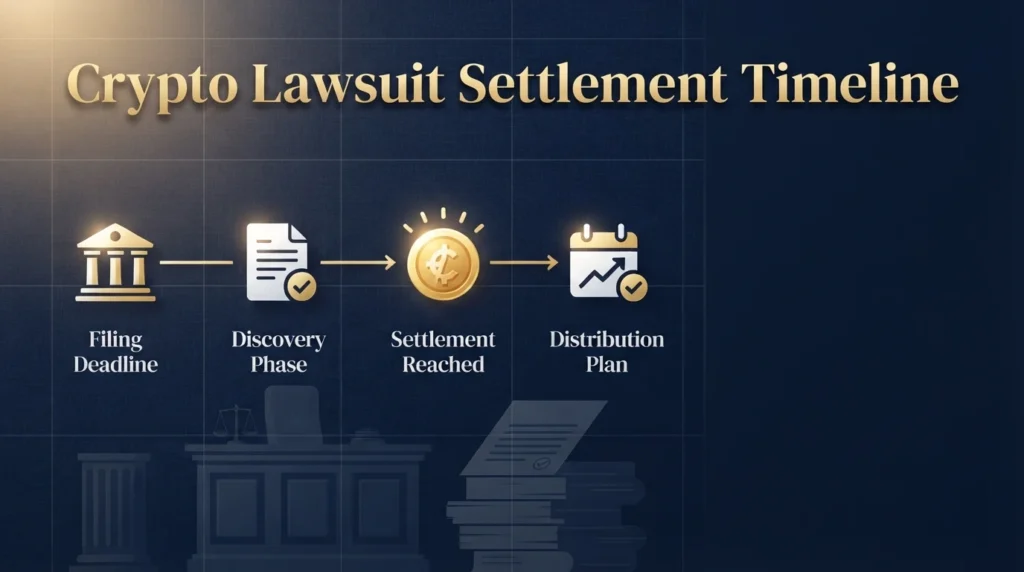
Think of it like a relay race with four legs: filing, certification, settlement, and distribution. Nvidia’s case, for example, took nearly eight years to reach its current stage.
Nvidia agreed to a $290 million settlement of a securities class action lawsuit alleging it misled investors about cryptocurrency mining demand, with the proposed agreement filed on November 24, 2026, in the US District Court for the Northern District of California.
| Timeline Stage | Nvidia Example Date |
|---|---|
| Lawsuit originally filed | 2018 |
| Class certified | March 2026 |
| Settlement agreed | November 24, 2026 |
| Preliminary approval hearing | February 4, 2027 |
| Final distribution | Expected later in 2027 |
For comparison, Voyager’s bankruptcy claims process moved much faster, closing claims by March 1, 2026 without the multi-year litigation grind. Bankruptcy claims and securities class actions simply run on different clocks.
Key Takeaway: A March 2026 milestone does not mean March 2026 money. Most crypto cases still need another 12 to 24 months before checks go out.
SEC Cryptocurrency Lawsuit March 2026
The SEC’s role in crypto litigation shifted in 2026, moving from aggressive new filings toward resolving older cases. A key SEC versus Coinbase motions hearing was scheduled for March 2026, part of the ongoing fight over whether the exchange operated as an unregistered broker.
Some SEC enforcement actions against Coinbase have since narrowed. Coinbase said New Jersey dropped a lawsuit accusing the crypto exchange of offering unregistered securities through its staking services and rescinded a 2023 cease-and-desist order.
The SEC’s biggest crypto win of the cycle, though, involves Terraform Labs. As of early 2026, a $4.47 billion SEC settlement anchors the liquidating plan with separate pools for 16,640 crypto loss claimants, with no distributions as of March 2026.
- SEC v. Coinbase: motions hearing March 2026, partially narrowed
- SEC v. Terraform Labs: $4.47 billion settlement, distributions still pending
- State-level staking actions: several dropped or settled in 2026
The common thread is that SEC cases rarely pay investors directly. Most penalty money flows into a general fund, with investor recovery handled through separate class actions.
How to File a Claim in the March 2026 Cryptocurrency Lawsuit
Filing a claim means submitting proof of your loss to the official claims administrator before the stated deadline. The process looks almost identical across most crypto cases, even though the deadlines differ wildly.
Steps to file a claim:
- Identify the exact case name and docket number
- Confirm your purchase or account dates fall within the class period
- Gather transaction records, account statements, or exchange history
- Complete the official claim form from the settlement administrator
- Submit before the stated deadline, no exceptions
In discovery-stage cases like the SEC action against Coinbase, both sides are exchanging documents and taking depositions, and a trial date has not yet been set, which means there is no claim form to file yet for that particular matter.
For cases that have reached settlement, like Nvidia, affected shareholders should watch for an official notice rather than searching randomly online. Scam claim sites often mimic real settlement notices, so always verify through the court docket.
| Stage | What You Do |
|---|---|
| Pre-settlement | Nothing yet, just stay informed |
| Preliminary approval | Watch for mailed notice |
| Claims window open | Submit form with documentation |
| Final approval | Wait for distribution |
Cryptocurrency Lawsuit March 2026 News
March 2026 produced a steady stream of headline-worthy crypto legal news, far more than a typical month. The volume reflects just how many major cases were already in motion heading into the year.
Federal securities class action filings rose to 118 cases in the first half of 2026, with average settlement values climbing to $54 million, the highest in a decade. That broader trend helps explain why so many crypto-adjacent cases reached milestones around the same time.
Beyond the headline cases already covered, smaller consumer actions also moved forward. The CryptoZoo lawsuit was settled out of court in July 2026 without additional public information and officially dismissed by Logan Paul on July 15, 2026. While that resolution came later in the year, early groundwork for it was already shifting in the spring.
Quick Facts, Notable March 2026 Headlines:
- Nvidia class certification
- FTX final bankruptcy claims deadline
- Voyager Digital claims closure
- Tether and Bitfinex sealed opinion order
- New dormant Bitcoin ownership filing
Key Takeaway: March 2026 was not one lawsuit. It was a pileup of deadlines and rulings across at least six separate crypto cases, each with its own rules for who gets paid.
Crypto Lawsuit Deadlines After March 2026
Several major deadlines still remain after March 2026, so missing a March date does not mean every crypto legal opportunity is gone. The Tether class action claim period, for example, runs through September 15, and the Binance opt-out deadline falls on August 15, 2026.
Other cases stretch even further into the future. A hearing on preliminary approval of the Nvidia settlement is scheduled for February 4, 2027, meaning actual shareholder payments likely will not arrive until later that year.
| Upcoming Deadline | Date | Case |
|---|---|---|
| Binance opt-out | August 15, 2026 | Investor class action |
| Tether claim period ends | September 15, 2026 | USDT reserve case |
| Nvidia preliminary approval | February 4, 2027 | Securities class action |
| Dormant Bitcoin hearing | TBD after stay | Property ownership dispute |
Securities class action settlements typically take 12 to 20 months from approval to payout, so patience is part of the process even after a deadline passes favorably. Mark your calendar for the next date tied to your specific case rather than assuming March was the only chance to act.
================================================================
Frequently Asked Questions
What is the cryptocurrency lawsuit in March 2026 about?
There is no single case. March 2026 saw multiple separate crypto lawsuits hit major milestones at once.
These include Nvidia’s class certification, FTX’s final claims deadline, and a new dormant Bitcoin ownership filing.
Each case has its own defendant, class period, and eligibility rules.
When is the FTX claims deadline in March 2026?
The FTX customer bankruptcy claims deadline was March 31, 2026.
This deadline was described as final and strictly enforced.
Customers who missed it likely forfeited their right to file a bankruptcy claim.
How much is the Nvidia crypto lawsuit settlement worth?
Nvidia agreed to pay $290 million to resolve the shareholder class action.
The case covers investors who bought shares between August 10, 2017, and November 15, 2018.
A preliminary approval hearing is set for February 4, 2027.
Who qualifies for a cryptocurrency class action lawsuit in 2026?
Qualification depends on the specific case, your purchase dates, and whether you opted out.
Most cases require proof of loss documentation tied to a defined class period.
Check the official settlement notice for exact eligibility rules.
How long does it take to get paid after a crypto lawsuit settles?
Most securities class actions take 12 to 20 months from court approval to actual payout.
Bankruptcy claims processes, like Voyager’s, can move on a different and sometimes faster schedule.
Always wait for official notice from the claims administrator rather than a third-party estimate.
================================================================
Final Word
March 2026 reshaped the cryptocurrency legal landscape in a single month. Nvidia’s class got certified, FTX’s deadline closed, and a new multi-billion dollar Bitcoin dispute began.
None of this happens automatically for you. Check your exchange history, confirm your class period, and watch official court notices closely.
Stay on top of upcoming deadlines for Binance, Tether, and Nvidia before they slip past you too.
================================================================