Pizza Hut is facing a $100 million lawsuit over an AI delivery system called Dragontail, and it is not customers suing. It is one of the chain’s own franchisees, and the fight is tearing through Texas business court right now.
This case matters because it is one of the first big legal tests of what happens when a company forces AI software onto operators who never wanted it. A single franchise group with over 100 stores says the technology wrecked a business that used to be one of Pizza Hut’s best performers.
In this article, you will learn exactly who is suing whom, what Dragontail actually does, whether you can join any kind of claim, and what a Texas court already decided in August 2026.
Here is a stat that might surprise you. Before this AI system rolled out, the franchisee says over 90% of its deliveries arrived within 30 minutes. After rollout, that number reportedly cratered.
Related: Pizza Hut Dragontail AI Lawsuit 2026: Franchisee Case Explained
What Is the Pizza Hut AI Lawsuit About
The Pizza Hut AI lawsuit is a breach of contract case filed by a major franchisee against Pizza Hut over a mandatory AI delivery and kitchen management system called Dragontail. The franchisee claims Pizza Hut forced it to adopt software that was never designed for its business model, and that the fallout cost it over $100 million in value.
This is not a lawsuit about data privacy or discrimination. It is a commercial dispute between a franchise operator and its franchisor over a piece of mandated technology.
The case was filed in the Business Court of Texas, First Division, a relatively new court built specifically to handle large commercial disputes. The legal action is cooking at the Texas Business Court, a recently plated tribunal meant to handle commercial litigation above $5 million.
Quick Facts:
- Filed: May 6, 2026
- Amount sought: at least $100 million
- Core claim: breach of franchise agreement
- Technology at issue: Dragontail AI delivery and kitchen management system
The lawsuit does not argue AI has no place in restaurants. The Chaac lawsuit does not argue that AI has no place in restaurant operations. It argues this specific rollout was handled badly.
Pizza Hut Dragontail AI Lawsuit Explained
The Pizza Hut Dragontail AI lawsuit centers on software that controls how kitchen orders get matched with delivery drivers. Dragontail was supposed to make deliveries faster and smarter, but the franchisee says it did the opposite.
The claim alleges that the mandatory implementation of Dragontail, an AI-based kitchen and delivery orchestration platform acquired by Yum! Brands, caused serious operational problems once it went live. Pizza Hut parent company Yum Brands purchased Dragontail in 2021.
Before Dragontail arrived, store staff handled things manually. Before Dragontail’s implementation, staff at Chaac Pizza Huts had to input pickup requests into a DoorDash tablet, according to the lawsuit, which would handle getting the delivery order to a driver.
That changed fast. The new AI system was designed to centralize the entire order-to-delivery pipeline under one platform, giving DoorDash complete visibility into the pizza-making process.
Here is the part that stings the most. The AI system gives drivers real-time visibility into kitchen workflow, which the lawsuit alleges incentivizes drivers to wait up to 15 minutes at the restaurant so they can take on multiple orders in a single pickup run.
Think of it like giving every delivery driver a live scoreboard of which orders pay the best tips before they even leave the restaurant. That is essentially what the lawsuit claims happened, and it reportedly turned fast pizza into cold pizza sitting on a counter.
Chaac Pizza Northeast Lawsuit Against Pizza Hut
The Chaac Pizza Northeast lawsuit is the formal name attached to this case, filed by a large East Coast franchise group against Pizza Hut LLC. Chaac is not a small operator. It is one of the chain’s biggest franchisees by store count.
The case, filed in the Business Court of Texas, First Division, under case number 26-BC01A-0037, pits Chaac Pizza Northeast LLC, a Delaware limited liability company headquartered in Irving, Texas, against Pizza Hut LLC.
Chaac is not small by any measure. Pizza Hut franchisee Chaac Pizza Northeast, which operates more than 110 Pizza Huts across New York, New Jersey, Maryland, Washington, D.C., and Pennsylvania, filed a lawsuit in Texas Business Court earlier this month claiming that its franchiser’s Dragontail Artificial Intelligence system gave outsized visibility of operations to third-party delivery drivers, enabling them to prioritize certain orders, slowing delivery times and throttling customer satisfaction.
And this franchisee was not struggling before. Chaac, which operates dozens of Pizza Huts locations in Northeast states including New York, New Jersey and Maryland, is one of Pizza Hut’s largest franchisees in both size and earnings.
| Detail | Info |
|---|---|
| Plaintiff | Chaac Pizza Northeast LLC |
| Defendant | Pizza Hut LLC |
| Locations affected | 111 stores across NY, NJ, MD, DC, PA |
| Court | Business Court of Texas, First Division |
| Case Number | 26-BC01A-0037 |
Is the Pizza Hut AI Lawsuit a Class Action
No, the Pizza Hut AI lawsuit is not a class action. It is a single breach of contract case brought by one franchise group, Chaac Pizza Northeast, against Pizza Hut LLC and connected to parent company Yum! Brands.
This matters because a lot of people searching for this case assume it works like a product recall settlement where thousands of people can file claims. That is not how this works. There is no class, no claim form, and no public payout pool tied to this case.
Pizza Hut franchisee Chaac Pizza Northeast LLC is suing their franchisor chain and Pizza Hut’s parent company Yum! Brands for $100 million, over claims the AI dispatch system hurt their operations directly, not the public’s.
Key points on structure:
- The plaintiff is a business entity, not a group of individual consumers
- Damages sought go to Chaac, not to the general public
- No other franchisee has publicly joined this suit
- Yum! Brands and Pizza Hut LLC are the named defendants
Key Takeaway: This is a business to business contract fight over AI software, not a consumer class action, and no outside party can currently file a claim to receive money from it.
Who Qualifies for the Pizza Hut AI Lawsuit
Nobody outside the two parties currently qualifies for anything in this lawsuit, because it is a private contract dispute between Chaac Pizza Northeast and Pizza Hut LLC. There is no eligibility window for customers, employees, or other franchisees to file a claim.
That said, the case does affect a defined group indirectly: anyone connected to Chaac’s 111 restaurant locations. The franchisee, Chaac Pizza Northeast, operates 111 Pizza Hut locations on the East Coast, including in New York, New Jersey, and Washington, DC.
Who the case actually touches:
- Chaac Pizza Northeast as the plaintiff seeking damages
- Pizza Hut LLC and its parent Yum! Brands as defendants
- Store employees at affected locations, indirectly, through operational chaos
- Customers who experienced delivery delays, though they have no legal claim here
If you worked at or ordered from a Chaac-operated Pizza Hut, you were likely affected by the described delivery problems. That does not translate into legal standing in this specific case.
Pizza Hut AI Lawsuit Eligibility Requirements
There are no public eligibility requirements for this lawsuit because it is not structured as an open claims process. Eligibility, in the traditional class action sense, simply does not apply here.
Compare that to typical mass tort or class action cases, where a company sets a class period and lets affected people file:
| Lawsuit Type | Who Can File | Example |
|---|---|---|
| Class action | Any member of defined consumer group | Product defect cases |
| Mass tort | Individuals with specific injury | Pharmaceutical harm cases |
| Franchise dispute (this case) | Only the named franchisee | Chaac v. Pizza Hut |
Chaac Pizza Northeast LLC, which operates approximately 111 Pizza Hut locations across New York, New Jersey, Maryland, Washington, D.C., and central Pennsylvania, filed suit on May 6, 2026, in the Business Court of Texas, First Division (Case No. 26-BC01A-0037).
No other party has filed to join. Pizza Hut has not yet filed its defense, stating only that it will respond through the appropriate legal channels. Until that changes, eligibility stays locked to the two original parties.
Pizza Hut AI Lawsuit Settlement Amount
There is no settlement yet in the Pizza Hut AI lawsuit. The case is actively being litigated, and the franchisee is seeking damages rather than negotiating a settlement figure at this stage.
The number everyone keeps repeating is $100 million, but that is the demand, not a confirmed payout. Chaac is seeking no less than $100 million in compensatory and consequential damages for lost revenue, profits, business interruption, reputational harm, customer loss, and diminished enterprise value plus attorneys’ fees and other relief.
Breaking down what that $100 million demand is supposed to cover:
- Lost revenue and profits across 111 stores
- Business interruption costs
- Reputational harm to the franchise group
- Customer loss tied to delivery slowdowns
- Diminished enterprise value of the franchise itself
- Attorneys’ fees and related legal costs
No dollar figure has been awarded or agreed to as of this writing. Settlement talks, if they happen, typically stay private until a deal is final or a trial date forces disclosure.
Pizza Hut AI Lawsuit Payout
There is currently no payout available to anyone from the Pizza Hut AI lawsuit. Any eventual payout, if the case settles or Chaac wins at trial, would go to Chaac Pizza Northeast as the plaintiff, not to individual customers or workers.
This is the single biggest misconception search traffic reveals around this topic. People search “pizza hut ai lawsuit payout” assuming there is a claim form somewhere. There isn’t one.
What could eventually happen to the money, if Chaac prevails:
| Outcome | Where the money goes |
|---|---|
| Settlement reached | Paid directly to Chaac Pizza Northeast |
| Trial win | Court-ordered damages to Chaac |
| Case dismissed entirely | No payout to anyone |
| Partial ruling (current status) | Case continues on narrowed claims |
As of August 2026, the case already took a major turn that limits what Chaac can even recover, which the next section covers in detail.
Pizza Hut AI Lawsuit Timeline
The Pizza Hut AI lawsuit timeline runs from an April 2026 related patent case through a May 2026 filing and an August 2026 partial dismissal ruling. Here is the sequence in order.
April 2026, Pizza Hut, DoorDash, and other companies are sued in Texas federal court for alleged infringement on five mobile ordering and payments patents, per a footnote in Chaac’s complaint. That is a separate case, but it is referenced inside Chaac’s filing.
The main event came shortly after. May 6, 2026, Chaac Pizza Northeast files its Original Petition in the Business Court of Texas, First Division (Case No. That filing triggered a wave of press coverage within days.
| Date | Event |
|---|---|
| April 2026 | Related patent lawsuit filed against Pizza Hut and DoorDash |
| May 6, 2026 | Chaac files Original Petition in Texas Business Court |
| May 14, 2026 | First trade press coverage published by Restaurant Dive |
| May 19 to 24, 2026 | Wider national coverage from Fortune, The Register, Futurism |
| August 2026 | Court ruling narrows the case to one surviving claim |
Key Takeaway: This case moved from filing to a major court ruling in under four months, which is fast for commercial litigation of this size.
Pizza Hut AI Lawsuit Case Update 2026
The biggest Pizza Hut AI lawsuit update of 2026 is the August court ruling that threw out most of Chaac’s claims. One breach of contract claim survived, but the broader case got significantly smaller.
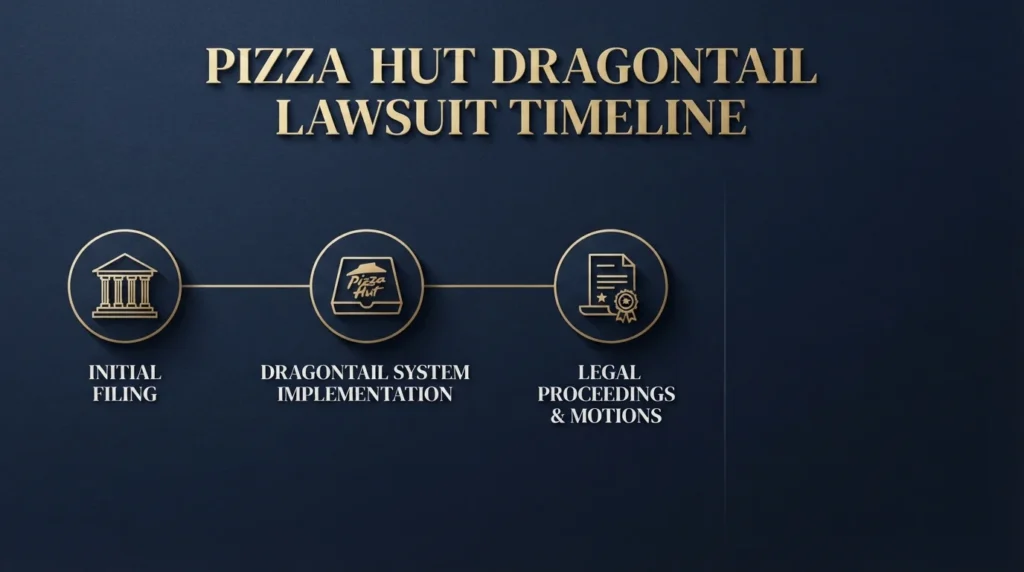
In August 2026, a Texas court dismissed all but one breach-of-contract claim. The ruling left open factual questions about how Pizza Hut implemented the delivery changes.
This is a meaningful development because it means the court agreed with Pizza Hut on most legal theories Chaac tried to use, while still leaving room for a narrower fight over how the rollout itself was handled.
What this means in plain terms:
- Most of Chaac’s original legal arguments did not survive
- One breach of contract claim is still alive and active
- The case is not over, but it is much narrower than it was in May
- Pizza Hut can still be held liable on the surviving claim if facts favor Chaac
This kind of partial dismissal is common in commercial litigation. Courts often trim weaker arguments early while letting the strongest claim proceed toward discovery or trial.
Pizza Hut AI Lawsuit Court Ruling
The Pizza Hut AI lawsuit court ruling issued in August 2026 dismissed most of Chaac’s claims but kept the core breach of contract allegation alive. That single surviving claim is now the entire case.
Before this ruling, Pizza Hut had only issued public statements, not legal filings. “We are in the process of reviewing the claim and will respond through the appropriate legal channels,” a Pizza Hut spokesperson said in an emailed statement, adding that the chain could not comment on pending litigation.
A similar statement followed later coverage. Pizza Hut has said it is reviewing the lawsuit and will respond through appropriate legal channels.
What the surviving claim argues, based on the original filing:
“Despite Chaac’s objections, Pizza Hut required Chaac to adopt and continue use of the Dragontail software system without reasonable accommodation for Chaac’s third-party delivery model (which relies exclusively on DoorDash drivers), and without providing the consultation and field support Pizza Hut promised, therefore depriving Chaac of the benefit of its bargain,” the lawsuit reads.
That single sentence is now basically the backbone of the entire remaining case.
What Happens Next in the Pizza Hut AI Lawsuit
What happens next is discovery on the surviving breach of contract claim, followed by either a settlement or a trial date. The broad $100 million theory took a hit in August, but the case is still alive and moving forward.
Courts typically push surviving claims into fact discovery next, where both sides exchange internal records, emails, and performance data tied to the Dragontail rollout.
Realistic paths forward from here:
- Settlement negotiation, which often happens quietly after a partial dismissal narrows risk
- Continued discovery, where both sides gather evidence on the one surviving claim
- Trial, if no settlement is reached and the claim survives further motions
- Appeal, possible from either side depending on later rulings
Given that the result, according to the complaint, was pizzas sitting out longer, slower deliveries and frustrated customers, Fortune reported, the operational facts here are not seriously disputed. What remains disputed is who is legally responsible for those outcomes under the franchise agreement.
Pizza Hut Yum Brands AI Lawsuit Connection
Yum! Brands is directly tied to this lawsuit because it owns Pizza Hut and because it personally acquired the Dragontail technology at the center of the dispute. The lawsuit names both the Pizza Hut brand and its parent company’s decisions.
Chaac Pizza Northeast is suing Pizza Hut for over $100 million, claiming its mandated Dragontail AI system wrecked delivery operations.
This arrives during a rough stretch for the parent company overall. Brands announced in February that it would close 250 Pizza Hut locations during the first half of 2026. CEO Chris Turner has also confirmed a formal review of strategic options for the Pizza Hut brand, widely interpreted as exploration of a potential sale.
Quick Facts on Yum! Brands’ role:
- Acquired Dragontail Systems Ltd. in 2021
- Mandated the software across franchise locations
- Closing 250 stores in the first half of 2026
- Reviewing strategic options for the entire Pizza Hut brand
This lawsuit is landing at a genuinely bad moment for the company, which only adds pressure to settle or resolve it quickly.
How to File a Pizza Hut AI Lawsuit Claim
You cannot currently file a claim in the Pizza Hut AI lawsuit because it is not a class action and has no public claims process. This section exists purely to clear up that confusion, since it is one of the most searched questions tied to this case.
If you are a Pizza Hut customer, employee, or a different franchisee wondering how to join, the honest answer is you can’t, at least not through this case. The plaintiff is one specific franchise entity, and the lawsuit does not include a mechanism for outside parties to opt in.
Situations where filing is simply not possible right now:
- You ordered from a Pizza Hut location and experienced a late delivery
- You worked at a Pizza Hut location using the Dragontail system
- You are a different franchisee who also had problems with the same AI tool
- You lost money as a DoorDash driver tied to Pizza Hut deliveries
If a separate class action tied to this technology ever gets filed by a different group, it would be an entirely new case with its own docket number and claims process.
Pizza Hut Store Closures AI Lawsuit Connection
The store closures and the AI lawsuit are connected through timing and broader company pressure, even though they are technically separate decisions. Both point to a brand under real financial strain in 2026.
The lawsuit arrives at a difficult moment for Pizza Hut and its parent company. Brands announced in February that it would close 250 Pizza Hut locations during the first half of 2026.
It helps to picture this like a ship already taking on water from several directions. Store closures, a strategic review, and a $100 million lawsuit are not three unrelated events. They are symptoms of the same underlying operational and financial stress.
Context connecting the dots:
| Pressure Point | Status in 2026 |
|---|---|
| Store closures | 250 locations closing in H1 2026 |
| Strategic brand review | Confirmed by CEO Chris Turner |
| AI lawsuit | $100M demand, narrowed to one claim in August |
| Related patent suit | Filed April 2026 against Pizza Hut and DoorDash |
None of these are formally linked in court documents, but together they paint a picture of a brand trying to modernize fast and stumbling along the way.
Pizza Hut Dragontail System Lawsuit Technical Details
The technical core of this lawsuit is how Dragontail handles order visibility and driver assignment, not the AI concept in general. The software itself is marketed as a scheduling and efficiency tool, which makes the lawsuit’s claims notable.
Dragontail is a back-of-house AI management system that Pizza Hut describes as having true AI throughout, with AI scheduling for both delivery and in-store service.
The lawsuit claims the real-world results did not match that marketing. In the complaint’s own words: “With the intention to improve efficiency and service to the customer, Dragontail did the exact opposite; it caused significant delays and pummeled consumer satisfaction.”
Specific performance numbers cited in the complaint:
- Deliveries within 30 minutes dropped from over 90% to roughly 50%
- Rack time increased from under 5 minutes to up to 20 minutes
- Year-over-year sales growth in New York fell from 10.19% to negative 9.78%
Chaac Pizza Northeast claims its year-over-year sales growth in New York City fell from 10.19% to -9.78% after the system was implemented. Numbers like that are exactly why a judge let one claim survive instead of tossing the whole case out.
Pizza Hut AI Lawsuit News
The latest Pizza Hut AI lawsuit news centers on the August 2026 partial dismissal, which trimmed the case down to a single surviving breach of contract claim. Coverage has slowed since the initial May filing frenzy, but the case remains active.
Early reporting focused heavily on the dollar figure and the operational chaos described in the filing. A major Pizza Hut franchisee is suing the pizza chain, claiming gig workers leveraged its AI system for their own benefit, causing “cascading operational breakdowns” that pummeled sales at more than 100 locations.
What to watch for in upcoming news cycles:
- Discovery filings tied to the surviving claim
- Any settlement announcement from either party
- Pizza Hut’s formal answer to the amended complaint
- Updates on the related store closures and brand sale review
This is not a dead story. A single surviving claim worth a fraction of the original $100 million demand is still a meaningful commercial lawsuit, and Texas Business Court cases tend to move faster than traditional civil dockets.
Frequently Asked Questions
Is the Pizza Hut AI lawsuit a class action I can join?
No, it is not a class action.
It is a single breach of contract lawsuit filed by one franchisee, Chaac Pizza Northeast, against Pizza Hut LLC.
There is no claims process for customers or employees to join.
How much money is Pizza Hut being sued for over its AI system?
The franchisee is seeking at least $100 million in damages.
This covers lost revenue, profits, business interruption, and diminished enterprise value.
No payout has been awarded as of the most recent court ruling.
What is Dragontail and why did Pizza Hut get sued over it?
Dragontail is an AI powered kitchen and delivery management system Yum! Brands acquired in 2021.
Pizza Hut mandated its use, and a major franchisee says it caused major delivery delays and lost sales.
The lawsuit claims Pizza Hut ignored repeated requests to fix or adjust the rollout.
Has a court ruled on the Pizza Hut AI lawsuit yet?
Yes, a Texas court issued a ruling in August 2026.
The court dismissed all but one breach of contract claim.
The case is continuing on that single surviving claim.
Does the Pizza Hut AI lawsuit affect customers or employees?
Not legally, no.
Customers and employees experienced the operational fallout but have no formal claim in this specific case.
Only Chaac Pizza Northeast and Pizza Hut LLC are parties to the lawsuit.
Closing
This case boils down to one franchisee fighting Pizza Hut over a forced AI rollout that allegedly wrecked a business worth hundreds of millions. The $100 million demand is real, but most of it got trimmed back in August 2026.
If you are following this story, stay focused on the surviving breach of contract claim, not the original headline number.
Check back for updates as discovery moves forward and Pizza Hut formally answers the narrowed complaint.
================================================================