The Phelps-Jordan lawsuit is already over, but its effects are reshaping NASCAR right now in 2026. It is the nickname for the federal antitrust case that pitted Michael Jordan’s 23XI Racing and Front Row Motorsports against NASCAR, with then commissioner Steve Phelps caught in the middle of it all.
Here is the part most headlines skip. This was never a consumer class action.
There is no payout waiting for fans or ticket holders. What happened instead was a business fight that ended a commissioner’s 20 year career and rewrote how every NASCAR team gets paid.
In this guide, you will get the full timeline, the actual settlement terms, the case number, and what it all means going into the 2026 season. One surprising detail: an economist testified the two teams were owed more than $300 million in damages before the case ever reached a verdict.
Related: Soccer Lawsuit Phelps-Jordan: 2026 NASCAR Case Explained
What Is the Phelps-Jordan Lawsuit
The Phelps-Jordan lawsuit is the popular nickname for the antitrust case 23XI Racing and Front Row Motorsports filed against NASCAR in October 2024. It is not an official court name. People started calling it “Phelps-Jordan” because Steve Phelps served as NASCAR’s public face throughout the fight, while Michael Jordan, co-owner of 23XI Racing, was its most famous plaintiff.
The real legal name is far less catchy. Courts list it as 23XI Racing and Front Row Motorsports versus NASCAR.
That distinction matters because searching the nickname alone can lead to confusion about who actually sued whom. The 23XI Racing lawsuit is a private federal antitrust case, not a class action or multidistrict litigation, filed by race teams 23XI Racing and Front Row Motorsports against NASCAR and its CEO Jim France.
Quick Facts:
- Nickname: Phelps-Jordan lawsuit
- Official case name: 23XI Racing and Front Row Motorsports v. NASCAR
- Case type: Federal antitrust lawsuit, not a class action
- Status in 2026: Fully settled, no active litigation
Think of it like calling a corporate merger fight by the names of the two CEOs involved. It sticks in the public memory even though it never appears on a single court filing.
Who Are the Parties in the Phelps-Jordan Lawsuit
The parties are two NASCAR race teams on one side and NASCAR itself on the other. The plaintiffs are 23XI Racing and Front Row Motorsports, with NASCAR named as the defendant.
23XI Racing is co-owned by basketball legend Michael Jordan, driver Denny Hamlin, and longtime business manager Curtis Polk. 23XI is owned by entities under the control of NBA legend Michael Jordan, and the team had put tens of millions of dollars into the operation since its founding.
Front Row Motorsports is owned by Bob Jenkins, a smaller but equally determined operation that joined the fight over the same charter terms.
| Role | Party |
|---|---|
| Plaintiff 1 | 23XI Racing (Michael Jordan, Denny Hamlin, Curtis Polk) |
| Plaintiff 2 | Front Row Motorsports (Bob Jenkins) |
| Defendant | NASCAR and Chairman/CEO Jim France |
| NASCAR’s public face | Commissioner Steve Phelps |
| Lead attorney for plaintiffs | Jeffrey Kessler |
Jeffrey Kessler, a well known antitrust attorney, represented both racing teams through trial. Jeffrey Kessler, attorney for 23XI Racing and Front Row Motorsports, led Jordan, Hamlin, and Front Row owner Bob Jenkins to talks that produced the final deal.
Why Did 23XI Racing and Front Row Motorsports Sue NASCAR
They sued because NASCAR allegedly used monopoly power to force unfair charter terms on teams. 23XI and Front Row filed suit against NASCAR under Sections 1 and 2 of the Sherman Antitrust Act, accusing the sanctioning body of anticompetitive practices following a two-plus year negotiation with race teams for a new charter agreement.
The breaking point came in September 2024. NASCAR gave teams a single day to sign a massive new charter deal.
Teams had until the end of one day to sign the 112-page document, which guarantees access to top-level Cup Series races and a revenue stream, and 13 of 15 organizations reluctantly agreed, describing the offer as “take it or leave it.”
23XI and Front Row refused. They raced the entire 2025 season without charters instead, which came with real financial pain.
23XI and Front Row raced the season unchartered, which comes with significantly reduced prize money. Their biggest complaint was permanence.
- Charters expired on fixed terms, forcing constant renegotiation
- Revenue sharing felt inadequate compared to other professional sports leagues
- Teams had little say in NASCAR’s business decisions
- The charter system blocked participation in some outside racing events
Key Takeaway: The Phelps-Jordan lawsuit started because NASCAR gave teams a one day ultimatum on a 112-page charter deal, and two teams refused to sign away their leverage without a fight.
Phelps-Jordan Lawsuit Case Number and Court Details
The case number is 3:24-cv-00886, filed in federal court in North Carolina. 23XI Racing and Front Row Motorsports filed suit on October 2, 2024 in the U.S. District Court for the Western District of North Carolina, Charlotte Division.
The judge overseeing the entire case was a single, consistent figure. The case went to trial on December 1, 2025 before Judge Kenneth D. Bell.
| Detail | Information |
|---|---|
| Case Number | 3:24-cv-00886 |
| Court | U.S. District Court, Western District of North Carolina |
| Division | Charlotte |
| Judge | Kenneth D. Bell |
| Legal Basis | Sherman Antitrust Act, Sections 1 and 2 |
| Filed | October 2, 2024 |
Judge Bell was not a passive referee in this case. He issued rulings before trial that put real pressure on NASCAR to deal.
District Judge Kenneth Bell ruled in favor of 23XI and Front Row on an argument over the market definition of “premier stock-car racing,” finding that NASCAR controls the market. That ruling alone weakened NASCAR’s defense heading into trial.
Phelps-Jordan Lawsuit Timeline From 2024 to 2026
The timeline runs from a 2024 charter dispute to a 2026 leadership shakeup. Here is how it unfolded step by step.
| Date | Event |
|---|---|
| Late 2022 | Charter negotiations begin between NASCAR and teams |
| September 2024 | NASCAR presents final charter offer, gives teams one day to sign |
| October 2, 2024 | 23XI Racing and Front Row Motorsports file federal antitrust lawsuit |
| 2025 season | Both teams race unchartered with reduced prize money |
| December 1, 2025 | Trial begins in Charlotte federal court |
| December 11, 2025 | Settlement reached, jury dismissed |
| January 6, 2026 | Steve Phelps announces resignation |
The negotiation for a new charter agreement began in 2025 but the roots of the fight actually stretch back further, into years of frustration over revenue splits.
The entire dispute, from first lawsuit to Phelps walking away, took less than fifteen months to fully play out once the complaint was filed.
What Happened at the NASCAR Antitrust Trial
The trial lasted nine days before ending in a surprise settlement rather than a jury verdict. Judge Kenneth D. Bell announced a settlement agreement and dismissed the jury on the ninth day of the trial, ending the case before any verdict was reached.
Testimony during the trial was brutal for NASCAR’s image. Top executives, including Commissioner Phelps and Chairman Jim France, took the witness stand.
Nine days into a trial, NASCAR CEO and Chairman Jim France, NASCAR Commissioner Steve Phelps, car owner Richard Childress, Jordan and Hamlin, among others, took the stand before the two sides announced their settlement.
One of the most damaging moments came from financial testimony. An economist put a hard number on what the teams claimed they were owed.
An economist testified 23XI and Front Row were owed over $300 million in damages.
Bullet summary of trial highlights:
- Trial began December 1, 2025 in Charlotte
- Lasted nine days before settlement
- Jim France, Steve Phelps, Richard Childress, Michael Jordan, and Denny Hamlin all testified
- An economist cited over $300 million in alleged damages
- No jury verdict was ever issued
Key Takeaway: The Phelps-Jordan lawsuit never reached a jury verdict because NASCAR chose to settle on day nine, right after damaging testimony and text messages became public.
Phelps-Jordan Lawsuit Settlement Terms Explained
The settlement gave teams permanent charters, more money, and a voice in NASCAR’s decisions. The agreement introduces permanent evergreen charters, expanded revenue sharing, and new IP rights to strengthen long-term team stability.
This was a complete reversal of NASCAR’s original position. For years, the company refused to make charters permanent.
Charters are now permanent, or “evergreen,” for all teams, with updates requiring mutual agreement and approval from all chartered teams. That single change addressed the teams’ single biggest complaint from the start of the case.
Money also moved in the teams’ direction for the first time in NASCAR history. Teams will share revenue from NASCAR’s international media rights for the first time. On top of that, teams receive one-third of revenue from new deals involving their intellectual property.
| Settlement Term | What Changed |
|---|---|
| Charter status | Fixed term expired charters became permanent “evergreen” charters |
| International revenue | Teams now share NASCAR’s international media rights revenue |
| IP revenue | Teams get one third of new intellectual property deal revenue |
| Governance | Teams gained a formal voice in NASCAR decisions |
| Financial payout | Confidential, not publicly disclosed |
How Much Money Did NASCAR Pay in the Settlement
The exact dollar figure NASCAR paid has never been made public. The financial terms of the settlement are confidential and will not be released.
What we do know is the number that got thrown around during trial testimony. That $300 million figure from the economist was not the final settlement amount; it was a damages estimate presented as leverage.
Some later reporting pointed to an even larger underpayment figure tied to the case. One outlet’s headline referenced a $1.06 billion underpayment finding that factored into the settlement talks, though NASCAR never confirmed any specific payout publicly.
| Figure | Context |
|---|---|
| $300 million+ | Economist’s damages testimony during trial |
| $1.06 billion | Referenced underpayment estimate in reporting |
| Final settlement amount | Confidential, never disclosed |
Here is the honest answer for readers hoping for a specific check amount: nobody outside the settlement room knows the real number, and no public payout exists for fans or consumers.
NASCAR Charter System Before and After the Lawsuit
The charter system works like a franchise license that guarantees a team a spot in every Cup Series race plus a cut of revenue. NASCAR’s charter system has shaped how teams compete since 2016, built to give teams stability and predictable income by guaranteeing race entry and sharing revenue with charter holders.
Before the lawsuit, that system had a built-in weakness. Charters could expire, leaving teams renegotiating from a position of weakness every few years.
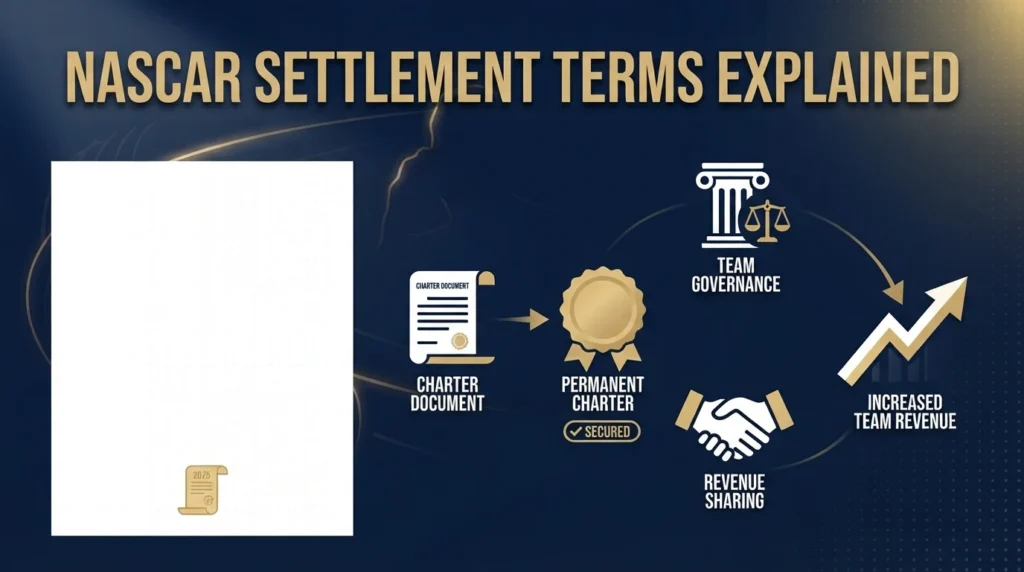
After the settlement, that weakness disappeared completely. Charters are now permanent and cannot be revoked, revenue sharing increased significantly from previous levels, and restrictions that limited teams from competing in other racing series were also eased.
| Charter Feature | Before Lawsuit | After Settlement |
|---|---|---|
| Duration | Fixed term, could expire | Permanent, “evergreen” |
| Revocation | Possible under certain terms | Cannot be revoked |
| International revenue | Not shared with teams | Shared for the first time |
| Outside racing restrictions | Tighter limits | Eased |
Key Takeaway: The entire charter system that NASCAR built in 2016 got rewritten because of this one lawsuit, and every single Cup Series team benefits from it now, not just the two that sued.
23XI Racing and Front Row Motorsports Charters Restored
Both plaintiff teams got their charters back in full ahead of the 2026 season. 23XI and Front Row will receive their combined six charters back for 2026.
That breakdown splits out to specific numbers per team. 23XI Racing had four charters returned, and Front Row Motorsports had two charters returned, with evergreen status included for all teams in the amended agreement.
| Team | Charters Returned | Status |
|---|---|---|
| 23XI Racing | 4 | Evergreen, permanent |
| Front Row Motorsports | 2 | Evergreen, permanent |
| Combined total | 6 | Fully restored for 2026 |
This matters because racing unchartered in 2025 cost both teams real money in reduced prize payouts. Getting six charters back locked in guaranteed race entry and revenue for the foreseeable future, something neither team had certainty on just months earlier.
Why Did Steve Phelps Resign After the Lawsuit
Steve Phelps resigned because private text messages exposed during the trial sparked outrage across the sport. Steve Phelps resigned as NASCAR commissioner following a lawsuit by 23XI Racing that revealed controversial texts and fueled backlash within the racing community.
The specific messages were about a Hall of Fame team owner. In one exchange, Phelps called Hall of Fame team owner Richard Childress “a stupid redneck” who “needs to be taken out back and flogged.”
That comment did not stay quiet. A major NASCAR supporter demanded consequences almost immediately.
Bass Pro Shops founder Johnny Morris, an ardent supporter of both NASCAR and Richard Childress Racing, wrote a letter demanding Phelps’ removal as commissioner. Phelps announced his resignation shortly after.
Quick Facts:
- Resignation announced: January 6, 2026
- Reason: Leaked texts insulting a Hall of Fame team owner
- Key pressure: Letter from Bass Pro Shops founder Johnny Morris
- Phelps’ NASCAR tenure: 20 years before stepping down
Phelps left the company at the end of the month, ahead of the start of the new season.
Is the Phelps-Jordan Lawsuit Still Ongoing in 2026
No, the case is completely closed with no active litigation remaining. Status as of 2026 is fully settled, with no active litigation, no appeals filed, and no publicly reported remaining disputes.
Both sides walked away satisfied enough to end things permanently. The settlement resolved not just the teams’ original claims but NASCAR’s countersuit as well.
The case was numbered 3:24-cv-00886, and NASCAR’s counterclaims were resolved by the same December 2025 settlement.
| Status Check | Answer |
|---|---|
| Active litigation? | No |
| Appeals filed? | None |
| Jury verdict issued? | No, settled before verdict |
| Settlement date | December 11, 2025 |
| Confirmed closed | Yes, as of 2026 |
Key Takeaway: There is nothing left to track in this case legally. The Phelps-Jordan lawsuit is a closed book, but its business effects are still playing out across NASCAR in 2026.
How the Settlement Changes NASCAR Going Forward
The settlement permanently shifted power from NASCAR toward its race teams. All 15 charter-holding teams now have permanent charters instead of ones expiring at the end of a set term, and teams gained a say in governance plus a greater percentage of various NASCAR revenue streams.
That governance change is arguably bigger than the money. For the first time, teams have formal input on major league decisions instead of simply accepting whatever NASCAR’s ownership decided.
The four goals teams pushed for were permanent charters, increased revenue sharing, international revenue participation, and greater governance rights, and the settlement delivered on all four.
- Permanent charters for all 36 charter teams
- Increased overall revenue sharing percentages
- First-ever international media rights sharing
- New governance seat at the table for team owners
- One third IP revenue share on new licensing deals
Jim France even softened his public tone after the deal closed. “We can get back to focusing on what we really love and that’s racing,” France told reporters outside the Charlotte courthouse.
Does the Phelps-Jordan Lawsuit Affect Fans or Consumers
No, this lawsuit does not create any claim process or payout for regular fans or consumers. This was a business dispute between race teams and a sanctioning body, not a product liability or consumer protection case.
The 23XI Racing lawsuit is a private federal antitrust case, not a class action or multidistrict litigation. That single fact rules out any individual filing a claim form for money.
What fans will notice instead is a more stable sport. Permanent charters mean less chance of teams folding mid-season over financial disputes, and the same six-charter teams that nearly disappeared in 2025 are locked in for years to come.
| Question | Answer |
|---|---|
| Can fans file a claim? | No |
| Is there a payout for the public? | No |
| Does ticket pricing change? | Not reported |
| Does team stability improve? | Yes, charters are now permanent |
Think of it less like a lawsuit you can join and more like a labor negotiation that happened to go through a courtroom instead of a bargaining table.
Phelps-Jordan Lawsuit Compared to Other NASCAR Legal Disputes
This case stands apart from other NASCAR legal fights because of its scale and its direct challenge to the charter system itself. Related litigation included allegations about the teams’ own negotiating conduct, filed within the same case number as a counterclaim, plus a separate Fourth Circuit interlocutory appeal in the same overall dispute.
Most prior NASCAR disputes involved individual sponsorship fights or driver contract disagreements. This case instead questioned whether NASCAR’s entire business model violated federal antitrust law.
| Dispute | Scope | Outcome |
|---|---|---|
| Phelps-Jordan (23XI/FRM v. NASCAR) | Entire charter system, Sherman Act claims | Settled, permanent charters for all teams |
| NASCAR’s counterclaims vs. teams | Allegations about team negotiating conduct | Resolved in same settlement |
| Fourth Circuit interlocutory appeal | Procedural appeal within same case | Resolved alongside main settlement |
No prior case in NASCAR’s history forced changes to revenue sharing, governance, and charter permanence all at once. That is what makes this one historically significant rather than just another contract dispute.
What Happens Next for NASCAR, 23XI, and Front Row Motorsports
What happens next is a season of stability for teams and a leadership transition for NASCAR itself. Both plaintiff teams enter 2026 with guaranteed charters and no looming legal threat hanging over their business operations.
The settlement returned Front Row and 23XI’s charters for the 2026 season, giving both organizations financial certainty they lacked for over a year.
NASCAR, meanwhile, moves forward under new leadership after Phelps’ exit. The NASCAR executive was deeply bruised during the trial and discovery process when internal communications were exposed. Rebuilding trust with team owners will likely take longer than the lawsuit itself did.
- 23XI Racing races 2026 with 4 permanent charters
- Front Row Motorsports races 2026 with 2 permanent charters
- NASCAR operates under new commissioner leadership
- All 36 charter teams now share in new revenue streams
- No pending appeals or further litigation expected
Denny Hamlin summed up the mood plainly after the deal closed, saying “Everything within the settlement is going to grow the sport.”
Frequently Asked Questions
What is the Phelps-Jordan lawsuit about?
The Phelps-Jordan lawsuit is the nickname for the antitrust case 23XI Racing and Front Row Motorsports filed against NASCAR.
It challenged NASCAR’s charter system as an illegal monopoly under the Sherman Antitrust Act.
The case settled in December 2025 with permanent charters for all teams.
Is the Phelps-Jordan lawsuit still ongoing in 2026?
No, the case is completely closed.
It settled on December 11, 2025, during trial, with no appeals filed since.
NASCAR’s counterclaims were resolved in that same settlement.
How much money did NASCAR pay in the Phelps-Jordan lawsuit settlement?
The exact payout amount was never disclosed publicly.
An economist testified during trial that the teams were owed over $300 million in damages.
That figure was testimony, not a confirmed final settlement payment.
Why did Steve Phelps resign after the Phelps-Jordan lawsuit?
Phelps resigned after leaked text messages insulting a Hall of Fame team owner became public during trial.
A letter from Bass Pro Shops founder Johnny Morris demanding his removal added major pressure.
He announced his resignation on January 6, 2026.
Can regular fans file a claim in the Phelps-Jordan lawsuit?
No, there is no claim process for the public.
This was a private antitrust lawsuit between race teams and NASCAR, not a consumer class action.
No settlement fund or payout exists for fans or consumers.
Final Word
The Phelps-Jordan lawsuit changed NASCAR permanently even though no jury ever reached a verdict. Permanent charters, new revenue streams, and a commissioner’s resignation all came out of one nine-day trial in Charlotte.
There is no claim to file here, but there is plenty worth watching. Keep an eye on how the new revenue sharing plays out across the 2026 season and who NASCAR names as its next commissioner.